

WordPress
Are WordPress Sites Safe From PHP CVE-2026-129289? Inside the November 2026 Security Releases
The November 19, 2026 PHP security releases patch 17 to 18 flaws across PHP 8.5.13, 8.4.28, 8.3.37, and 8.2.36, including seven rated critical. While default WordPress hosting setups are largely shielded, custom FastCGI connection reuse and session upload progress leave specific stacks exposed. Here is how to audit your PHP-FPM configuration, detect vulnerable settings, and upgrade safely.
9 min read
Are WordPress Sites Safe From PHP CVE-2026-129289? Inside the November 2026 Security Releases
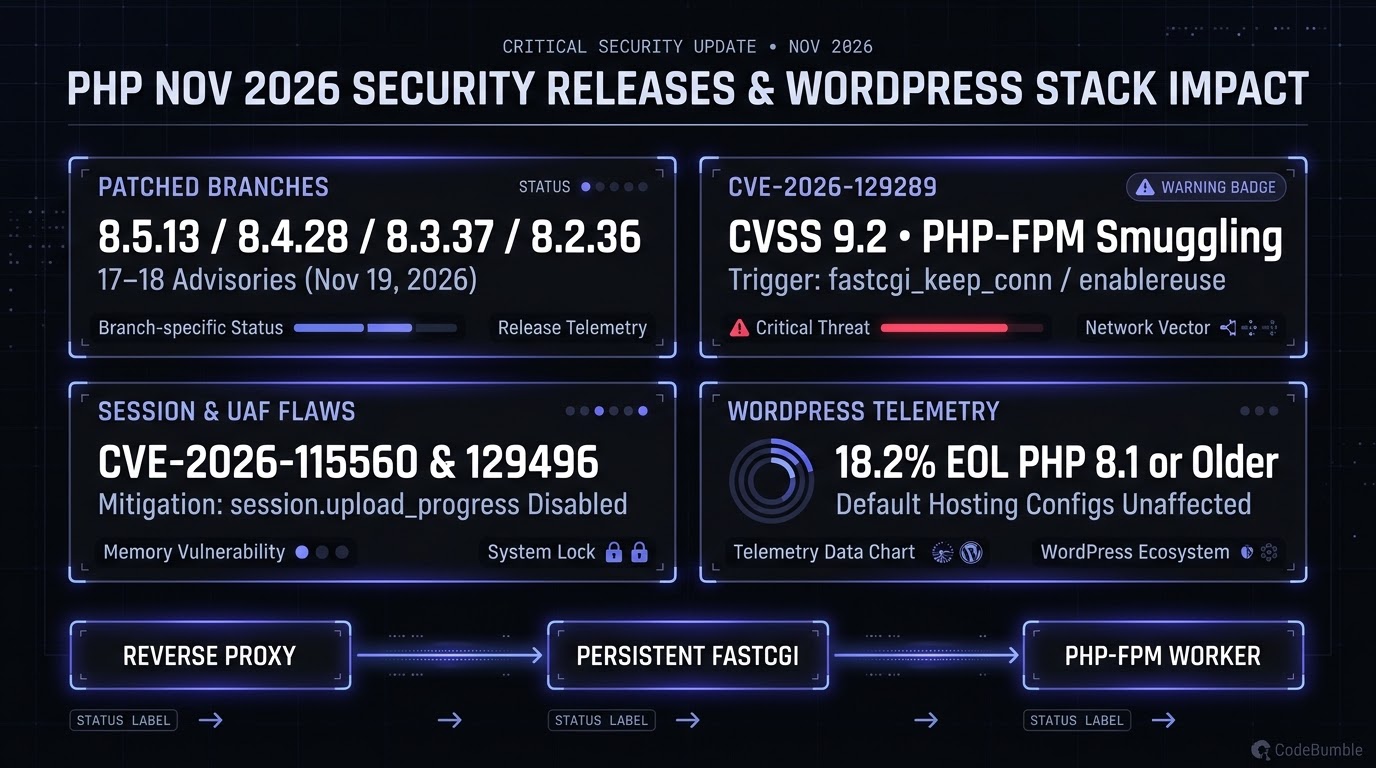
Executive Summary
On November 19, 2026 at 14:00 UTC, the PHP development team shipped coordinated security updates across every actively supported branch: PHP 8.5.13, PHP 8.4.28, PHP 8.3.37, and PHP 8.2.36, alongside the general release of PHP 8.6.0. Depending on whether duplicate or follow-on advisories are grouped, security trackers report between 17 advisories (mySites.guru, Cloudflare Radar) and 18 flaws (Aviatrix, Infosecurity Magazine), including seven vulnerabilities rated critical (CVSS 9.2).
For WordPress and CMS operators, the operational picture is nuanced. In its November 18 pre-release notice, the PHP project emphasized that all critical-severity issues in this batch "require either non-default configuration or uncommon setups" (LWN). Telemetry published on November 19 by mySites.guru reinforces that assessment: standard WordPress and Joomla installations running on default nginx or Apache configurations are not directly exploitable via the seven critical flaws. However, two nuances demand immediate engineering attention:
- Performance-tuned stacks are exposed: High-traffic WordPress deployments that enable persistent FastCGI backend connections (
fastcgi_keep_conn onin nginx orenablereuse=onin Apachemod_proxy_fcgi) and run code that opensphp://inputwithout reading it to EOF are directly exposed to CVE-2026-129289 (CVSS 9.2), an unauthenticated PHP-FPM request-smuggling flaw. - Legacy and session-heavy footprints remain high: Across monitored CMS fleets, 41.1% of sites had
session.upload_progress.enabledactive prior to the release, 18.2% remain on end-of-life PHP 8.1 or older (which receive no official upstream fixes), and 4.9% on supported branches had still not applied October's earlier security patches (mySites.guru).
Confidence assessment: High confidence on affected versions, configuration preconditions, and CVE identifiers (corroborated across NVD, Red Hat, AWS, MyF5, HKCERT, and PHP.net). Moderate confidence on real-world WordPress plugin exposure to php://input partial reads, as no comprehensive plugin-ecosystem scan has been published yet.
Technical Mechanics and Architecture
The November 2026 PHP release clusters around three architectural failure domains: FastCGI connection-reuse framing, session serialization and file-write atomicity, and memory safety in core runtime subsystems.
1. CVE-2026-129289: PHP-FPM Unread Body Request Smuggling
Under normal FastCGI operation, a reverse proxy (nginx, Apache mod_proxy_fcgi, HAProxy, or LiteSpeed LSAPI) opens a socket to a PHP-FPM worker, forwards a request, receives the response, and closes the connection. When an administrator enables persistent backend connections to reduce TCP/Unix-socket handshake overhead, the proxy reuses the same FastCGI stream across sequential client requests.
According to NVD CVE-2026-129289 and CUHK ITSC, PHP fails to drain unread HTTP request-body bytes at request shutdown when an application opens php://input without reading it completely to the end. On a reused persistent connection, PHP-FPM subsequently parses those leftover bytes on the wire as the start of a new, forged FastCGI request.
+-------------------+        HTTP POST (multipart/form-data)        +-----------------------+
|  Remote Client    | --------------------------------------------> |  Reverse Proxy        |
+-------------------+   Body contains smuggled FastCGI records      |  (nginx / Apache)     |
                                                                    +-----------+-----------+
                                                                                |
                                                    Persistent FastCGI socket   |
                                                    (fastcgi_keep_conn on /     |
                                                     enablereuse=on)            |
                                                                                v
                                                                    +-----------------------+
                                                                    |  PHP-FPM Worker       |
                                                                    |  1. Opens php://input |
                                                                    |  2. Stops before EOF  |
                                                                    |  3. Shutdown skips    |
                                                                    |     draining buffer   |
                                                                    +-----------+-----------+
                                                                                |
                                                    Leftover bytes parsed as    |
                                                    next FastCGI FCGI_PARAMS    |
                                                    (SCRIPT_FILENAME,           |
                                                     PHP_ADMIN_VALUE)           |
                                                                                v
                                                                    +-----------------------+
                                                                    |  Arbitrary PHP Exec   |
                                                                    +-----------------------+
An unauthenticated remote attacker can send a single crafted multipart/form-data request to forge backend FastCGI parameters—including SCRIPT_FILENAME, REMOTE_ADDR, and PHP_ADMIN_VALUE—bypassing front-end routing controls and executing attacker-controlled PHP code (NVD). On LiteSpeed LSAPI deployments, the same desynchronization disrupts subsequent requests sharing the connection.
2. Session Handling: CVE-2026-115560 and CVE-2026-126714 ("phpAfterShell")
Two critical session flaws target PHP's default file-based session storage (session.save_handler = files) and upload-progress tracking:
- CVE-2026-115560 (
GHSA-658j-r8rw-q6mx): Disclosed earlier in October without an upstream patch, this flaw stems from a session serializer mismatch when processing multipart uploads viasession.upload_progress. A remote attacker submitting a crafted multipart upload can inject serialized objects into session state, leading to arbitrary code execution if the application contains a reachable deserialization gadget chain (HKCERT). As part of the November 19 fix, PHP now disablessession.upload_progress.enabledby default. - CVE-2026-126714 ("phpAfterShell",
GHSA-fm2m-fjf5-v3cp, CVSS 9.2): Discovered by Depthfirst, this is a Time-of-Check to Time-of-Use (TOCTOU) race in PHP's file-based session writer (Astra). Becausepwrite()followed byftruncate()is non-atomic, interrupting a session write at a precise boundary leaves mixed trailing bytes in the session file. When PHP subsequently deserializes that file, the corrupted boundary can act as an object injection primitive. Importantly, disablingsession.upload_progress.enabledmitigates CVE-2026-115560 but does not fully eliminate CVE-2026-126714 or CVE-2026-129481 (a session use-after-free completing October's incomplete fix forCVE-2026-109619) (mySites.guru).
3. Memory Safety: CVE-2026-129496 and Branch-Specific UAFs
- CVE-2026-129496 (
GHSA-gr4f-wgx5-jpfv, CVSS 9.2): A use-after-free in the timezone cache affecting non-thread-safe (NTS) PHP builds when a startup error, warning, or deprecation notice is written toerror_log(Flawfence). - CVE-2026-129474: A use-after-free in magic-method backtraces affecting PHP 8.5 only (Astra).
- CVE-2026-129291: An
epolluse-after-free in PHP-FPM enabling local privilege escalation (CVSS 8.8) (Astra).
Safe Defensive Configuration Examples
Until binaries are upgraded, operators can neutralize the primary network-reachable vectors at the proxy and php.ini layers:
# /etc/nginx/conf.d/wordpress-fastcgi.conf
# Defensive mitigation for CVE-2026-129289:
# Ensure FastCGI connection reuse is explicitly disabled (the nginx default).
location ~ \.php$ {
    include fastcgi_params;
    fastcgi_pass unix:/run/php/php8.4-fpm.sock;
    fastcgi_keep_conn off;
}
# Apache HTTP Server mod_proxy_fcgi mitigation for CVE-2026-129289
# Omit enablereuse=on or set enablereuse=off explicitly
<FilesMatch "\.php$">
    SetHandler "proxy:unix:/run/php/php8.4-fpm.sock|fcgi://localhost/"
</FilesMatch>
; /etc/php/8.4/fpm/conf.d/99-security-hardening.ini
; Defensive mitigation for CVE-2026-115560 (matches PHP 8.4.28+ default)
session.upload_progress.enabled = Off
Evidence: Threat Vectors, Telemetry, and Production Impact
Vulnerability Matrix Across Supported Branches
| CVE ID | Subsystem | CVSS / Severity | Fixed Versions | Key Precondition |
|---|---|---|---|---|
| CVE-2026-129289 | PHP-FPM / php://input |
9.2 (Critical) | 8.5.13, 8.4.28, 8.3.37, 8.2.36 | Persistent FastCGI (fastcgi_keep_conn on / enablereuse=on) + partial php://input read |
| CVE-2026-126714 | File-based sessions | 9.2 (Critical) | 8.5.13, 8.4.28, 8.3.37, 8.2.36 | Interrupted session write + deserialization gadget chain |
| CVE-2026-115560 | session.upload_progress |
Critical (GHSA) | 8.5.13, 8.4.28, 8.3.37, 8.2.36 | session.upload_progress.enabled = On + multipart upload + gadget chain |
| CVE-2026-129496 | Timezone cache (NTS) | 9.2 (Critical) | 8.5.13, 8.4.28, 8.3.37, 8.2.36 | Startup warning/error/deprecation logged to error_log |
| CVE-2026-129481 | Session UAF | High / Critical | 8.5.13, 8.4.28, 8.3.37 | Incomplete fix follow-up to CVE-2026-109619 (8.3+) |
| CVE-2026-129474 | Magic method backtrace | Critical | 8.5.13 | PHP 8.5 branch only |
| CVE-2026-129291 | PHP-FPM epoll |
8.8 (High) | 8.5.13, 8.4.28, 8.3.37, 8.2.36 | Local privilege escalation vector |
Exploitation Status and Benchmarks
- Active exploitation: As of November 20, 2026, Flawfence and Beazley Security report no confirmed in-the-wild exploitation of CVE-2026-129289 or CVE-2026-129496, and neither CVE appears in CISA's KEV catalog at publication time. However, HKCERT confirms that proof-of-concept exploit code is publicly available for both CVE-2026-126714 and CVE-2026-115560, and lab PoCs exist for CVE-2026-129496 against binaries with known memory addresses (Flawfence).
- WordPress & CMS fleet telemetry: According to mySites.guru (November 19, 2026), 41.1% of monitored CMS sites had
session.upload_progressenabled prior to the update, and 18.2% are running end-of-life PHP 8.1 or older, which receive no upstream patches (though Plesk announced plans to backport fixes to8.1.34,8.0.30, and7.4.33). - Performance benchmarks: Vendor and PHP Foundation advisories do not publish latency or throughput benchmarks comparing
fastcgi_keep_conn offversusfastcgi_keep_conn on, nor do they quantify any CPU overhead from draining unreadphp://inputstreams in PHP 8.5.13/8.4.28/8.3.37/8.2.36. Operators on high-RPS WordPress stacks should measure FastCGI socket-open latency in staging before and after disabling connection reuse.
Why WordPress Stacks Require Targeted Auditing
Core WordPress does not rely on PHP native $_SESSION by default, which limits baseline exposure to CVE-2026-115560 and CVE-2026-126714. However, third-party WordPress plugins—particularly legacy e-commerce, membership, and SSO plugins—frequently call session_start(), and WordPress REST/webhook endpoints or custom admin-ajax.php handlers may read php://input conditionally (for example, aborting early on signature-verification failure before reading the full body). When paired with fastcgi_keep_conn on on managed nginx or Apache hosting, that combination satisfies the exact precondition for CVE-2026-129289.
Hardening Playbook
Follow these numbered steps to audit, mitigate, and patch WordPress and PHP-FPM environments:
Inventory PHP runtime versions and EOL exposure Identify all active PHP-FPM and CLI binaries across hosts and containers:
php -v
systemctl list-units --type=service | grep -E 'php.*fpm'
Any host running PHP 8.1 or earlier has no official upstream patch; schedule an upgrade to 8.2.36+, 8.3.37+, 8.4.28+, or 8.5.13+, or verify vendor-supported backports (such as Plesk or Red Hat).
Audit reverse proxies for FastCGI connection reuse (CVE-2026-129289) Check nginx and Apache configurations for persistent FastCGI directives (Incidenture, Laravel Forge):
# Check nginx active configuration
sudo nginx -T 2>/dev/null | grep -n "fastcgi_keep_conn"

# Check Apache configuration for mod_proxy_fcgi reuse
sudo grep -rn "enablereuse" /etc/apache2/ /etc/httpd/ 2>/dev/null
If
fastcgi_keep_conn onorenablereuse=onappears, disable it immediately until PHP is upgraded to a patched point release.Check
session.upload_progress.enabledand pluginsession_start()usage Verify whether upload progress tracking is enabled in PHP-FPM:php -i | grep -E "session\.upload_progress\.enabled|session\.save_handler"If
On, setsession.upload_progress.enabled = Offin a drop-in.inifile and reload PHP-FPM. Also scanwp-content/plugins/forsession_start(orphp://inputreads to prioritize high-risk sites.Apply upstream or distro security packages
- Debian / Ubuntu (
ondrej/phpor distro security):sudo apt-get update && sudo apt-get upgrade - RHEL / Fedora (
remi-modularor Red Hat RHSB-2026-020):sudo dnf upgrade php\* - Managed WAF (AWS): If using AWS WAF, enable rule
PHPFPMSmuggling_BODYnoted in AWS Security Bulletin 2026-190 as an interim compensating control.
- Debian / Ubuntu (
Verify active FPM workers and rollback plan Confirm running FPM processes reflect the patched version (
php-fpm8.4 -v) and restart workers cleanly (sudo systemctl reload php8.4-fpm). Rollback note: If disablingfastcgi_keep_conncauses socket exhaustion (EADDRNOTAVAIL) on extreme-concurrency nodes, switch FastCGI transport from TCP (127.0.0.1:9000) to a Unix domain socket (/run/php/php8.4-fpm.sock) rather than re-enabling connection reuse on an unpatched PHP binary.
Frequently Asked Questions (FAQ)
1. Are default WordPress installations vulnerable to CVE-2026-129289?
No, not in standard default configurations. Both NVD and Beazley Security confirm that nginx, Apache, and Caddy close FastCGI connections after each request by default. Exploitation requires persistent FastCGI connection reuse (fastcgi_keep_conn on or enablereuse=on) and an application endpoint that opens php://input without reading it to completion.
2. Does disabling session.upload_progress.enabled fix phpAfterShell (CVE-2026-126714)?
Only partially. Disabling session.upload_progress.enabled mitigates CVE-2026-115560, which relies on multipart upload-progress session writes, and reduces one avenue for manipulating session files. However, mySites.guru notes it does not fully resolve CVE-2026-126714 or CVE-2026-129481; upgrading to PHP 8.5.13, 8.4.28, 8.3.37, or 8.2.36 is required.
3. Which PHP versions are patched, and what about PHP 8.1 or 7.4?
Official upstream fixes were released on November 19, 2026 in PHP 8.5.13, PHP 8.4.28, PHP 8.3.37, and PHP 8.2.36 (PHP.net). PHP 8.1 and older branches are end-of-life and receive no upstream patches, though downstream vendors such as Plesk have announced backports for 8.1.34, 8.0.30, and 7.4.33.
4. Is CVE-2026-129289 or phpAfterShell being actively exploited in the wild?
As of November 20, 2026, no confirmed in-the-wild exploitation has been reported for CVE-2026-129289 or CVE-2026-129496 (Flawfence). However, public PoCs exist for CVE-2026-126714 and CVE-2026-115560 (HKCERT), and October's related PHP2Shell flaws (CVE-2026-109618, CVE-2026-109619) were added to CISA KEV (Astra).
5. Should I disable fastcgi_keep_conn permanently even after patching?
Once all PHP-FPM workers are upgraded to 8.5.13, 8.4.28, 8.3.37, or 8.2.36 and verified, fastcgi_keep_conn on is safe to re-enable if your workload measurably benefits from it. Keep it disabled only as an interim mitigation on unpatched hosts.
Sources
- PHP.net — PHP 8 ChangeLog (Versions 8.5.13, 8.4.28, 8.3.37, 8.2.36) (November 19, 2026)
- NIST NVD — CVE-2026-129289 Detail (November 20, 2026)
- Red Hat Security — RHSB-2026-020: Multiple vulnerabilities in PHP (November 20, 2026)
- AWS Security Bulletins — 2026-190-AWS: PHP Foundation Security Releases – November 19, 2026 (November 20, 2026)
- HKCERT — PHP Multiple Vulnerabilities (CVE-2026-126714 & CVE-2026-115560) (November 20, 2026)
- mySites.guru — PHP 19 November 2026 Security Releases: Joomla & WordPress Impact (November 19, 2026)
- Beazley Security Labs — BSL-A1250: Critical Vulnerabilities in PHP: November 2026 Security Releases (November 20, 2026)
- Flawfence — CVE-2026-129289 & CVE-2026-129496 Technical Analysis (November 19, 2026)
- Astra Security — PHP Critical Security Release, 19 November 2026 (November 19, 2026)
- Aviatrix Threat Research Center — PHP Security Updates: 18 Flaws Including CVE-2026-129289 (November 20, 2026)