

Security
PHP Fixes 7 Critical Flaws (CVSS 9.2): Why PHP-FPM Request Smuggling Beats the Session Bug
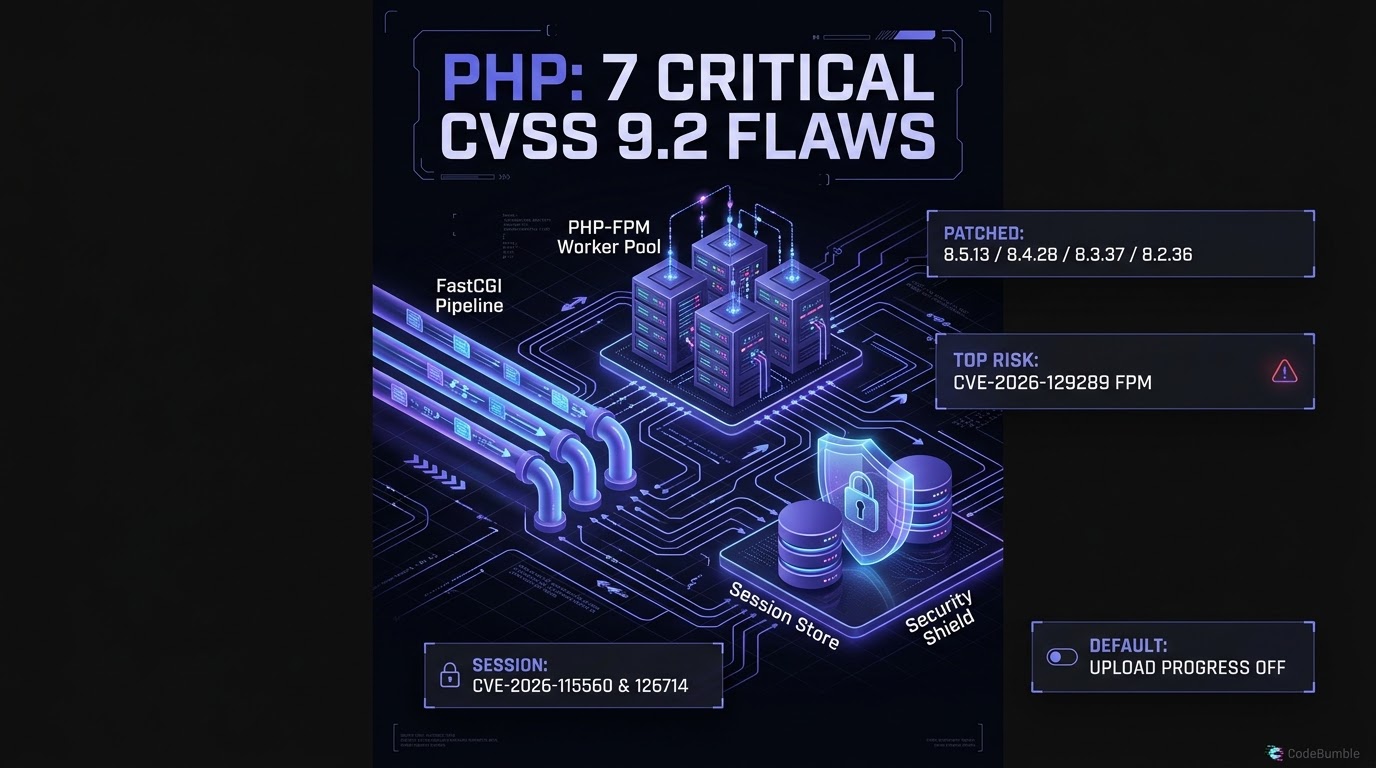
On November 19, 2026, the PHP Group released PHP 8.5.13, 8.4.28, 8.3.37, 8.2.36, and 8.6.0 to patch seven Critical (CVSS v4.0 9.2) vulnerabilities across PHP-FPM, session handling, the date extension, and the engine. While October's CVE-2026-115560 session notice drew early attention, today's full advisories reveal that FastCGI connection reuse (CVE-2026-129289) offers a direct single-request RCE path and shared session stores widen serializer mismatch risk. Learn how to audit FastCGI reuse, harden php.ini, and deploy patched builds.
7 min read
PHP Fixes 7 Critical Flaws (CVSS 9.2): Why PHP-FPM Request Smuggling Beats the Session Bug
Executive Summary
On November 19, 2026, the PHP development team released PHP 8.5.13, PHP 8.4.28, PHP 8.3.37, PHP 8.2.36, and PHP 8.6.0 (php.net) to remediate seven Critical vulnerabilities, each scored 9.2 on CVSS v4.0, alongside an eighth High-severity (CVSS 8.8) local privilege escalation flaw in PHP-FPM.
Although October's preliminary notice around CVE-2026-115560 framed PHP's session upload-progress bug as a rare ini_set() edge case, the full advisories published today reveal a far broader exposure profile—documented in detail by The Hacker News and Upwind:
- Direct PHP-FPM Request Smuggling (
CVE-2026-129289): Requires no memory corruption, race condition, or gadget chain—only FastCGI connection reuse (fastcgi_keep_conn onin NGINX orenablereuse=onin Apachemod_proxy_fcgi) and an application path that opensphp://inputwithout reading it completely. - Broader Session Deserialization (
CVE-2026-115560&CVE-2026-126714): Separate apps, FPM pools, virtual hosts, or CLI jobs sharing a single session store with differingsession.serialize_handlersettings are exposed without any runtimeini_set()call. - Incomplete October
PHP2ShellMitigations: Three of today's use-after-free bugs (CVE-2026-129481,CVE-2026-129182,CVE-2026-129474) stem from gaps or regressions in October'sCVE-2026-109619(PHP2Shell) patch, meaning October'ssession.upload_progress.enabled=0workaround does not cover them.
Confidence Level: High for fixed PHP release numbers, CVE identifiers, CVSS v4.0 9.2 / 8.8 scores, and configuration triggers (verified across php.net, The Hacker News, and Upwind). Note that PHP 8.2 reaches End of Life on December 31, 2026, and end-of-life branches (8.1 and older) receive no upstream fix.
Technical Mechanics and Architecture
1. PHP-FPM FastCGI Request Smuggling (CVE-2026-129289)
When a reverse proxy (NGINX, Apache mod_proxy_fcgi, or HAProxy) maintains persistent FastCGI connections to PHP-FPM workers, unread php://input body bytes from one HTTP request can remain in the stream buffer and be interpreted by PHP-FPM as a second, smuggled FastCGI request that the front-end proxy never authorized:
[Unauthenticated Client]
        │
        ▼  Single HTTP Request with Unread php://input Tail
┌──────────────────────────────────────────────────────────┐
│  Front-End Proxy (NGINX fastcgi_keep_conn on /           │
│                   Apache mod_proxy_fcgi enablereuse=on)  │
└──────────────────────────────────────────────────────────┘
        │  Persistent FastCGI Connection Reused
        ▼
┌──────────────────────────────────────────────────────────┐
│                 PHP-FPM Worker (5.6.0–8.5.x)             │
│  1. Script opens php://input without reading to EOF      │
│  2. Remaining bytes stay on persistent FastCGI socket    │
│  3. Parsed as a smuggled FastCGI request ──► Arbitrary   │
│     PHP Execution (if attacker knows 1 existing .php)    │
└──────────────────────────────────────────────────────────┘
Default configurations that close the FastCGI connection after every request are not exposed to CVE-2026-129289. On LiteSpeed LSAPI, PHP reports service disruption rather than remote code execution.
2. Session Serializer Mismatch & Interrupted Writes (CVE-2026-115560, CVE-2026-126714)
CVE-2026-115560(Session Upload-Progress RCE): PHP writes upload-progress data using onesession.serialize_handler(php,php_binary, orphp_serialize), and another app, FPM pool, or CLI worker sharing the samesession.save_path(or Redis/Memcached backend) reads it back with a different serializer—converting attacker-controlled multipart upload text into deserialized PHP objects. The advisory documents working command execution with Guzzle and Monolog 2.11.1 gadget chains. Today's patch disablessession.upload_progress.enabledby default and rejects runtimeini_set()changes tosession.serialize_handlerwhile upload progress is enabled.CVE-2026-126714("phpAfterShell" Session Files TOCTOU): Under the defaultfilessession handler, PHP rewrites a session file without clearing it first. As Depthfirst explains, if apwrite()/ftruncate()update is interrupted, PHP can leave a malformed trailing session file thatsession_start()later deserializes—affecting apps that store large user-controlled strings in$_SESSIONeven when upload progress is off.
Safe Read-Only Configuration Audit Commands
Run these read-only checks on your web front ends and PHP-FPM hosts to map immediate exposure before patching:
# 1. Check installed PHP version and SAPI
php -v

# 2. Audit NGINX and Apache configs for FastCGI connection reuse (CVE-2026-129289)
grep -rnE "fastcgi_keep_conn\s+on|enablereuse=on" /etc/nginx/ /etc/apache2/ /etc/httpd/ 2>/dev/null

# 3. Audit php.ini and FPM pool configs for upload_progress, serialize_handler, and backtraces
grep -rnE "session\.upload_progress\.enabled|session\.serialize_handler|fatal_error_backtraces|zend\.exception_ignore_args" \
  /etc/php* /usr/local/etc/php* 2>/dev/null
Evidence: All 7 Critical CVEs (Plus PHP-FPM LPE) and Branch Matrix
Not every bug affects every PHP branch: PHP 8.2 is hit by four of the seven Critical CVEs, 8.3 and 8.4 by five, and 8.5 by all seven.
| CVE ID | Component & Class | CVSS v4.0 | Affected Branches & Fixed Versions | Key Exposure Condition |
|---|---|---|---|---|
| CVE-2026-129289 | PHP-FPM Request Smuggling | 9.2 |
Fixed in 8.2.36, 8.3.37, 8.4.28, 8.5.13, 8.6.0 |
Reused FastCGI conn + partial php://input read |
| CVE-2026-115560 | Session Upload-Progress RCE | 9.2 |
Fixed in 8.2.36, 8.3.37, 8.4.28, 8.5.13, 8.6.0 |
Mismatched session.serialize_handler or shared store |
| CVE-2026-126714 | Session Files TOCTOU (phpAfterShell) |
9.2 |
Fixed in 8.2.36, 8.3.37, 8.4.28, 8.5.13, 8.6.0 |
files handler + interrupted pwrite()/ftruncate() |
| CVE-2026-129496 | Date-Extension Use-After-Free | 9.2 |
Fixed in 8.2.36, 8.3.37, 8.4.28, 8.5.13, 8.6.0 |
Non-thread-safe build logging startup warning to file error_log |
| CVE-2026-129481 | Session Cleanup Use-After-Free | 9.2 |
Fixed in 8.3.37, 8.4.28, 8.5.13, 8.6.0 |
Fatal error during session shutdown on reused worker |
| CVE-2026-129182 | Engine Use-After-Free | 9.2 |
Fixed in 8.5.13, 8.6.0 |
Stale fatal-error backtrace across requests (PHP 8.5) |
| CVE-2026-129474 | Engine __call() Use-After-Free |
9.2 |
Fixed in 8.5.13, 8.6.0 |
Fatal error entering __call()/__callStatic() (mitigated by zend.exception_ignore_args=On) |
| CVE-2026-129291 | PHP-FPM Worker Use-After-Free (LPE) | 8.8 |
Fixed in 8.2.36, 8.3.37, 8.4.28, 8.5.13, 8.6.0 |
Local code exec + catch_workers_output + epoll |
Hardening Playbook: Immediate Mitigations and Upgrade Steps
Step 1: Upgrade to Patched PHP Builds First
Upgrading to 8.5.13, 8.4.28, 8.3.37, 8.2.36, or 8.6.0 (or verified Linux distribution backports) is the only complete remediation covering all seven Critical CVEs and CVE-2026-129291. Rebuild all container images and vendor appliances that bundle PHP.
Step 2: Disable FastCGI Connection Reuse Until Patched
If patching must wait, eliminate CVE-2026-129289 by disabling persistent FastCGI backend connections on every NGINX, Apache, and HAProxy front end:
- NGINX: Remove or set
fastcgi_keep_conn off;in your upstream/location blocks and reload NGINX. - Apache
mod_proxy_fcgi: Removeenablereuse=onfromProxyPass/SetHandlerdirectives and reload Apache.
Step 3: Lock Down php.ini and FPM Pool Settings
Apply these interim mitigations in php.ini or FPM pool configs (never via application ini_set()), then restart every PHP-FPM worker:
- Set
session.upload_progress.enabled = 0(and auditconf.d/ pool configs for any explicit= 1that would override PHP's new safe default after upgrading). - On PHP 8.5, set
fatal_error_backtraces = 0(covers bothCVE-2026-129182andCVE-2026-129474) and ensurezend.exception_ignore_args = On. - Fix any invalid or deprecated
php.inidirectives emitting startup diagnostics, or routeerror_logtosyslogto remove the demonstrated trigger forCVE-2026-129496.
Step 4: Audit Shared Session Stores & Monitor Worker Lineage
Map every app, FPM pool, vhost, and CLI cron job sharing a session.save_path, Redis, or Memcached store and enforce an identical session.serialize_handler across all of them. In EDR/auditd telemetry, alert on php-fpm, apache2, or httpd worker processes spawning sh, bash, curl, or wget.
Step 5: Safe Rollback & Post-Upgrade Verification
Before upgrading packages or swapping container tags, back up /etc/php*/ and check php-fpm -t after any config edit. Note that setting pm.max_requests = 1 mitigates only CVE-2026-129481 at a severe CPU/latency penalty and does not stop CVE-2026-129496 or CVE-2026-129289. If an upgrade causes application regressions, roll back the container tag while keeping fastcgi_keep_conn off and session.upload_progress.enabled = 0 active.
Frequently Asked Questions (FAQs)
1. Which PHP versions fix all seven Critical November 2026 vulnerabilities? PHP 8.5.13, 8.4.28, 8.3.37, 8.2.36, and 8.6.0 (released November 19, 2026) contain the complete upstream fixes. Distribution packages (RHEL, Ubuntu, Debian) may carry backported patches under earlier version strings.
2. Does setting session.upload_progress.enabled = 0 protect against all seven Critical CVEs?
No. It mitigates CVE-2026-115560 and removes one input path for CVE-2026-126714, but it does not protect against PHP-FPM request smuggling (CVE-2026-129289) or the four use-after-free bugs (CVE-2026-129496, CVE-2026-129481, CVE-2026-129182, CVE-2026-129474).
3. Who is actually exposed to CVE-2026-129289 (PHP-FPM request smuggling)?
Deployments using a front-end proxy with persistent FastCGI connection reuse enabled (such as NGINX fastcgi_keep_conn on or Apache enablereuse=on) where an application path opens php://input without reading it to completion. Default configs that close connections per request are not affected.
4. Why did Upwind say the October CVE-2026-115560 framing was too narrow?
October's notice highlighted applications calling ini_set('session.serialize_handler', 'php') at runtime. Today's full advisory confirms that separate apps, FPM pools, vhosts, or CLI jobs sharing one session store with different serializers are equally exposed.
5. When does PHP 8.2 reach End of Life? PHP 8.2 reaches End of Life on December 31, 2026, after which it will receive no further upstream security fixes. Plan migrations to PHP 8.4, 8.5, or 8.6 immediately.
Sources
- The PHP Group (Primary): PHP Official Releases — 8.6.0, 8.5.13, 8.4.28, 8.3.37, 8.2.36 (Published November 19, 2026)
- The Hacker News (Press & CVE Summary): PHP Fixes 7 Critical Flaws, Including Bugs That Could Allow Remote Code Execution (Published November 19, 2026)
- Upwind Security (Technical Breakdown & Mitigations): PHP Critical Vulnerabilities: Affected Versions and Mitigations (Published November 19, 2026)
- WAYSCloud Trust Center (Preliminary Advisory): PHP security release, November 2026: CVE-2026-115560 (Published November 19, 2026)