

AI
Qwen 3.8 27B vs. DeepSeek V4.1 Flash: Architecture, Benchmarks, Token Pricing & Self-Hosting Trade-Offs
Qwen 3.8 27B (27.8B dense, Apache 2.0) and DeepSeek V4.1 Flash (552B MoE, MIT) represent opposite architectural bets in open-weight AI. Using November 26, 2026 Artificial Analysis benchmarks, Hugging Face model cards, and European API measurements, we compare token efficiency, pricing, Cerebras raw speed, and single-GPU vs. 8-GPU self-hosting trade-offs.
8 min read
Qwen 3.8 27B vs. DeepSeek V4.1 Flash: Architecture, Benchmarks, Token Pricing & Self-Hosting Trade-Offs
Executive Summary
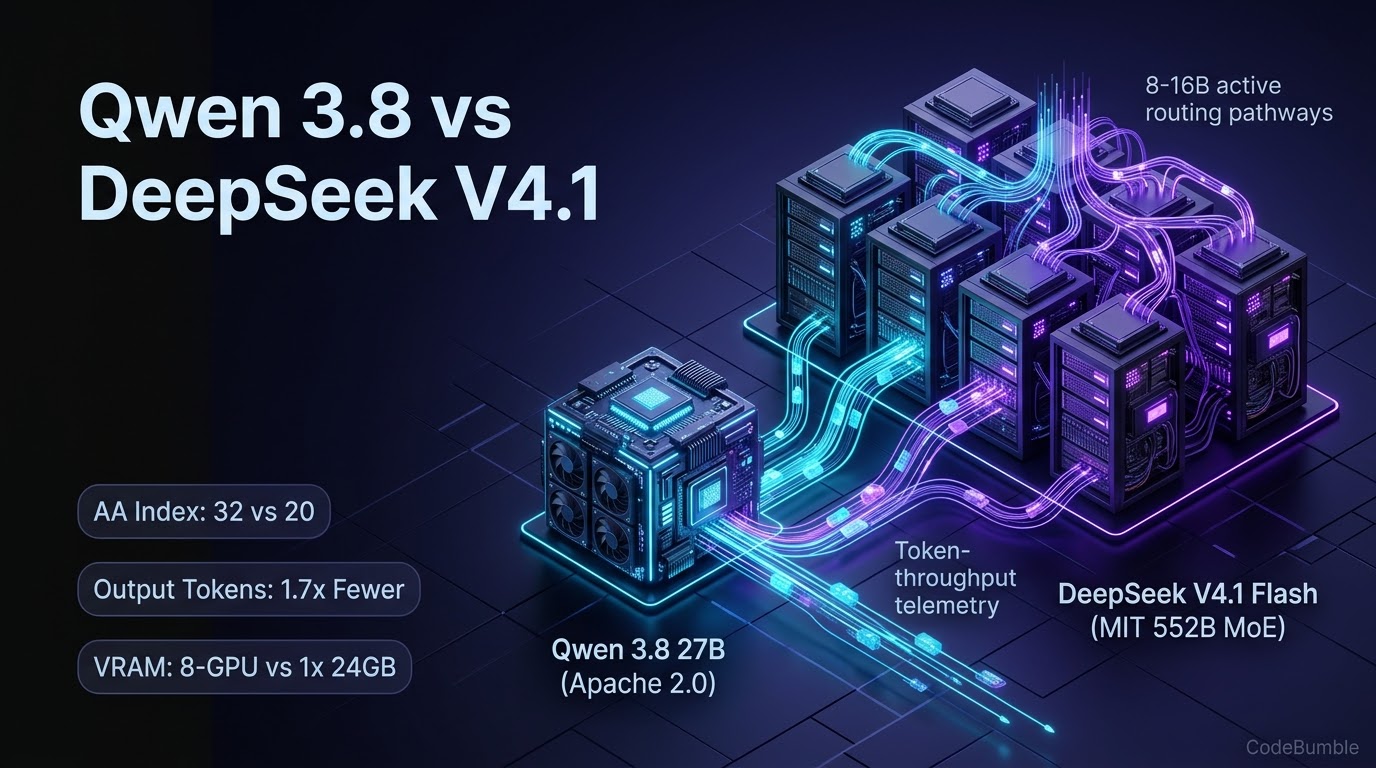
Qwen 3.8 27B (Alibaba, Apache 2.0) and DeepSeek V4.1 Flash (DeepSeek, MIT) sit in the same mid-tier enterprise API price bracket, yet they embody opposite architectural philosophies (Hugging Face Qwen3.8-27B; Hugging Face DeepSeek-V4.1-Flash). Qwen 3.8 27B is a 27.8-billion-parameter hybrid dense model that fits on a single 24 GB GPU in 4-bit (17–18 GB) or a single 80 GB H100 in FP8 (30.9 GB). DeepSeek V4.1 Flash is a 552-billion-parameter Mixture-of-Experts (MoE) model that activates only 8 billion to 16 billion parameters per token, weighs 510 GB in FP8/INT8, and requires an eight-GPU server for production self-hosting (Ask This Guy Benchmark, Nov 26, 2026).
That structural split creates a counterintuitive production trade-off verified by November 26, 2026 Artificial Analysis and European API telemetry: through a hosted API, DeepSeek V4.1 Flash is both smarter and cheaper—scoring 32 vs. 20 on the Artificial Analysis Intelligence Index v5.0.1 at maximum reasoning, writing 1.7x fewer output tokens at equivalent intelligence, and costing €0.432 vs. €0.860 per million tokens on average at OVHcloud. Conversely, Qwen 3.8 27B wins wherever single-GPU self-hosting, single-card fine-tuning, or specialized wafer-scale API speed (5,434 characters/s on Cerebras) is required.
Architecture & How It Works
While both models ship under permissive open-weight licenses that permit commercial deployment, modification, and inference resale, their internal designs dictate vastly different memory and compute footprints (Hugging Face Qwen3.8-27B; Hugging Face DeepSeek-V4.1-Flash; Ask This Guy).
| Specification | Qwen 3.8 27B | DeepSeek V4.1 Flash (1017 revision) |
|---|---|---|
| Developer & License | Alibaba Qwen Team — Apache 2.0 | Hangzhou DeepSeek AI — MIT |
| Release Timeline | August 13–14, 2026 | September 10, 2026 (1017 update Oct 17, 2026) |
| Architecture | Hybrid dense: 64 layers (16 × [3× Gated DeltaNet → FFN, 1× Gated Attention → FFN]) |
MoE: 384 experts (6 active per token) + Engram memory + DeepSeek-ViT |
| Parameters | 27.8B (all active per token) | 552B total (8B active reading / 16B generating) |
| Weight Footprint | 17–18 GB (4-bit), 30.9 GB (FP8), 55.6 GB (BF16) |
510 GB (FP8 and INT8; no official 4-bit release) |
| Native Context Window | 262,144 tokens (1,000,000 with extension) |
1,000,000 tokens native |
| Modalities & Reasoning | Text, image, video; reasoning_effort (none to xhigh) |
Text, image; adjustable reasoning (none to max) |
Dense vs. Sparse MoE Execution Mechanics
In Qwen 3.8 27B, every generated token traverses all 27.8 billion parameters across its 64-layer hybrid Gated DeltaNet and Gated Attention stack (48 V / 16 QK linear attention heads; 24 Q / 4 KV gated attention heads). That makes its static weight footprint compact enough for single-GPU inference and LoRA/full fine-tuning, but increases per-token FLOPs on standard GPU APIs and requires 64 KiB of KV-cache memory per conversation token (plus ~75 MB fixed state). On the serving side, Qwen3.8-27B enables thinking mode (<think>...</think>) by default—recommending temperature=1.0, top_p=0.95, top_k=20 for thinking, or temperature=0.7, top_p=0.80, presence_penalty=1.5 for direct instruct responses (Hugging Face Qwen3.8-27B).
By contrast, DeepSeek V4.1 Flash spreads knowledge across 384 experts and an Engram memory structure, activating only 6 experts (8–16B parameters) per token while compressing its KV cache down to 890 bytes per conversation token (Ask This Guy). That sparse activation explains why DeepSeek V4.1 Flash computes less per output token—allowing API providers to price it lower—despite needing 16x more GPU memory (510 GB) to hold all weights in VRAM.
flowchart LR
    A[Incoming Prompt + Context] --> B{Deployment Constraint}
    B -->|Managed / Sovereign API| C[DeepSeek V4.1 Flash: 552B MoE]
    C -->|8-16B Active Experts + 890B KV Cache| D[Lower Output Cost & 1.7x Fewer Tokens]
    B -->|Single-GPU Self-Host / Fine-Tune| E[Qwen 3.8 27B: 27.8B Dense]
    E -->|17.5 GB 4-bit / 30.9 GB FP8| F[1x 24GB Card or 1x H100 + vLLM]
    B -->|Ultra-Low Latency Non-Sovereign| G[Qwen 3.8 27B on Cerebras]
    G -->|5,434 chars/s| H[1.2s Full Answer / 131k Context Cap]
Benchmarks, Cost & Latency Analysis
1. Independent Intelligence & Token Efficiency (Artificial Analysis)
On the Artificial Analysis Intelligence Index v5.0.1 (read November 26, 2026), DeepSeek V4.1 Flash outscores Qwen 3.8 27B at every reasoning tier and requires significantly fewer output tokens to reach comparable accuracy (Artificial Analysis DeepSeek V4.1 Flash 1017; Ask This Guy):
| Model & Reasoning Setting | AA Intelligence Index | Output Tokens to Complete Index |
|---|---|---|
Qwen 3.8 27B (none) |
10.0 |
37.5 million |
Qwen 3.8 27B (low) |
15.7 |
77.3 million |
Qwen 3.8 27B (medium) |
17.5 |
89.3 million |
DeepSeek V4.1 Flash (none) |
18.5 (19 rounded) |
51.2 million |
Qwen 3.8 27B (xhigh max) |
20.1 (20 rounded) |
128 million |
DeepSeek V4.1 Flash (high) |
28.7 |
134 million |
DeepSeek V4.1 Flash (max) |
32.4 (32 rounded) |
174 million |
Even with reasoning turned off, DeepSeek V4.1 Flash (18.5 with 51.2M tokens) nearly matches Qwen 3.8 27B pushed to xhigh (20.1 with 128M tokens), writing 1.7x fewer tokens at matched intelligence levels. In a separate November 24, 2026 ATG blind evaluation of 96 French business texts per model, DeepSeek V4.1 Flash scored 4.90 / 5 (90% rated 5/5; 3/96 major errors; €0.35 per 1,000 answers) versus 4.43 / 5 for Qwen 3.8 27B (50% rated 5/5; 23/96 major errors; €0.91 per 1,000 answers).
Benchmark Caveat: Artificial Analysis evaluates English reasoning, coding, and agentic tasks—it does not capture domain-specific RAG retrieval quality, where document chunking and search often outweigh model differences (for example, ATG noted no significant difference on FinanceBench when swapping Qwen 3.8 27B for Gemini 3.8 Flash).
2. Real-World API Latency & Token Pricing (Nov 23–26, 2026)
Measured across 112 non-reasoning calls per configuration between November 23 and November 26, 2026 at sovereign European providers (OVHcloud, Scaleway) and US custom-silicon provider Cerebras (Ask This Guy):
| Provider & Model | Time to First Token | Speed (chars/s) |
Total Answer Time | Input / Output (€/1M) |
Avg Cost (€/1M)* |
|---|---|---|---|---|---|
| OVHcloud — DeepSeek V4.1 Flash | 0.27 s | 984 | 3.3 s | €0.27 / €1.08 |
€0.432 |
| OVHcloud — Qwen 3.8 27B | 0.36 s | 763 | 5.7 s | €0.40 / €2.70 |
€0.860 |
| Scaleway — DeepSeek V4.1 Flash | 0.46 s | 933 | 4.0 s | €0.60 / €1.80 |
€0.648 |
| Scaleway — Qwen 3.8 27B | 0.37 s | 682 | 6.9 s | €0.60 / €3.30 |
€0.948 |
| Cerebras (US) — Qwen 3.8 27B | 0.27 s | 5,434 | 1.2 s | €0.90 / €1.36 |
€0.992 |
*Average cost assumes 40% cached input, 40% uncached input, and 20% output. Note that Scaleway showed occasional tail-latency spikes (>= 3.9s TTFT in 1 of 10 calls) on DeepSeek V4.1 Flash, and Cerebras caps Qwen 3.8 27B context at 131,072 tokens.
Production Deployment & Trade-Offs
1. When to Choose DeepSeek V4.1 Flash
- Managed API Chatbots, Agents & Coding: Through an API, DeepSeek V4.1 Flash delivers higher reasoning scores (
32vs.20),1Mnative context, half the average token bill at OVHcloud (€0.432vs.€0.860), and faster end-to-end answers (3.3svs.5.7s) thanks to terser responses. - High-Concurrency Long-Context Workloads (on 8-GPU Clusters): Once you pay the 8-GPU entry cost (eight H100s at Scaleway, or eight H200s at
€42/hr/ ~€30,700/monthat OVHcloud, or> €250,000capex to buy eight H200 NVL cards), DeepSeek's tiny 890-byte/token KV cache supports high concurrency over long contexts.
2. When to Choose Qwen 3.8 27B
- On-Premises, Air-Gapped & Single-GPU Hosting: Qwen 3.8 27B runs in 4-bit on a single 24 GB GPU (
~46 tok/ssingle-user) or on a single 80 GB H100 (€2.80/hr/€1,940/monthat OVHcloud) serving ~50 concurrent users via vLLM at32–35 tok/seach (Ask This Guy). - Fine-Tuning & Video Inputs: A 27.8B dense model can be fine-tuned on a single GPU (with 800+ community fine-tunes already published), and Qwen 3.8 27B natively accepts video alongside text and images.
- Custom-Silicon Speed (Non-Sovereign): If EU data residency is not required, Cerebras (
5,434 chars/s,1.2sfull answer) and Groq (2,043 chars/spreview) serve Qwen 3.8 27B—neither currently hosts DeepSeek V4.1 Flash.
3. Governance & Switching Gotchas
Both models originate from Chinese labs, meaning calling the labs' own consumer/API endpoints routes data to China; hosting open weights on sovereign European providers (OVHcloud, Scaleway, IONOS, STACKIT, Regolo) keeps inference inside EU legal boundaries. To avoid lock-in ahead of upcoming Qwen 4 and DeepSeek V4.1 Pro releases, call both models behind an OpenAI-compatible gateway so model swaps require a single config change.
Frequently Asked Questions
1. Why is DeepSeek V4.1 Flash cheaper than Qwen 3.8 27B via API despite being 20x larger?
DeepSeek V4.1 Flash is a sparse MoE model that activates only 8–16B parameters per token, whereas Qwen 3.8 27B is dense and computes all 27.8B parameters for every token. DeepSeek also writes 1.7x fewer tokens for equivalent reasoning scores, lowering both per-token pricing and total output cost (Ask This Guy).
2. Can DeepSeek V4.1 Flash run on a single GPU in production?
No. Its published FP8/INT8 weights require 510 GB of VRAM—far beyond a single 80 GB H100 or 141 GB H200—requiring an 8-GPU server for production serving (Ask This Guy).
3. What is the minimum GPU needed to self-host Qwen 3.8 27B?
In 4-bit quantization (17–18 GB weights), Qwen 3.8 27B fits on a single 24 GB GPU for single-user workloads (~46 tok/s), while FP8 (30.9 GB weights) on one 80 GB H100 with vLLM handles ~50 concurrent users (Ask This Guy).
4. Which model has a larger native context window?
DeepSeek V4.1 Flash supports 1,000,000 tokens natively, whereas Qwen 3.8 27B supports 262,144 tokens natively (extensible to 1M) and is capped at 131,072 tokens on Cerebras (Hugging Face Qwen3.8-27B; Ask This Guy).
5. Which model is better for multi-step AI agents and coding?
For API-based agent and coding pipelines, DeepSeek V4.1 Flash leads cleanly (32.4 vs 20.1 max reasoning on Artificial Analysis). However, for ultra-fast chained agent calls where EU sovereignty is not required, Qwen 3.8 27B on Cerebras completes responses in 1.2 seconds (Ask This Guy).
Sources
- Qwen/Qwen3.8-27B Model Card — Hugging Face (August 13, 2026) (Primary)
- deepseek-ai/DeepSeek-V4.1-Flash Model Card — Hugging Face (October 17, 2026) (Primary)
- DeepSeek V4.1 Flash 1017 Benchmarks — Artificial Analysis (October–November 2026) (Secondary / Leaderboard)
- Qwen 3.8 27B or DeepSeek V4.1 Flash? — Ask This Guy Benchmark (November 26, 2026) (Secondary)