

AI
Gemini 4 Neon vs. Hydrogen vs. Carbon: 2026 Benchmarks, Token Pricing & Claude/GPT Tier Trade-Offs
Plotly's November 25, 2026 DataAnalyticsBench and Artificial Analysis's Coding Agent Index put Google's Gemini 4 Hydrogen, Neon, and Carbon side by side against Claude Fable 5.2, Opus 5.5, and GPT-6.2. Here are the verified accuracy scores, per-run token costs, latency medians, and December 1 Carbon pricing trade-offs.
9 min read
Gemini 4 Neon vs. Hydrogen vs. Carbon: 2026 Benchmarks, Token Pricing & Claude/GPT Tier Trade-Offs
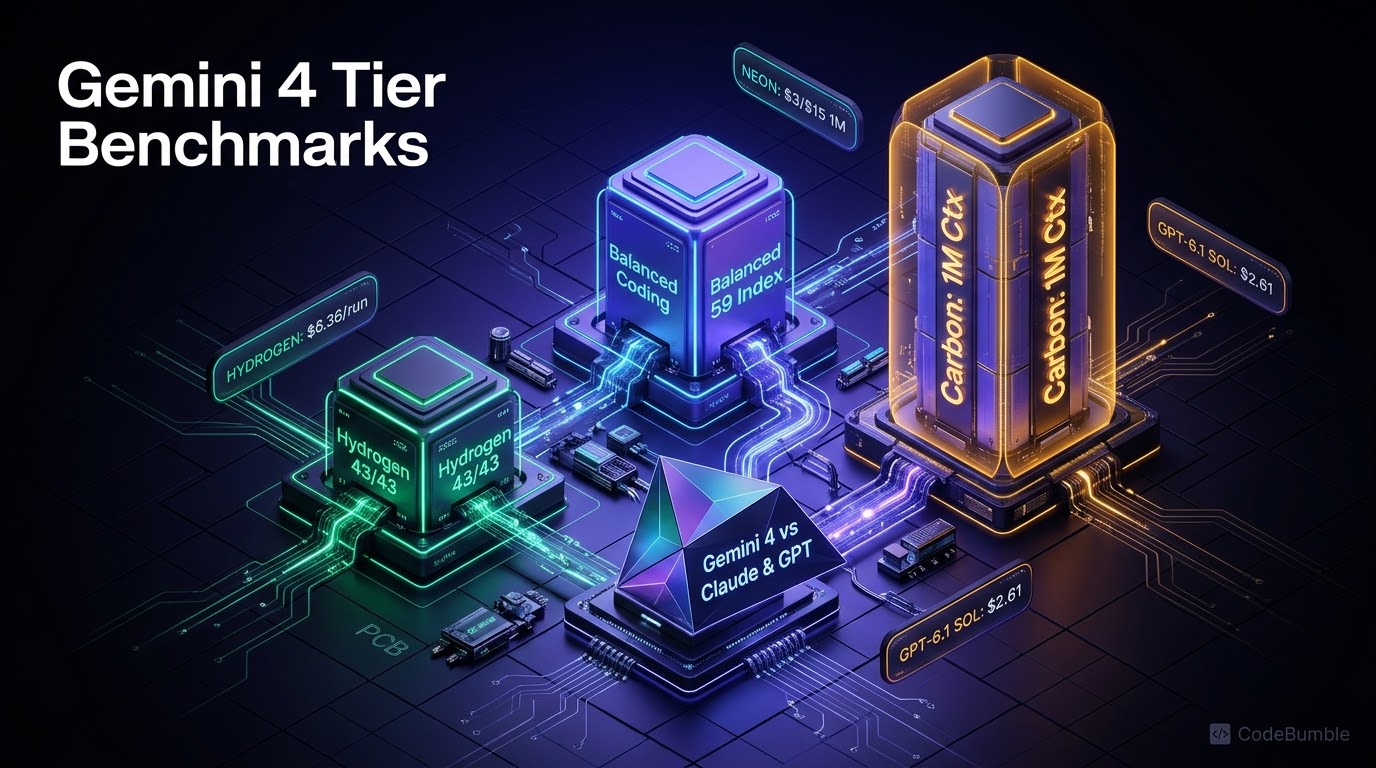
Executive Summary
Between November 10 and November 18, 2026, Google shipped three distinct Gemini 4 models—Carbon (gemini-4-carbon), Hydrogen (gemini-4-hydrogen), and Neon (gemini-4-neon)—alongside Interactions API upgrades for on-demand tool retrieval and multimodal file slicing (Google AI Studio Changelog). On November 25, 2026, Plotly published side-by-side DataAnalyticsBench results comparing all three Gemini 4 models against Anthropic's Claude 5.x and OpenAI's GPT-6.x lineups (Plotly Blog).
- Data Analytics Surprise: Gemini 4 Hydrogen (
$1.50 / $7.50per 1M input/output tokens) matched Gemini 4 Neon ($3.00 / $15.00) with a perfect 43 / 43 score on Plotly's exam at $6.36 per run (versus $17.03 for Neon) and a 32.2-second median question time (versus 46.0 seconds for Neon), while Gemini 4 Carbon scored 42 / 43 at 93.4 seconds median (Plotly Blog). - Coding Agent Reversal: On Artificial Analysis's Coding Agent Index (v2.1), Gemini 4 Neon (
xhigh) leads the Gemini lineup at 59 ($6.86/task in Antigravity CLI), ahead of Carbon (high, 55) and Hydrogen (xhigh, 52), and competitive with Claude Fable 5.2 (58,$7.51–$15.47/task) and Claude Opus 5.5 (58,$12.61/task) (Artificial Analysis; Plotly Blog). - Pricing Cliff Warning: Carbon's introductory $2.00 / $10.00 per 1M token pricing expires November 30, 2026, doubling to $4.00 / $20.00 on December 1, 2026—at which point the same Plotly run rises from
$11.55to roughly $23.10 (Google AI Studio Changelog; Plotly Blog).
Architecture & How It Works
All three November 2026 Gemini 4 releases share a unified 1 million-token context window and accept text, image, audio, video, and PDF inputs (with Neon also supporting long decode up to 1M tokens) (Google AI Studio Changelog; Plotly Blog). Rather than shipping a single fixed reasoning budget, Neon and Hydrogen expose four configurable thinking_level tiers—low, medium, high (default), and xhigh—while Carbon is tuned for sustained, multi-step reasoning and cybersecurity defense (Google AI Studio Changelog).
Multi-Tier Routing & Interactions API Optimization
Two November 18–19 Gemini API capabilities directly reduce token overhead for production agent stacks (Google AI Studio Changelog):
- On-Demand Tool Retrieval (
defer_loading: true): In the Interactions API, developers can mark large tool libraries and remote MCP servers withdefer_loading: truealongside a{"type": "tool_search"}tool so Gemini retrieves only relevant function schemas dynamically instead of paying input-token costs for every schema on every turn. - Multimodal File Slicing: Developers can pass Microsoft Office (
Word,PowerPoint,Excel) and OpenDocument files directly and slice specific page ranges, worksheet tabs, cell ranges, video timestamps, or audio intervals so models process only the required payload.
flowchart TD
    A["Incoming Agent Task"] --> B{"Task Profile & Latency Budget"}
    B -->|"High-Volume Classification / Extraction"| C["GPT-6 Luna or Claude Haiku 5.5<br/>($0.10 / $0.50 per 1M)"]
    B -->|"Everyday Coding & Data Analytics"| D["Gemini 4 Hydrogen ($1.50/$7.50)<br/>or GPT-6.1/6.2 Sol ($1–$2/$5–$10)"]
    B -->|"Complex Coding Agents & Tool Chains"| E["Gemini 4 Neon xhigh ($3/$15)<br/>or Claude Opus 5.5 ($4/$20)"]
    B -->|"Long-Horizon Security / Hardest Specs"| F["Gemini 4 Carbon ($4/$20 Dec 1)<br/>or Fable 5.2 / GPT-6.2 Astra ($8/$40)"]
For teams adopting deferred tool loading in the Gemini Interactions API (v1beta), schemas are marked at request time so the model fetches only matching tools (Google AI Studio Changelog):
{
  "model": "gemini-4-hydrogen",
  "tools": [
    { "type": "tool_search" },
    {
      "type": "function",
      "name": "query_warehouse_metrics",
      "description": "Run read-only SQL aggregations against telemetry tables.",
      "defer_loading": true
    }
  ]
}
Benchmarks, Cost & Latency Analysis
Independent testing by Plotly (via OpenRouter on November 25, 2026) and Artificial Analysis (November 18, 2026) highlights a sharp divergence between structured data-analysis agents and long-horizon software-engineering agents.
1. Gemini 4 Head-to-Head on DataAnalyticsBench
| Metric | Gemini 4 Hydrogen |
Gemini 4 Neon |
Gemini 4 Carbon |
|---|---|---|---|
| GA Release Date | Nov 12, 2026 | Nov 18, 2026 | Nov 10, 2026 (Google AI Studio) |
| DataAnalyticsBench Score | 43 / 43 | 43 / 43 | 42 / 43 (Plotly Blog) |
| Cost of One Full Run | $6.36 | $17.03 | $11.55 (~$23.10 after Dec 1) |
| Median Time per Question | 32.2 s | 46.0 s | 93.4 s |
| Whole Exam Wall Time | 43 min | 58 min | 108 min |
| Effective Output Speed | 104 tok/s | 96 tok/s | 34 tok/s |
| Total Tokens Used | 18.0M | 20.1M | 29.5M |
| List Price ($/1M In / Out) | $1.50 / $7.50 (Free tier available) | $3.00 / $15.00 | $2.00 / $10.00 → $4.00 / $20.00 (Dec 1) |
Plotly notes that Hydrogen and Neon consumed similar total tokens (18.0M vs. 20.1M), meaning Hydrogen's 63% cost savings come directly from its lower token rate. Carbon consumed the most tokens (29.5M) and took 93.4 seconds median per question because it executes more, smaller steps with higher time-to-first-token latency (Plotly Blog).
2. Cross-Lab Comparison: Google vs. Anthropic vs. OpenAI
| Model | Lab Tier | List Price ($/1M In / Out) | DataAnalyticsBench | Full Run Cost | Coding Agent Index v2.1 (Setting) | Coding Cost / Task |
|---|---|---|---|---|---|---|
| Gemini 4 Carbon | Top | $2/$10 → $4/$20 (Dec 1) | 42 / 43 | $11.55 | 55 (high, Antigravity) |
$9.75 |
| Claude Fable 5.2 | Top | $8.00 / $40.00 | 43 / 43 | $35.74 | 58 (high, Claude Code) |
$7.51 ($15.47 xhigh) |
| GPT-6.2 Astra | Top | $8.00 / $40.00 | 41 / 43 | $4.11 | 53 (max, Codex) |
$5.12 |
| Gemini 4 Neon | Balanced | $3.00 / $15.00 | 43 / 43 | $17.03 | 59 (xhigh, Antigravity) |
$6.86 |
| Claude Opus 5.5 | Balanced | $4.00 / $20.00 | 41 / 43 | $13.31 | 58 (max, Claude Code) |
$12.61 |
| GPT-6.2 Sol | Balanced | $2.00 / $10.00 | 40 / 43 | $1.22 | 50 (xhigh, Codex) |
$0.90 |
| Gemini 4 Hydrogen | Fast | $1.50 / $7.50 | 43 / 43 | $6.36 | 52 (xhigh, Antigravity) |
$4.45 |
| Claude Sonnet 5.5 | Fast | $2.00 / $10.00 | 38 / 43 | $7.30 | 56 (max, Claude Code) |
$11.40 |
| GPT-6.1 Sol | Prior Balanced | — | 43 / 43 | $2.61 | 52 (max, Codex) |
$1.51 |
| Claude Haiku 5.5 | Budget | $0.10 / $0.50 | 37 / 43 | $0.38 | 30 (max, Claude Code) |
$2.25 |
| GPT-6 Luna | Budget | $0.10 / $0.50 | 38 / 43 | $0.13 | 26 (max, Codex) |
$0.19 |
Sources: Plotly Blog and Artificial Analysis (verified as of November 25, 2026).
Benchmark Caveats & Saturation Notes
- Ceiling Effects on DataAnalyticsBench: Because multiple models scored a perfect
43 / 43—and Plotly observed up to 3 points of run-to-run variance on repeat runs—a 1- to 2-point gap is effectively a statistical tie (Plotly Blog). - Harness Coupling on Coding Benchmarks: Artificial Analysis ran each model inside its own vendor's CLI harness (Antigravity CLI for Gemini, Claude Code for Anthropic, Codex for OpenAI) at specific effort settings, meaning scores reflect agent + model pairing rather than raw weights in isolation (Plotly Blog).
- Speed Measurement Methodology: Plotly's 104 tok/s (
Hydrogen), 96 tok/s (Neon), and 34 tok/s (Carbon) include waiting for time-to-first-token across multi-turn tool calls, which is lower than pure decode throughput (Artificial Analysis measured Neon's raw output speed at ~110 tok/s vs. Carbon's ~57 tok/s) (Plotly Blog; Artificial Analysis).
Production Deployment & Trade-Offs
1. Selecting the Right Model Tier by Workload
- Structured Data Analytics & Dashboards: Pick GPT-6.1 Sol (
$2.61per full run,43/43) if OpenAI is on your allowlist, or Gemini 4 Hydrogen ($6.36per run,43/43,32.2smedian) if you are building on Google Cloud / Gemini API—where Hydrogen is also the only November Gemini 4 release available on the free tier (Plotly Blog; Google AI Studio Changelog). - Autonomous Coding Agents: Avoid dropping to the
$0.10 / $0.50budget tier (Haiku 5.5 at30, GPT-6 Luna at26), which loses roughly 48%–51% of flagship coding capability. Instead, target Gemini 4 Neon (xhigh,59at$6.86/task), Claude Sonnet 5.5 (56), or GPT-6.2 Sol (50at$0.90/task) for cost-sensitive loops (Plotly Blog). - Presentation & Visual Reasoning: Artificial Analysis notes that Gemini 4 Neon (
xhigh) achieved 1771 Elo on AA-Briefcase Presentation Quality (45 points ahead of Claude Sonnet 5.5) and 33.4% (high) onGDP.pdf, making it preferable to Carbon for document-heavy enterprise outputs (Artificial Analysis).
2. Operational & Migration Gotchas
- Gemini 2.5 Auto-Routing on December 1, 2026: Both
gemini-2.5-proandgemini-2.5-flashare deprecated and will automatically route togemini-3.8-flashandgemini-3.5-flash-liteon December 1, 2026, introducing breakingthought_signaturevalidation andthinking_levelchanges (Google AI Studio Changelog). - Rate Limits & Vertex AI Entitlements: Production teams should monitor provider quota shifts closely—on November 26, 2026, developers also reported tighter API rate limits on GPT-6.2 Astra and Sol (Emergent)—and pair multi-provider gateways (such as OpenRouter) with fallback routing across Gemini 4 Hydrogen, GPT-6.2 Sol, and Claude Opus 5.5.
- Closed Weights: None of Gemini 4 Hydrogen, Neon, or Carbon have open weights; teams requiring on-premise deployment must use open-weight alternatives such as Gemma, Qwen, or
gpt-oss(Plotly Blog).
Frequently Asked Questions
What is the difference between Gemini 4 Hydrogen, Neon, and Carbon?
All three share a 1M-token context window and multimodal inputs, but target different tiers: Hydrogen ($1.50/$7.50 per 1M) is the fast everyday agentic workhorse; Neon ($3.00/$15.00 per 1M) balances depth and efficiency for complex coding and enterprise workflows; and Carbon ($2.00/$10.00 intro, doubling to $4.00/$20.00 on Dec 1, 2026) is Google's heaviest reasoning model for long-horizon engineering and cybersecurity defense (Google AI Studio Changelog; Plotly Blog).
Which Gemini 4 model is best for data analysis vs. coding agents?
On Plotly's DataAnalyticsBench, Gemini 4 Hydrogen tied Neon at 43 / 43 for 37% of the cost ($6.36 vs. $17.03) and faster median latency (32.2s vs. 46.0s). On Artificial Analysis's Coding Agent Index, Gemini 4 Neon (xhigh) leads Gemini at 59, ahead of Carbon (55) and Hydrogen (52) (Plotly Blog).
Why does Gemini 4 Carbon cost more after December 1, 2026?
Google launched gemini-4-carbon on November 10, 2026 with introductory $2.00 / $10.00 per 1M token pricing valid through November 30, 2026, after which standard $4.00 / $20.00 rates take effect on December 1, 2026 (Google AI Studio Changelog; Artificial Analysis).
Can I use Haiku 5.5 or GPT-6 Luna instead of frontier models for agents?
For structured data queries and classification, GPT-6 Luna ($0.13/run, 38/43) and Claude Haiku 5.5 ($0.38/run, 37/43) deliver ~86%–88% of top-tier accuracy at ~1% of the cost. For coding agents, however, they score roughly half of flagship models (26 and 30 vs. 53 and 58) (Plotly Blog).
Are Gemini 4 Neon, Hydrogen, or Carbon open-weight?
No. All three are proprietary models accessed via the Gemini API, Vertex AI, or OpenRouter (Plotly Blog).
Sources
- Google AI Studio — Gemini API Release Notes (
gemini-4-carbon,gemini-4-hydrogen,gemini-4-neon, Tool Retrieval) (Updated November 19, 2026): https://aistudio.google.com/docs/changelog - Plotly Blog — Gemini 4 Neon vs Carbon vs Hydrogen vs Claude and GPT Tiers (2026) (Published November 25, 2026): https://plotly.com/blog/gemini-4-neon-vs-carbon-vs-hydrogen/
- Artificial Analysis — Google continues to accelerate its release cadence with Gemini 4 Neon (Published November 18, 2026): https://artificialanalysis.ai/articles/gemini-4-neon-intelligence-gain
- Emergent — OpenAI Cuts GPT-6.2 Usage: Astra, Sol Hit Limits Faster (Published November 26, 2026): https://emergent.sh/news/openai-cuts-gpt-6-2-usage-astra-sol-hit