

AI
Google Workspace MCP Servers and gwscli: Standardized Quotas, OAuth Rules, and the February 2027 Agent Mandate
Google made its Workspace MCP servers and gwscli binary generally available on November 24, 2026, setting a February 1, 2027 deadline for AI agents to move off direct REST APIs. Here is how the 5,000/day Standard Tier, April 2027 Scaled billing, and Day-1 OAuth caveats work in production.
11 min read
Google Workspace MCP Servers and gwscli: Standardized Quotas, OAuth Rules, and the February 2027 Agent Mandate
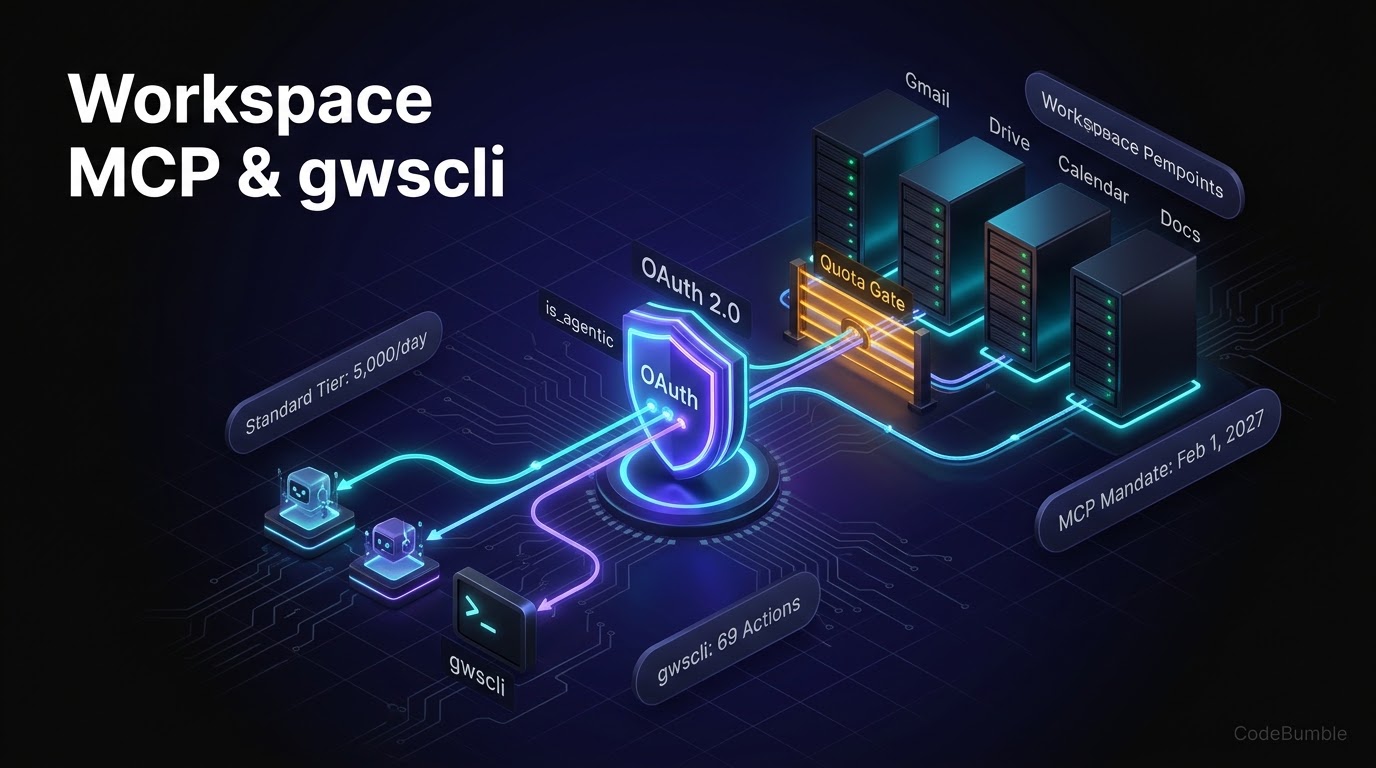
Executive Summary
On November 24, 2026, Google announced general availability (GA) for its Google Workspace Model Context Protocol (MCP) servers, the official Google Workspace CLI (gwscli), standardized API usage tiers, and enterprise Admin Console controls for AI agents (Google Workspace Updates). The release shifts how external and internal AI agents integrate with Gmail, Drive, Docs, Sheets, Slides, Calendar, Chat, and Tasks:
- Mandatory MCP Deadline: Beginning February 1, 2027, Google's Workspace AI Tools Addendum takes effect, requiring AI agents and similar access tools to use Workspace MCP servers rather than calling Workspace REST APIs directly. Agents that continue calling REST APIs directly after that date are capped at Standard Tier quotas regardless of the Cloud project's billing tier (Google Developers).
- Quota & Billing Split: The default Standard Tier remains free (no Google Cloud Billing account required) and provides 5,000 requests per day, per project, per product across GA MCP servers. Starting April 1, 2027, projects needing higher limits must enroll in the Scaled Tier—where REST APIs retain daily no-charge allowances, whereas Scaled Tier Gmail, Calendar, and Drive MCP usage is billed from the first request with no daily free allowance (Google Developers).
- Primary Developer Takeaway: Google expects fewer than 1% of active Workspace developers to exceed the Standard Tier (Google Developers), making
gwscliand hosted MCP endpoints a zero-cost starting point for individual and small-team agents. However, independent Day-1 testing on November 24–25, 2026 highlights key operational caveats: conflicting GA vs. Developer Preview status across Google's own docs, permission errors on new Personal Mode projects during the two-week rollout, product-wide OAuth scopes, and explicit developer responsibility for prompt-injection screening (PortEden; DEV Community).
Architecture & How It Works
Google's November 24 release provides two Google-managed entry points into Workspace data, replacing custom REST wrappers with runtime-discovered schemas and centralized OAuth governance (Google Workspace Updates):
- Hosted Workspace MCP Servers (Streamable HTTP): Remote endpoints hosted per product on
*.googleapis.com/mcp/v1for cloud and web-based AI agents (such as Claude custom connectors and Google Antigravity). - Official Workspace CLI (
gwscli): A statically linked native binary (11,673,751bytes /11.7 MBon Linux x86_64, tested atv1.0.6.1026726559) that routes terminal agents—such as Claude Code, Codex, and Antigravity—through the same*mcp.googleapis.combackend APIs (Google Developers CLI Guide; DEV Community).
flowchart LR
    A["Cloud / Web Agent<br/>(Claude, Antigravity)"] -->|Streamable HTTP| C["OAuth 2.0 Client<br/>(is_agentic = true)"]
    B["Terminal Agent<br/>(Claude Code, Codex via gwscli)"] -->|HTTPS / Localhost Callback| C
    C --> D["Admin Console Governance<br/>DLP + HITL Rules + Audit Logs"]
    D --> E["Standard / Scaled Quota Gate<br/>(5,000 req/day/product on Standard)"]
    E --> F["Workspace MCP Endpoints<br/>gmailmcp / drivemcp / calendarmcp / workspacemcp"]
    F --> G["Underlying Workspace APIs & Data"]
Supported MCP Endpoints and CLI Surfaces
According to Google's quota documentation, eight MCP servers are designated GA (gmailmcp, calendarmcp, drivemcp, docsmcp, sheetsmcp, slidesmcp, chatmcp, and tasksmcp), while people, classroommcp, and workspacemcp (Universal Search) also appear in Google's setup guides (PortEden). Independent inspection of gwscli on November 24, 2026 recorded 69 actions across 9 services (gmail: 23, calendar: 9, drive: 9, tasks: 9, sheets: 6, chat: 4, slides: 4, people: 3, docs: 2), with action definitions fetched dynamically from the MCP servers at runtime rather than compiled into the binary (DEV Community).
| Surface / Product | Remote MCP Endpoint | gwscli Support |
Status Note (Nov 24–25, 2026) |
|---|---|---|---|
| Gmail | https://gmailmcp.googleapis.com/mcp/v1 |
gwscli gmail (23 actions) |
GA in quota docs; create_draft only, no direct send in CLI (DEV Community) |
| Google Drive | https://drivemcp.googleapis.com/mcp/v1 |
gwscli drive (9 actions) |
GA in quota docs; requires drive.file for list_recent_files / search_files (DEV Community) |
| Google Calendar | https://calendarmcp.googleapis.com/mcp/v1 |
gwscli calendar (9 actions) |
GA in quota docs (Google Developers) |
| Google Docs / Sheets / Slides | docsmcp, sheetsmcp, slidesmcp.googleapis.com/mcp/v1 |
docs (2), sheets (6), slides (4) |
GA in quota docs; docs read_doc returns Markdown (DEV Community) |
| Google Chat / Tasks | chatmcp, tasksmcp.googleapis.com/mcp/v1 |
chat (4), tasks (9) |
GA in quota docs; Chat writes require a configured Chat app (Google Developers CLI Guide) |
| People API | https://people.googleapis.com/mcp/v1 |
gwscli people (3 actions) |
Marked Developer Preview in CLI guide (Google Developers CLI Guide) |
| Classroom / Universal Search | classroommcp, workspacemcp.googleapis.com/mcp/v1 |
Not listed in gwscli |
search_corpus queries Gmail, Drive, Calendar, and Chat in one call (PortEden) |
Confidence note on availability status: PortEden's November 24 audit flagged an inconsistency across Google's own documentation: the usage-tier guide lists the eight core MCP servers as GA, whereas the MCP setup guide still displayed a Developer Preview banner at launch (PortEden).
OAuth is_agentic Flag, Personal Mode, and Configuration
To enforce agent-specific governance and quotas, Google requires OAuth 2.0 clients used by AI agents to enable Use this client for an AI-powered agent (is_agentic) in Google Cloud Console; traditional non-agent features must use a separate OAuth client (Google Workspace Updates). For single-user workflows, Google introduced Personal Mode links that pre-enable Workspace and MCP services and create a single-account OAuth client without app verification or separate consent-screen setup (PortEden).
For terminal agents, gwscli ships pre-built discovery flags (--help, --show-scopes, --schema) that work prior to login, plus packaged agent skills (SKILL.md, 318 lines):
# Install gwscli on Linux/macOS and inspect version
curl -fsSL https://dl.google.com/workspace-cli/install.sh | bash
gwscli version

# Install packaged agent skill for Claude Code
gwscli skills install --dir ~/.claude/skills

# Register Personal Mode Desktop OAuth client and authenticate incrementally
gwscli auth setup --oauth_client_file=$HOME/Downloads/client_secret.json
gwscli auth login "drive list_recent_files" "gmail search_threads"
For cloud agents such as Antigravity, Google's configuration schema maps each remote MCP server and its is_agentic OAuth credentials inside ~/.gemini/config/mcp_config.json (PortEden):
{
  "mcpServers": {
    "gmail": {
      "serverUrl": "https://gmailmcp.googleapis.com/mcp/v1",
      "oauth": {
        "clientId": "YOUR_AGENT_CLIENT_ID",
        "clientSecret": "YOUR_AGENT_CLIENT_SECRET"
      }
    }
  }
}
Benchmarks, Cost & Latency Analysis
Vendor Claims vs. Independent Day-1 Telemetry
Google states that hosted MCP tools lower token consumption and latency compared to raw REST APIs because tools return synthesized summaries within Workspace's boundary rather than forcing agents to download raw payloads line by line, while gwscli allows terminal agents to chain calls locally (Google Workspace Updates).
Independent hands-on testing on November 24, 2026 (Linux x86_64, gwscli 1.0.6.1026726559) verified real-world execution latency and uncovered launch-day friction (DEV Community):
- Measured Command Latency: Across Drive (
list_recent_files), Calendar (list_events), Gmail (search_threads), and Tasks (list_tasks), authenticated JSON responses returned in 0.55 to 2.19 seconds per command on a Developer Preview-enrolled project. - Rollout & Personal Mode Caveat: On launch day (Nov 24), testing the exact same account and scopes with a brand-new Personal Mode project returned
"Developer Preview required"for Calendar, Gmail, and Tasks and"The caller does not have permission"for Drive. Google's rollout schedule specifies a two-week progressive rollout for GA MCP servers andgwscli(Google Workspace Updates; DEV Community). - Scope Bundle Gotcha: Running
gwscli auth login --bundle=readonlyomits thedrive.filescope, whichgwscli drive list_recent_filesanddrive search_fileslist in their Recommended Minimal Scopes—causing Drive read commands to fail until authorized per command.
Standard vs. Scaled Tier Pricing and Quota Math
| Attribute | Standard Tier (Default) | Standard + Internal-Use Exception | Scaled Tier (Whole-Project Opt-In) |
|---|---|---|---|
| Cost & Billing Account | $0; no Cloud Billing account required | $0 (requires Workspace super admin) | Linked active Cloud Billing account required (Google Developers) |
| MCP Request Quota | 5,000 req/day, per project, per product + per-minute limits | Not eligible for MCP quota increases (REST APIs only) | Higher quotas after opt-in and approved quota increase request |
| REST API Billing (from Apr 1, 2027) | Free (throttled at Standard limits) | Free within approved internal limits | Billed only above daily no-charge allowances |
| MCP Billing (from Apr 1, 2027) | Free (throttled at 5,000/day/product) | Not applicable | Gmail, Calendar, Drive MCP billed from the 1st request (no free allowance) |
| Pricing Buckets | N/A | N/A | Light, Medium, Plus, Premium (Drive uses all 4; Gmail uses Light/Medium/Premium; Calendar uses Plus) |
The Multi-Agent & Multi-Request Trap: Google notes two critical accounting details in its quota guide (Google Developers):
- Compound Tool Calls: Unlike single REST calls, certain MCP tools count as multiple requests against the daily cap because they execute multiple underlying API calls.
- Whole-Project Pool & Zero Free MCP Tier on Scaled: Standard Tier's 5,000-request daily cap is per Cloud project, per product—not per user. As PortEden calculates, a single inbox-triage agent running 1 search, 30 thread reads, and 10 draft creations every 15 minutes over a 10-hour workday consumes
41 × 40 = 1,640Gmail calls/day; just three such agents sharing one project consume 4,920 of the 5,000 daily Gmail calls (PortEden). Worse, opting a project into Scaled Tier applies to the entire Cloud project, immediately removing the free 5,000/day MCP allowance once billing begins on April 1, 2027.
Key Enforcement Timeline
- May 1, 2026: Baseline quotas for Gmail, Calendar, and Drive APIs applied to new Cloud projects.
- November 24, 2026: GA rollout begins (2-week window) for Workspace MCP servers,
gwscli, Admin Console agent controls, and the Google Cloud Console Usage & Cost Estimator dashboard. - February 1, 2027: Workspace AI Tools Addendum and MCP Mandate take effect; AI agents calling REST APIs directly are restricted to Standard Tier quotas regardless of billing tier, and extended caching/scraping of Workspace-derived data by agents is prohibited.
- April 1, 2027: Full enforcement of Standard limits and Scaled Tier billing (first-request billing for Gmail, Calendar, and Drive MCP).
- Through December 2027: Workspace APIs remain excluded from Google Cloud Support variable fee calculations (with 90 days' notice before any change).
Production Deployment & Trade-Offs
Scope Isolation, Prompt Injection, and Context Bloat
- Product-Level OAuth Boundaries: Google's hosted MCP servers inherit the signed-in user's permissions within granted OAuth scopes (PortEden). Because scopes like
gmail.readonlyandcalendar.events.readonlycover an entire mailbox or calendar set—andworkspacemcp.googleapis.com(search_corpus) queries Gmail, Drive, Calendar, and Chat simultaneously—Google's endpoints cannot natively restrict an agent to a single Gmail label, specific contact list, or date range. Organizations requiring record-level isolation or field redaction must place a policy proxy (such as an internal gateway or third-party data firewall) in front of the agent or restrict agents to dedicated service accounts. - Mandatory Prompt-Injection Screening: Google explicitly places indirect prompt-injection defense on the developer, stating that builders "must screen prompts and responses for malicious content or prompt injection attacks" using Google's Model Armor or an equivalent control before agents process untrusted external emails or shared Drive files (Google Developers CLI Guide; PortEden).
- Context Window & Schema Stability: Wiring all 10 MCP servers into a single agent floods its context window with dozens of tool schemas and noisy multi-product results. Connect only the specific MCP servers a workflow requires, and avoid hardcoding
gwsclicommand signatures in static bash scripts because Google warns that dynamically discovered CLI parameters and JSON schemas may change without backward compatibility (Google Developers CLI Guide). - Headless & Telemetry Defaults:
gwscli auth loginbinds a localhost HTTP callback (http://127.0.0.1:<port>/), which times out after 5 minutes on headless VMs unless you forward the port over SSH (ssh -L <port>:127.0.0.1:<port>) or pass short-lived tokens via--oauth_token(avoiding literal tokens in process lists). Note also thatgwsclitelemetry is enabled by default until you rungwscli logging off(DEV Community).
Pre-February 2027 Migration Checklist
- Separate OAuth Clients: Audit existing Google Cloud projects and isolate agent traffic onto dedicated OAuth 2.0 clients with
is_agenticenabled, distinct from deterministic app clients. - Project & Billing Segmentation: Keep low-volume or internal prototypes on separate Standard Tier projects (preserving the 5,000/day free MCP cap), and only move high-volume production agent fleets to Scaled Tier projects after modeling April 2027 per-request MCP costs in the Cloud Console Cost Estimator.
- Enable Admin HITL & DLP: In the Google Workspace Admin Console (
Security > API Controls), verify that existing user DLP rules apply and configure human-in-the-loop (HITL) confirmation policies for sensitive actions such as external file sharing (Google Workspace Updates).
Frequently Asked Questions
Are Google Workspace MCP servers and gwscli free to use?
Yes, on the default Standard Tier, both the hosted MCP servers and gwscli incur $0 and require no Google Cloud Billing account, up to 5,000 requests per day, per project, per product across the eight GA MCP services (Google Developers).
What happens on February 1, 2027 if an AI agent still calls Gmail or Drive REST APIs directly?
When the Workspace AI Tools Addendum takes effect on February 1, 2027, AI agents must use Workspace MCP servers rather than direct REST APIs. Any agent still calling REST APIs directly is throttled to Standard Tier quotas even if its Cloud project is enrolled in the paid Scaled Tier (Google Developers).
Why does enrolling in Scaled Tier remove my free MCP requests?
Under Google's standardized billing model taking effect April 1, 2027, REST APIs on the Scaled Tier keep daily no-charge allowances per billing bucket, whereas Scaled Tier usage of the Gmail, Calendar, and Drive MCP servers has no daily free allowance and is billed from the first successful request across the entire enrolled Cloud project (Google Developers).
What is the difference between gwscli and the open-source gws CLI on GitHub?
gwscli is Google's official, statically linked Workspace CLI distributed from dl.google.com and documented on developers.google.com that routes commands through *mcp.googleapis.com endpoints. It is separate from the community/open-source gws CLI in the googleworkspace GitHub repository, which is not an officially supported Google product (PortEden).
Why did gwscli drive list_recent_files fail after I logged in with --bundle=readonly?
Independent testing on November 24, 2026 showed that --bundle=readonly grants drive.readonly and drive.metadata.readonly, but omits drive.file, which drive list_recent_files and drive search_files require in their Recommended Minimal Scopes. Authorizing those specific commands directly (gwscli auth login "drive list_recent_files") resolves the missing scope (DEV Community).
Sources
- Google Workspace Updates — Simplifying agent access while keeping organizations in control: MCP servers, CLI, standardized usage tiers, and admin policies (Published November 24, 2026): https://workspaceupdates.googleblog.com/2026/11/mcp-servers-cli-standardized-usage-tiers-now-available.html
- Google Workspace for Developers — Usage tiers and quotas for Google Workspace APIs and MCP servers (Last updated November 24, 2026 UTC): https://developers.google.com/workspace/guides/quota-usage-tiers
- Google Workspace for Developers — Use the Google Workspace command-line interface (CLI) (Updated November 24, 2026): https://developers.google.com/workspace/guides/workspace-cli
- DEV Community (Google Developer Experts / xbill) — Install and Use the Google Workspace CLI: gwscli on Linux, From curl to Agent Skills (Published November 24, 2026): https://dev.to/gde/install-and-use-the-google-workspace-cli-gwscli-on-linux-from-curl-to-agent-skills-12dm
- PortEden — Google Workspace MCP Servers: Personal Mode, CLI, and Quotas (Published November 24, 2026): https://porteden.com/blog/google-workspace-mcp-servers/