

Web performance
QEMU VM Memory Tiering: How Red Hat Plans to Save DRAM Using NVMe SSDs and MADV_PAGEOUT
Presented by Red Hat's Peter Xu at KVM Forum 2026 and covered by Phoronix on November 14, 2026, QEMU VM memory tiering aims to offload cold guest pages onto NVMe SSDs without tanking live migration performance. Explore the three competing designs, why mincore() + MADV_PAGEOUT leads, and how to audit swap/MGLRU behavior today.
8 min read
QEMU VM Memory Tiering: How Red Hat Plans to Save DRAM Using NVMe SSDs and MADV_PAGEOUT
Executive Summary
At KVM Forum 2026 in Vancouver, Canada (November 12, 2026), Red Hat virtualization engineer Peter Xu presented QEMU memory tiering, outlining how hypervisors can leverage fast NVMe SSDs as a secondary memory tier to reduce expensive DRAM consumption for QEMU/KVM virtual machines. As reported by Phoronix on November 14, 2026, the effort is driven directly by high DRAM pricing—pushing cloud and enterprise virtualization teams to increase VM density without sacrificing workload responsiveness.
Because Linux has maintained a mature two-tier memory hierarchy via swap and memcg (memory cgroups) for decades, QEMU can already offload cold guest memory onto NVMe-backed swap and benefit automatically from kernel advances such as Multi-Gen LRU (MGLRU). However, Xu's KVM Forum 2026 abstract highlights a critical catch: because QEMU itself is currently tier-unaware, operations like live migration can trigger severe performance regressions when touching paged-out cold memory.
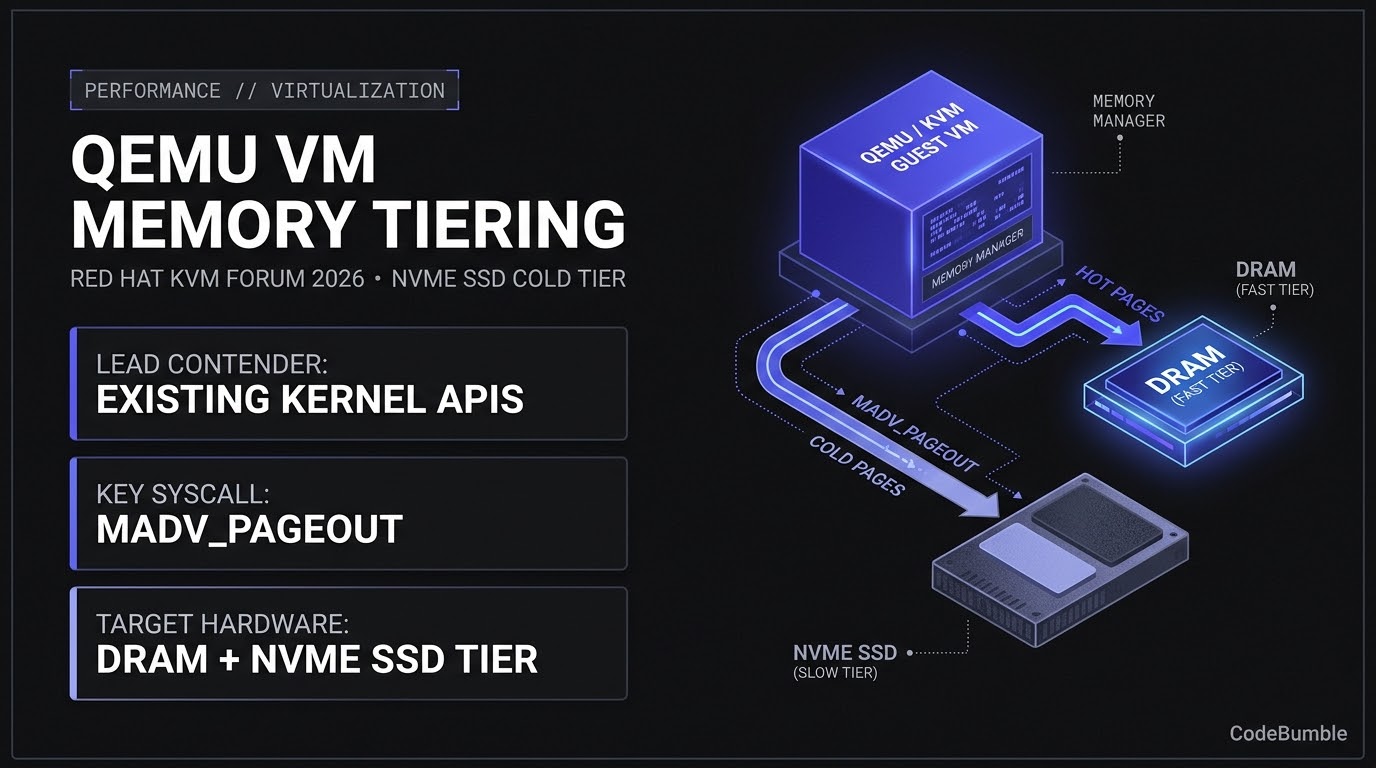
To solve this, Red Hat is evaluating three architectural paths: introducing a new maccess() system call, implementing full user-space tiering inside QEMU, or combining existing Linux APIs (mincore() + MADV_PAGEOUT) with a targeted kernel fix for asynchronous reclaim swap overshoot. Right now, the existing-kernel-API approach (mincore() + MADV_PAGEOUT) is the lead contender because it requires minimal QEMU changes and avoids duplicating kernel page-tracking overhead. Public latency and throughput numbers from Xu's talk slides are not included in the published abstracts, so quantitative benchmarks remain unavailable until upstream patches or slide decks are posted.
Why Naive Linux Swap Hurts Tier-Unaware QEMU VMs
Using Linux's existing swap subsystem and memcg per-VM limits appears deceptively simple: the kernel tracks page hotness via MGLRU, demotes cold guest pages to an NVMe SSD, and faults them back into DRAM when the guest touches them.
The breakdown happens when QEMU's user-space hypervisor threads—not the guest OS—scan guest memory:
- Live Migration & Bulk Memory Scans: During live migration pre-copy, QEMU reads every guest physical page to transmit it over the network. If QEMU is tier-unaware, reading a cold page that the kernel previously swapped out to NVMe forces a synchronous page-in into DRAM—thrashing the host's page cache, spiking
memcgpressure, and triggering swap overshoot as the kernel races to reclaim memory back out. - Duplicated Hotness Tracking: Conversely, if QEMU tries to manage the slow tier entirely in user space using
userfaultfdand idle-page tracking, both QEMU and the Linux kernel end up tracking page hotness independently, creating CPU overhead and conflicts (for example, MGLRU may not yet work cleanly alongside legacy page-idle tracking).
Technical Mechanics & Architecture
Comparing Red Hat's Three QEMU Memory Tiering Approaches
Per Peter Xu's KVM Forum 2026 session and Phoronix's November 14, 2026 report, Red Hat is weighing three distinct designs:
| Approach | Mechanism | Kernel Changes Needed | Key Trade-Offs |
|---|---|---|---|
1. New maccess() Syscall |
Introduces a new Linux syscall for tier-aware user-space memory access | High (new syscall ABI + MM plumbing) | Clean semantics for hypervisors, but requires long upstream MM review |
| 2. Full User-Space Tiering | QEMU owns the slow NVMe tier via userfaultfd + idle page tracking |
Low/None (uses existing userfaultfd) |
Duplicates kernel hotness tracking; conflicts with MGLRU |
3. mincore() + MADV_PAGEOUT (Lead) |
QEMU queries residency with mincore(), migrates, and hints reclaim via MADV_PAGEOUT |
None initially; small optional patch for swap overshoot | Avoids duplicated tracking; leverages MGLRU & memcg |
+-----------------------------------------------------------------------+
|                    QEMU / KVM HOST (LINUX + MGLRU + MEMCG)            |
|                                                                       |
|  [ QEMU Guest VM Process ]                                            |
|   * Live Migration / Memory Scan                                      |
|   * Checks page residency via mincore()                               |
|   * Hints immediate reclaim via madvise(..., MADV_PAGEOUT)            |
+-------------------+-------------------------------+-------------------+
                    |                               |
          Hot Pages |                               | Cold Pages
          (In RAM)  v                               v (Reclaimed)
+-------------------------------+       +-------------------------------+
|       DRAM (FAST TIER)        |       |     NVME SSD (SLOW TIER)      |
|  * Active guest working set   |       |  * High-speed NVMe swap/tier  |
|  * Managed by MGLRU + memcg   |       |  * Avoids swap overshoot via  |
|  * Low-latency vCPU access    |       |    targeted MADV_PAGEOUT fix  |
+-------------------------------+       +-------------------------------+
How mincore() + MADV_PAGEOUT Fixes Live Migration
As documented in the Linux madvise(2) manual page (and process_madvise(2)), MADV_PAGEOUT (introduced in Linux 5.4) instructs the kernel to immediately reclaim a specified range of pages, freeing their DRAM frames while preserving their contents in swap/backing storage.
In Red Hat's lead contender workflow:
- Residency Check (
mincore()): Before touching or migrating a guest memory range, QEMU checks which pages are currently resident in DRAM versus already swapped out to the NVMe slow tier. - Controlled Reclaim (
MADV_PAGEOUT): After QEMU reads and transmits a cold page during migration, it can issuemadvise(..., MADV_PAGEOUT)so the page does not linger in DRAM and inflate the host's active working set. - Fixing Async Reclaim Swap Overshoot: Xu noted in his KVM Forum 2026 abstract that
mincore() + MADV_PAGEOUTeliminates most migration-induced performance degradation, and that a relatively small kernel patch can eliminate the remaining issue—specifically swap overshoot caused by asynchronous reclaim ofMADV_PAGEOUT.
Integration With memcg, MGLRU, and zswap
Because the lead contender keeps the Linux kernel in charge of page-hotness tracking, virtualization operators retain full compatibility with modern kernel memory-management features:
- Per-VM Isolation via
memcg: Placing each QEMU instance in its own cgroup v2 (memory.high/memory.max/memory.swap.max) gives hypervisor schedulers deterministic per-VM DRAM vs. NVMe tier budgets. - MGLRU Page Aging: Multi-Gen LRU continues to age cold anonymous guest pages without interference from user-space idle-page-tracking bit-clearing.
- Optional Compression Layer (
zswap): Hosts with fast hardware compression (such as Intel IAA viaiaa_cryptodocumented in Linux Kernel Docs) can even interpose compressed DRAM before spilling to NVMe swap. - Avoiding
MADV_PAGEOUTPitfalls on Special Mappings: Permadvise(2), memory-advice operations must respect special VM mappings (VM_IO,VM_PFNMAP, ormemfd_secret(2)regions) andmlock(2)boundaries. In virtualized hosts using VFIO PCI passthrough (where guest DMA pages are pinned in DRAM), QEMU must cleanly skip pinned ranges somincore()andMADV_PAGEOUTonly target pageable anonymous guest RAM.
Evidence & Readiness Assessment
- Problem & Contender Status (High Confidence): Peter Xu's KVM Forum 2026 talk and Phoronix's November 14, 2026 coverage confirm that
mincore() + MADV_PAGEOUTis currently the lead contender, requiring no mandatory kernel changes initially and small QEMU changes, with a follow-up kernel patch under exploration forMADV_PAGEOUTasync reclaim swap overshoot. - Open Upstream Design Decision (Moderate Confidence): Xu explicitly notes in his abstract that "It is still an open question on how QEMU should implement its tiering functionality," meaning upstream QEMU mailing-list consensus will determine the final patch series.
- Quantitative Benchmarks (Unavailable): Although Xu's talk abstract mentions sharing numbers to illustrate live-migration slowdowns and
mincore() + MADV_PAGEOUTimprovements, those specific figures are not published in the public Pretalx abstract or Phoronix summary.
Hypervisor Memory Tiering Audit & Tuning Playbook
For KVM/QEMU operators and Linux systems engineers preparing NVMe-backed memory tiering hosts, use this five-step operational checklist today:
- Verify
MGLRUandcgroup v2Readiness: Confirm Multi-Gen LRU (/sys/kernel/mm/lru_gen/enabled) is active on your Linux host and that QEMU VMs run inside isolatedcgroup v2slices with explicitmemory.highandmemory.swap.maxlimits. - Benchmark NVMe Swap Latency & Queue Depth: Tiered cold memory is only viable on low-latency enterprise NVMe SSDs; avoid spinning rust or network-attached block storage for VM swap backing.
- Monitor
pswpin/pswpoutDuring Live Migration: Track/proc/vmstat(pswpin,pswpout) and per-cgroupmemory.stat(pgfault,pgmajfault) duringvirsh migratetests to spot tier-unaware migration thrashing early. - Watch
MADV_PAGEOUT&process_madvise(2)Capabilities: Remember thatprocess_madvise(2)on external processes requiresPTRACE_MODE_READ_FSCREDSandCAP_SYS_NICE(process_madvise(2)), whereas in-process QEMUmadvise(2)requires no extra privileges. - Maintain Safe Rollback Controls: Keep live-migration bandwidth caps (
--bandwidth) andmemory.swap.max = 0overrides ready in libvirt/systemd unit templates for latency-SLA VMs that must remain pinned in DRAM. - Avoid Mixing
MGLRUWith Legacy Idle Page Tracking: If you benchmark user-space tiering prototypes that rely on/sys/kernel/mm/page_idle/bitmap, note Xu's warning that MGLRU may conflict with idle-page tracking; keep production hosts on kernel-managed MGLRU +memcguntilmincore()+MADV_PAGEOUTpatches land upstream.
Below is a safe, read-only Python diagnostic script for Linux KVM hosts to inspect MGLRU status, vmstat swap activity, and cgroup v2 memory/swap limits for running qemu-system processes:
#!/usr/bin/env python3
'''Read-only audit of MGLRU, swap counters, and QEMU cgroup v2 memory limits.'''
from pathlib import Path

def read_text(path: Path, default: str = "N/A") -> str:
    try:
        return path.read_text().strip()
    except OSError:
        return default

def main() -> None:
    mglru = read_text(Path("/sys/kernel/mm/lru_gen/enabled"))
    print(f"MGLRU (/sys/kernel/mm/lru_gen/enabled): {mglru}")

    vmstat = Path("/proc/vmstat").read_text().splitlines()
    for key in ("pswpin", "pswpout", "pgmajfault"):
        match = [line for line in vmstat if line.startswith(key + " ")]
        print(match[0] if match else f"{key} N/A")

    cgroup_root = Path("/sys/fs/cgroup")
    for mem_curr in sorted(cgroup_root.rglob("memory.current"))[:10]:
        cg_dir = mem_curr.parent
        if "qemu" in cg_dir.name.lower() or "machine" in str(cg_dir).lower():
            sw_curr = read_text(cg_dir / "memory.swap.current")
            sw_max = read_text(cg_dir / "memory.swap.max")
            print(f"{cg_dir.name}: mem={mem_curr.read_text().strip()}B | swap={sw_curr}B / max={sw_max}")

if __name__ == "__main__":
    main()
Frequently Asked Questions (FAQ)
Why is Red Hat working on QEMU VM memory tiering?
With DRAM prices remaining high, Red Hat engineers are exploring ways for QEMU/KVM VMs to use cheaper, fast NVMe SSDs as a secondary cold-memory tier to conserve DRAM while maintaining acceptable performance (Phoronix).
Why does standard Linux swap cause issues for QEMU live migration?
Because QEMU is currently tier-unaware, operations like live migration scan all guest memory pages, pulling swapped-out cold pages back into DRAM and causing severe performance regressions and swap overshoot (KVM Forum 2026).
Which QEMU memory tiering approach is currently leading?
According to Phoronix, using existing Linux kernel APIs (mincore() + MADV_PAGEOUT) is the lead contender because it requires small QEMU changes, no mandatory kernel changes initially, and can be further improved with a small kernel patch for MADV_PAGEOUT async reclaim swap overshoot.
What are the other two approaches Red Hat evaluated?
Red Hat also evaluated adding a new maccess() system call for tier-aware user-space memory access, and implementing full user-space tiering inside QEMU using userfaultfd and idle page tracking—though user-space tiering duplicates kernel work and can conflict with MGLRU (KVM Forum 2026, Phoronix).
Are benchmark numbers available for QEMU mincore() + MADV_PAGEOUT tiering?
Not publicly in the written summaries. While Peter Xu's KVM Forum 2026 talk included slides comparing approaches, exact benchmark numbers are not available in the published Pretalx abstract or Phoronix article.