

Web performance
Soft Navigations in CrUX (2026): How Chrome 151 Measures SPA LCP, INP & CLS in the Field
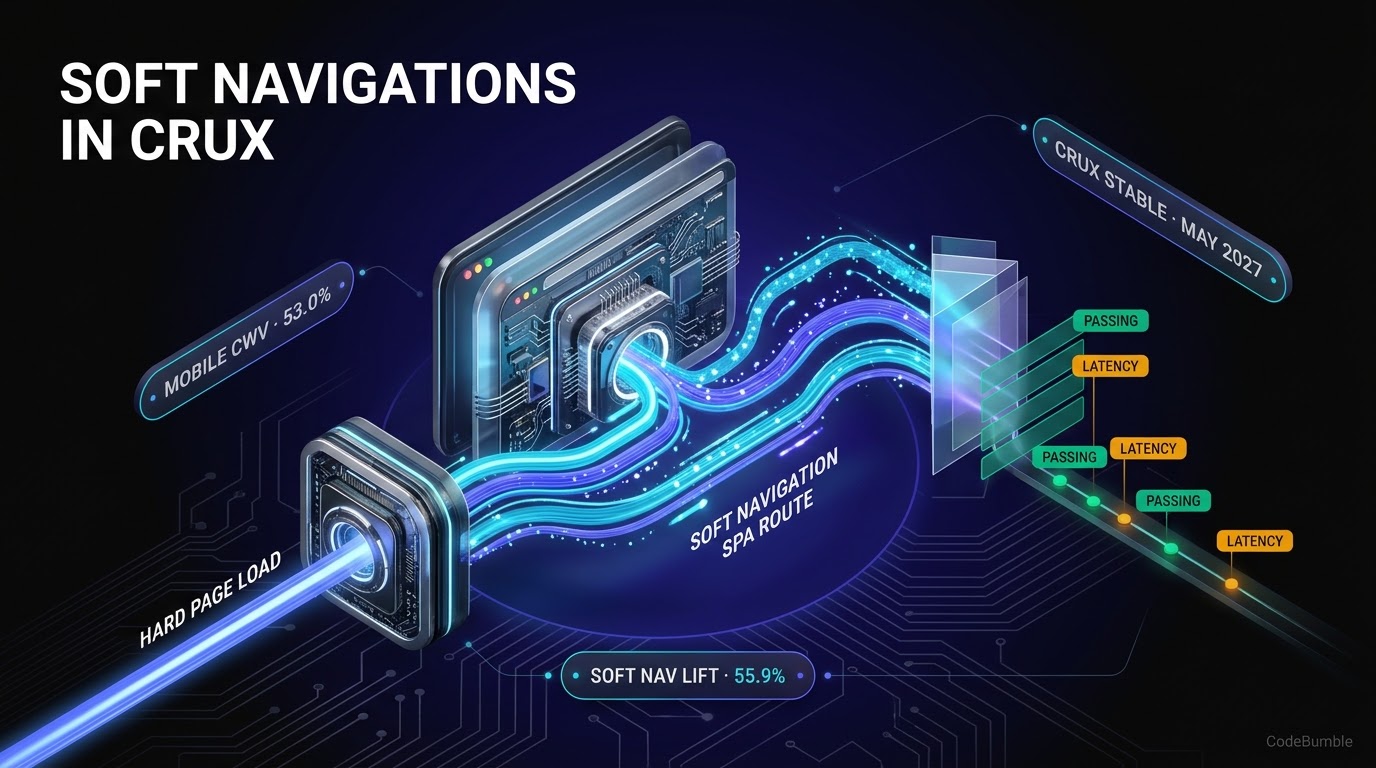
Single-Page Applications have long distorted Core Web Vitals field data by hiding route transitions inside a single hard page load. With Chrome 151 shipping Soft Navigations by default and October 2026 CrUX telemetry lifting mobile pass rates from 53.0% to 55.9%, this diagnostic guide explains the API, web-vitals v6 setup, and field-vs-lab traps.
9 min read
Soft Navigations in CrUX (2026): How Chrome 151 Measures SPA LCP, INP & CLS in the Field
Executive Summary
Single-Page Applications (SPAs) have historically distorted Core Web Vitals field telemetry because browsers only recognized the initial "hard" document load, leaving subsequent client-side route transitions unmeasured for Largest Contentful Paint (LCP) while accumulating Interaction to Next Paint (INP) and Cumulative Layout Shift (CLS) across an entire session. In this evergreen diagnostic and November 2026 telemetry deep dive, we examine how Chrome 151's default-enabled Soft Navigations API and Chrome UX Report (CrUX) experimental metrics reshape real-user measurement.
Key engineering takeaways verified against October–November 2026 documentation and HTTP Archive data:
- Field pass rates shift when SPAs are sliced: According to HTTP Archive Tech Report counts analyzed by Deploi (updated November 21–22, 2026), 53.0% of 8,294,416 assessed mobile origins and 61.1% of 5,374,299 desktop origins passed Core Web Vitals in October 2026. Counting soft navigations lifts the all-sites mobile pass rate from 53.0% to 55.9% (and from 76.5% to 77.2% on Shopify origins).
- Two new performance entries close the SPA gap: Chrome 151 enables
soft-navigationandinteraction-contentful-paintby default, allowing RUM scripts and CrUX to isolate per-route FCP, LCP, INP, and CLS—ending the initial hard-nav CLS and INP windows at the first soft navigation. - CrUX graduation timeline: Experimental soft-navigation Core Web Vitals launched in CrUX in October 2026 and are scheduled to graduate to stable CrUX metrics in May 2027, per Chrome for Developers CrUX release notes.
- Lab vs. field divergence widens: Synthetic Lighthouse runs only test the cold initial load. Teams that rely on lab scores miss multi-route INP degradation, stale
navigationIdattribution, and asynchronous fetch-to-paint latency on client-side navigations.
Under the Hood: Browser & Network Mechanics
In a Multi-Page Application (MPA), every link click triggers a full document navigation, resetting the browser's PerformanceNavigationTiming, LCP, INP, and CLS timelines. In an SPA, JavaScript intercepts the click, fetches data or swaps DOM nodes, and calls history.pushState() or the Navigation API. From the browser's traditional perspective, the document never navigated.
How Chrome 151 Defines and Emits a Soft Navigation
Per Chrome's Soft Navigations specification documentation (updated September 20, 2026), Chrome emits a PerformanceSoftNavigation (soft-navigation) entry only when three criteria are all satisfied:
- User initiation: The navigation is triggered by a trusted user interaction (such as a click or tap).
- Visible URL change: The URL changes visibly in the address bar.
- Visible paint: The interaction results in a visible contentful paint on screen.
Crucially, Chrome's InteractionContentfulPaint (interaction-contentful-paint) API propagates interaction causality across asynchronous tasks (fetch, await, setTimeout). Standard largest-contentful-paint stops emitting after the first user interaction, and PerformanceEventTiming (used for INP) stops at the very next animation frame (such as a spinner or button active state). interaction-contentful-paint bridges that gap by attributing asynchronous post-fetch DOM paints back to the initiating interactionId.
sequenceDiagram
    participant User
    participant Browser as Chrome 151 Engine
    participant App as SPA Router / Fetch
    participant RUM as PerformanceObserver / CrUX

    User->>Browser: Clicks route link (interactionId = 42)
    Browser->>App: Dispatches click handler (startTime recorded)
    App->>App: fetch('/api/product') + history.pushState()
    App->>Browser: Renders new product hero & text
    Browser->>RUM: Emits interaction-contentful-paint (interactionId = 42)
    Browser->>RUM: Emits soft-navigation (name = new URL, navigationId = 2)
    RUM->>RUM: Finalizes Hard Nav CLS & INP; seeds Route 2 LCP
Measuring Soft Navigations in Production (web-vitals v6 & Native APIs)
For most engineering teams, Google recommends web-vitals v6.0.0+ with { reportSoftNavs: true }, which handles URL attribution, startTime subtraction, and metric resets automatically:
import { onTTFB, onFCP, onLCP, onCLS, onINP } from 'web-vitals';

function sendToAnalytics(metric) {
  navigator.sendBeacon('/analytics', JSON.stringify({
    name: metric.name,
    value: metric.value,
    navigationType: metric.navigationType,
    navigationURL: metric.navigationURL,
  }));
}

// Traditional hard-navigation baseline (cross-browser)
onTTFB(sendToAnalytics);
onFCP(sendToAnalytics);
onLCP(sendToAnalytics);
onCLS(sendToAnalytics);
onINP(sendToAnalytics);

// Soft-navigation sliced metrics (Chrome/Edge 151+)
onTTFB(sendToAnalytics, { reportSoftNavs: true });
onFCP(sendToAnalytics, { reportSoftNavs: true });
onLCP(sendToAnalytics, { reportSoftNavs: true });
onCLS(sendToAnalytics, { reportSoftNavs: true });
onINP(sendToAnalytics, { reportSoftNavs: true });
If you instrument PerformanceObserver directly, Chrome's Modern Web Guidance (updated November 2, 2026) highlights three mandatory rules:
- Subtract
softNavEntry.startTime: AllPerformanceEntrytimestamps are relative to the initial hard document load, not the soft navigation. Soft-navigationstartTimebegins at the user interaction (including event handler execution), unlike hard navigations which start at commit time. - Match by
interactionId, nevernavigationId: If an SPA renders pixels before callinghistory.pushState(), earlyinteraction-contentful-paintentries carry the previousnavigationId. Always callsoftNavEntry.getLargestInteractionContentfulPaint()to seed LCP, then match subsequent entries viaicpEntry.interactionId === softNavEntry.interactionId. - Report TTFB as
0: Because soft-navigation content may already be cached, prefetched, or fetched via multiple API calls,web-vitalsreportsTTFB = 0for soft navigations (matching back/forward cache restores).
Field Telemetry & Benchmarks: CrUX vs. Lab
Real-user CrUX telemetry from October 2026 demonstrates both why field monitoring diverges from synthetic lab runs and how soft-navigation slicing changes origin-level pass rates.
October 2026 Global Core Web Vitals Pass Rates
Per Deploi's analysis of HTTP Archive Tech Report CrUX counts (data through October 2026, published November 21, 2026), 47.0% of assessed mobile origins still fail Core Web Vitals at the 75th percentile (p75):
| Metric / Slice (October 2026) | Mobile Passing (%) | Mobile Origins Assessed | Desktop Passing (%) | Desktop Origins Assessed |
|---|---|---|---|---|
| All Assessed Origins | 53.0% | 8,294,416 | 61.1% | 5,374,299 |
| Top 1k Popularity Tier | 54.0% | 735 | 65.6% | 575 |
| Top 10k Popularity Tier | 47.0% | 7,226 | 61.5% | 6,025 |
| Top 100k Popularity Tier | 43.3% | 71,020 | 60.8% | 60,194 |
| Top 1M Popularity Tier | 46.9% | 737,759 | 62.3% | 636,304 |
| January 2020 Baseline | 22.8% | 3,284,928 | 37.2% | 2,936,234 |
Note: In October 2026, 22.5% of all assessed mobile origins lacked sufficient INP samples and were evaluated on LCP and CLS alone; in the Top 1k–1M tiers, 0%–0.6% lacked INP, making those four tiers directly comparable.
Why Counting Soft Navigations Lifts Mobile Pass Rates
When CrUX's experimental soft-navigation methodology is applied to October 2026 data, the overall mobile pass rate rises from 53.0% to 55.9% (+2.9 percentage points across all sites), and Shopify storefronts rise from 76.5% to 77.2%. As CSS Wizardry's November 18, 2026 analysis notes, soft navigations lift CrUX pass rates for two structural reasons:
- Ending runaway hard-nav CLS and INP: Previously, a user browsing 10 SPA routes accumulated layout shifts and slow interactions from all 10 views into a single "hard navigation" bucket. Under the new CrUX model, hard-nav CLS and INP finalize as soon as the first soft navigation occurs, isolating each route's regressions.
- Faster repeat-view LCP: Soft navigations reuse already-loaded CSS, fonts, and JavaScript bundles. Only newly painted elements triggered by the interaction qualify for soft-navigation LCP—meaning persistent headers or hero banners from the prior view are excluded, often producing faster p75 LCP than cold hard loads.
Why Lighthouse 95 Still Fails CrUX in Production
A synthetic Lighthouse score of 95 only audits a single cold load under fixed CPU/network throttling. It cannot capture:
- Multi-route memory leaks and main-thread bloat that degrade INP on the third or fourth soft navigation.
- Unattributed async render delays when a client-side router triggers a slow API call before painting the next route's LCP element.
- Non-Chromium traffic variance: Because Firefox and Safari do not yet support
soft-navigationorinteraction-contentful-paint(as of Chrome 151's support matrix), CrUX only reflects opted-in Chrome users, while your own RUM must run dual methodologies to track Safari/iOS users.
Diagnostic & Optimization Playbook
1. Inspect Soft Navigations in Chrome DevTools
Starting in Chrome 145–152, Chrome DevTools surfaces soft navigations directly in the Performance panel:
- Trace View: Record a user journey clicking through 2–3 SPA routes. Look for
Soft Navigationmarkers on the Interactions/Timings track alongsideInteraction Contentful Paintevents. - Live Metrics View (Chrome 152+): Toggle local field-like metrics in the Performance panel's Live Metrics view to watch soft-navigation LCP, INP, and CLS reset per route transition in real time.
2. Audit Five Common Implementation Gotchas
- Do not use
performance.getEntriesByType('soft-navigation')in long-lived SPAs: Chrome caps the performance entry buffer at the first 50 soft navigation entries. Always use aPerformanceObserverwith{ type: 'soft-navigation', buffered: true }so routes beyond #50 are captured. - Finalize on
visibilitychange: Always flush the active soft navigation's LCP, INP, and CLS whendocument.visibilityState === 'hidden', otherwise the final route a user visits before closing the tab is dropped. - Beware persistent-element LCP shifts: If your SPA keeps a large banner image mounted across routes and only swaps text below it, soft-navigation LCP measures the new text block, whereas a deep-link hard load to that same URL measures the banner image. Segment RUM dashboards by
navigationType(navigatevs.soft-navigation) so you don't conflate the two. - Feature-detect before observing: Always guard with
PerformanceObserver.supportedEntryTypes?.includes('soft-navigation')(or'SoftNavigationEntry' in window) so Firefox and Safari do not throw errors, and keep standardlargest-contentful-paint,event, andlayout-shiftobservers active for cross-browser parity. - Avoid over-aggressive prefetching/prerendering: While Speculation Rules prefetching can reduce soft-navigation API wait times, prefetching unvisited routes on low-end mobile devices consumes memory and main-thread bandwidth, which can worsen INP on the current view.
FAQ
When do Soft Navigations become official Core Web Vitals in CrUX? Experimental soft-navigation Core Web Vitals launched in CrUX in October 2026. According to Chrome for Developers' CrUX release notes and Soft Navigations documentation, Google plans to graduate these metrics to stable CrUX metrics in May 2027.
Which browsers support the Soft Navigations API in late 2026?
As of September–November 2026 documentation, soft-navigation and interaction-contentful-paint are enabled by default in Chrome 151+ and Edge 151+, and are not yet supported in Firefox or Safari.
Why does web-vitals report TTFB as 0 for soft navigations?
In an SPA route change, there is no single initial HTML document request—data may be cached in memory, prefetched, or split across multiple API calls. Following the same convention used for back/forward cache (bfcache) restores, web-vitals v6.0.0+ reports TTFB = 0 for soft navigations.
Does enabling Soft Navigations change my initial hard-navigation LCP?
No. Standard largest-contentful-paint entries already finalize on the first user interaction. Since a soft navigation requires a user interaction to start, hard-navigation LCP remains unchanged; only hard-navigation CLS and INP stop accumulating at the first soft navigation.
Why shouldn't I match interaction-contentful-paint entries by navigationId?
If your SPA paints new DOM content before calling history.pushState() to update the URL, those interaction-contentful-paint entries are emitted with the previous navigationId. Always seed LCP via softNavEntry.getLargestInteractionContentfulPaint() and correlate follow-up entries by matching interactionId.
Sources
- Chrome for Developers — Measuring soft navigations by Barry Pollard & Michal Mocny (Last updated September 20, 2026 / October 20, 2026): https://developer.chrome.com/docs/web-platform/soft-navigations
- Chrome for Developers — Measure interaction and soft-navigation paint timing (Modern Web Guidance) (Last updated November 2, 2026): https://developer.chrome.com/docs/modern-web-guidance/guides/performance/interaction-paint-timing
- Chrome for Developers — Chrome UX Report (CrUX) Release Notes & Metrics Methodology (Updated October 13 & November 11, 2026): https://developer.chrome.com/docs/crux/release-notes and https://developer.chrome.com/docs/crux/methodology/metrics
- Deploi (HTTP Archive Tech Report Analysis) — What share of websites pass Core Web Vitals, and how has it changed since 2020? (Updated November 21–22, 2026): https://deploi.ca/shopify/data/share-of-websites-passing-core-web-vitals
- CSS Wizardry — Web-Perf Wednesday 018 – Soft Navigations Lift the CrUX Pass Rate by Harry Roberts (Published November 18, 2026): https://csswizardry.com/