

Web performance
Core Web Vitals in Late 2026: CrUX Soft Navigations, the INP Regression, and Field-First Debugging
A technical breakdown of Chrome's late-2026 CrUX soft navigation metrics, the year-over-year INP regression, why Lighthouse 100s still fail real users, and how to instrument interaction-contentful-paint and Chrome 155/156 DevTools.
12 min read
Core Web Vitals in Late 2026: CrUX Soft Navigations, the INP Regression, and Field-First Debugging
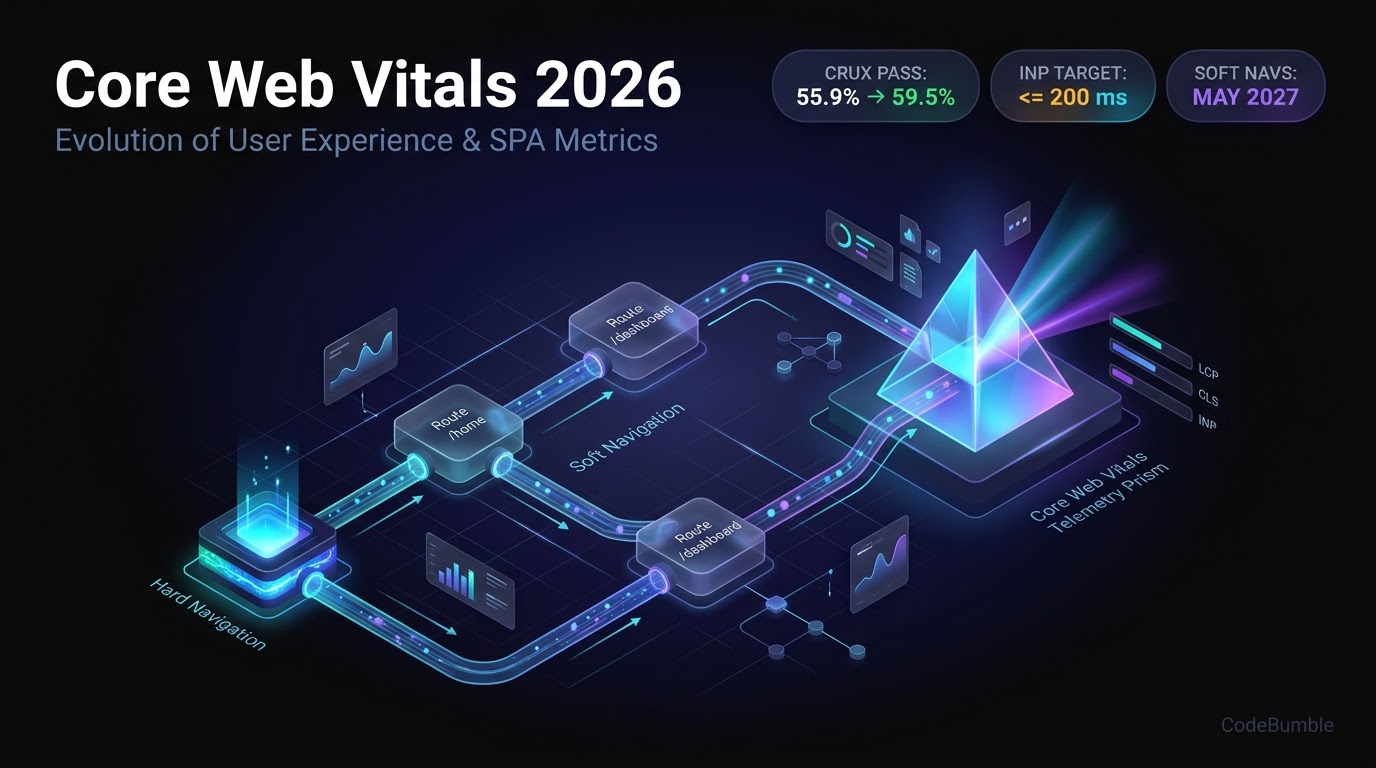
Executive Summary
- Soft navigations reshape SPA field telemetry: Chrome's September and October 2026 Chrome UX Report (CrUX) releases introduced experimental Core Web Vitals variants (
_with_softnavs) alongside First Contentful Paint (FCP) and Navigation Types for Single-Page Applications (SPAs). Including soft navigations lifts the October 2026 overall CrUX pass rate from 56.3% to 60.3% across 18,070,207 origins, with official Search Console graduation targeted for May 2027. - INP is the only Core Web Vital regressing in 2026: While Largest Contentful Paint (LCP) and Cumulative Layout Shift (CLS) improved year-over-year, the share of origins with good Interaction to Next Paint (INP ≤ 200 ms) dropped from 87.2% in March 2026 to 85.3% in August and 85.2% in October—a trend the Chrome team flagged as a "cause for concern" without a single definitive root cause.
- Lab scores still diverge from the 75th percentile (p75): A Lighthouse 95–100 score reflects one simulated load without real user clicks (substituting Total Blocking Time for INP), whereas CrUX evaluates the 75th percentile of opted-in Chrome visits over a rolling 28-day window, split separately by mobile and desktop.
- New browser and DevTools primitives close the observability gap: Developers can now correlate asynchronous SPA paints using
InteractionContentfulPaintandPerformanceSoftNavigation(orweb-vitalsv6.0.0+ with{ reportSoftNavs: true }) and diagnose memory retention and main-thread bottlenecks using Chrome 155/156 DevTools upgrades.
The Late-2026 Core Web Vitals Inflection Point
For years, engineering teams building Single-Page Applications (SPAs) faced a structural measurement blind spot in Google's Core Web Vitals program. When a user landed on an SPA, Chrome recorded a single "hard" navigation. Every subsequent client-side route transition—where JavaScript intercepted a link click, fetched JSON, swapped DOM subtrees, and updated the address bar via history.pushState()—remained invisible to CrUX as a separate navigation. Instead, all layout shifts and slow interactions across an entire 20-minute session were attributed back to that initial landing URL.
In October and November 2026, two major shifts collided in production telemetry. First, Chrome began publishing experimental soft-navigation Core Web Vitals in CrUX following the Soft Navigations API rollout in Chrome 151, as detailed in web.dev's October 13, 2026 announcement and the November 11, 2026 CrUX release notes. Second, despite steady gains in loading (LCP) and visual stability (CLS), real-world interactivity (INP) steadily eroded from spring through autumn 2026.
For frontend architects and site reliability teams, this means two things: your SPA's field metrics are about to become far more granular ahead of the May 2027 graduation, and main-thread JavaScript contention is once again the hardest bottleneck to keep green at the 75th percentile.
Under the Hood: How Chrome Measures Soft Navigations and Interaction Paints
Why Legacy Performance Entries Missed SPA Route Transitions
Standard browser performance primitives were designed around multi-page document lifecycles:
largest-contentful-paint(LCP): Stops emitting new candidates the moment the user first interacts with the page (click, tap, or key press). In an SPA, every route change is triggered by a user interaction, meaning standard LCP could never measure post-interaction route renders.event/PerformanceEventTiming(INP): Measures responsiveness from the hardware input timestamp through event handlers and layout/paint up to the very next frame (for example, rendering a button's active state or a loading spinner). It does not capture the asynchronous contentful paint that occurs 350 ms later whenfetch()resolves and the new view renders.- URL Mutation Listeners: Naive analytics scripts that listen to
popstateor monkey-patchhistory.pushStatefrequently over-report anchor-hash jumps, query-parameter filters, or multi-step redirects that users do not perceive as page navigations.
Causality Propagation via interactionId
To solve this without relying on framework-specific hooks, Chrome's interaction and soft-navigation paint timing architecture (updated November 2, 2026) propagates interaction causality across asynchronous tasks (fetch, await, setTimeout, and microtasks). Two new PerformanceEntry types work together:
InteractionContentfulPaint(interaction-contentful-paint): Emitted whenever a user interaction triggers progressively larger contentful paints. Each entry exposesinteractionId,startTime(interaction start),paintTime,presentationTime,duration(presentationTime - startTime), and alargestContentfulPaintsnapshot.PerformanceSoftNavigation(soft-navigation): Emitted only when a trusted user interaction causes both a visible URL change and a contentful paint. It carriesnavigationId,interactionId, the destination URL inname, andgetLargestInteractionContentfulPaint()to retrieve paints that happened before the URL updated.
sequenceDiagram
    participant User
    participant MainThread as Browser Main Thread
    participant AsyncNet as Async fetch() / Router
    participant PerfObs as PerformanceObserver

    User->>MainThread: Clicks SPA Route Link (interactionId: 42)
    MainThread->>PerfObs: event entry (INP measures to next frame)
    MainThread->>AsyncNet: Dispatches route data fetch (propagates interactionId: 42)
    AsyncNet-->>MainThread: Resolves JSON & renders DOM
    MainThread->>PerfObs: interaction-contentful-paint (interactionId: 42)
    MainThread->>MainThread: Calls history.pushState('/dashboard')
    MainThread->>PerfObs: soft-navigation (navigationId: 2, interactionId: 42)
    Note over PerfObs: Correlate via interactionId === 42 (not navigationId)
A subtle implementation trap highlighted in Chrome's guidance occurs when an SPA renders the new view before calling history.pushState(). In that sequence, the initial interaction-contentful-paint entry fires while the old navigationId is still active. Consequently, RUM scripts must seed the soft navigation's LCP candidate using softNavEntry.getLargestInteractionContentfulPaint() and correlate subsequent entries strictly by interactionId rather than navigationId.
Instrumenting Hard and Soft Navigations in Production
For most engineering teams, Chrome's Modern Web Guidance recommends using the web-vitals library (v6.0.0+) with { reportSoftNavs: true } rather than manually slicing metric timelines:
import { onLCP, onFCP, onCLS, onINP } from 'web-vitals';

function sendToAnalytics(metric) {
  navigator.sendBeacon(
    '/telemetry/cwv',
    JSON.stringify({
      name: metric.name,
      value: metric.value,
      rating: metric.rating,
      navigationType: metric.navigationType,
      navigationURL: metric.navigationURL,
    })
  );
}

// Emits metrics for the initial hard load plus each detected soft navigation
onLCP(sendToAnalytics, { reportSoftNavs: true });
onFCP(sendToAnalytics, { reportSoftNavs: true });
onCLS(sendToAnalytics, { reportSoftNavs: true });
onINP(sendToAnalytics, { reportSoftNavs: true });
If you maintain a custom RUM agent without web-vitals, always feature-detect PerformanceObserver.supportedEntryTypes?.includes('soft-navigation') and pass { buffered: true } so observers initialized asynchronously do not miss early entries. Avoid polling performance.getEntriesByType('soft-navigation') in long-lived sessions, as the browser buffer is capped at the first 50 soft navigation entries.
Field Telemetry & Benchmarks: 2026 CrUX Trends and Lab vs. Field Gaps
The 2026 CrUX Trajectory: LCP and CLS Climb While INP Slips
Examining the monthly CrUX release notes from March through October 2026 reveals a clear divergence between loading/stability and responsiveness:
| CrUX Dataset Month | Release Date | Total Origins | Good LCP (≤ 2.5 s) | Good CLS (≤ 0.1) | Good INP (≤ 200 ms) | Good All Three (CWV Pass) |
|---|---|---|---|---|---|---|
| March 2026 | Apr 14, 2026 | 18,257,384 | 69.0% | 81.2% | 87.2% | 56.5% |
| June 2026 | Jul 14, 2026 | 18,210,974 | 67.7% | 81.4% | 85.9% | 55.3% |
| August 2026 | Sep 8, 2026 | 18,294,881 | 68.1% | 81.5% | 85.3% | 55.6% |
| September 2026 | Oct 13, 2026 | 18,376,044 | 68.3% | 81.7% | 85.4% | 55.9% |
| October 2026 (Standard) | Nov 11, 2026 | 18,070,207 | 68.8% | 81.6% | 85.2% | 56.3% |
| October 2026 (+ Soft Navs) | Nov 11, 2026 | 18,070,207 | 73.6% (+7.0% vs. no soft navs) | 85.0% (+4.2%) | 87.0% (+2.1%) | 60.3% (+7.1%) |
(Note: In CrUX release notes, the delta percentages in the "+ Soft Navs" comparison reflect the change relative to the unadjusted baseline cohort where soft navigations are excluded.)
Two operational insights stand out from this telemetry:
- INP's 2.0-percentage-point slide since March 2026: Even though 85.2% of origins pass INP overall, it is the only Core Web Vital moving in the wrong direction in 2026. As Chrome's August 2026 release note explicitly stated, "The continued regression of INP in particular is a cause for concern, but we don't have a definitive reason for this." Increased client-side hydration weight, third-party consent/marketing tags, and main-thread contention on mid-tier Android devices remain the primary culprits on individual sites.
- LCP remains the decisive gatekeeper: At 68.8% good (standard) in October 2026, LCP still fails more origins than CLS (81.6%) or INP (85.2%). Because a URL or origin only passes Core Web Vitals when all three metrics hit "Good" at the 75th percentile, LCP dictates the overall 56.3% pass rate.
Who Actually Sees a Jump from Soft Navigations?
Across the entire web, roughly 66–75% of origins have fewer than 5% soft-navigation page views, and only 7.0% on Android and 10.6% on Desktop rely on soft navigations for more than half of their traffic (web.dev). However, among the top 1,000 websites, 35% on Android and 42% on Desktop exceed 50% soft navigations.
For those SPA-heavy sites, the metric shifts are dramatic:
- LCP: Origins with 75–100% soft navigations jump from 26% "Good" LCP to 87% "Good" LCP on Android because follow-up route transitions reuse already-cached JavaScript bundles and assets.
- INP: Android pass rates roughly double for mostly-soft-nav sites because interactions are evaluated per route view rather than taking the single slowest interaction across an entire multi-page session. Crucially, however, web.dev notes that SPA-heavy origins still trail traditional Multi-Page Applications (MPAs) in Good INP, proving that heavy JavaScript route transitions remain an interaction risk.
- CLS: Segmenting layout shifts per route brings SPA-heavy Desktop sites in line with MPAs and nearly matches them on Android.
Why Lighthouse 100 Still Fails Real Users
| Dimension | Core Web Vitals (CrUX Field Data) | Lighthouse Performance Score (Lab Data) |
|---|---|---|
| Measurement Source | Opted-in Chrome visitors on real devices & networks | One simulated page load on a fixed profile |
| Evaluation Window | Rolling 28 days, refreshed daily | Single run lasting a few seconds |
| Pass Criteria | 75th percentile (p75) of LCP ≤ 2.5 s, INP ≤ 200 ms, CLS ≤ 0.1 | Weighted 0–100 score (30% TBT, 25% LCP, 25% CLS, 10% FCP, 10% SI) |
| INP Coverage | Directly measured across real clicks, taps, and keys | Not measured; Total Blocking Time (TBT) acts as a proxy |
| Device Segmentation | Mobile and Desktop assessed independently | Single emulated device per run |
| Search Console / Ranking | Feeds Search Console CWV report & ranking signal | Diagnostic tool only; not used for ranking |
As documented in Evaluat's November 19, 2026 analysis and CoreWebVitals.io's November 4, 2026 guide, p75 means three out of four visits must meet the threshold. Optimizing the median or fastest 50% of visits does not move your p75 score—you must fix the slowest quarter, which is overwhelmingly dominated by mid-tier Android phones on variable cellular networks. Note also that while Safari 26.2 (released December 12, 2025) brought LCP and INP measurement support to all three major browser engines for your own RUM, CrUX itself remains strictly Chrome-user telemetry, and CLS remains Chromium-only.
Diagnostic & Optimization Playbook
1. Audit Field Data Before Touching Code
- Check CrUX Vis and PageSpeed Insights (Mobile Tab First): Google deprecated the legacy Looker Studio CrUX Dashboard in November 2025. Use CrUX Vis (which now plots
experimental_*_with_softnavsmetrics, FCP, and Navigation Types) and the top field-data panel of PageSpeed Insights. Always inspect Mobile before Desktop—a site can pass Desktop cleanly while failing Mobile p75. - Remember the 28-Day Roll-Off: CrUX data lags by roughly two days and aggregates a 28-day rolling window. Validate fixes immediately in the lab or via first-party RUM (
web-vitalsv6+), then allow 2–4 weeks for CrUX p75 to reflect the full improvement.
2. Leverage Chrome 155/156 DevTools Upgrades (November 2026)
Chrome 155 and 156 introduced several high-leverage debugging features detailed in New in DevTools - November 2026 (published October 20, 2026):
- Dead Context Field Detection in Memory: In the Memory panel, filter heap snapshots by
Objects retained by contextsto uncover unused closure variables kept alive by sibling long-lived closures in shared V8 execution contexts—a frequent cause of creeping SPA memory bloat and garbage-collection pauses that spike INP. - Early Hints (
103) Preload Warnings: The Network panel now warns when103 Early Hintspreload links are ignored whileDisable cacheis active, preventing false-negative preload debugging. - Preserved Performance Panel State & Smoother Minimap: Call tree and Bottom-up expanded nodes, selections, and scroll positions now persist across panel switches, while DevTools for agents supports a 1.2 GB default trace buffer with chunked parsing for heavy traces.
- CPU Performance Tier Overrides: Use the Sensors panel's
navigator.cpuPerformanceoverride to test adaptive JavaScript execution paths against constrained devices.
3. Targeted Fixes for Each Bottleneck
- LCP (≤ 2.5 s): Eliminate
loading="lazy"on above-the-fold hero images, move hero backgrounds out of render-blocking CSS into<img>tags withfetchpriority="high", and reduce TTFB by caching HTML documents at the CDN edge (avoidCache-Control: no-storewhere safe, which also unlocks back/forward cachebfcachewins). - INP (≤ 200 ms): Break up long tasks (> 50 ms) during route hydration and event callbacks using
scheduler.yield()orsetTimeoutchunking. Audit third-party tag managers and consent banners—avoid "delay all JS until first interaction" plugins, which dump initialization work directly onto the first click and tank INP. - CLS (≤ 0.1): Set explicit
widthandheightattributes (or CSSaspect-ratio) on all media, reserve fixed-height containers for dynamic ad slots and cookie banners, and pairfont-display: swapwith size-adjusted fallback font metrics (size-adjust,ascent-override) so font swaps do not trigger layout shifts.
Frequently Asked Questions
Why does my site score 98–100 in Lighthouse but fail Core Web Vitals in Search Console?
Lighthouse measures a single simulated page load on a fixed device and network profile and cannot measure INP because no real user clicks during the audit (it substitutes Total Blocking Time). Search Console uses CrUX field data collected over a rolling 28 days from real Chrome visitors at the 75th percentile—where slower Android CPUs, congested mobile networks, and interactive JavaScript handlers push real-user p75 past the thresholds.
When will CrUX Soft Navigations affect Google Search rankings and Search Console?
Chrome introduced experimental soft-navigation LCP, INP, and CLS metrics in the September 2026 CrUX dataset (published October 13, 2026) and expanded them with FCP and Navigation Types in the October 2026 release (published November 11, 2026). Chrome targets May 2027 to graduate these metrics from experimental to stable, at which point Google Search Console will switch to the new data.
Why has global INP been regressing in 2026 CrUX reports?
Between March 2026 (87.2% good) and October 2026 (85.2% good), global INP pass rates declined by 2.0 percentage points. The Chrome team noted in the August 2026 release notes that they do not yet have a definitive single explanation for the macro trend, though heavy client-side framework hydration, third-party script accumulation, and main-thread contention on mobile remain the primary site-level causes.
Should I use web-vitals v6+ or write a manual PerformanceObserver for soft navigations?
Use web-vitals (v6.0.0+) with { reportSoftNavs: true } for standard analytics reporting. Writing a custom PerformanceObserver for soft-navigation and interaction-contentful-paint requires manually seeding getLargestInteractionContentfulPaint(), correlating by interactionId rather than navigationId, and finalizing metrics on visibilitychange—all of which web-vitals handles out of the box.
Do Safari and Firefox users contribute to my CrUX Core Web Vitals scores?
No. Although Safari 26.2 (December 2025) added support for measuring LCP and INP—allowing your own first-party RUM tools to track both metrics across Chromium, Firefox, and Safari—Google's CrUX dataset is collected exclusively from eligible, opted-in Chrome users (excluding Chrome on iOS and Android WebViews). CLS measurement also remains Chromium-only.
Sources
- Chrome for Developers — Chrome UX Report (CrUX) Release Notes (Published November 11, 2026): https://developer.chrome.com/docs/crux/release-notes
- web.dev — Experimental soft navigation metrics now available in CrUX (Published October 13, 2026): https://web.dev/blog/crux-experimental-soft-navs
- Chrome for Developers — Measure interaction and soft-navigation paint timing (Published November 2, 2026): https://developer.chrome.com/docs/modern-web-guidance/guides/performance/interaction-paint-timing
- Chrome for Developers — New in DevTools - November 2026 (Published October 20, 2026): https://developer.chrome.com/blog/new-in-devtools-november-2026?hl=en
- Evaluat — What Are Core Web Vitals? LCP, INP and CLS (Published November 19, 2026): https://www.evaluat.com/blog/what-are-core-web-vitals
- CoreWebVitals.io — What Are the Core Web Vitals? LCP, INP & CLS Explained (2026) (Updated November 4, 2026): https://www.corewebvitals.io/core-web-vitals