

Web performance
PHP 8.6 Performance: How Io\Poll, Stateless Closure Caching, and TLS 1.3 0-RTT Reshape the Runtime
Scheduled for General Availability on November 19, 2026, PHP 8.6 introduces native epoll/kqueue multiplexing via the Io\Poll API, stateless closure caching, loop-compiled array_map() callbacks, and TLS 1.3 0-RTT stream support. Independent Beta 1 benchmarks show up to 10–16x lower CPU cost per 1,000 I/O events compared to select() and poll(), alongside 8–12.5% gains in callback and clamping hot paths. This engineering breakdown covers the architecture, benchmark caveats, WordPress 7.2 compatibility audit, and safe rollout steps.
7 min read
PHP 8.6 Performance: How Io\Poll, Stateless Closure Caching, and TLS 1.3 0-RTT Reshape the Runtime
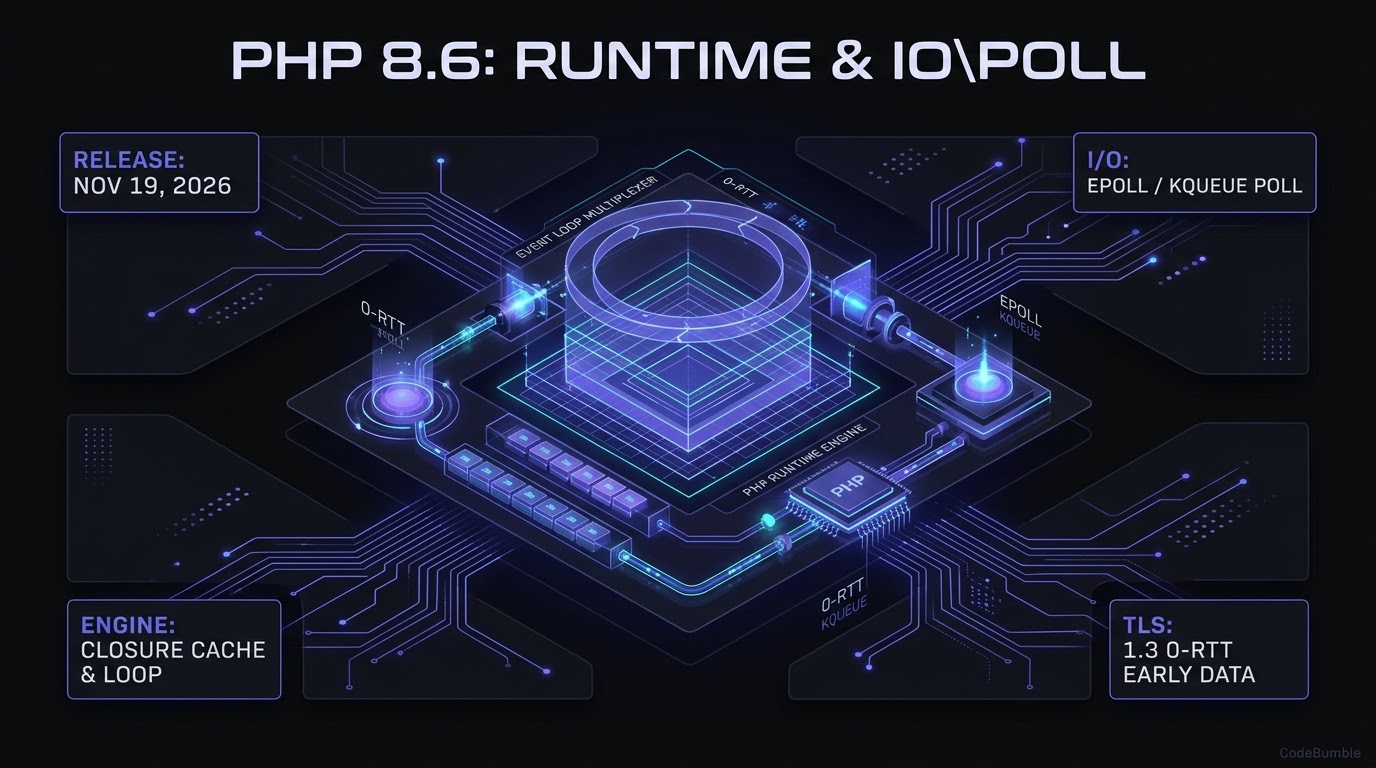
Executive Summary
Scheduled for release on November 19, 2026 (PHP 8.6 Release Announcement), PHP 8.6 introduces a targeted set of runtime, I/O, and compiler optimizations designed to remove long-standing concurrency and callback bottlenecks. The headline runtime addition is the native Io\Poll API, which exposes OS-level epoll (Linux), kqueue (BSD/macOS), event ports, and WSAPoll multiplexing directly to PHP—eliminating the classic stream_select() ceiling of roughly 1,024 file descriptors.
Beyond event-driven I/O, PHP 8.6 adds stateless closure caching and static closure inference, compiles array_map() with first-class callables or Partial Function Application (PFA) callbacks directly into internal loops, accelerates printf() and JSON encoding, and adds TLS 1.3 early data (0-RTT) and session resumption to PHP TLS streams. It also introduces Time\Duration with nanosecond precision for unambiguous timeout and benchmark instrumentation.
Confidence & Benchmark Caveat: High for all PHP 8.6 language features, API signatures, INI/session defaults, and deprecations (verified directly against php.net/releases/8.6/en.php, php.watch/versions/8.6, and the WordPress Developer Blog). Moderate for exact percentage speedups: the official PHP 8.6 release announcement does not publish an aggregate benchmark score; quantitative figures cited below come from independent PHP 8.6 Beta 1 testing by PHPBenchLab, and final GA (8.6.0) numbers may vary.
Technical Mechanics and Architecture
1. Breaking the stream_select() Ceiling with Io\Poll
In PHP 8.5 and earlier, pure-PHP event loops (such as those in ReactPHP, AMPHP, or custom socket servers) relied on stream_select(), which wraps POSIX select(). Because select() uses fixed-size FD_SET bitmasks (typically capped at 1,024 file descriptors) and scans every descriptor in $O(n)$ time on each iteration, high-concurrency workloads required C extensions like ext-event, ext-uv, or Swoole.
PHP 8.5 (stream_select / select()):
  [1,024+ Sockets] ──► O(n) Linear Scan Every Loop ──► Hard FD Cap (~1,024) + High CPU Wakeups

PHP 8.6 (Io\Poll):
  [100,000+ Sockets]
        │
        ▼  Kernel Event Notification (epoll / kqueue / event ports / WSAPoll)
┌─────────────────────────────────────────────────────────────────┐
│  Io\Poll\Context::wait()  ──► O(1) Ready-List Dispatch          │
│   ├── Sleeps cleanly when idle (minimal CPU burn)               │
│   └── Yields only active StreamPollHandle watchers              │
└─────────────────────────────────────────────────────────────────┘
With Io\Poll, the PHP process registers StreamPollHandle instances once and sleeps in Io\Poll\Context::wait() until the kernel notifies it of ready descriptors in $O(1)$ time relative to total connections.
2. Compiler & Engine Optimizations (Zero-Code-Change Gains)
Even synchronous request-response applications (such as WordPress, Laravel, and Symfony) benefit from four engine-level improvements documented in the PHP 8.6 Release Announcement and WordPress Developer Blog:
- Static Closure Inference: When a non-static closure does not reference
$this, the engine automatically treats it as a static closure, avoiding unnecessary object binding overhead. - Stateless Closure Caching: Stateless closures are cached across invocations rather than re-allocated on every call.
- Loop Compilation for
array_map():array_map()invoked with first-class callables or Partial Function Application (?/...) is compiled directly into an internal loop. - Faster
printf()and JSON Encoding: Reduced allocation and formatting overhead in hot serialization and template paths, plusTime\Durationfor nanosecond-accurate timing.
Safe Defensive Code: Io\Poll, Time\Duration, and clamp()
Below is a safe, production-oriented pattern demonstrating PHP 8.6's Io\Poll, Time\Duration, and clamp() without relying on legacy stream_select() or nested min(max()) calls:
<?php

declare(strict_types=1);

use Io\Poll\Context;
use Io\Poll\Event;
use Io\Poll\StreamPollHandle;
use Time\Duration;

// Clamp incoming concurrency limits safely between 10 and 10,000
$maxClients = clamp((int) ($_ENV['MAX_CLIENTS'] ?? 1000), 10, 10_000);

// Nanosecond-precision timeout using Time\Duration
$waitTimeout = clamp(
    Duration::fromMilliseconds(250),
    min: Duration::fromMilliseconds(50),
    max: Duration::fromSeconds(5),
);

$server = stream_socket_server('tcp://127.0.0.1:8080', $errno, $errstr);
if ($server === false) {
    throw new RuntimeException("Socket bind failed ($errno): $errstr");
}

$poll = new Context();
$poll->add(new StreamPollHandle($server), [Event::Read]);
Evidence: Benchmarks, Ecosystem Impact, and Migration Risks
Preliminary Beta 1 Benchmark Results (PHPBenchLab)
In independent testing on a 4 vCPU, 8 GB RAM Ubuntu 22.04 host running PHP 8.6 Beta 1 with OPcache and tracing JIT (128M buffer), PHPBenchLab measured the following median latencies across 10 runs:
| Feature / Benchmark | Baseline (PHP 8.5 / Legacy Pattern) | PHP 8.6 Result | Measured Delta |
|---|---|---|---|
Io\Poll vs. select() / poll() (10K simulated conns) |
select(): ~500 max, 48 ms CPU / 1K events; poll(): ~1,000 max, 32 ms |
Io\Poll (epoll): 100,000+ conns, 3 ms CPU / 1K events |
10–16x faster CPU per 1K events |
| Partial Function Application (PFA) (1M calls) | Closure wrapper: 68.4 ms |
PFA (? placeholder): 62.9 ms |
+8.0% faster |
Native clamp() (10M calls) |
min(max($x, 0), 100): 89.4 ms |
clamp($x, 0, 100): 78.2 ms |
+12.5% faster |
array_map() + First-Class Callable (1M elements) |
array_map(closure): 48.2 ms |
array_map(first-class): 43.5 ms |
+9.8% faster |
Important Caveat: As noted by both PHPBenchLab and Dibodev, I/O-bound web applications waiting on external databases or APIs typically see 0–3% aggregate gains from language micro-optimizations alone, whereas CPU-heavy loops, high-concurrency event loops, and callback-dense routing layers see the largest benefit.
Compatibility & Deprecation Audit (WordPress & Legacy Codebases)
According to the WordPress Developer Blog (November 18, 2026), PHP 8.6 introduces 26 deprecated functions, 39 INI directive changes, and 2 extension removals. Key compatibility traps to audit before upgrading include:
- Hardened Session Defaults:
session.use_strict_modeandsession.cookie_httponlyare now enabled by default, andsession.cookie_samesitedefaults toLax. Custom session handlers that do not implement bothcreate_sid()andvalidateId()are deprecated. - Oniguruma
mbstringRegex Deprecations:mb_ereg()andmb_split()are deprecated because the underlying Oniguruma library is unmaintained; migrate topreg_*with the/umodifier. - Legacy Alias & Hash Deprecations:
spl_object_hash()(8,772 matches across 2,359 WordPress plugins),is_long()(10,809 matches),is_integer()(2,720 matches), andis_double()(790 matches) are deprecated in favor ofspl_object_id(),is_int(), andis_float(). - Strict
ValueError& Stream Failures:fclose(),file_put_contents(), andcopy()now returnfalseon flush/close failures, andtrim()/ltrim()/rtrim()now strip form feed (\f) characters by default.
Hardening & Upgrade Playbook: Safe PHP 8.6 Rollout
Step 1: Audit Dependencies for PHP 8.6 Deprecations
Before switching production FPM pools, run static analysis across your codebase and vendor/ directory for deprecated functions and aliases:
# Scan application source (excluding vendor) for newly deprecated PHP 8.6 functions
grep -rnE "\b(mb_ereg|mb_split|spl_object_hash|is_double|is_long|is_integer|doubleval|strcoll|metaphone)\s*\(" src/ app/
Step 2: Test Session Handling and trim() Edge Cases in Staging
Because PHP 8.6 enables session.use_strict_mode=1, session.cookie_httponly=1, and session.cookie_samesite=Lax by default, verify that cross-site OAuth/SAML POST callbacks and JavaScript session readers still behave as expected in staging.
Step 3: Benchmark Your Actual Workload with opcache.jit
Do not rely on synthetic microbenchmarks. Replay representative production traffic in staging with PHP 8.5 vs. PHP 8.6, monitoring p95/p99 latency, FPM worker RSS memory, and OPcache hit rates:
# Verify OPcache and JIT configuration on the candidate PHP 8.6 binary
php -i | grep -E "opcache.enable|opcache.jit|session.use_strict_mode|session.cookie_samesite"
Step 4: Adopt Io\Poll and TLS 1.3 0-RTT Selectively
If you run long-lived PHP workers (ReactPHP, AMPHP, or Revolt), plan to adopt Io\Poll once framework adapters ship stable support. If enabling TLS 1.3 early data (0-RTT) on outbound TLS streams, restrict it strictly to idempotent requests (GET/HEAD) to avoid replay risks.
Step 5: Canary Rollout and Clean Rollback
Deploy PHP 8.6 to a single canary FPM pool or Kubernetes Deployment behind your load balancer while keeping PHP 8.4/8.5 pools warm. Watch PHP-FPM error logs for E_DEPRECATED log floods (which can degrade disk I/O if error_reporting logs deprecations in production) and ValueError exceptions. If regressions appear, drain traffic back to the PHP 8.5 pool immediately without touching database schemas.
Frequently Asked Questions (FAQs)
1. When is PHP 8.6 released and how long will it be supported?
PHP 8.6 is scheduled for General Availability on November 19, 2026 (following 8.6.0RC7 on November 12, 2026). Under PHP's four-year support policy (two years of bug fixes plus two years of security fixes), PHP 8.6 is expected to receive security updates through the end of 2030.
2. Does Io\Poll make PHP faster for standard WordPress or Laravel sites?
No. Io\Poll improves event-driven, long-lived socket servers (such as ReactPHP or AMPHP handling 10,000+ concurrent connections). Standard synchronous PHP-FPM apps benefit instead from stateless closure caching, static closure inference, faster printf()/JSON encoding, and array_map() loop compilation.
3. Is WordPress compatible with PHP 8.6 on day one? WordPress 7.2 RC1 is testing PHP 8.6 in its PHPUnit matrix (currently allowed to fail due to deprecation notices), and WordPress's compatibility chart stops at PHP 8.5 prior to GA. Test all themes and plugins in staging before upgrading live sites.
4. What are the biggest breaking changes to watch for when upgrading from PHP 8.5 to 8.6?
The most subtle runtime changes are the new secure session defaults (session.use_strict_mode, session.cookie_httponly, session.cookie_samesite=Lax), trim() stripping \f by default, ValueError being thrown for invalid flags/NUL bytes, and deprecations for mb_ereg() and spl_object_hash().
5. Should I upgrade from PHP 8.2 directly to PHP 8.6? PHP 8.2 reaches end of security support on December 31, 2026. If your codebase or CMS plugins are not yet verified on PHP 8.6, upgrading first to PHP 8.4 or 8.5 provides immediate security coverage with fewer migration surprises while you prepare for 8.6.
Sources
- The PHP Group (Primary): PHP 8.6 Release Announcement (Published November 19, 2026)
- WordPress Developer Blog (Primary Ecosystem Analysis): What's new in PHP 8.6 and what that means for WordPress? (Published November 18, 2026)
- PHP.Watch (Changelog & Release Tracking): PHP 8.6: What's New and Changed (Checked November 19, 2026)
- PHPBenchLab (Independent Beta 1 Benchmarks): PHP 8.6 New Features — Deep Dive with Benchmarks (2026) (Published August 16, 2026)
- Dibodev (Support Lifecycle & Compatibility Context): PHP 8.6: Release Date, New Features & Update Guide (Published November 15, 2026)