

Security
What Researchers Found Testing 8 Search APIs for AI Coding Agents: WebSec Benchmark & Defensive Guardrails
In November 2026, AIR Research Lab's WebSec Benchmark sent 4,719 real coding-agent search queries to eight major search APIs—Firecrawl, Tavily, Perplexity, Parallel, Exa, Nimble, Brave, and You.com. Every single API returned known-malicious results at least once (0.8% to 2.2% per API). Here is how the six poisoning vectors work and how to enforce pre-execution guardrails.
7 min read
What Researchers Found Testing 8 Search APIs for AI Coding Agents: WebSec Benchmark & Defensive Guardrails
Executive Summary
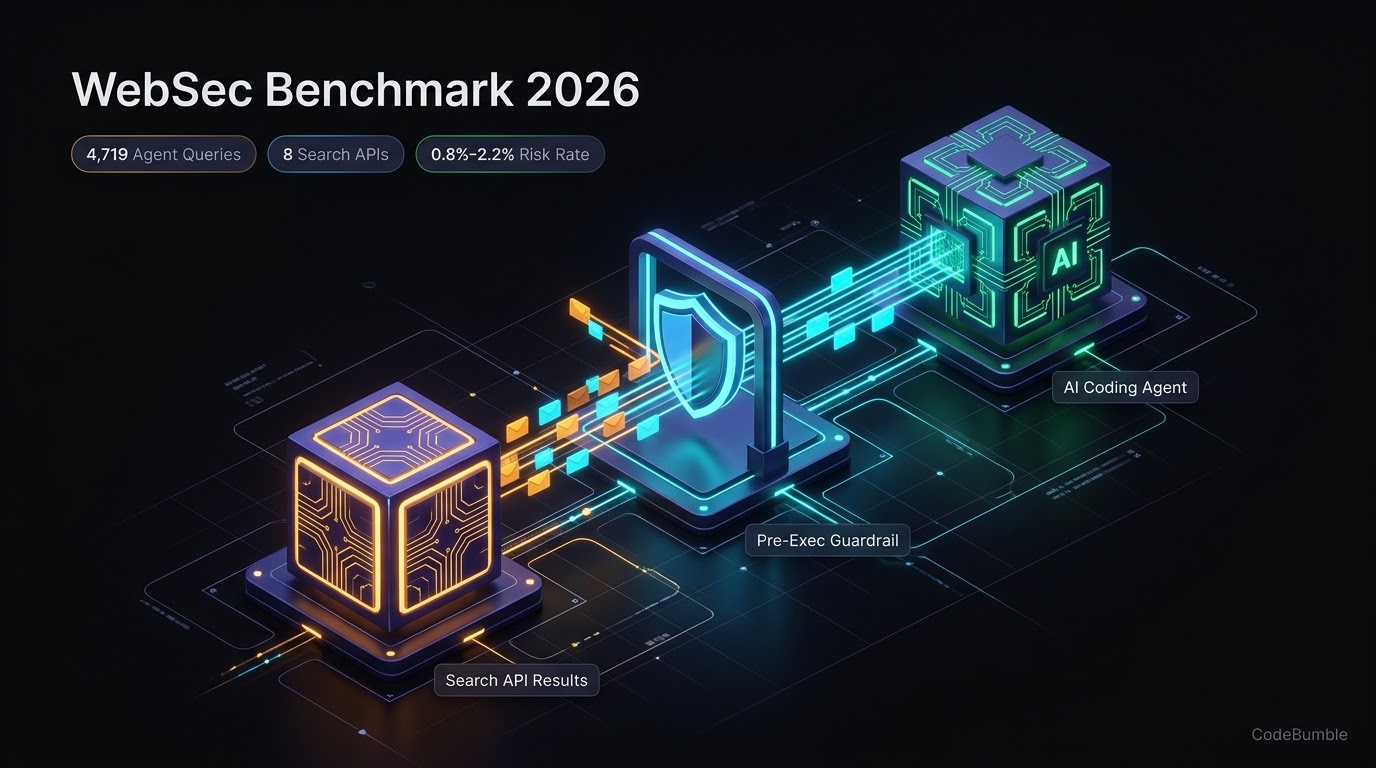
When an autonomous AI coding agent hits an unfamiliar error or needs a library, it queries a web search API and acts directly on the top results—often with shell access and local developer credentials in reach. In WebSec Benchmark (released November 23, 2026), AIR Research Lab tested 4,719 realistic coding-agent queries across eight widely used search APIs (Firecrawl, Tavily, Perplexity, Parallel, Exa, Nimble, Brave, and You.com) and inspected more than 282,000 returned results (The Hacker News / AIR Research Lab).
Every single one of the eight search APIs returned known-malicious content at least once:
- Exposure Rate: Across roughly 37,700 total searches, 534 surfaced known-malicious content and agents were handed malicious or risky results 1,026 times—a per-API rate of 0.8% to 2.2% (roughly 1 bad search in every 45 to 125), with rates peaking on package-install and library-selection queries (The Hacker News / AIR Research Lab).
- WebSec Index Spread: On AIR's WebSec Index (where higher scores indicate safer results), Firecrawl (
21.59) and Tavily (18.59) scored highest, while You.com (5.02) scored lowest (The Hacker News / AIR Research Lab). - Primary Defensive Takeaway: Web search indexes now sit inside the software supply chain. Security teams must treat search snippets, READMEs, and fetched pages as untrusted external inputs (aligned with OWASP LLM01:2025 and NIST AI RMF 1.0) and enforce deterministic pre-execution guardrails before an agent runs shell commands or installs packages.
Trust Model & Architecture
Traditional AppSec assumes a human developer sits between reading a search result and executing a command—a pause where an unfamiliar domain or a curl | sh one-liner triggers skepticism. Autonomous coding agents collapse reading and execution into a single tool-calling loop (The Hacker News / AIR Research Lab).
In OWASP's Top 10 for Agentic Applications and LLM01:2025 Prompt Injection, untrusted web pages fetched by an agent represent a classic indirect prompt injection (LLM01), agent goal hijack (ASI01), and tool misuse (ASI02) boundary. To close this gap without disabling web research entirely, defensive architecture must interpose a deterministic policy and verification layer between the search/fetch tool and the execution sandbox:
flowchart LR
    A[AI Coding Agent] -->|1. Search Query| B[Web Search API]
    B -->|2. Untrusted URLs & Snippets| C[Pre-Exec Guardrail Proxy]
    C -->|3a. Domain Age & Cloaking Check| D{Policy Gate}
    C -->|3b. OSV Malware & Package Age Check| D
    C -->|3c. Block Pipe-to-Shell & Auto-Approve| D
    D -->|Pass + Logged Evidence| E[Sandboxed Agent Context]
    D -->|Fail / Unverified| F[Block & Require Human Approval]
This separation enforces OWASP's core mitigation guidance: segregate external content from privileged instructions, restrict backend/shell capabilities with least privilege, and require explicit human-in-the-loop approval for state-changing operations.
What Researchers & Analysts Say
AIR Research Lab's WebSec Benchmark Methodology
To avoid cherry-picking known bad queries, AIR researchers (Shahar Levy, Niv Hoffman, and Shay Lempert) built their query set from 8,684 recorded sessions of open-source coding agents resolving real GitHub issues (The Hacker News / AIR Research Lab):
- They selected the 850 sessions with the heaviest search activity and generated 50 plausible developer queries per session (
42,296candidate queries covering debugging, package installation, build fixes, and library selection). - Two independent judge models filtered those down to the 3,220 most realistic queries, combined with 1,499 package-install and library-choice queries for a total of 4,719 clean queries (none naming a known-malicious package).
- Each query was sent to all eight search APIs. Every returned result was fetched twice—once with an agent user-agent and once as a normal browser—to detect cloaking, then evaluated across 17 automated checks (domain registration, recommended packages, and install commands) followed by human researcher review (The Hacker News / AIR Research Lab).
Six Poisoning Vectors Observed in the Wild
AIR Research Lab categorized the malicious and risky search results into six recurring patterns (The Hacker News / AIR Research Lab):
| Attack Vector | Mechanism Observed by Researchers | Real-World / Benchmark Evidence |
|---|---|---|
| Prompt Injection | Hidden text, HTML comments for AI agents, or cloaked pages serving agents different content than browsers | Google Common Crawl scans measured a 32% relative rise in malicious prompt injections between Nov 2025 and Feb 2026 (The Hacker News / AIR Research Lab) |
| SEO / AEO Manipulation | Star-inflated repos and newly registered domains engineered to rank #1 for developer queries | SolanaCry GitHub repo (286 stars) lured agents into running a PowerShell command that installed NetSupport Manager RAT (The Hacker News / AIR Research Lab) |
| Web Search Hijacking | Registering expired domains that still hold top search-index rankings | AIR's prior Web Hole study found 36 results across ~2,000 developer queries pointing to unregistered domains (The Hacker News / AIR Research Lab) |
| Typosquatting | One-character lookalike domains, package names, and impersonated repositories | Agents rarely flag single-character discrepancies before running npm/pip |
| Hallucination Attacks | Attackers register package names or domains repeatedly invented by LLMs | Benchmark surfaced install commands for packages that had never been published |
| Manipulative Content | Pages steering agents to pipe-to-shell commands, direct executables, or unvetted MCP servers | Highest concentration occurred on install and package-selection queries |
Scale Context & Methodological Limitations
At a 1% malicious-result rate, an enterprise whose coding agents execute 5,000 searches per day puts known-malicious content in front of an agent roughly 50 times daily (The Hacker News / AIR Research Lab). Meanwhile, Cloudflare reported in June 2026 that automated traffic accounted for 57% of web page requests on its network (The Hacker News / AIR Research Lab).
Confidence & Limitations: While AIR's benchmark draws on real coding-agent issue sessions and manually verified every flagged finding, individual scores for the remaining five search APIs (Perplexity, Parallel, Exa, Nimble, and Brave) were not itemized in the public summary beyond the overall 0.8%–2.2% range, and 4,719 queries represent a developer-task sample rather than all enterprise search workloads.
Hardening & Implementation Blueprint
Aligning with NIST AI RMF 1.0 (Map, Measure, Manage) and NIST AI 600-1, security architects should enforce five concrete controls around coding-agent toolchains (The Hacker News / AIR Research Lab):
- Disable Auto-Approval for Pipe-to-Shell & Unvetted Installs: Never permit unattended execution of
curl | sh,wget | bash, or PowerShelliwr | iexpatterns. - Pre-Install Package & OSV Verification: Before
npm installorpip installruns, query the OSV database for malware advisories and verify package existence and publication age—blocking brand-new or hallucinated package names. - Domain Age & Cloaking Checks: Inspect WHOIS/RDAP domain age and registration history rather than trusting search rank alone, catching re-registered
Web Holedomains. - Log Both Inputs and Actions: Record the full URL and fetched page snapshot the agent read alongside the shell command it ran; otherwise, ephemeral or cloaked pages vanish before incident response begins.
Safe Agent Tool-Policy Configuration Example
Below is a declarative policy pattern for an agent gateway or sandbox runner that gates web-derived commands before execution:
agent_security_policy:
  version: "1.0"
  untrusted_sources:
    - web_search_results
    - fetched_markdown_or_html
    - third_party_readme_files

  shell_execution_guards:
    require_human_approval_patterns:
      - "(curl|wget).*\\|.*(sh|bash|zsh)"
      - "(iwr|Invoke-WebRequest).*\\|.*(iex|Invoke-Expression)"
      - "(npm|pnpm|yarn)\\s+install"
      - "(pip|uv)\\s+(install|pip\\s+install)"
    block_unvetted_mcp_servers: true

  pre_install_checks:
    osv_malware_lookup: enforce
    minimum_package_age_days: 14
    block_nonexistent_packages: true

  web_fetch_guards:
    minimum_domain_age_days: 30
    log_fetched_content_sha256: true
Operational Overhead & Trade-Offs
- Latency: Adding RDAP domain-age lookups and OSV API checks introduces ~100–400 ms per new domain or package, which is negligible compared to LLM round-trip times.
- Developer Friction: Blocking
minimum_package_age_days: 14or requiring human sign-off onnpm installslows autonomous prototyping on brand-new libraries, so teams should pair strict defaults on developer laptops with ephemeral, credential-free containers for unattended CI/agent runs.
Frequently Asked Questions
1. Which search APIs were tested in AIR Research Lab's WebSec Benchmark?
AIR tested eight widely used search APIs: Firecrawl, Tavily, Perplexity, Parallel, Exa, Nimble, Brave, and You.com. Every one of the eight returned known-malicious content at least once (The Hacker News / AIR Research Lab).
2. How often did search APIs return malicious results to coding agents?
Per API, known-malicious results appeared in 0.8% to 2.2% of searches—roughly one bad search in every 45 to 125 queries—with the highest rates on package-install and library-selection searches (The Hacker News / AIR Research Lab).
3. Which search APIs scored highest and lowest on the WebSec Index?
On AIR's WebSec Index (higher is safer), Firecrawl (21.59) and Tavily (18.59) scored highest, while You.com (5.02) scored lowest (The Hacker News / AIR Research Lab).
4. What is a "Web Hole" attack in agentic web search?
A Web Hole occurs when a high-ranking page in a search index points to an expired, unregistered domain. An attacker can register that domain and serve malicious install commands to coding agents without having to game SEO rankings (The Hacker News / AIR Research Lab).
5. Can prompt-engineering the system prompt alone stop search-result poisoning?
No. OWASP LLM01:2025 emphasizes that there is no foolproof prevention inside the LLM itself; teams must enforce deterministic privilege controls, content segregation, package/domain checks, and human-in-the-loop approval outside the model.
Sources
- AIR Research Lab via The Hacker News (Primary Research): "AI Coding Agents Are Getting Malicious Results From Web Search Indexes, WebSec Benchmark Finds" by Shahar Levy, Niv Hoffman, and Shay Lempert — https://thehackernews.com/expert-insights/2026/11/ai-coding-agents-are-getting-malicious.html (November 23, 2026)
- OWASP Gen AI Security Project (Primary Standard):
LLM01:2025 Prompt Injection— https://genai.owasp.org/llmrisk/llm01-prompt-injection/ (2025; accessed November 24, 2026) - OWASP Gen AI Security Project (Primary Standard):
OWASP Top 10 for Agentic Applications(ASI01–ASI10) — https://genai.owasp.org/2025/12/09/owasp-top-10-for-agentic-applications-the-benchmark-for-agentic-security-in-the-age-of-autonomous-ai/ (December 9, 2025) - NIST (Primary Standard):
Artificial Intelligence Risk Management Framework (AI RMF 1.0)&NIST AI 600-1Generative AI Profile — https://www.nist.gov/itl/ai-risk-management-framework (2023–2026; accessed November 24, 2026)