

Engineering
AMD openSIL Quietly Replaces AGESA on Every 6th Gen EPYC "Venice" Server
AMD confirmed that every 6th Gen EPYC 9006 "Venice" platform boots with openSIL rather than legacy AGESA, with Venice open-source code slated for release roughly one quarter post-launch. Explore the three-library C-2020 architecture (xSIM, xPRF, xUSL), GUIDed HOB memory handoff, and OpenBMC integration.
8 min read
AMD openSIL Quietly Replaces AGESA on Every 6th Gen EPYC "Venice" Server
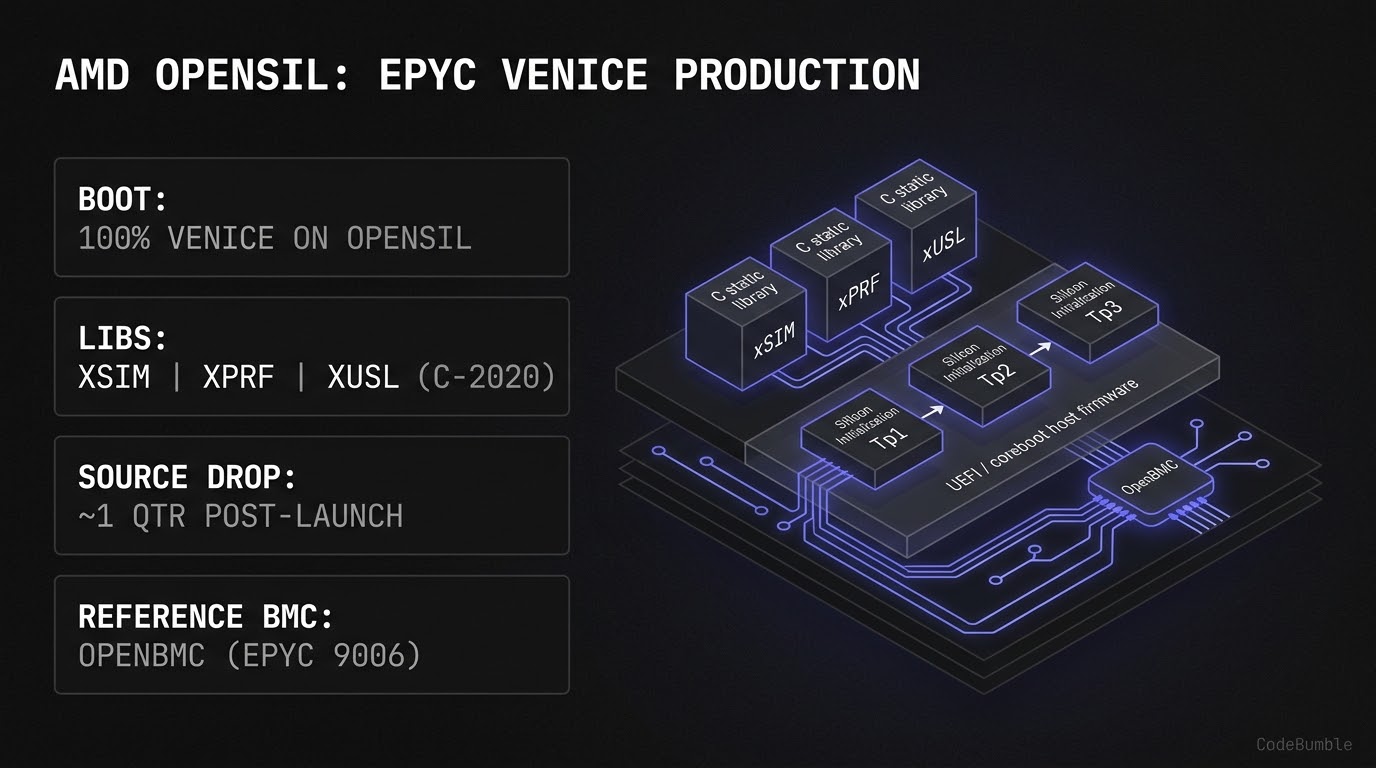
Executive Summary
With the launch of AMD's 6th Gen EPYC 9006 ("Venice") SP7 server processors in November 2026, AMD achieved a multi-year firmware engineering milestone: openSIL (Open-Source Silicon Initialization Library) has transitioned from proof-of-concept evaluation to production silicon initialization (Phoronix). Following up on the EPYC 9006 announcements—which omitted explicit openSIL slides—AMD confirmed to Phoronix on November 13, 2026 that "no Venice platform has booted anything without openSIL" (Phoronix).
AMD also reaffirmed its staggered open-source release policy: Venice openSIL source code will be published roughly one quarter (~3 months) after the official product launch, matching the roadmap laid out at the OCP Global Summit (Phoronix, TechPowerUp). Alongside openSIL, AMD's EPYC 9006 reference boards continue to run OpenBMC rather than proprietary baseboard management controller stacks. For hyperscalers, cloud providers, and firmware security engineers, this shift replaces monolithic, UEFI-coupled AGESA binaries with a minimal, auditable, host-firmware-agnostic set of C-2020 static libraries (xSIM, xPRF, xUSL) capable of powering UEFI, coreboot, oreboot, or LinuxBoot (AMD openSIL Blog, GitHub openSIL).
Confidence Level: High for AMD's Venice boot confirmation, one-quarter post-launch source schedule, OpenBMC reference usage, and the xSIM/xPRF/xUSL architecture (verified directly against Phoronix's November 13, 2026 AMD confirmation, AMD's official openSIL engineering blog, and AMD's openSIL GitHub repositories). Note that Venice openSIL source files are not yet public on GitHub as of November 15, 2026, and Coreboot-based EPYC 9006 server availability depends on OEM and community porting once those sources drop.
Architectural Context: Why AGESA Needed Replacement
For over a decade, AMD Generic Encapsulated Software Architecture (AGESA) coupled silicon initialization tightly to UEFI host firmware protocols. As AMD's firmware engineering team documented when introducing openSIL, that coupling made it difficult for hyperscalers and security-focused hardware vendors to adopt lighter host firmware stacks such as coreboot, oreboot, FortiBIOS, or Project µ, and complicated Software Bill of Materials (SBOM) traceability and independent security auditing (AMD openSIL Blog).
By decoupling silicon initialization from UEFI protocols and compiling it as host-agnostic static C libraries, openSIL aims to deliver:
- Reduced Attack Surface: Eliminating unnecessary UEFI DXE/PEI protocol plumbing from silicon initialization shrinks the Trusted Computing Base (TCB).
- Portability Across Host Firmware: The same
xSIM/xPRF/xUSLlibraries link into AMI/EDK II UEFI (opensil-uefi-interface) or coreboot/Dasharo without rewriting silicon init logic (GitHub opensil-uefi-interface, Phoronix). - Auditability & SBOM Traceability: Open-source static libraries enable static analysis, fuzzing, and deterministic SBOM tracking across enterprise server fleets (AMD openSIL Blog).
Technical Mechanics & Architecture
1. The Three-Library Static Architecture (xSIM, xPRF, xUSL)
The openSIL codebase (written in C-2020, built with Meson and Kconfiglib, and supporting GCC, LLVM/Clang, and MSVC) is partitioned into three distinct static libraries (GitHub openSIL, AMD openSIL Blog):
AMD openSIL Host-Firmware Integration Flow:
  [Embedded uControllers] ──(Pre-x86 Reset: DRAM JEDEC & Memory Training)──> [Memory Ready]
                                                                                  │
  [Host Firmware: UEFI / coreboot / LinuxBoot]                                    ▼
     │  1. Allocates contiguous GUIDed HOB (IP Block Data)
     ├──> Calls InitializeAMDSiTp1()  [Pre-PCIe Scan Silicon Init]
     ├──> Host performs PCIe Enumeration
     ├──> Calls InitializeAMDSiTp2()  [Post-PCIe Scan Silicon Init]
     ├──> Calls xPRF Services (xPrfCollectDimmMap, xPrfCreateSratApicEntry, GPIO/SMM)
     └──> Calls InitializeAMDSiTp3()  [Final SoC Init prior to OS Bootloader]
xSIM(x86 Silicon Initialization Modules): Exposes platform-agnostic APIs (InitializeAMDSiTp1,InitializeAMDSiTp2,InitializeAMDSiTp3) to initialize SoC IP blocks across three boot time points. Because AMD's embedded microcontrollers already handle DRAM JEDEC initialization and memory interface training before x86 reset de-assertion, system memory is already available whenxSIMexecutes (AMD openSIL Blog).xPRF(x86 Platform Reference Firmware): Handles board- and platform-specific initialization (such as GPIO programming and RAS/SMM handlers) and exposes helper APIs likexPrfCollectDimmMap,xPrfCollectCpuMap,xPrfCreateSratApicEntry,xPrfGetNbiotopologyStructure, andxPrfGetSystemMemoryMapfor ACPI table generation (AMD openSIL Blog). OEMs customizexPRFfor board deviations while leavingxSIMuntouched.xUSL(x86 Utilities & Services Library): Internal utility layer exclusively consumed byxSIMandxPRF, never exposed directly to the host firmware.
2. Memory Handoff & UEFI Integration (opensil-uefi-interface)
When integrated into a UEFI/EDK II stack via opensil-uefi-interface (AmdOpenSilPkg), the host firmware allocates a single contiguous block of memory using a GUIDed Hand-Off Block (HOB) containing openSIL IP block data populated prior to Time Point 1 (Tp1). If the host relocates that HOB across PEI/DXE phases, it must pass the updated base address to each subsequent openSIL time point (Tp2, Tp3) (GitHub opensil-uefi-interface). Inside AmdOpenSilPkg, the AmdOpenSilPkg.dec declaration file and accompanying INF files expose xSIM, xPRF, and xUSL to the target DSC file, while the SilToUefi folder houses PEI modules that invoke openSIL silicon initialization tasks. This modular interface is what enabled AMD to advance from Phase I–III evaluation POCs on Genoa and Turin to Phase IV production UEFI integration trending in 2026 (GitHub openSIL, GitHub opensil-uefi-interface).
3. Build Toolchain, IP Governance & Industry Ecosystem
Unlike legacy binary-distributed AGESA drops, openSIL is engineered to integrate with standard open-source build pipelines. The reference repository relies on Meson and Python-based Kconfiglib to produce 32-bit or 64-bit static libraries (xSIM, xPRF, xUSL, or a combined openSIL target), supporting GCC (v10.2.0+), LLVM/Clang (v10.0+), and MSVC (v19.00+) (GitHub openSIL). This allows firmware teams to compile silicon initialization with the exact same compiler toolchains, sanitizers, and static analyzers used for host firmware.
At the same time, AMD balances open-source transparency with silicon intellectual property (IP) protection. As Chief Firmware Architect Raj Kapoor outlined at the Open Compute Project (OCP) Global Summit, AMD keeps platform-specific sources under NDA until product launch and publishes open-source platform code roughly one quarter after shipping (TechPowerUp). Public pull requests are accepted, though maintainers review contributions to prevent exposing sensitive microarchitectural IP.
The initiative has been developed in close collaboration with industry partners across hyperscale cloud, enterprise OEMs, and open-source firmware vendors—including 9elements, AMI, AWS, 3mdeb, Datacom, Google, Meta, and Oxide—all targeting faster platform bring-up, smaller TCBs, and auditable server boot chains (AMD openSIL Blog).
Evidence, Roadmap & Production Milestones
The table below tracks openSIL's progression from 2023 proof-of-concept to 2026 production on 6th Gen EPYC "Venice" (GitHub openSIL, Phoronix, TechPowerUp):
| Milestone / Platform | Architecture / Generation | Status as of Nov 2026 | Key Engineering Details |
|---|---|---|---|
| Phase II–III POCs | 4th Gen EPYC (Genoa, Onyx CRB) & Turin POC | Complete (Public GitHub) | Meson/Kconfig C-2020 static libs (xSIM, xPRF, xUSL); UEFI AmdOpenSilPkg |
| Zen 5 Community Ports | Ryzen & EPYC 9005 (Turin) | POC / Community | Coreboot-based Dasharo ports by 3mdeb on MSI Ryzen & Gigabyte EPYC boards |
| openSIL Spec 1.0 & Phoenix | Client SoC ("Phoenix") & Architecture Spec | Published (Oct 2025) | Standardized 3-library interface & host-firmware agnosticism |
| Phase IV Production (Venice) | 6th Gen EPYC 9006 ("Venice", Zen 6, SP7) | Production (Shipping) | All Venice platforms boot with openSIL; OpenBMC on reference boards; code drop ~1 Qtr post-launch |
| Zen 6 Client ("Medusa") | Ryzen ("Medusa", Zen 6) | Planned H1 2027 | Slated for H1 2027 openSIL target per AMD's OCP roadmap |
Benchmark Availability Note: AMD has not published boot-time latency deltas comparing AGESA vs. openSIL on 6th Gen EPYC 9006 ("Venice") as of November 15, 2026. While Phoronix has published compute benchmarks for EPYC 9686F and 9996, isolated firmware-initialization timing benchmarks are unavailable.
Firmware Engineering & Verification Playbook
Systems engineers, platform OEMs, and security teams preparing to audit or integrate AMD openSIL on EPYC server platforms can follow these safe, read-only verification and build steps:
Step 1: Clone & Inspect the Reference openSIL Build Tree (Read-Only)
Before Venice sources land (~1 quarter post-launch), teams can inspect the public openSIL static library layout, Kconfig options, and Meson targets using the reference repository:
# Clone the official AMD openSIL reference repository and inspect library layout
git clone https://github.com/openSIL/openSIL.git
cd openSIL
ls -la xSIM xPRF xUSL
Step 2: Verify UEFI Integration & HOB Relocation Contracts
For OEMs migrating from legacy AGESA to AmdOpenSilPkg in EDK II, audit the SilToUefi PEI modules to confirm that the GUIDed HOB base address is preserved across memory relocation before InitializeAMDSiTp1, Tp2, and Tp3 calls (GitHub opensil-uefi-interface):
// Conceptual defensive check for openSIL HOB base alignment before Time Point calls
#include <stdint.h>
#include <stdbool.h>

bool validate_opensil_hob_pointer(uintptr_t hob_base, size_t hob_size) {
    if (hob_base == 0 || hob_size == 0) {
        return false; // Reject null or zero-length openSIL IP block HOB
    }
    if ((hob_base & 0x7ULL) != 0) {
        return false; // Require 8-byte alignment prior to Tp1/Tp2/Tp3 execution
    }
    return true;
}
Step 3: Track OpenBMC & Coreboot/Dasharo Readiness
- Verify OpenBMC on Reference Platforms: Confirm whether your server vendor's EPYC 9006 BMC stack builds on AMD's OpenBMC reference design or a proprietary BMC fork, and align firmware SBOM scanning accordingly (Phoronix).
- Rollback & Bug Bounty Caution: Note that the public Genoa POC branch on GitHub explicitly states it is not for production firmware and is excluded from AMD bug bounty programs (GitHub openSIL). Production deployments must use vendor-signed OEM firmware images until production Venice openSIL sources are formally released and integrated.
Frequently Asked Questions (FAQs)
1. Does 6th Gen EPYC "Venice" still support legacy AGESA as a boot fallback? No. AMD confirmed to Phoronix on November 13, 2026 that "no Venice platform has booted anything without openSIL," confirming openSIL is the mandatory production silicon-initialization path on EPYC 9006 (Phoronix).
2. Is the openSIL source code for EPYC 9006 "Venice" already on GitHub? Not yet. AMD reaffirmed that it releases platform-specific openSIL source code approximately one quarter (~3 months) after the official product launch, meaning Venice sources are expected around early 2027 (Phoronix, TechPowerUp).
3. Does openSIL eliminate UEFI or BIOS completely?
No. openSIL replaces the silicon initialization layer (AGESA), not the entire host firmware. It compiles as static C libraries (xSIM, xPRF, xUSL) that can link into UEFI/EDK II, or into alternative host firmware like coreboot, oreboot, or LinuxBoot (AMD openSIL Blog).
4. Will Coreboot or Dasharo immediately support EPYC 9006 "Venice" servers? Not at launch. AMD stated it continues to monitor customer interest in Coreboot-based EPYC 9006 servers, while independent firmware teams (such as 3mdeb's Dasharo) will be able to evaluate porting once AMD publishes the Venice openSIL sources in roughly three months (Phoronix).
5. What BMC software do AMD's EPYC 9006 reference boards use? AMD's EPYC 9006 reference motherboards continue using OpenBMC, continuing the open-source BMC practice AMD began with Genoa reference platforms (Phoronix).
Sources
- AMD openSIL Official GitHub Repository — openSIL: AMD open Silicon Initialization Library: https://github.com/openSIL/openSIL
- AMD Official Engineering Blog — Empowering The Industry with Open System Firmware – AMD openSIL (Apr 13, 2023): https://www.amd.com/en/blogs/2023/empowering-the-industry-with-open-system-firmware-.html
- AMD openSIL UEFI Interface Repository — opensil-uefi-interface: https://github.com/openSIL/opensil-uefi-interface
- Phoronix — AMD openSIL Achieves Its Production Goal With 6th Gen EPYC "Venice" (Nov 13–14, 2026): https://www.phoronix.com/news/AMD-openSIL-Venice-Goal
- TechPowerUp — AMD openSIL Targets "Zen 6" Support in the First Half of 2027 (Oct 30, 2025): https://www.techpowerup.com/342415/amd-opensil-targets-zen-6-support-in-the-first-half-of-2027