

Engineering
wfx GitHub Actions Credential Stealer Hits 8,093 Repos: Self-Erasing CI/CD Secret Theft and Cloud Persistence
The wfx (wfx-loot) campaign used 4,837 hijacked GitHub accounts to push a self-erasing CI/CD credential stealer into 8,093 repositories, exfiltrating secrets from at least 1,806 and planting AWS IAM and Azure Entra ID backdoors. Here is the technical breakdown of the attack flow, IOCs, and cloud persistence cleanup steps.
9 min read
wfx GitHub Actions Credential Stealer Hits 8,093 Repos: Self-Erasing CI/CD Secret Theft and Cloud Persistence
Executive Summary
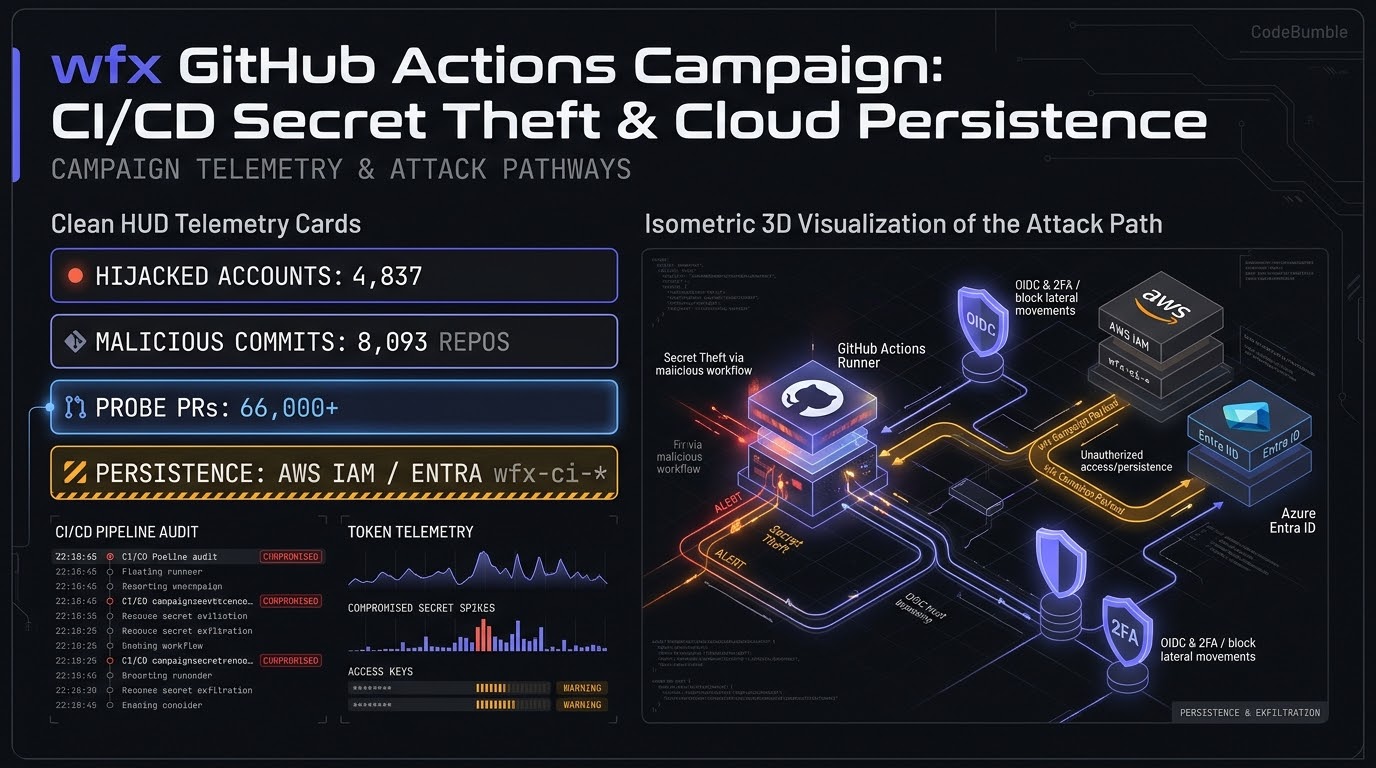
Between November 10 and November 12, 2026, an active software supply chain campaign tracked as wfx (also dubbed wfx-loot) leveraged 4,837 hijacked GitHub accounts to probe tens of thousands of repositories and inject a self-erasing credential stealer into CI/CD pipelines. According to independent telemetry from SafeDep, Phoenix Security, and OX Security (following initial reporting by Aikido Security), 8,093 public repositories received malicious commits on their default branches, and at least 1,806 repositories executed the payload and exfiltrated secrets.
There is no CVE behind this campaign—it exploits stolen GitHub access tokens rather than a software flaw in GitHub Actions. What makes wfx uniquely dangerous for engineering and platform teams is two operational behaviors:
- Self-Erasing Forensics: In nearly every compromised repository, the attacker reverts the malicious commit within minutes (
ci: restoreorci: cleanup) and deletes the workflow run and its logs—leaving the default branch looking clean and leaving only a gap in workflow run numbers. - Cloud Persistence That Survives Secret Rotation: Beyond stealing GitHub secrets,
GITHUB_TOKEN, process memory API keys, and OIDC tokens, the payload attempts to plant persistent backdoors in AWS IAM (creating long-lived access keys and rewriting role trust policies viawfx-*sessions) and Azure Entra ID (adding federated identity credentials namedwfx-ci-*to app registrations). Rotating repository secrets alone does not evict the attacker.
Campaign Scale and Compromised Package Matrix
The primary objective of wfx is CI/CD secret and cloud credential theft, not package registry poisoning. However, automated release workflows on three repositories triggered package publications containing the payload:
| Package / Module | Ecosystem | Poisoned Version(s) | Clean / Remediation Action |
|---|---|---|---|
digitalelvis/neuronai-studio |
Packagist | v3.14.3 |
Pin v3.14.2 or earlier (or 3.14.4 per OX); composer install does not run the hook, but npm install inside vendor/ does |
github.com/vkuznet/gocurl |
Go Module Proxy | v0.0.0-20261111095532-8d5aad0cb0da |
Block pseudo-version; payload sits in .github/workflows/build.yml (Go tooling does not run workflows) |
github.com/onuragtas/redock (docker-env) |
Go Module Proxy | v1.0.278, v1.0.280, v1.0.282 |
Block poisoned tags; v1.0.277 and v1.0.279/281/283 are clean reverts |
Additionally, SafeDep and OX Security documented that the attacker pushed two chore: add ci helper commits to 28 WebdriverIO repositories via the compromised wdio-bot account on November 11 at 12:11 UTC; no package release was poisoned, though the wdio-bot token was compromised. Across a scan of 218 npm, Go, and Packagist packages whose source repositories received malicious commits, SafeDep found no other published versions carrying the payload.
Technical Mechanics: Four-Phase Attack Flow and Persistence
Because the attacker uses stolen GitHub tokens, commits appear authored by legitimate repository users (using their noreply email without GPG/SSH signatures). SafeDep noted that accounts hit in the October 2026 GhostAction wave were roughly 1,000 times more likely to be reused in wfx.
+-----------------------------------------------------------------------------+
|                wfx / wfx-loot CAMPAIGN EXECUTION & PERSISTENCE              |
+-----------------------------------------------------------------------------+
|                                                                             |
|  [ PHASE 1: WRITE-ACCESS PROBE ]                                            |
|   Stolen Token ---> Opens PR "docs: dependency audit notes" (branch:wfx-docs)|
|   (Observed in 61,734–66,200+ repos; 10,431 via collaborator/org/bot access)|
|                                     |                                       |
|                                     v                                       |
|  [ PHASE 2: PAYLOAD INJECTION (8,093 REPOS) ]                               |
|   |-- Existing Workflow ("ci: refresh build cache") -----> 7,309 repos      |
|   |-- npm postinstall Hook ("chore: add ci helper") ----->   771 repos      |
|   +-- New Workflow ("chore: add dependency audit workflow") -> 16 repos     |
|                                     |                                       |
|                                     v                                       |
|  [ PHASE 3: HARVEST & EXFILTRATE (1,806+ RUNS) ]                            |
|   |-- Exports ACTIONS_RUNTIME_TOKEN, ACTIONS_RESULTS_URL, toJSON(secrets)   |
|   |-- Scans runner memory for AWS, OpenAI, Anthropic, npm, PyPI keys        |
|   |-- Requests GitHub OIDC tokens for AWS, Azure, GCP, Vault, Kubernetes    |
|   +-- POSTs loot to 194.150.166[.]244:8080 / 18.143.168[.]96 / Telegram     |
|                                     |                                       |
|                                     v                                       |
|  [ PHASE 4: CLOUD PERSISTENCE & SELF-ERASURE ]                              |
|   |-- AWS: AssumeRole (session wfx-*) -> CreateAccessKey / UpdateAssumeRole |
|   |-- Azure: Adds Entra ID federated credential "wfx-ci-*"                  |
|   +-- GitHub: Pushes "ci: restore" / "ci: cleanup" & deletes workflow run   |
+-----------------------------------------------------------------------------+
1. The Probe Pull Request (wfx-docs)
Before injecting the stealer, the attacker tests whether a stolen token can write to a repository by opening a pull request titled docs: dependency audit notes from a branch named wfx-docs. SafeDep counted 61,879 probe PRs across 61,734 repositories (with OX Security later counting over 66,200 PRs as the campaign continued). Even if no malicious commit followed, the presence of a wfx-docs PR proves the author's GitHub account is compromised.
2. Three Injection Vectors
Once write access is confirmed, the ~1,500-line un-obfuscated shell payload is planted in one of three ways:
- Existing Workflow Injection (
ci: refresh build cache): 7,309 repositories. Modifies an existing.github/workflows/*.ymlfile on the default branch. npm postinstallHook (chore: add ci helper): 771 repositories. Adds.ci-<6chars>.shand apackage.jsonpostinstallhook, which executes both in CI and on developer laptops runningnpm install.- New Workflow File (
chore: add dependency audit workflow): 16 repositories. Adds.github/workflows/build-audit-<6chars>.yml(in empty repositories, preceded bychore: initial commit).
3. Shifting Exfiltration Channels
The injected workflow requests id-token: write and statuses: write, copies ACTIONS_RUNTIME_TOKEN, ACTIONS_RUNTIME_URL, ACTIONS_CACHE_URL, and ACTIONS_RESULTS_URL into GITHUB_ENV, and passes ${{ toJSON(secrets) }} and ${{ toJSON(vars) }} to the script. Starting around 05:30 UTC on November 12, OX Security observed new variants shifting exfiltration from HTTP POST callbacks (194.150.166[.]244:8080/exfil, 18.143.168[.]96:8080/exfil, 153.75.82[.]159:8080) to five Telegram bots posting to chat ID -1004340163187.
4. Cloud Persistence Beyond Secret Rotation
Because the workflow requests id-token: write, the payload exchanges GitHub OIDC tokens for cloud sessions—even in repositories not configured for cloud deployments:
- AWS: Creates new IAM access keys and rewrites role trust policies to permit any principal, operating under session names matching
wfx-<pid>. - Azure: Registers a new federated identity credential named
wfx-ci-<n>on Entra ID app registrations, allowing any future workflow on the repository'smainbranch to authenticate as that application without stored client secrets. - GCP & HashiCorp Vault: Attempts
GenerateAccessToken/SignJwtcalls via GitHub workload identity pools and JWT logins against Vault/Kubernetes APIs.
Evidence: Indicators of Compromise (IOCs)
All IOCs below are compiled from SafeDep, Phoenix Security, and OX Security as of November 12–13, 2026:
- Exfiltration Endpoints:
http://194.150.166[.]244:8080/exfil,http://18.143.168[.]96:8080/exfil(AWSap-southeast-1),153.75.82[.]159:8080, andapi.telegram.org(sendDocumentto chat-1004340163187). - Sample Payload SHA-256:
89695abb392d5cfd4972672961e644bb46baa98aa1ed7173c2a2816c762735cf(note: hashes vary across per-repo configuration headers). - GitHub Artifacts: Branch
wfx-docs; PR titledocs: dependency audit notes; commit messagesci: refresh build cache,chore: add ci helper,chore: add dependency audit workflow,ci: restore,ci: cleanup; files.github/workflows/build-audit-[a-z0-9]{6}.ymland.ci-[a-z0-9]{6}.sh. - Cloud Artifacts: AWS CloudTrail session names
wfx-*; Azure Entra ID federated credentialswfx-ci-*; runner staging path$RUNNER_TEMP/.wfx-<pid>/.
Hardening Playbook: Detection, Cloud Hunting, and Preventive Controls
Because wfx erases its commits and workflow logs within minutes, standard git status or branch-head inspections will miss it. Execute these defensive checks across your GitHub organizations and cloud accounts.
Step 1: Audit GitHub Repositories and Detect Deleted Workflow Runs
Search git reflogs, commit histories across all branches (not just main), and GitHub audit logs for probe PRs, revert commits, and gaps in workflow run numbers (run_number sequences that skip integers indicate deleted runs):
    # 1. Search local/mirrored git history across all branches for wfx commit signatures
git log --all --since="2026-11-10" --grep="refresh build cache\|add ci helper\|dependency audit workflow\|ci: restore\|ci: cleanup" --oneline

    # 2. Check for open probe PRs or wfx-docs branches using GitHub CLI
gh search prs "docs: dependency audit notes" --owner YOUR_ORG --state all --json repository,title,author,url
In your GitHub Organization Audit Log, query for workflows.delete_workflow_run and git.push events since November 10, 2026, 12:00 UTC.
Step 2: Revoke Compromised Tokens and Rotate All Reachable Secrets
If any repository received a wfx-docs probe PR or a suspicious commit:
- Revoke Entry Credentials: Immediately revoke all Personal Access Tokens (PATs), OAuth app authorizations, SSH keys, and active sessions for the commit/PR author—and enforce hardware/TOTP 2FA.
- Rotate Secrets: Rotate every repository, environment, and organization secret/variable reachable by that repository's workflows, even if no workflow run is visible.
- Quarantine Artifacts & Laptops: Yank any package version built between the malicious commit and
ci: cleanup, and treat any developer workstation that rannpm installon an affected commit as compromised.
Step 3: Hunt for AWS, Azure, and GCP Persistence Backdoors
Do not stop after rotating GitHub secrets. Run the following read-only cloud audit commands to detect wfx persistence:
    # Azure Entra ID: Search all App Registrations for wfx-ci-* federated identity credentials
az ad app list --all --query "[].{appId:appId, displayName:displayName}" -o tsv | while read -r appId name; do
  az ad app federated-credential list --id "$appId" --query "[?starts_with(name, 'wfx-ci-')]" -o table
done
    # AWS CloudTrail: Query recent AssumeRoleWithWebIdentity / IAM persistence events
aws cloudtrail lookup-events \
  --lookup-attributes AttributeKey=EventName,AttributeValue=UpdateAssumeRolePolicy \
  --start-time 2026-11-10T00:00:00Z \
  --query "Events[?contains(CloudTrailEvent, 'wfx-')].[EventTime,Username,EventName]" --output table

aws cloudtrail lookup-events \
  --lookup-attributes AttributeKey=EventName,AttributeValue=CreateAccessKey \
  --start-time 2026-11-10T00:00:00Z \
  --query "Events[?contains(CloudTrailEvent, 'wfx-')].[EventTime,Username,EventName]" --output table
In GCP, audit Cloud Logging for GenerateAccessToken and SignJwt calls originating from your GitHub Workload Identity Pool since November 10, 2026.
Step 4: Harden GitHub Actions Permissions and OIDC Trust Policies
Prevent future stolen-token campaigns from reaching cloud environments or bypassing review:
- Enforce Signed Commits & Branch Protection: Require signed commits (
Require signed commits) and pull-request approvals on default branches, and remove bot accounts from branch-protection bypass lists. - Scope OIDC Trust Policies: Never trust
repo:ORG/*in AWS/Azure/GCP OIDC trust policies. Restrictsubclaims to exact repositories, protected branches, or deployment environments (e.g.,repo:ORG/APP:environment:production). - Least-Privilege
GITHUB_TOKEN&id-token: Set default workflow permissions tocontents: readand omitid-token: writefrom workflows that do not deploy to cloud providers. - Note on
--ignore-scripts: Disabling npm lifecycle scripts stops the 771-repopostinstallvector on developer machines, but does not stop the 7,309-repo workflow-injection vector in CI.
Step 5: Rollback and Recovery Notes
- Deleting
wfx-docsand Reverting: Delete anywfx-docsbranches, close probe PRs, and if a malicious commit remains on a default branch, reset or revert cleanly and force-rotate all secrets afterward. - Cloud Backdoor Removal: Delete any discovered
wfx-ci-*Entra federated credentials, delete unauthorized IAM access keys, and restore AWS IAM role trust policies from version-controlled Terraform/CloudFormation state.
Frequently Asked Questions
1. Is the wfx campaign caused by a vulnerability or CVE in GitHub Actions?
No. wfx has no CVE. Attackers used 4,837 stolen GitHub access tokens to push commits as legitimate owners, collaborators, or bot accounts, abusing default workflow write trust and CI secret/OIDC access.
2. Why does my repository's main branch look clean if it was hit?
In nearly all 8,093 affected repositories, the attacker pushed a follow-up revert commit (ci: restore or ci: cleanup) within minutes and deleted the GitHub Actions workflow run and logs. Check git history since November 10 and look for missing workflow run numbers.
3. If I only received a docs: dependency audit notes pull request from wfx-docs, am I compromised?
Yes, the account that opened the pull request is compromised. Even if no payload commit followed, revoke that account's GitHub tokens, OAuth grants, SSH keys, and active sessions immediately, and enable 2FA.
4. Is rotating GitHub repository secrets enough to stop the attacker?
No. In AWS and Azure, the payload uses stolen OIDC tokens to plant persistent backdoors—such as wfx-ci-* federated identity credentials in Entra ID and new IAM access keys or widened role trust policies in AWS—that survive repository secret rotation.
5. Which public packages were poisoned by the wfx campaign?
Three packages were confirmed to contain the payload in published artifacts: digitalelvis/neuronai-studio (v3.14.3 on Packagist), github.com/vkuznet/gocurl (v0.0.0-20261111095532-8d5aad0cb0da on Go), and github.com/onuragtas/redock / docker-env (v1.0.278, v1.0.280, v1.0.282 on Go).
Sources
- SafeDep: wfx: GitHub Actions Credential Stealer Hits 8,000 Repos — Published November 12, 2026.
- Phoenix Security: wfx GitHub Actions Credential Stealer: CI Secret Theft and Cloud Persistence Across 8,000+ Repositories — Published November 12, 2026.
- OX Security: Thousands Of GitHub Accounts Hijacked With wfx-loot CI Secret Stealing Malware Via GitHub Actions & npm — Published November 12, 2026.