

Engineering
ARTEX AI Attacks: 8 Behavioral Hallmarks and the Defensive Engineering Playbook
Autonomous AI pentesting orchestrators like ARTEX are turning leaked GitHub secrets and exposed APIs into cloud compromises in minutes. Here are the 8 behavioral hallmarks Unit 42 and Cisco Talos documented—plus defensive middleware, detection queries, and hardening steps.
11 min read
ARTEX AI Attacks: 8 Behavioral Hallmarks and the Defensive Engineering Playbook
Executive Summary
Autonomous AI penetration testing orchestrators have compressed multi-day intrusion lifecycles into minutes. Between late July and mid-November 2026, threat intelligence teams at Cisco Talos, Palo Alto Networks Unit 42, StepSecurity, and Cloudflare documented a rapid operational shift: adversaries—ranging from state-aligned espionage clusters (Storm-0940, VAPOR PANDA) to financially motivated groups (Storm-3358, Crafty Falcon)—are using open-source, LLM-driven multi-agent frameworks such as ARTEX (and derivatives including AntiFox and ScopeWeaver) against production APIs, identity workflows, and cloud environments.
Although ARTEX's original author took the GitHub repository closed-source on October 8, 2026, more than 12,000 forks and rebranded copies remain in circulation. Because operators constantly fork the codebase, swap LLM backends (often using DeepSeek models), and rotate cloud VPS infrastructure, static indicator-of-compromise (IOC) blocklists fail quickly.
Instead, defensive engineering teams must pivot to two durable controls:
- Behavioral Detection: Spotting the unmistakable machine-speed cadence, inference pauses, canary inputs, and self-correction loops inherent to LLM-driven planners.
- Identity and Surface Hardening: Eliminating long-lived secrets, public OpenAPI/source-map attack maps, and unauthenticated write or self-service endpoints—the exact primitives ARTEX agents exploit fastest, sometimes moving from a public GitHub secret search to Azure Key Vault exfiltration in five minutes.
The 8 Behavioral Hallmarks of ARTEX-Driven Attacks
Because ARTEX is forked and modified continuously, user agents and source IPs lose fidelity within hours. In its November 2026 analysis of live intrusions, Palo Alto Networks Unit 42 identified 8 durable behavioral hallmarks that distinguish an autonomous LLM planner from standard vulnerability scanners or manual human testing:
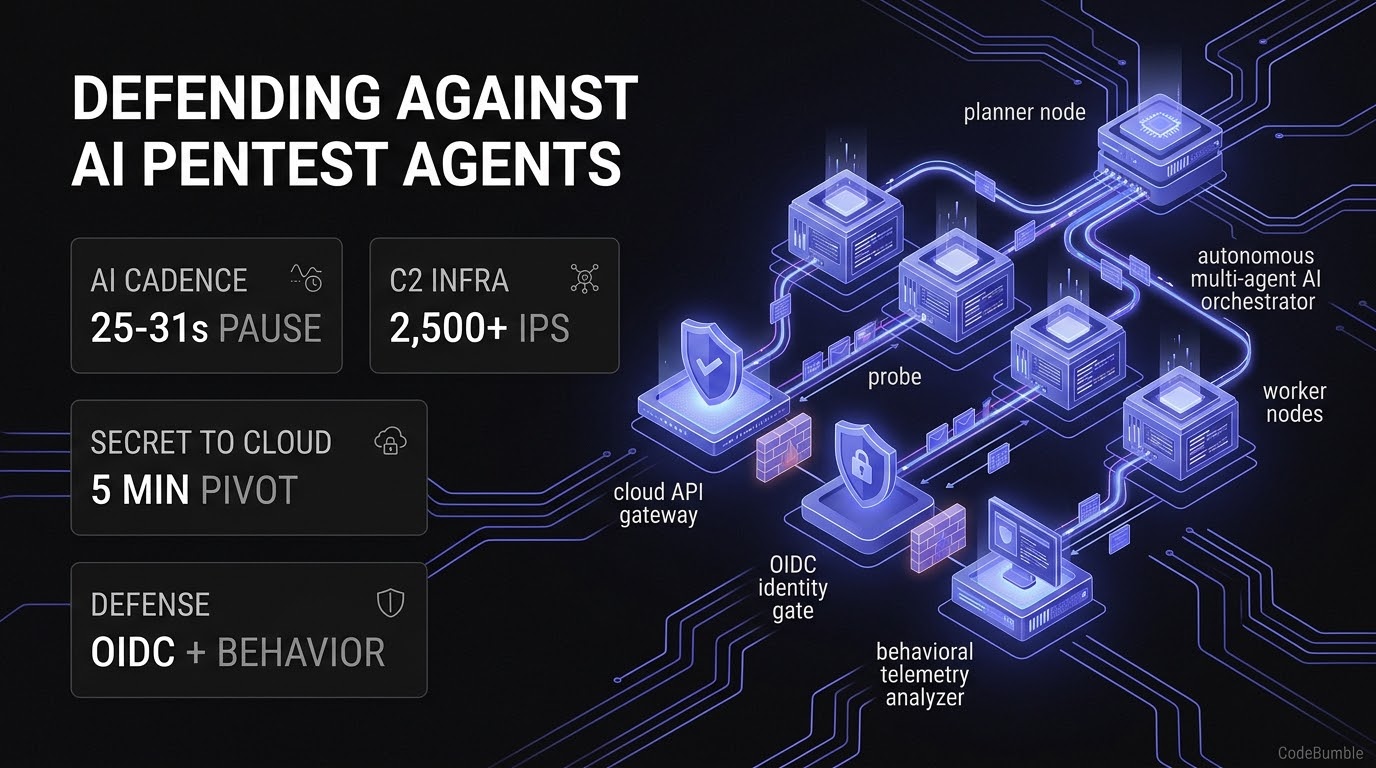
- Think-Then-Act Cadence: Agents emit bursts of 1 to 14 requests roughly one second apart, followed by a 25 to 31 second pause while the orchestration loop waits on an upstream LLM inference call to decide the next step.
- Machine-Speed Pivoting: Operators act on newly discovered credentials within roughly one minute of download. Unit 42 observed an agent validate more than 200 application client secrets in about three minutes.
- Spec-Driven Targeting: Immediately after downloading exposed OpenAPI/Swagger specifications or JavaScript source maps, agents issue targeted requests against the exact routes and parameter schemas discovered in those files.
- Automated Self-Correction: When an API returns a validation error (such as
HTTP 422 Unprocessable Entity), the agent reads the error payload, adjusts its JSON or query parameters, and retries successfully roughly 28 to 30 seconds later. - Checking Its Own Work: After almost every successful write operation (
POST,PUT,PATCH), the agent issues an immediateGETto the same path to verify state—or performs rapid write-then-delete probes on cloud object storage buckets. - Canary Inputs: Before testing real target accounts, agents inject bogus or placeholder usernames and values such as
evil[.]com,test@example[.]com, anddeadbeefdeadbeefdeadbeef12into identity and registration endpoints. - Parallel Multi-Surface Targeting: Within a single hour, an ARTEX controller can simultaneously probe an application delivery controller, more than a dozen VPN appliances, a NAS device, workforce identity portals, and cloud APIs.
- Persistent Recheck Loops: Agents execute automated polling every 48 seconds for up to three days, or replay identical multi-step attack sequences roughly 30 seconds apart.
Technical Mechanics and Architecture
How the ARTEX Orchestration Loop Works
Per source-code and telemetry analyses from StepSecurity and Cisco Talos, ARTEX (v0.3.15, the final open-source release) packages a Go backend, a Next.js web console (defaulting to port 8787), and a PostgreSQL database—typically deployed via Docker Compose. Rather than shipping an embedded AI model, it connects via standard APIs to external LLMs and coordinates a multi-agent graph:
+-----------------------------------------------------------------------------+
|            ARTEX MULTI-AGENT ORCHESTRATION VS. DEFENSIVE GATEWAY            |
+-----------------------------------------------------------------------------+
|                                                                             |
|  [ ADVERSARY / TESTER ORCHESTRATOR (Go + Next.js + PostgreSQL :8787) ]      |
|   Operator Goal ("Get admin access")                                        |
|     +---> Planner Agent (LLM Inference: 25-31s pause per reasoning cycle)   |
|             |-- Breaks goal into tasks stored in Asset & Step Graph         |
|             |-- Dispatches Worker Agents (3/task default): nmap, HTTP, sh   |
|             |-- Extensible via MCP (can pair with VShell, AdaptixC2, etc.)  |
|             +-- Retest Agent (re-verifies findings & write-then-delete)     |
|                                                                             |
|                                   |  (1-14 req/s bursts + canary inputs)    |
|                                   v                                         |
|  [ DEFENSIVE ENGINEERING PERIMETER ]                                        |
|   1. Edge / WAF: Strip OpenAPI/source maps; uniform errors; silent throttle |
|   2. Behavioral Telemetry: Detect 25-31s cadence + canary values + 422 retry|
|   3. Identity Gate: OIDC short-lived tokens; FIDO2; block local dev creds   |
+-----------------------------------------------------------------------------+
Crucially, while ARTEX is not natively bundled with a traditional command-and-control (C2) framework, its Model Context Protocol (MCP) extensibility layer allows operators to attach external tool servers. Cisco Talos observed ARTEX infrastructure running concurrently alongside post-exploitation and C2 tooling including VShell, AdaptixC2, Cobalt Strike, Gophish, Fscan, Interactsh, and Chisel.
Defensive Engineering Pattern 1: Deceptive Uniform Errors & Inference-Loop Friction
Unit 42 notes that LLM-driven orchestrators rely heavily on HTTP status codes and verbose validation messages (422, 400, stack traces, or OpenAPI schema hints) as context for self-correction. Returning uniform, opaque error responses and applying silent connection throttling starves the agent's context window and forces it to burn inference tokens on dead ends.
Below is a safe, defensive FastAPI middleware pattern that detects canary payloads and enforces uniform error responses on public self-service endpoints without leaking schema hints:
import hashlib
import time
from fastapi import FastAPI, Request
from fastapi.responses import JSONResponse

app = FastAPI()

CANARY_TOKENS = {
    "evil.com",
    "test@example.com",
    "deadbeefdeadbeefdeadbeef12",
}

@app.middleware("http")
async def agentic_defense_middleware(request: Request, call_next):
    # 1. Flag known AI pentest user-agent leads (treat as telemetry lead, not sole block)
    ua = request.headers.get("user-agent", "").lower()
    is_known_agent_ua = any(sig in ua for sig in ("artex-enrich", "norma/", "infra-hunt", "verify-911-probe"))

    # 2. Inspect query/path for canary placeholders without logging sensitive secrets
    raw_target = f"{request.url.path}?{request.url.query}".lower()
    if any(canary in raw_target for canary in CANARY_TOKENS) or is_known_agent_ua:
        client_hash = hashlib.sha256(
            (request.client.host if request.client else "unknown").encode()
        ).hexdigest()[:12]
        # Emit structured telemetry for SOC correlation
        print(f'{{"event":"agentic_probe_suspected","client_hash":"{client_hash}","ts":{int(time.time())}}}')
        # Return opaque, uniform response to deny self-correction feedback
        return JSONResponse(status_code=400, content={"error": "request_rejected"})

    response = await call_next(request)

    # 3. Mask verbose 422 schema validation details on public auth/reset endpoints
    if request.url.path.startswith("/api/v1/auth/") and response.status_code == 422:
        return JSONResponse(status_code=400, content={"error": "invalid_request"})

    return response
Defensive Engineering Pattern 2: Stripping Machine-Readable Attack Maps at the Reverse Proxy
Because ARTEX agents immediately target routes parsed from downloaded OpenAPI/Swagger specs and JavaScript .map files, production reverse proxies (such as Nginx or edge gateways) should explicitly deny public access to documentation and source-map paths:
# Block public access to OpenAPI specs, Swagger UI, and JS source maps in production
location ~* ^/(swagger|openapi|api-docs|v[0-9]+/api-docs) {
    return 404;
}

location ~* \.map$ {
    return 404;
}
Evidence: Campaign Scale, Exposed Infrastructure, and Speed
Multiple independent telemetry datasets published between November 5 and November 13, 2026 establish the operational scale of ARTEX and peer agentic platforms:
| Metric / Observation | Reported Figure | Primary Source & Date |
|---|---|---|
| ARTEX-associated C2 IPs | > 2,500 IP addresses | Cisco Talos (Nov 13, 2026) |
| Exposed ARTEX / CyberStrikeAI hosts | 609 ARTEX, 1,323 CyberStrikeAI (21 running both) | Palo Alto Networks Unit 42 (Nov 11, 2026) |
Exposed ARTEX consoles (port 8787) |
1,465 (Censys, Nov 4) / 1,645 (BadByte, Nov 4) | StepSecurity (Nov 12, 2026) |
| Reachable PentAGI instances | > 700 instances | Cisco Talos (Nov 13, 2026) |
Backdoored Docker image pulls (tomicdd/artex) |
9,131 pulls (637 GitHub repos still pointing to it) | StepSecurity / BadByte (Nov 12, 2026) |
| VAPOR PANDA campaign | > 200 orgs in 14 countries; ~1.4 billion LLM tokens in one intrusion | Cisco Talos / StepSecurity |
| Storm-0940 M365 tenant targeting | > 2,250 downstream tenants via stolen ConnectWise app creds | Cisco Talos (Nov 13, 2026) |
| GitHub secret to Azure Key Vault exfil | 5 minutes | Cisco Talos / StepSecurity |
| Dosu incident request volume | > 80,000 requests in 90 minutes | Cisco Talos (Nov 13, 2026) |
- Confidence Level: High on campaign timelines, exposed host counts, and behavioral hallmarks across Cisco Talos, Unit 42, and StepSecurity. Note that Censys (1,465) and BadByte (1,645) reported slightly different exposed console counts on November 4 due to differing scanning methodologies, and Unit 42's October count (609) predates the November scans.
- Benchmark Caveat: Neither Cloudflare, Cisco Talos, nor Unit 42 has published a standardized, vendor-neutral false-positive benchmark comparing behavioral cadence detectors against human pentest traffic or CI/CD integration suites. Engineering teams should run behavioral rules in audit/alert mode first to baseline legitimate automated API clients.
Hardening Playbook: Stopping Autonomous AI Pentest Agents
Step 1: Eliminate Long-Lived Secrets and Development Credentials
- Scan all public and private repositories—including full
githistory and forks—for API keys, Entra ID client secrets, and cloud tokens. Rotate every exposed secret immediately; deleting a file does not invalidate a leaked credential. - Replace static AWS/GCP/Azure keys in GitHub Actions with short-lived OIDC federated sign-in tokens, and migrate classic GitHub Personal Access Tokens (PATs) to fine-grained PATs with mandatory expiration dates.
- Audit every internet-facing staging, test, and internal admin tool to ensure zero development or default passwords are accepted, and never share credentials between staging and production.
Step 2: Lock Down Public Attack Maps and Origin Ingress
- Remove OpenAPI/Swagger specifications, GraphQL introspection, and JavaScript source maps from unauthenticated production routes.
- Restrict origin servers to accept traffic only from your CDN/WAF ingress (such as Cloudflare's Modern Security Model combining WAF rate limiting, bot behavioral analysis, and Zero Trust access) so attackers cannot bypass edge protections by hitting origin IPs directly.
- Require authentication on every write endpoint, including development and staging APIs, and enforce rate limits plus bot protection on registration, password-reset, and OTP verification endpoints.
Step 3: Deploy Behavioral and Signature-Based Detection Queries
Hunt for ARTEX-specific user agents (artex-enrich/1.0, norma/0.4, Mozilla/5.0 (compatible; ArtEx/1.0), Mozilla/5.0 (compatible; infra-hunt/1.0), verify-911-probe/1.0), JA4 TLS fingerprints (t13d3013h1_1d37bd780c83_8537cf56674e), and think-then-act request bursts in your SIEM or WAF logs:
-- Example Splunk / SQL-style hunt for ARTEX user agents & canary probes in WAF/API logs
SELECT
  client_ip,
  user_agent,
  COUNT(*) AS req_count,
  MIN(event_time) AS first_seen,
  MAX(event_time) AS last_seen
FROM api_gateway_logs
WHERE event_time >= NOW() - INTERVAL '14 days'
  AND (
    LOWER(user_agent) LIKE '%artex-enrich%'
    OR LOWER(user_agent) LIKE '%norma/%'
    OR LOWER(user_agent) LIKE '%infra-hunt%'
    OR request_uri LIKE '%evil.com%'
    OR request_body LIKE '%deadbeefdeadbeefdeadbeef12%'
  )
GROUP BY client_ip, user_agent
ORDER BY req_count DESC;
For Microsoft Entra ID environments, alert immediately on AADSTS7000215 (wrong client secret) or AADSTS7000222 (expired client secret) bursts—especially when a failed secret attempt is followed by a successful sign-in from the same IP or when one IP signs in across multiple service principals.
For Cisco Snort deployments, Talos provides network coverage via Snort 3 (7:78, 7:77, 7:76) and Snort 2 (1:67496, 1:67495, 1:67494), noting that 7:78 and 1:67496 detect the norma agentic harness and are shipped as disabled-by-default POLICY rules.
Step 4: Audit Internal Red-Team Usage for Backdoored Containers
If your own security team uses ARTEX for authorized testing, verify immediately that no host pulled the backdoored Docker images tomicdd/artex or congdonglinux/artex (SHA-256 of backdoored /app/artex: d5070f52262effe216b840711343bff8f2787f39208d887d8dfd9c673f8d1573), which execute arbitrary commands as root via the login form. Bind port 8787 to localhost behind a VPN/SSH tunnel and enforce scope at the network firewall level—not via the tool's soft blocklist.
Step 5: Rollback Notes
When deploying uniform 400 error masking on /api/v1/auth/ or blocking /swagger / .map paths, validate in staging first that internal SDKs, API contract tests, and browser error-monitoring tools (such as Sentry source-map ingestion) use private authenticated upload pipelines rather than public .map fetches. If a regression occurs, revert only the specific location block or middleware path prefix rather than disabling edge rate limiting.
Frequently Asked Questions
1. What is ARTEX and why are security teams warning about it in November 2026?
ARTEX is an open-source, LLM-driven multi-agent penetration testing framework published on GitHub in July 2026. Although the author took the repo closed-source on October 8, 2026, over 12,000 forks and derivatives (AntiFox, ScopeWeaver) are actively used by espionage and cybercrime groups to automate reconnaissance, credential validation, and cloud exploitation at machine speed.
2. Why do traditional WAF rules and IP blocklists struggle against ARTEX?
Adversaries continuously fork the open-source codebase, rotate cloud VPS infrastructure (Talos tracked over 2,500 ARTEX-associated C2 IPs), and use residential proxies. Static IOCs decay quickly, whereas behavioral patterns—such as 25–31 second LLM inference pauses between request bursts and automated HTTP 422 self-correction—remain consistent.
3. What is the fastest way ARTEX compromises cloud environments?
Per Microsoft and StepSecurity reporting, ARTEX agents autonomously search public GitHub repositories and git history for leaked application secrets, AI API keys, and development credentials—moving from a GitHub search to Azure Key Vault data exfiltration in as little as five minutes without exploiting a single software CVE.
4. How can defenders disrupt an AI penetration testing agent's reasoning loop?
Unit 42 recommends serving uniform, generic error responses and applying silent connection throttling. Because LLM agents depend on detailed error messages and status codes to adapt their next prompt, removing that feedback forces the agent to burn context windows and compute budgets on dead ends.
5. Is it safe for internal red teams to run open-source ARTEX Docker images?
Only if verified from trusted source builds. BadByte and StepSecurity documented backdoored Docker Hub images (tomicdd/artex and congdonglinux/artex) downloaded over 9,100 times that grant root command execution through the login form, alongside default Docker Compose files that expose port 8787 to the public internet.
Sources
- Cisco Talos: ARTEX and beyond: AI-enabled penetration testing platforms — Published November 13, 2026.
- Palo Alto Networks Unit 42: ARTEX and AI-Powered Red Teaming Tools: What Defenders Need to Know — Published November 11, 2026 (syndicated Nov 12, 2026).
- StepSecurity: ARTEX: Attackers Adopted This AI Pentesting Tool in Three Months. Leaked Secrets Are Its Fastest Way In. — Published November 12, 2026.
- Cloudflare Blog: Adapting to AI penetration testing orchestrators: The Modern Security Model — Published November 13, 2026.