

AI
Atomic Engine for Inkling 2 Mini: SSD MoE Streaming, dspark Drafting, and Apple Silicon Benchmarks
Atomic Chat open-sourced Atomic Engine on llama.cpp to solve Inkling 2 Mini's laptop RAM bottleneck via --engine-budget-mib memory capping, SSD expert streaming, and dspark speculative drafting. On M5 Max, benchmarks reach 84–143 tok/s versus 40 tok/s on stock llama.cpp while cutting AD-Q4_K peak RAM from ~15.8 GiB to ~6.3 GiB, though Metal-only validation, slower prefill, and copy-heavy drafter inflation require careful local testing.
8 min read
Atomic Engine for Inkling 2 Mini: SSD MoE Streaming, dspark Drafting, and Apple Silicon Benchmarks
Executive Summary
Atomic Engine—open-sourced on llama.cpp by Atomic Chat and documented on November 23–24, 2026—targets a concrete local-AI bottleneck: running Thinking Machines Lab's Inkling 2 Mini (a 26.4B-total, 3.4B-active looped Mixture-of-Experts model) alongside a developer's IDE without blowing past laptop unified memory (explainx.ai; Inkling 2 Mini Model Card). By combining a hard RAM ceiling (--engine-budget-mib), on-demand SSD MoE expert streaming, and dspark speculative drafting, Atomic Engine cuts peak AD-Q4_K RSS on Apple Silicon from ~15.8 GiB (stock llama.cpp) to ~6.3 GiB under an 8 GB budget (explainx.ai).
On an Apple M5 Max, Atomic Chat's reported benchmarks reach 84 tok/s on AD-IQ2_M document summarization and 122–143 tok/s on copy-heavy prompts versus 40 tok/s on stock llama.cpp (b12600), while keeping greedy (temp=0) outputs byte-identical in documented copy tests (explainx.ai). Engineers should weigh those gains with empirical caution: the 122–143 tok/s headline figures come from copy-heavy prompts where speculative drafting naturally excels, prefill throughput drops under an 8 GB budget (556 tok/s vs. 812 tok/s), and current validation is Metal-only without verified Linux CUDA paths (explainx.ai).
Architecture & How It Works
Why Inkling 2 Mini Strains Laptop Memory
Released on November 20, 2026 under Apache 2.0, Inkling 2 Mini is a 24-layer multimodal decoder-only transformer with sparse MoE feed-forward layers (routing each token to 8 of 128 experts per layer) and a 1M-token context window (Inkling 2 Mini Model Card; Thinking Machines Lab Blog). Its middle 12 layers execute three times with shared weights—yielding 48 layer applications per token and ~5.4B effective active parameters from 26.4B stored parameters (Inkling 2 Mini Model Card).
Even though only 3.4B–5.4B parameters are active per token, an MoE runtime cannot predict in advance which experts a prompt will activate, so stock llama.cpp loads the entire weight footprint into unified memory or VRAM (Oflight). Thinking Machines Lab recommends 32 GB+ unified memory or VRAM for its ~20 GB mixed NVFP4/MXFP8 checkpoint, and even 4-bit GGUFs (UD-Q4_K_XL at 17.63 GB, AD-Q4_K at ~16.5 GB) trigger Metal OOM failures or ~4 tok/s CPU fallback on 18 GB M3 Pro laptops (Oflight; explainx.ai).
Atomic Engine's Three Stack Modifications
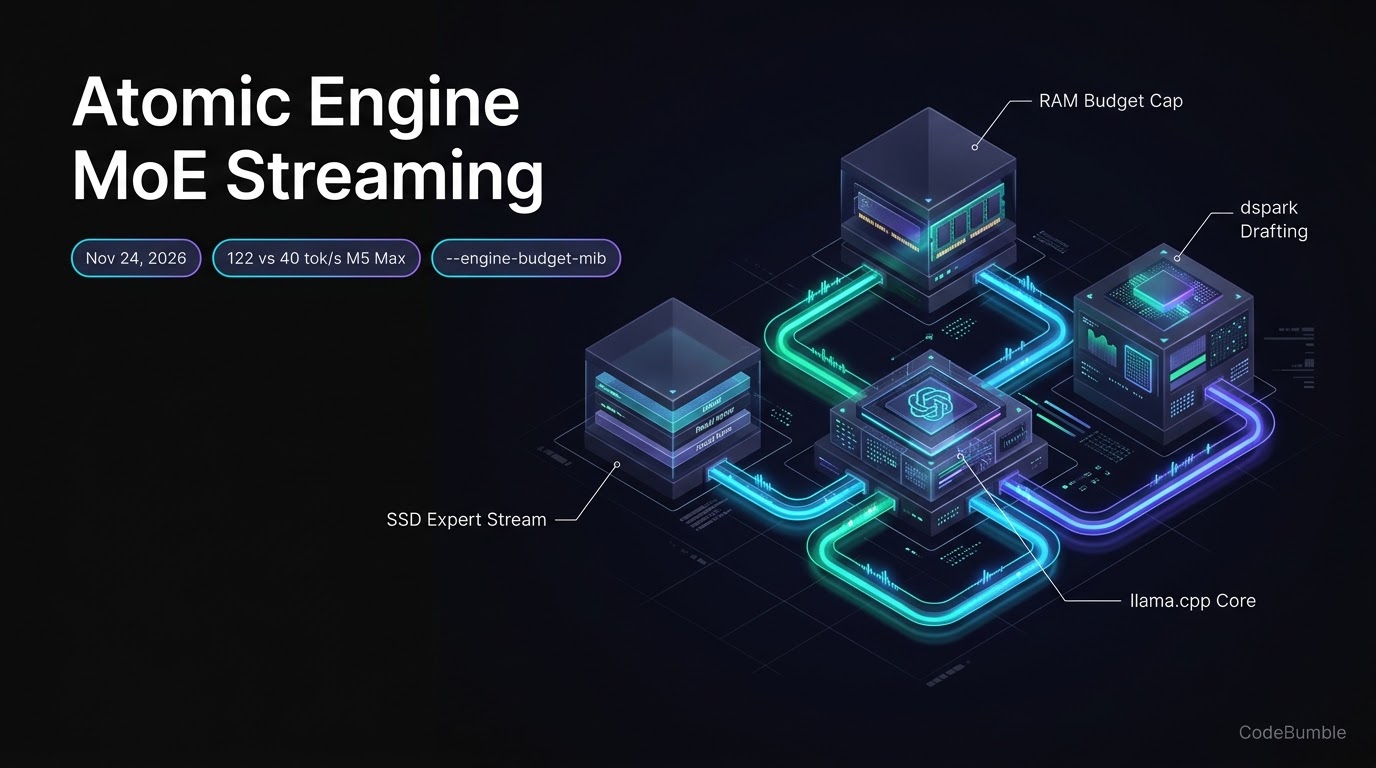
Atomic Engine forks llama.cpp execution behavior around three coordinated mechanisms (explainx.ai):
--engine-budget-mibMemory Cap: Enforces a hard resident RAM ceiling (such as8192MiB for an 8 GB background assistant) covering shared core layers and hot MoE experts, leaving room for IDEs, browsers, and macOS overhead.- SSD Expert Streaming: Cold MoE experts remain on NVMe SSD and stream into memory on demand when a token activates them, trading disk I/O for dramatic RSS reduction.
dsparkSpeculative Drafting: A lightweight draft model (~0.5 GBq8_0in Atomic Chat's test configuration) proposes candidate tokens ahead of the main looped MoE, allowing Inkling 2 Mini to verify batches in a single forward pass when draft predictions match.
flowchart LR
    A[Prompt + OpenAI-Compatible API] --> B[dspark Draft Model ~0.5 GB q8_0]
    B -->|Proposes Draft Token Batch| C[Atomic Engine Core / llama.cpp]
    D[RAM Budget Pool --engine-budget-mib] -->|Hot Experts + Core Layers| C
    E[NVMe SSD Weight Store] -->|Streams Cold MoE Experts| C
    C -->|Verifies Batch Across 3x Looped Layers| F[Verified Output Tokens]
Verification & Configuration Snippet
Atomic Engine exposes an OpenAI-compatible API (baseURL + model ID) for coding harnesses like OpenCode and supports deterministic parity checks against stock llama.cpp (explainx.ai):
# Run Atomic Engine with an 8 GiB resident memory cap and dspark drafting
./llama-server \
  -m Inkling-2-Mini-AD-Q4_K.gguf \
  --engine-budget-mib 8192 \
  --draft-model dspark-q8_0.gguf \
  --temp 0 \
  -c 4096
Benchmarks, Cost & Latency Analysis
M5 Max Decode, Prefill & Memory Benchmarks
Atomic Chat cofounder Daniel documented head-to-head benchmarks on November 23, 2026 comparing Atomic Engine (e110381) against stock llama.cpp (b12600) on an Apple M5 Max using Metal, Flash Attention, Q4_0 KV cache, 4,096 context, 512-token outputs, temp=0, and cold first requests (explainx.ai):
| Quantization & Prompt Type | Atomic Engine | Stock llama.cpp (b12600) |
Speedup | Caveat | Source |
|---|---|---|---|---|---|
AD-IQ2_M — Summarize docs |
84 tok/s | 40 tok/s | 2.1x | Representative prose workload | explainx.ai |
AD-IQ2_M — Continue in-doc |
122 tok/s | 40 tok/s | 3.05x | Benefits from draft context overlap | explainx.ai |
AD-IQ2_M — Repeated log (copy test) |
143 tok/s | 40 tok/s | 3.58x | Copy-heavy; inflates drafter win rate | explainx.ai |
AD-Q4_K — Summarize docs |
43 tok/s | 38 tok/s | 1.13x | Higher-precision quant limits decode jump | explainx.ai |
Two additional metrics highlight the real engineering trade-off (explainx.ai):
- Peak RAM Footprint:
AD-Q4_Kunder an 8 GB budget peaked at ~6.3 GiB RSS versus ~15.8 GiB on stockllama.cpp—a 60% RAM reduction that enabled an 18 GB M3 Pro (which previously OOM'd or dropped to ~4 tok/s on CPU) to runAD-Q4_Kat ~10 tok/s. - Prefill Penalty: At the 8 GB budget,
AD-Q4_Kprompt prefill dropped to 556 tok/s versus 812 tok/s on stockllama.cpp(~31.5% slower), meaning tight memory caps optimize decode headroom rather than long-prompt ingestion speed.
Inkling 2 Mini Model Capability Context
Why do developers want Inkling 2 Mini locally in the first place? In Thinking Machines Lab's vendor-reported evaluations, Inkling 2 Mini leads sub-100B open-weight models on agentic coding and search suites—scoring 48.2% on DeepSWE v1.1 (vs. 42.2% for Qwen3.8-27B), 77.9% on SWE-bench Pro v2 Hard (vs. 73.8% for Qwen3.8-27B), 79.2% on SWE-bench Verified, and 82.7% on MCP Atlas—while trailing Qwen3.8-27B on multi-turn chat (MultiChallenge 50.0%, ComplexConstraints v1.1 33.4%) and factual recall (Thinking Machines Lab Blog; Inkling 2 Mini Model Card). Note that all model card benchmarks are vendor-reported rather than independent reproductions (Oflight).
Local Inference Stack Comparison (November 2026)
| Runtime Stack | Hardware Sweet Spot | Core Mechanism | Reported Inkling 2 Mini Result | Primary Limitation | Source |
|---|---|---|---|---|---|
| Atomic Engine | Apple Silicon laptops (18–48 GB+ with fast SSD) | --engine-budget-mib + SSD expert streaming + dspark |
84–143 tok/s (AD-IQ2_M, M5 Max); 6.3 GiB RSS (AD-Q4_K) |
Metal-only validation; slower prefill at 8 GB | explainx.ai |
Unsloth (v0.1.923-beta) |
Desktop NVIDIA GPUs (8–32 GB VRAM) | Fused kernels + 2-token speculative decode default | Up to 1.9x decode; 125 tok/s cited on RTX Pro 6000 | Unsloth marketing figure; Windows iGPU bug fixed recently | explainx.ai |
Stock llama.cpp (b12600) |
Machines where full GGUF + KV fits in RAM/VRAM | Standard full-weight load on GPU/Metal | 38–40 tok/s on M5 Max; 15.8 GiB RSS (AD-Q4_K) |
OOM or ~4 tok/s CPU fallback on 18 GB Macs | explainx.ai |
| vLLM / SGLang | 32 GB+ VRAM GPUs & NVIDIA DGX Spark | Official ~20 GB NVFP4/MXFP8 checkpoint |
Day-0 serving; 0.703 Stanford Intelligence/Watt on DGX Spark | Requires 32 GB+ VRAM; not built for 8 GB laptop budgets | Inkling 2 Mini Model Card; Thinking Machines Lab Blog |
Production Deployment & Trade-Offs
Memory Budgeting, Quantization & Context Scaling
Even with SSD expert streaming, developers must watch KV-cache growth carefully. Because Inkling 2 Mini has 20 local sliding-window layers (1,024-token window) and 4 global attention layers, a 32K context adds roughly 0.62–1.24 GB of KV cache, whereas a full 1M-token context would require ~17.3–34.5 GB for KV alone—making 1M context impractical on 16–32 GB laptops (Oflight). Keep local contexts in the 8K–32K range when running under tight --engine-budget-mib caps.
Practical Decision Framework & Operational Gotchas
- Use Atomic Engine when running Inkling 2 Mini as a background coding or summarization assistant on Apple Silicon laptops (18–36 GB unified memory) alongside heavy IDE/Docker workloads where keeping RSS under ~6.3–8 GiB matters more than peak prefill speed (explainx.ai).
- Skip Atomic Engine if you are deploying on Linux NVIDIA CUDA servers (where Metal-only validation does not apply and Unsloth, vLLM, or SGLang are better suited), if you require maximum prefill speed on long prompts, or if enterprise compliance restricts heavy SSD wear from continuous expert streaming (explainx.ai).
- Guard Against Looped Reasoning & Destructive Tools: Thinking Machines Lab's model card warns that Inkling 2 Mini can enter repetitive reasoning loops during debugging, cannot fully disable reasoning at minimum effort, and may take destructive file actions without confirmation—so always cap
max_tokens, limit agent turns, and run local agents inside a sandbox (Inkling 2 Mini Model Card). - Benchmark Correctly: Do not evaluate speculative drafting on repetitive log-copy prompts alone. Run greedy (
temp=0) parity hashes against stockllama.cppon the same GGUF and measure normal prose summarization (~84 tok/sclass) alongside RSS peak (explainx.ai).
Frequently Asked Questions
How does Atomic Engine reduce Inkling 2 Mini's RAM usage by more than half?
Atomic Engine enforces a resident memory cap via --engine-budget-mib (such as 8192 MiB), keeping only core layers and hot MoE experts in RAM while streaming cold experts from SSD on demand. On AD-Q4_K, this drops peak RSS from ~15.8 GiB in stock llama.cpp to ~6.3 GiB (explainx.ai).
Why do Atomic Engine benchmarks show both 84 tok/s and 122–143 tok/s on M5 Max?
Atomic Engine pairs SSD streaming with dspark speculative drafting. On copy-heavy or in-document continuation prompts, the small draft model predicts tokens accurately, pushing decode to 122–143 tok/s; on normal prose summarization (AD-IQ2_M), decode is ~84 tok/s versus 40 tok/s on stock llama.cpp (explainx.ai).
Does Atomic Engine change model outputs compared to stock llama.cpp?
In Atomic Chat's documented greedy (temp=0) M5 Max copy tests, Atomic Engine produced byte-identical outputs to stock llama.cpp (b12600) on the same GGUF. However, third-party GGUF quantizations (AD-IQ2_M, AD-Q4_K) themselves affect accuracy compared to the official ~20 GB NVFP4/MXFP8 checkpoint (explainx.ai; Oflight).
Can I run Atomic Engine on Linux with NVIDIA CUDA GPUs?
Atomic Chat's published November 23 benchmarks and instructions are validated on Apple Silicon (Metal) only, with CUDA paths unverified in the release post. For NVIDIA GPUs (8–32 GB+ VRAM), Unsloth v0.1.923-beta, vLLM, or SGLang are currently the primary documented options (explainx.ai; Inkling 2 Mini Model Card).
Why does Inkling 2 Mini list both 3.4B and ~5.4B active parameters?
Each forward pass activates 3.4B parameters across 8 of 128 experts in 24 physical layers, but the middle 12 layers loop three times with shared weights—adding roughly 1.0B effective active parameters per extra pass for ~5.4B effective active parameters per token (Inkling 2 Mini Model Card).
Sources
- Atomic Engine: Inkling 2 Mini 122 tok/s on M5 Max — explainx.ai (November 24, 2026)
- Introducing Inkling 2 Mini — Thinking Machines Lab (November 20, 2026)
- Inkling 2 Mini Model Card — Thinking Machines Lab (November 20, 2026)
- Inkling 2 Mini Requirements: VRAM, GPU & Mac (26.4B) — Oflight (November 21, 2026)