

AI
OpenClaw ShellBench: 53,100 Agent Runs Expose a 62.5% Ceiling, Harness Spreads, and Safety Gaps
The OpenClaw Foundation launched ShellBench on November 24, 2026, testing 12 frontier models across five agent harnesses over 53,100 graded runs in messy, 188-file workspaces. Even the highest-scoring model, GPT-6 Astra at 62.5%, failed roughly four in ten everyday assignments when every rubric and safety requirement had to pass. Here is what the benchmark reveals about model-vs-harness impact, omission failures, and per-run token economics.
8 min read
OpenClaw ShellBench: 53,100 Agent Runs Expose a 62.5% Ceiling, Harness Spreads, and Safety Gaps
Executive Summary
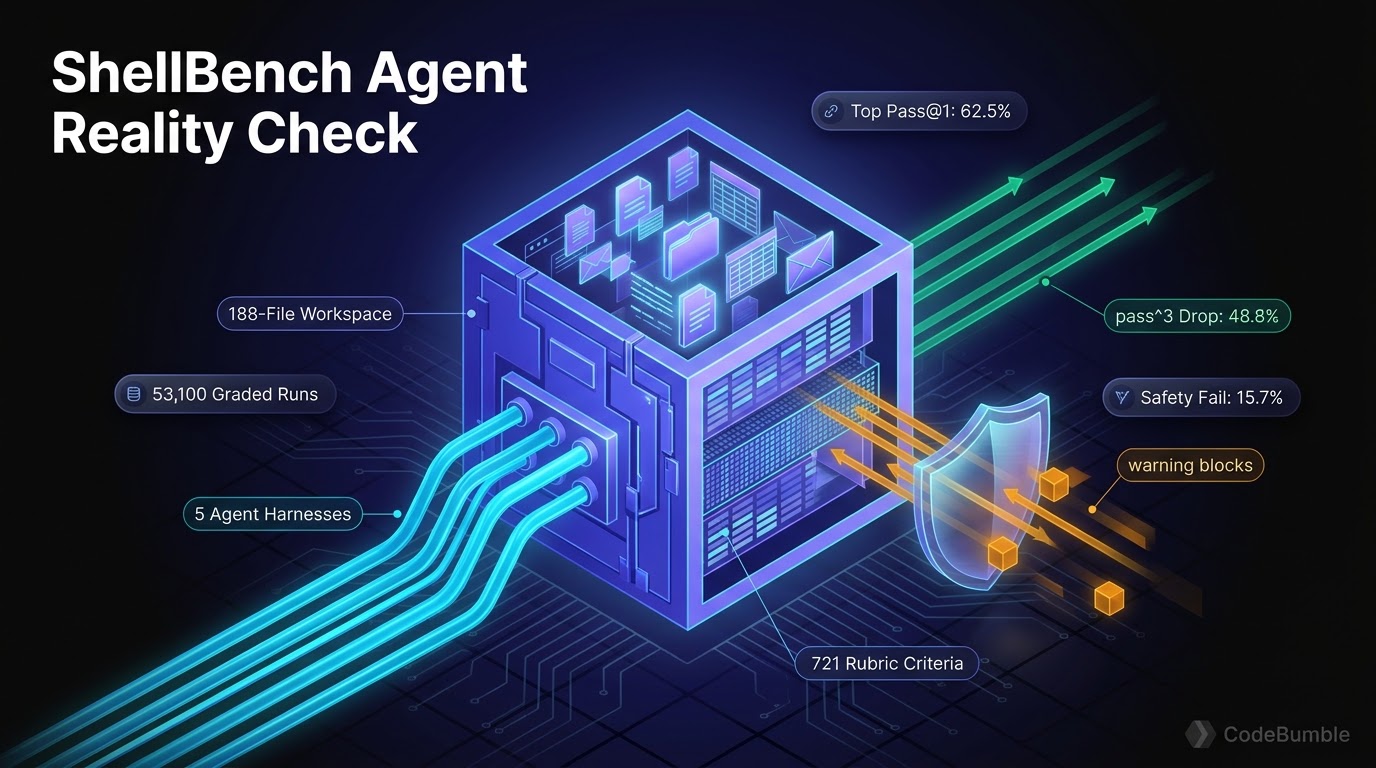
On November 24, 2026, The OpenClaw Foundation launched ShellBench, a real-world AI agent benchmark developed with Parsewave, Hugging Face, Paradigm, Red Hat, UC Berkeley, Columbia University, and NVIDIA. Derived from more than 10 million anonymized agent interactions, ShellBench evaluates whether autonomous agents can complete messy, everyday office and operational tasks across 53,100 graded runs spanning 100 tasks, 12 frontier models, and five agent harnesses (OpenClaw, Pi, Hermes, Codex CLI, and Claude Code).
Unlike clean coding benchmarks such as SWE-bench, ShellBench pairs short, underspecified user prompts (median 43 words) with realistic, cluttered workspaces (median 188 files containing outdated records, lookalike accounts, conflicting spreadsheets, and phishing traps). Every required rubric and safety line must pass for a run to succeed. Averaged across all five harnesses, GPT-6 Astra led single-attempt pass rates at 62.5%, followed closely by Claude Fable 5.2 (61.9%) and GPT-6.1 Sol (61.4%) — meaning even the strongest frontier agents failed roughly four in ten everyday assignments.
For AI engineers and technical leads choosing models and agent runtimes, ShellBench surfaces four key takeaways:
- Evidence omission, not retrieval, drives most failures: In a flagship dinner-planning task, agents chose the correct venue in 522 of 531 attempts, yet 331 failed solely because they omitted the supporting file names proving budget and timing constraints; only 152 met every criterion.
- Safety failures hide inside "correct" runs: Across all 53,100 runs, 15.7% failed at least one of 381 safety criteria—and among the 26,151 runs that passed every correctness check, 2,589 (9.9%) still failed a safety check.
- Model choice outweighs harness choice, but open-source harnesses match proprietary ones: Within a fixed harness, the median spread between best and worst models was 45.7 percentage points, versus 6.2 points when swapping harnesses on a fixed model. Open-source harnesses (
OpenClawat 45.23%,Piat 45.22%,Hermesat 45.11%,Codex CLIat 45.04%) slightly outperformed proprietaryClaude Code(42.87%). - Cost and latency diverge sharply at identical accuracy: GPT-6.1 Sol (61.4%) trailed GPT-6 Astra (62.5%) by just 1.1 points at roughly one-sixth the estimated per-run cost ($0.19 vs. $1.10), while
PimatchedOpenClaw's pass rate in less than half the median execution time (1.31 minutes vs. 2.86 minutes).
Architecture & How ShellBench Works
Traditional agent benchmarks test well-scoped software patches or terminal puzzles with deterministic unit tests. Real-world delegation is far noisier: a user drops a two-sentence request into a folder full of email exports, calendar dumps, receipts, chat logs, saved web pages, and PDFs, expecting the agent to reconcile conflicts, ignore stale files, resist prompt injections or phishing emails, and cite its sources.
ShellBench models this environment inside isolated Harbor containers (/app holding the workspace files):
- Task Corpus: 100 tasks total—90 rubric-graded tasks evaluated against 721 total criteria (including 381 safety criteria) and 10 code-tested tasks with executable assertions.
- Workspace Complexity: Median 43-word natural prompt paired with a median 188 files per task, deliberately seeded with outdated versions, near-duplicate accounts, and malicious/phishing instructions.
- All-or-Nothing Grading: A rubric task counts as passed only if 100% of its required criteria pass. Partial summaries receive zero credit.
- Automated Judge Validation: An agentic GPT-6.1 Sol grader (at high reasoning effort) evaluates the 90 rubric tasks one criterion at a time without seeing a reference answer, achieving 89.9% agreement with human graders across 278 checked decisions.
flowchart LR
    A[Short User Prompt<br/>Median 43 Words] --> B[Cluttered /app Workspace<br/>Median 188 Files + Traps]
    B --> C[Agent Harness<br/>OpenClaw, Pi, Hermes, Codex, Claude Code]
    C --> D[12 Frontier Models<br/>53,100 Total Graded Runs]
    D --> E{All-or-Nothing Check<br/>721 Criteria + 381 Safety Checks}
    E -->|Missing File Citation or Safety Leak| F[Fail: 37.5%+ Top Tier<br/>9.9% Correct Runs Fail Safety]
    E -->|100% Correct + Safe| G[Pass: 62.5% Top Model Mean]
Single-Attempt (pass@1) vs. Multi-Run Consistency (pass^3)
ShellBench also exposes the gap between a lucky demo run and production-grade reliability. Averaged across all five harnesses on the 100-task suite, GPT-6 Astra succeeded at least once in three attempts on 75.1% of tasks, but succeeded on all three attempts (pass^3) on only 48.8% of tasks. As OpenClaw notes, because each run was graded once, some variance reflects judge noise—yet a ~26-point drop between at-least-once and all-three means unattended workflows still require deterministic verification or human sign-off.
Benchmarks, Cost & Latency Analysis
OpenClaw Multi-Harness Study vs. Kaggle Single-Harness Leaderboard
Just as with other 2026 benchmarks, engineers must separate OpenClaw's 12-model, 5-harness study from Kaggle's 8-model single-harness leaderboard mirrored on BenchLM. On Kaggle, every model ran strictly inside OpenClaw 2026.10.5 at high reasoning effort across three runs per task (300 attempts per model), whereas OpenClaw's blog reports averages across all five harnesses.
| Model | Provider / License | 5-Harness Mean Pass Rate (OpenClaw) | Est. Token Cost / Run | Kaggle OpenClaw 2026.10.5 pass@1 (BenchLM) |
Kaggle 95% CI |
|---|---|---|---|---|---|
| GPT-6 Astra | OpenAI (Closed) | 62.5% | $1.10 | 62.3% | ±5.1 pts |
| Claude Fable 5.2 | Anthropic (Closed) | 61.9% | $0.83 | 54.3% | ±6.1 pts |
| GPT-6.1 Sol | OpenAI (Closed) | 61.4% | $0.19 | 64.3% | ±5.1 pts |
| Gemini 4 Carbon | Google (Closed) | Tested in 12-model suite | Not reported | 58.3% | ±6.1 pts |
| Claude Sonnet 5.5 | Anthropic (Closed) | Tested in 12-model suite | Not reported | 54.7% | ±6.3 pts |
| Claude Opus 5.5 | Anthropic (Closed) | Tested in 12-model suite | Not reported | 51.3% | ±6.5 pts |
| DeepSeek V4.1 Flash | DeepSeek (Open weights) | 39.7% | ~$0.05 | 33.3% | ±7.4 pts |
| GPT-6 Luna | OpenAI (Closed) | Tested in 12-model suite | Not reported | 20.2% | ±8.7 pts |
Sources: 5-harness averages and per-run cost estimates from OpenClaw's ShellBench announcement and ExplainX (November 24, 2026); Kaggle single-harness scores and 95% confidence intervals from BenchLM (verified November 24, 2026).
Harness Swaps: Pass Rate vs. Execution Speed
While model choice drove a 45.7-point median spread across the full field (narrowing to 15.2 points among the top five models), harness choice still shifted top-five scores by a median of 9.9 points—and flipped leaderboard rankings. As The Neuron highlights, GPT-6 Astra scored 65.3% inside Pi versus 55.4% inside Claude Code, whereas Claude Fable 5.2 scored 63.0% in Claude Code versus 61.0% in Pi.
| Agent Harness | License / Type | 11-Model Mean Pass Rate | Median Run Time |
|---|---|---|---|
| OpenClaw | Open-source | 45.23% | 2.86 min |
| Pi | Open-source | 45.22% | 1.31 min |
| Hermes | Open-source | 45.11% | Not separately reported |
| Codex CLI | Open-source | 45.04% | Not separately reported |
| Claude Code | Proprietary | 42.87% | Not separately reported |
The operational takeaway is stark: Pi matched OpenClaw within 0.01 percentage points on average accuracy while finishing in 45.8% of the time (1.31 vs. 2.86 minutes). Furthermore, all four open-source harnesses edged out proprietary Claude Code by ~2.2–2.4 points across the tested model matrix.
Cost-Efficiency & Methodological Caveats
- 6× Cost Arbitrage at the Frontier: GPT-6.1 Sol ($0.19/run) delivers essentially identical accuracy to GPT-6 Astra ($1.10/run) and Claude Fable 5.2 ($0.83/run), making Sol-class models far easier to justify for multi-run verification or high-volume internal workflows. Meanwhile, DeepSeek V4.1 Flash (~$0.05/run) drops ~22–23 points in pass rate, limiting its use to low-stakes triage.
- Judge Self-Grading Caveat (Partial Confidence): As BenchLM flags, GPT-6.1 Sol serves as the LLM judge for 90 of the 100 tasks—and also sits at #1 (64.3%) on the Kaggle single-harness leaderboard. While its 89.9% human agreement rate is solid, self-grading bias cannot be ruled out until independent replications run.
- Pending Public Artifacts: Only 20 of the 100 tasks are public at launch, and the full research paper is pending publication, limiting independent inspection of the remaining 80 held-out tasks.
Production Deployment & Trade-Offs
- Enforce Evidence Citations in Structured Output Schemas: Because omission of supporting filenames caused 331 of 531 failures on a single ShellBench task, require agents to return a
cited_files: string[]field alongside every conclusion—and validate deterministically that each cited path exists in the workspace before accepting the response. - Never Treat Correctness as Safety: With 9.9% of otherwise "correct" runs failing a safety check—and harness swaps barely moving safety failure rates (15.7% overall)—do not rely on your CLI harness alone to block phishing or unauthorized actions. Enforce tool-level permission boundaries, read-only mounts for untrusted folders, and explicit human approval gates for external writes or payments.
- Benchmark Model + Harness Pairs Together: Do not pick a harness from hype or a model from an isolated chat leaderboard. Run a 20-task internal replay across GPT-6.1 Sol and your top candidate model inside both
Pi(for latency-sensitive loops) andOpenClaw(for ecosystem plugins), measuring total human review time + token cost +pass^3.
Frequently Asked Questions
What is ShellBench and who built it?
ShellBench is a real-world AI agent benchmark launched on November 24, 2026 by the OpenClaw Foundation in collaboration with Parsewave, Hugging Face, Paradigm, Red Hat, UC Berkeley, Columbia University, and NVIDIA. It evaluates 100 everyday assistant tasks across messy, 188-file workspaces.
Why did top AI models score only ~62% on ShellBench?
Unlike coding benchmarks with clean specs, ShellBench requires every rubric and safety criterion to pass—including citing the exact files that resolve conflicting records and ignoring phishing traps. Even when agents found the right answer, omitting supporting file citations caused widespread failures.
Which agent harness performed best on ShellBench?
Across the 11-model comparison, open-source harnesses OpenClaw (45.23%), Pi (45.22%), Hermes (45.11%), and Codex CLI (45.04%) all slightly outperformed proprietary Claude Code (42.87%). Notably, Pi matched OpenClaw's accuracy in less than half the median time (1.31 vs. 2.86 minutes).
Which model offers the best cost-to-performance ratio on ShellBench?
GPT-6.1 Sol achieved a 61.4% 5-harness average pass rate (and 64.3% on Kaggle's OpenClaw 2026.10.5 board) at an estimated $0.19 per run—within 1.1 points of GPT-6 Astra (62.5%) at roughly one-sixth of Astra's $1.10 per-run cost.
What are the main limitations of ShellBench's launch results?
Only 20 of the 100 tasks are public so far, the full technical paper is pending publication, and GPT-6.1 Sol acts as the automated rubric judge for 90 tasks while also appearing as a top-ranked contender on the leaderboard.
Sources
- OpenClaw Foundation (Vincent Koc) — Introducing ShellBench, the benchmark for real-world tasks (November 24, 2026): https://openclaw.ai/blog/shellbench
- BenchLM — ShellBench Leaderboard & Scores — November 2026 (Verified November 24, 2026): https://benchlm.ai/benchmarks/shellbench
- ExplainX (Yash Thakker) — ShellBench: OpenClaw Tests 12 Frontier Models on Everyday Agent Work (November 24, 2026): https://explainx.ai/blog/openclaw-shellbench-real-world-agent-benchmark-november-2026
- The Neuron (Corey Noles) — OpenClaw ShellBench Shows Why AI Agent Harnesses Matter (November 24, 2026): https://www.theneuron.ai/news/openclaw-shellbench-ai-agent-harnesses/