

AI
Google DeepMind Humanity's First Exam (HFE): 544-Prompt Consistency Benchmarks, Visual Failure Modes, and Production Trade-Offs
Google DeepMind launched Humanity's First Exam (HFE) on November 24, 2026, exposing a wide gap between what frontier models can solve once and what they solve reliably every time. Across 544 elementary prompts grouped into 136 four-variant families, top models hit 100% family pass@4 yet drop to 85.8%–92.4% on strict family pass^4. Here is what the technical report and Kaggle leaderboard reveal about visual perception failures, test-time compute limits, and production model selection.
10 min read
Google DeepMind Humanity's First Exam (HFE): 544-Prompt Consistency Benchmarks, Visual Failure Modes, and Production Trade-Offs
Executive Summary
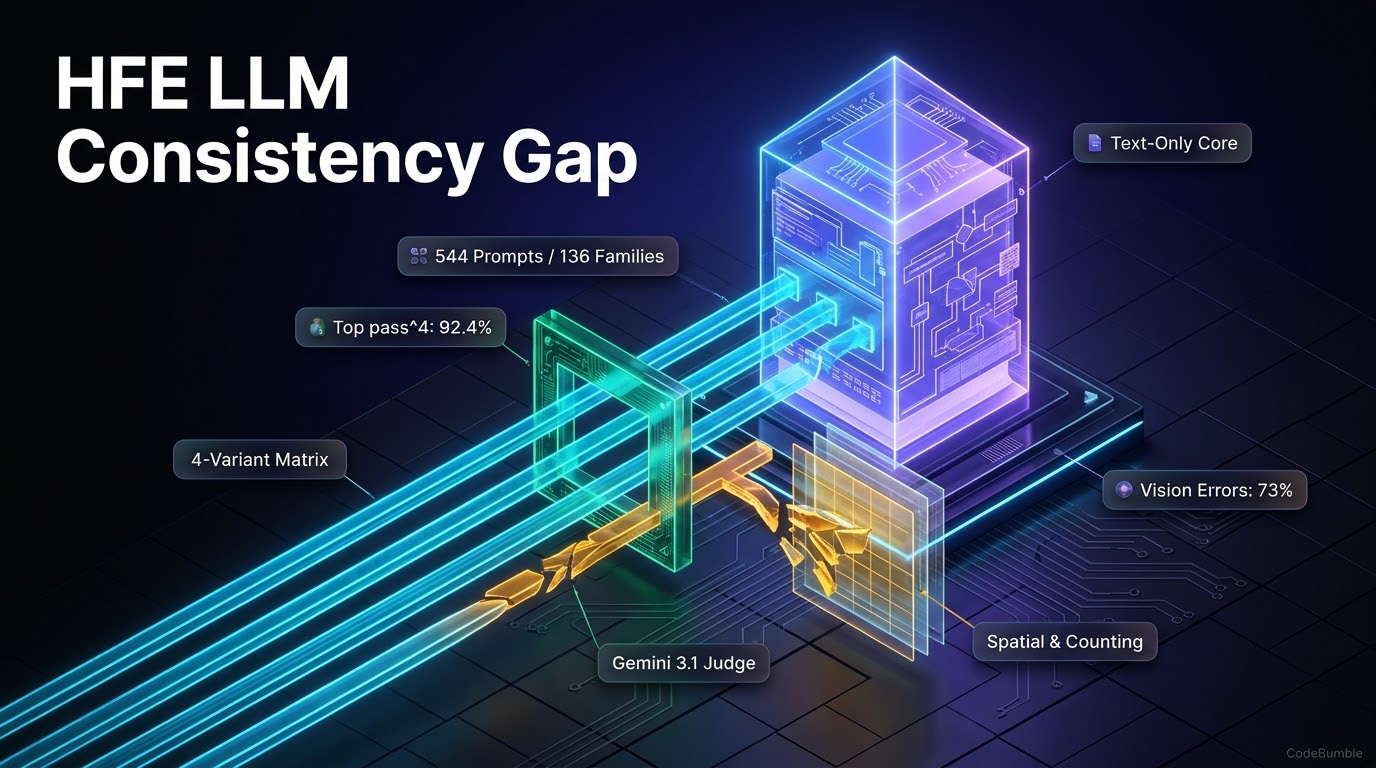
On November 24, 2026, Google DeepMind launched Humanity's First Exam (HFE) on Kaggle, introducing a 544-prompt reliability benchmark built to test whether frontier models answer straightforward, everyday questions consistently across small input variations. While traditional evaluations such as Humanity's Last Exam measure upper-bound capability ceilings in advanced mathematics and science, HFE acts as a floor test for "jagged intelligence"—measuring whether models execute elementary counting, color identification, spatial reasoning, arithmetic, and false-premise checks reliably every single time.
The headline finding from DeepMind's 18-model technical report and Kaggle/BenchLM leaderboard is a sharp gap between one-shot capability and repeatable reliability. In the technical report summarized by Unite.AI, OpenAI's GPT-6.2 Astra leads at 92.4% family pass^4, followed by GPT-6.2 Sol (86.9%) and Google's Gemini 4 Neon (85.8%)—even though all three achieved 100% family pass@4. DeepMind calls this delta the Family Reliability Gap (7.6, 13.1, and 14.2 percentage points, respectively; spanning 7.6 to 80.1 points across all 18 systems). On Kaggle's 16-model isolated launch leaderboard mirrored on BenchLM, GPT-6.2 Astra (xhigh reasoning) scores 90.7% (±4.7 points), GPT-6.2 Sol (xhigh) scores 87.5% (±5.1 points), and Gemini 4 Neon (high) scores 85.6% (±5.7 points).
For AI engineers building production agents and multimodal pipelines, HFE highlights three practical findings:
- Visual perception dominates failures: Across wrong-answer rollouts in the technical report, 73% involved visual perception errors—led by position, direction, and path tracking (31%) and object counting (23%).
- Test-time compute helps symbolic tasks far more than vision: Moving Gemini 4 Carbon from low to high reasoning effort lifted overall
family pass^4by 17.4 percentage points, driven by a 42.4-point gain on Math and Algorithmic tasks versus only 3.1 points on Vision tasks. - Cost-per-reliability trade-offs favor mid-tier models under 272K tokens: GPT-6.2 Sol ($2.00/$10.00 per 1M tokens) undercuts Gemini 4 Neon ($3.00/$15.00) by a third while trailing by less than 2 points on Kaggle HFE; above 272K input tokens, Sol's input rate doubles to $4.00/1M while Neon remains flat.
Architecture & How Humanity's First Exam Works
Most public LLM leaderboards rely on pass@1 or pass@k over static prompts. If a model answers a prompt correctly once out of four samples, pass@4 credits the capability as solved. In automated production pipelines—where an agent processes thousands of invoices, UI screenshots, or support tickets without human retries—occasional success is indistinguishable from unreliability.
HFE restructures evaluation around prompt families rather than isolated questions:
- Dataset Scale: 544 prompts organized into 136 families of four prompts each (one seed prompt plus three controlled variants).
- Modalities: 316 multimodal prompts (58.1%, combining text and images) and 228 text-only prompts (41.9%).
- Capability Coverage: 20 subcategories across four domains: Vision (51 families), Math and Algorithms (40), Spatial and Positional (27), and Reasoning and Language (18).
- Controlled Variants: Each family preserves the underlying logic while mutating surface details—renaming entities, reordering clauses, or altering visual attributes—so the expected answer changes predictably. One public example from Google DeepMind's announcement shows a multicolor neon sign reading "Dance While The Music Plays" and asks for the color of the third letter of each word in order (
green; yellow; white; blue; blue).
Human Screening & Contamination Controls
DeepMind began with 315 five-prompt families and retained only seeds solved by at least three of four independent human raters working without LLMs, web search, calculators, or code execution. Across the 136 retained seeds, single-rater human accuracy reached 90.8% with a median solve time of 1.5 minutes, and each seed was calibrated to trip at least one frontier model when written.
To curb contamination and overfitting, DeepMind split the benchmark:
- Public split: 112 prompts (28 families) released under
CC-BY-4.0. - Private held-out split: 432 prompts (108 families) executed inside isolated Kaggle Harbor containers without public internet access.
- Community Hackathon: A three-week Kaggle competition through December 15, 2026 invites everyday failure cases to refresh HFE quarterly.
Evaluation Harness & family pass^4 Scoring Pipeline
Every prompt runs zero-shot in a single turn with no system prompt and no tools, sampled six independent times at temperature = 1.0. A deterministic Gemini 3.1 Pro judge grades only the final visible answer—scoring refusals, empty outputs, and truncations as 0.
flowchart LR
    A[Seed Prompt + 3 Variants<br/>136 Families / 544 Prompts] --> B[Zero-Shot Inference<br/>No Tools, Temp 1.0, 6 Samples]
    B --> C[Deterministic Judge<br/>Gemini 3.1 Pro Final Answer]
    C --> D{Prompt Reliability<br/>All 4 of 6 Draws Correct}
    D -->|6/6=1.0, 5/6=0.333<br/>4/6=0.067, <=3/6=0| E[Multiply 4 Variant Scores<br/>Yields Family pass^4]
    E --> F[Average Across 136 Families<br/>Leaderboard Score]
For each prompt, family pass^4 estimates the probability that four answers drawn without replacement from six samples are all correct: 6/6 scores 1.0, 5/6 scores 0.333, 4/6 scores 0.067, and 3 or fewer score 0.0. The four prompts' scores within a family are multiplied together, so a single brittle variant drives the entire family to zero. Among the top 12 models, 61% to 85% of failing families had just one problematic prompt while the other three passed all six runs.
Benchmarks, Cost & Latency Analysis
Technical Report vs. Kaggle Launch Leaderboard
Comparisons must distinguish DeepMind's 18-model technical report from Kaggle's 16-model launch leaderboard. As BenchLM and Unite.AI note, the two differ in model configurations and sampling runs (Spearman rank correlation 0.98, not identical scores). The paper includes Claude Fable 5.1 and 5.2, while Kaggle tracks 16 closed-weight API models evaluated November 16–24, 2026.
| Rank (Kaggle) | Model | Provider | Reasoning Setting | Kaggle family pass^4 |
95% CI | Tech Report family pass^4 |
API Price (Input / Output per 1M) |
|---|---|---|---|---|---|---|---|
| 1 | GPT-6.2 Astra | OpenAI | xhigh |
90.7% | ±4.7 pts | 92.4% (100% pass@4) |
$8.00 / $40.00 (≤272K in) |
| 2 | GPT-6.2 Sol | OpenAI | xhigh |
87.5% | ±5.1 pts | 86.9% (100% pass@4) |
$2.00 / $10.00 (≤272K in) |
| 3 | Gemini 4 Neon | high |
85.6% | ±5.7 pts | 85.8% (100% pass@4) |
$3.00 / $15.00 (flat to 1M) | |
| 4 | GPT-6 Astra | OpenAI | xhigh |
84.0% | ±5.9 pts | Not separately reported | $10.00 / $50.00 |
| 5 | GPT-6.1 Sol | OpenAI | xhigh |
81.7% | ±6.1 pts | Not separately reported | $2.00 / $10.00 |
| 6 | Gemini 4 Carbon | high |
79.2% | ±6.6 pts | Used in effort ablation | $2.00 / $10.00 (promo thru Nov 30) | |
| 7 | GPT-6.1 Terra | OpenAI | xhigh |
78.1% | ±6.7 pts | Not separately reported | $1.00 / $5.00 |
| 8 | Gemini 4 Argon | high |
76.6% | ±6.8 pts | Not separately reported | Not verified in this run | |
| 9 | Gemini 4 Hydrogen | high |
70.5% | ±7.3 pts | Not separately reported | Not verified in this run | |
| 10 | Claude Opus 5.5 | Anthropic | max |
70.0% | ±7.4 pts | Not separately reported | Not verified in this run |
| 11 | Claude Sonnet 5.5 | Anthropic | max |
65.6% | ±7.7 pts | Not separately reported | Not verified in this run |
| 12 | GPT-5.6 Sol | OpenAI | max |
56.5% | ±7.9 pts | Not separately reported | $4.00 / $20.00 |
| 13 | Gemini 3.8 Flash | high |
56.1% | ±8.1 pts | Not separately reported | Not verified in this run | |
| 14 | Claude Haiku 5.5 | Anthropic | max |
42.5% | ±7.9 pts | Not separately reported | Not verified in this run |
| 15 | Gemini 3 Flash Preview | high |
33.4% | ±7.5 pts | Not separately reported | Not verified in this run | |
| 16 | Gemini 3.1 Flash-Lite Preview | high |
18.5% | ±6.2 pts | Not separately reported | Not verified in this run |
Sources: Leaderboard scores and 95% confidence intervals from BenchLM's Kaggle HFE mirror (verified November 24, 2026); technical report figures from Unite.AI; API token rates from DataCamp and AI Pricing Guru.
Two structural patterns stand out:
- Confidence Interval Overlap: Kaggle's 95% confidence intervals span ±4.7 to ±8.1 percentage points. GPT-6.2 Astra (90.7% ±4.7), GPT-6.2 Sol (87.5% ±5.1), and Gemini 4 Neon (85.6% ±5.7) overlap within statistical noise, so small gaps should not be over-interpreted.
- Fast-Tier Collapse: Lightweight models drop steeply on
family pass^4—falling to 56.1% (Gemini 3.8 Flash), 42.5% (Claude Haiku 5.5), 33.4% (Gemini 3 Flash Preview), and 18.5% (Gemini 3.1 Flash-Lite Preview). Compounding four-step consistency punishes occasional jitter severely.
Why Models Fail: Visual Perception & Near-Misses
- Visual Perception Bottleneck: 73% of wrong-answer rollouts involved visual perception—31% on position, direction, or paths, and 23% on object counting. Across the top nine models,
family pass^4reached 83% to 97% on text-only families versus 64% to 89% on multimodal families. - Test-Time Compute Asymmetry: Raising Gemini 4 Carbon from
lowtohigheffort lifted overallfamily pass^4by 17.4 points (+42.4 points on Math and Algorithms, but only +3.1 points on Vision). Extra reasoning tokens fix symbolic slips, not visual encoding errors. - Off-by-One Near-Misses: In 39% of failed prompt-model pairs (and 167 of 298 counting errors noted in iClarified and Unite.AI coverage), answers missed by a single element or count.
Cost & Latency Economics
- GPT-6.2 Astra ($8.00 / $40.00 per 1M tokens ≤272K; $16.00 / $60.00 >272K): Highest consistency (90.7% Kaggle / 92.4% report), at 4× Sol's token price.
- GPT-6.2 Sol ($2.00 / $10.00 ≤272K; $4.00 / $15.00 >272K): Trails Astra by 3.2 points on Kaggle HFE at a quarter of the price. In DataCamp's coding benchmark, Sol also used far fewer reasoning tokens per run (2,813–3,652 vs. 15,902–17,388 for Gemini 4 Neon), cutting per-run cost to roughly one-third ($0.19–$0.26 vs. $0.74–$0.77).
- Gemini 4 Neon ($3.00 / $15.00 flat to 1M): Holds a 15.1-point lead over Sol on long-context GraphWalks (95.2% vs. 80.1%) and avoids the 272K-token input price jump.
Methodological Caveats & Confidence Level
- Evidence Confidence: High for benchmark mechanics, Kaggle scores, and failure breakdowns (corroborated across Google DeepMind, BenchLM, and Unite.AI). Partial for open-weight parity: none of the 16 Kaggle launch rows are open-weight models, leaving self-hosted Llama, Qwen, and DeepSeek models unbenchmarked on the public HFE board.
- Adversarial Stress Test: DeepMind notes tasks were adversarially chosen to expose blind spots rather than sampled uniformly from user traffic. Grading also relies on a single Gemini 3.1 Pro judge and synthetic imagery.
Production Deployment & Trade-Offs
- Evaluate Prompt Families in CI: Replace single golden prompts with 3–4 controlled paraphrases, entity swaps, and cropped image variants, tracking
family pass^kalongside mean accuracy. - Avoid Burning Reasoning Tokens on Vision: Because high reasoning effort added only +3.1 points on Vision tasks, use deterministic pre-processing (cropping, bounding-box overlays, or dedicated detectors) before calling the VLM.
- Route by Context Length and Reliability Floor: Default to GPT-6.2 Sol under 272K tokens for cost-efficient consistency; switch to Gemini 4 Neon above 272K tokens; reserve GPT-6.2 Astra for high-stakes single-pass decisions; and pair fast-tier models with schema validators or Python tool execution to catch off-by-one slips.
Frequently Asked Questions
What is Humanity's First Exam (HFE) and how does it differ from Humanity's Last Exam?
Humanity's Last Exam tests expert-level PhD knowledge ceilings. Humanity's First Exam (HFE), launched by Google DeepMind on November 24, 2026, tests whether models answer 544 elementary text and image questions—like counting objects and spotting false premises—consistently across minor variations.
What does family pass^4 mean on the HFE leaderboard?
family pass^4 estimates the probability that a model answers all four related prompts in a family correctly across repeated attempts (six runs per prompt at temperature 1.0). Because the four prompt scores are multiplied together, failing even one variant consistently drives the family score to zero.
Which model ranks #1 on Humanity's First Exam?
In DeepMind's 18-model technical report, GPT-6.2 Astra leads at 92.4% family pass^4, followed by GPT-6.2 Sol (86.9%) and Gemini 4 Neon (85.8%). On Kaggle's 16-model launch leaderboard, GPT-6.2 Astra leads at 90.7% (±4.7), followed by GPT-6.2 Sol (87.5%) and Gemini 4 Neon (85.6%).
Why do frontier LLMs still fail 73% of HFE errors on visual tasks?
DeepMind found that 73% of wrong-answer rollouts stem from visual perception—including spatial/path tracking (31%) and object counting (23%). Extra test-time reasoning boosted Gemini 4 Carbon by 42.4 points on Math and Algorithms, but only 3.1 points on Vision.
Can developers inspect or contribute to the HFE dataset?
Yes. DeepMind released 112 prompts across 28 families under CC-BY-4.0, while holding 432 prompts private on Kaggle. Developers can submit new everyday failure cases through December 15, 2026.
Sources
- Google DeepMind (Oran Kelly) — We're launching Humanity's First Exam and a Kaggle hackathon to test LLM reliability (November 24, 2026): https://blog.google/innovation-and-ai/models-and-research/google-deepmind/humanitys-first-exam/
- BenchLM — Humanity's First Exam (HFE) Leaderboard — November 2026 (Verified November 24, 2026): https://benchlm.ai/benchmarks/humanitys-first-exam
- Unite.AI (Jonas Reeve) — Google DeepMind's 544-Prompt HFE Test Exposes LLM Consistency Gaps (November 24, 2026): https://www.unite.ai/google-deepminds-544-prompt-hfe-test-exposes-llm-consistency-gaps/
- DataCamp (Josef Waples) — Gemini 4 Neon vs. GPT-6.2 Sol: Benchmarks, Pricing, and a Hands-On Test (November 24, 2026): https://www.datacamp.com/blog/gemini-4-neon-vs-gpt-6-2-sol
- iClarified — Google Launches 'Humanity's First Exam' to Test AI Reliability (November 25, 2026): https://www.iclarified.com/103788/googles-new-ai-benchmark-shows-where-top-models-still-stumble
- AI Pricing Guru — GPT-6.2 Astra API Pricing (Verified November 24, 2026): https://www.aipricing.guru/models/gpt-6-2-astra-healthcare/