

AI
China Telecom Xing4.1-Preview: 285B Apache 2.0 MoE Trained on 8,192 Ascend 910C Chips, Benchmarks, and Trade-Offs
China Telecom's Xingchen AGI Lab released Apache 2.0 open weights for Xing4.1-Preview on November 23, 2026—a 285B-total, ~17B-active MoE with a 1M-token context trained end-to-end on 8,192 Huawei Ascend 910C chips and MindSpore HyperParallel. Converted to PyTorch safetensors for vLLM and SGLang, it trails Hy4-flash and GLM-5.3-Flash on most agent benchmarks while offering an un-gated Apache 2.0 non-CUDA frontier training milestone.
7 min read
China Telecom Xing4.1-Preview: 285B Apache 2.0 MoE Trained on 8,192 Ascend 910C Chips, Benchmarks, and Trade-Offs
Executive Summary
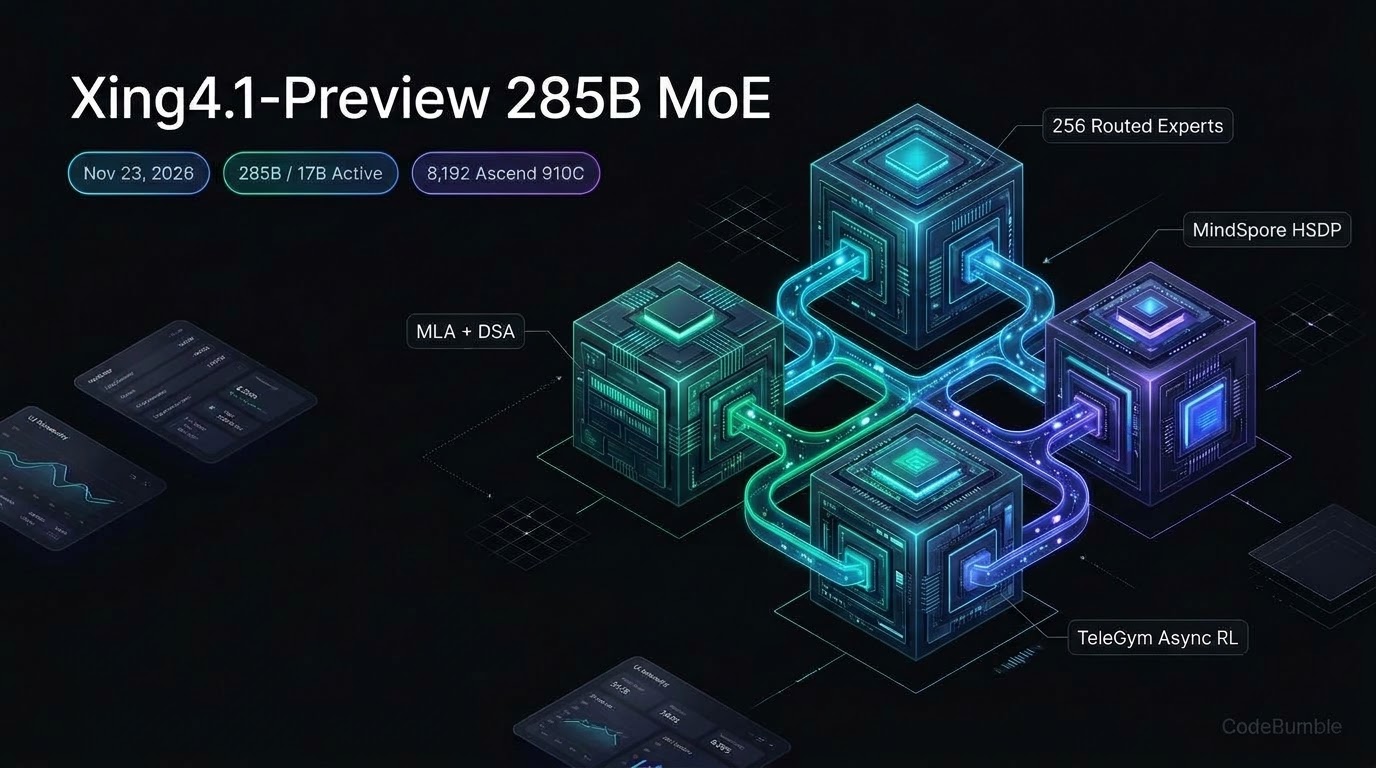
On November 23, 2026, China Telecom AI Technology (Xingchen AGI Lab) published Apache 2.0 open weights on Hugging Face for Xing4.1-Preview (XingChen-AGI/Xing4.1-Preview), a 285B-total / ~17B-active sparse Mixture-of-Experts (MoE) model with a 1M-token context window, following its November 17 technical report (arXiv:2611.22115) (Hugging Face Model Card; arXiv:2611.22115; explainx.ai). Its primary significance is infrastructural rather than leaderboard-topping: the entire pre-training pipeline ran end-to-end on 8,192 Huawei Ascend 910C accelerators using MindSpore HyperParallel and the TeleGym agent RL platform—without NVIDIA GPUs or CUDA anywhere in training—before being converted to PyTorch safetensors (~521.4 GiB BF16 across 261 shards) for vLLM, SGLang, ms-swift, and LLaMA-Factory (Hugging Face Model Card; Arniko Hack Club).
Empirically, engineers should separate the systems milestone from model quality. On its own Hugging Face model card, Xing4.1-Preview sits mid-pack against same-class flash models—scoring 20.6 on Terminal-Bench 4.0 (skipping GPU sandbox tasks), 45.3 on AutomationBench v1.0.6, and 50.7 on Apex-Agents v1.1, trailing Tencent Hy4-flash (52.2 / 63.1) and Z.ai GLM-5.3-Flash (35.4 / 48.4 / 51.5) (Hugging Face Model Card; Arniko Hack Club). Confidence in cross-hardware parity remains partial: Ascend 910C throughput numbers are author-reported (with attention comparisons relying on Huawei's Zhanlu simulator), and no independent third-party leaderboard audit has yet evaluated the preview checkpoint (arXiv:2611.22115; explainx.ai).
Architecture & How It Works
Wider-and-Shallower 45-Layer MoE + MLA & DSA
Xing4.1-Preview adopts a 45-layer decoder-only Transformer backbone (3 Dense FFN layers + 42 MoE FFN layers) with hidden size 4,096, 128 attention heads, 256 routed experts (8 active per token + 1 shared expert), and a 1M-token context window (RoPE/YaRN θ=100000, factor 32) (Hugging Face Model Card). In arXiv:2611.22115, the team shows that a 45-layer wider-FFN topology outperforms a 60-layer narrower baseline on Ascend 910C—cutting relative TTFT to 0.83×, relative TPOT to 0.90×, and boosting training throughput by ~10% by maximizing Cube matrix utilization and reducing per-layer routing/normalization overhead (arXiv:2611.22115).
Following the DeepSeek-V3.2 lineage, Xing4.1-Preview pairs Multi-head Latent Attention (MLA) (q LoRA rank 1536, kv LoRA rank 512) with DeepSeek Sparse Attention (DSA) (64 index heads, top-k 2,048) and cross-layer IndexShare, while DSpark provides block-wise speculative decoding during inference (Hugging Face Model Card; arXiv:2611.22115).
MindSpore HyperParallel & TeleGym Asynchronous RL
To train 285B parameters without pipeline bubbles on 8,192 Ascend 910C cards, China Telecom built on MindSpore HyperParallel (arXiv:2611.22115):
- Zero-Copy HSDP (No Pipeline Parallelism): Parameters are FSDP-sharded inside each SuperPoD and replicated across SuperPoDs (
PP=1), using zero-copy per-parameter collectives and three-way backward overlap to cut 1,024-NPU step time from 36.4 s (PP-1F1B) to 31.8 s (1.14× speedup) (arXiv:2611.22115). - Owner-Based Muon & Layer-Wise Indexer Backward: Assigning Newton–Schulz orthogonalization to a single owner rank per shard group cut step time by 9.1% (31.8 s → 28.9 s), selective operator recomputation via a 0–1 knapsack solver cut 6.9% (→ 26.9 s), and early layer-wise indexer backward cut 15.2% (→ 24.5 s) (arXiv:2611.22115).
- CPU Affinity & Core Isolation: Pinning training threads and isolating OS interrupts raised throughput by 1–2% on 512 cards and 5–10% on 8,192 cards (arXiv:2611.22115).
- TeleGym Post-Training: Separates rollout generation and policy optimization into disaggregated device pools with bounded oversampling and partial rollout, allowing long-horizon agent trajectories to pause at weight updates and resume under the new policy (arXiv:2611.22115).
flowchart LR
    A[8,192 Ascend 910C Cluster] --> B[MindSpore HyperParallel HSDP + Owner Muon]
    B --> C[285B / 17B-Active Backbone: MLA + DSA + IndexShare]
    C --> D[TeleGym Disaggregated Async RL + Partial Rollout]
    D --> E[PyTorch BF16 Safetensors 521.4 GiB / NVFP4 ~190 GB]
    E --> F[vLLM Plugin / SGLang TP=8 + DSpark]
SGLang & vLLM Serving Snippet (8×80 GB GPUs)
Because BF16 weights total ~521.4 GiB, full-precision serving requires 8×80 GB GPUs (--tp-size 8), while an NVFP4 build trims memory to ~190 GB (Hugging Face Model Card; Arniko Hack Club):
# Native SGLang main-branch serving (requires 8x 80 GB GPUs for BF16)
sglang serve --model-path XingChen-AGI/Xing4.1-Preview \
  --trust-remote-code \
  --host 0.0.0.0 \
  --port 8000 \
  --served-model-name Xing4.1-Preview \
  --tp-size 8 \
  --mem-fraction-static 0.90 \
  --max-running-requests 4 \
  --reasoning-parser xing4_0 \
  --tool-call-parser xing4_0
Benchmarks, Cost & Latency Analysis
Agentic & Reasoning Benchmarks (Model Card)
On Xing4.1-Preview's Hugging Face model card, China Telecom compares its preview checkpoint against public flash-class models (note that competitor scores are pulled from each model's public report, Terminal-Bench 4.0 skipped GPU sandbox tasks for Xing4.1-Preview, and HLE ran text-only) (Hugging Face Model Card):
| Benchmark | Xing4.1-Preview | Hy4-flash | GLM-5.3-Flash | DeepSeek-V4-Flash-0731 | Caveat | Source |
|---|---|---|---|---|---|---|
| Terminal-Bench 4.0 | 20.6† | 19.2 | 35.4 | 7.0 | †GPU sandbox tasks skipped for Xing4.1 | Hugging Face Model Card |
| AutomationBench v1.0.6 | 45.3 | 52.2 | 48.4 | 37.7 | Trails Hy4-flash and GLM-5.3-Flash | Hugging Face Model Card |
| Apex-Agents v1.1 | 50.7 | 63.1 | 51.5 | 55.3 | Trails all three flash peers | Hugging Face Model Card |
| HLE w/ tools | 45.7‡ | 55.2 | 52.2 | 51.5 | ‡Text-only subset for Xing4.1 | Hugging Face Model Card |
Claw-Eval (pass^3) |
49.7 | — | — | 49.3 | Near-tie with DeepSeek-V4-Flash | Hugging Face Model Card |
Systems & Inference Efficiency (arXiv:2611.22115)
In Zhanlu simulation at 256K context across 32 Ascend 910C cards (TP4DP4 prefill / TP2DP8 decode), adding DSA + IndexShare on top of MLA cut KV HBM access to 0.80×, relative TTFT to 0.21×, relative TPOT to 0.79×, and boosted prefill throughput by 4.68× and decode throughput by 1.27× (note the authors explicitly caveat that simulation can be more optimistic than end-to-end production serving) (arXiv:2611.22115). On six reasoning/coding benchmarks, DSpark speculative decoding delivered 2.67×–3.77× output throughput over the base model (peaking at 134.7 tok/s on HumanEval vs. 35.7 tok/s base) (arXiv:2611.22115).
Production Deployment & Trade-Offs
- When to Adopt
Xing4.1-Preview: Worth evaluating if you require Apache 2.0 commercial licensing, 1M-token context (served via Tianyi AI API at up to 896K input / 128K output), or multi-architecture deployment across Ascend and NVIDIA clusters via FlagOS, SGLang (main), or vLLM (xing4-vllm-plugin) (Hugging Face Model Card; Arniko Hack Club). - When to Pick Alternatives: For pure agentic coding and tool-use accuracy on NVIDIA GPUs,
GLM-5.3-Flash,Hy4-flash, andDeepSeek-V4.1-Flashscore higher across most reported benchmarks (Arniko Hack Club). - Operational & Governance Caveats: At ~521.4 GiB in BF16 (or ~190 GB in NVFP4), self-hosting still requires multi-GPU nodes;
llama.cppandKTransformerssupport applies only to the olderXing4.0series, notXing4.1-Preview; and procurement teams should verify the unbadgedXingChen-AGIHugging Face org and review export-control/compliance terms before deploying across cross-border clusters (Hugging Face Model Card; explainx.ai).
Frequently Asked Questions
Was Xing4.1-Preview really trained without NVIDIA GPUs?
Yes. According to China Telecom's technical report (arXiv:2611.22115) and model card, pre-training ran end-to-end on 8,192 Huawei Ascend 910C accelerators using MindSpore HyperParallel and TeleGym, before converting checkpoints to PyTorch safetensors for community serving (arXiv:2611.22115; Hugging Face Model Card).
What hardware is needed to self-host Xing4.1-Preview?
The unquantized BF16 checkpoint is ~521.4 GiB (261 shards), requiring roughly 8×80 GB GPUs (--tp-size 8) in vLLM or SGLang, while the quantized NVFP4 build reduces the footprint to roughly 190 GB (Hugging Face Model Card; Arniko Hack Club).
How does Xing4.1-Preview differ from Xing4.0?
Xing4.1-Preview uses a DeepSeek-V3.2-lineage MLA + DSA attention architecture (45 layers, 285B total / ~17B active), whereas Xing4.0-29B-A4B uses mHC + MLA + MTP; consequently, llama.cpp and KTransformers support applies only to Xing4.0, while Xing4.1-Preview runs on SGLang main, an official vLLM plugin, ms-swift, and LLaMA-Factory (Hugging Face Model Card).
What is TeleGym and why does it matter outside Ascend clusters?
TeleGym is China Telecom's unified agent RL platform that disaggregates rollout workers from policy trainers and supports partial rollouts across policy weight updates—a scheduling pattern equally applicable to CUDA/PyTorch agent harnesses with uneven tool latencies (arXiv:2611.22115; explainx.ai).
Does Xing4.1-Preview beat GLM-5.3-Flash or Hy4-flash on agent benchmarks?
No. On its own model card, Xing4.1-Preview trails Hy4-flash and GLM-5.3-Flash on AutomationBench v1.0.6, Apex-Agents v1.1, and HLE with tools, and trails GLM-5.3-Flash on Terminal-Bench 4.0 (20.6 vs. 35.4) (Hugging Face Model Card).
Sources
- XingChen-AGI/Xing4.1-Preview Model Card — Hugging Face (November 23, 2026 weights release)
- TeleChat to Xing4: Advancing Frontier Agentic Models on Domestic Chips and Frameworks — arXiv:2611.22115 (November 17, 2026)
- Xing4 and TeleGym: Frontier Agentic Training on 8,192 Ascend 910C GPUs — explainx.ai (Updated November 23, 2026)
- China Telecom Xing4.1 Ascend: 285B model goes open — Arniko Hack Club (November 23, 2026)