

AI
NVIDIA Alpamayo 2 Edge: 2B Reasoning VLA Architecture, DRIVE Thor Latency, and AlpaSim Benchmarks
NVIDIA open-sourced Alpamayo 2 Edge (OpenMDW-1.1 weights, Apache 2.0 code), a 2B-class reasoning vision-language-action (VLA) model combining a 2.45B Cosmos 3 Edge backbone with a 0.2B diffusion action expert for in-vehicle DRIVE AGX Thor deployment. Using adaptive <NOMINAL> tokens and FP8 TensorRT Edge-LLM + DFlash2 optimization, it reaches 160–190 ms latency and 15.15 km per at-fault incident in AlpaSim—though PyTorch BF16 validation is H100-only and LingoQA trails 34B Alpamayo 2 Super.
7 min read
NVIDIA Alpamayo 2 Edge: 2B Reasoning VLA Architecture, DRIVE Thor Latency, and AlpaSim Benchmarks
Executive Summary
NVIDIA has released Alpamayo 2 Edge (nvidia/Alpamayo2-Edge), an open-weight 2B-class reasoning vision-language-action (VLA) model designed for onboard autonomous vehicle planning on NVIDIA DRIVE AGX Thor, with weights under OpenMDW-1.1 and inference code under Apache 2.0 (Hugging Face Model Card; NVIDIA Technical Blog). While Hugging Face initially published the weights on November 10, 2026, broader ecosystem coverage and developer integration rolled out through November 22–23, 2026 (MarkTechPost; Emergent).
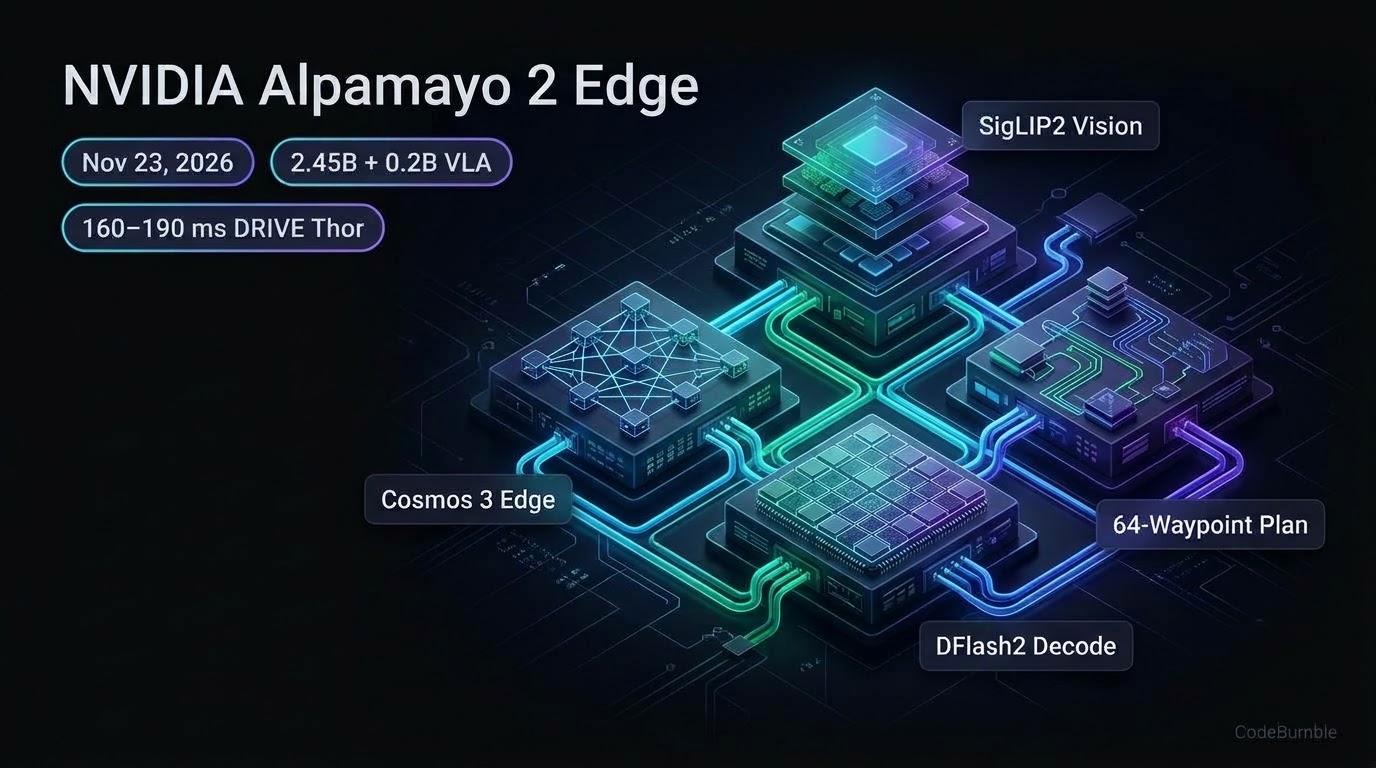
Using adaptive <NOMINAL> tokens to skip verbose Chain-of-Causation (CoC) traces during routine driving—plus an FP8 TensorRT Edge-LLM and DFlash2 speculative decoding pipeline—Alpamayo 2 Edge achieves 160 ms to 190 ms pixel-to-trajectory latency (13.02 Hz in AlpaSim) on DRIVE AGX Thor-X, and drives 15.15 ± 0.04 km per at-fault incident across 875 closed-loop AlpaSim scenarios (NVIDIA Technical Blog; MarkTechPost). Confidence in cross-hardware and comparative claims remains partial: Hugging Face's BF16 PyTorch validation is tested only on a single H100 80GB HBM3 GPU (12.06 GiB peak process memory), all AlpaSim/LingoQA numbers are self-reported by NVIDIA, and Alpamayo 2 Edge trails 34B Alpamayo 2 Super on LingoQA (75.2 vs. 79.2) (Hugging Face Model Card; MarkTechPost).
Architecture & How It Works
Parameter Breakdown: 2.45B Backbone + 0.2B Diffusion Action Expert
Although NVIDIA markets Alpamayo 2 Edge as a "2B" model, the Hugging Face model card specifies 2.45B backbone parameters (1.96B Nemotron-based language model from Cosmos 3 Edge, 0.41B SigLIP2 vision encoder, and 0.08B projector) paired with a 0.2B diffusion-based action expert—explaining why Hugging Face's safetensors metadata lists it as a 3B-class checkpoint (Hugging Face Model Card; MarkTechPost).
For trajectory prediction, the model ingests 6 cameras / 22 RGB frames per observation (5 frames each from front-wide and front-tele at -2, -1, -0.5, -0.1, 0 s; 3 frames each from cross-left, cross-right, rear-left, and rear-right at -1, -0.1, 0 s), 20 historical ego poses (-1.9 to 0 s at 0.1 s steps), and a navigation text prompt (Hugging Face Model Card). Its action expert runs 10 Euler flow-matching steps by default to output 64 waypoints spanning 0.1 to 6.4 seconds (xyz + 3×3 rotation matrices) integrated via a unicycle course-heading model (Hugging Face Model Card).
Adaptive Reasoning (<NOMINAL> Tokens) & AlpaJudge RL Loop
To avoid wasting onboard compute on trivial highway segments, Alpamayo 2 Edge emits a special <NOMINAL> token during routine driving instead of a full Chain-of-Causation trace, reserving multi-token causal explanations for complex maneuvers (NVIDIA Technical Blog). Training combines offline distillation from 34B Alpamayo 2 Super across ~115,000 hours of multi-camera video and ~3.7 million CoC traces, followed by closed-loop reinforcement learning in AlpaGym (which NVIDIA reports improved closed-loop driving by 128.5% over the best pre-RL checkpoint; note the blog's AI-generated summary cites 48.9% while the body text states 128.5%) and reasoning-reward shaping via AlpaJudge (AlpaJudge-RB reference-based and AlpaJudge-RF reference-free) (NVIDIA Technical Blog; Hugging Face Model Card).
flowchart LR
    A[6 Cameras: 22 Frames + 20 Ego Poses + Nav Text] --> B[0.41B SigLIP2 Vision + 0.08B Projector]
    B --> C[1.96B Cosmos 3 Edge / Nemotron LLM]
    C -->|Routine Scene| D[<NOMINAL> Token: Skip Full CoC]
    C -->|Complex Scene| E[Chain-of-Causation Trace + DFlash2]
    D --> F[0.2B Diffusion Action Expert: 10 Euler Steps]
    E --> F
    F --> G[64 Waypoints: 0.1s to 6.4s Trajectory]
DRIVE AGX Thor TensorRT Edge-LLM Execution Snippet
Running in real time on DRIVE AGX Thor-X (DRIVE OS 7.2.7.0, CUDA 13.4, TensorRT 11.3.1.9) requires calibrating FP8 scales, exporting ONNX graphs, and building TensorRT Edge-LLM engines with the DFlash2 speculative drafter (NVIDIA Technical Blog):
python -m alpamayo2edge_edgellm.runtime.run \
  --engines "$WORK/engines" \
  --model "$MODEL" \
  --reference "$INPUTS" \
  --dflash2 \
  --rolling \
  --warmup 1 \
  --repeat 5 \
  --output "$WORK/results.json"
Benchmarks, Cost & Latency Analysis
Closed-Loop, Open-Loop & VQA Benchmarks (NVIDIA-Reported)
All benchmark figures below come from NVIDIA's model card and technical blog; no independent third-party evaluation suite has reproduced them yet (Hugging Face Model Card; MarkTechPost):
- Closed-Loop AlpaSim (875 NuRec scenarios, 3 rollouts): 15.15 ± 0.04 km driven per at-fault incident—roughly 60x the 0.25 km NVIDIA measured for Alibaba's 4B
Qwen-Drive-1.0in its own run (Hugging Face Model Card; MarkTechPost). - Open-Loop Trajectory (
PhysicalAI-AV, 1,392 samples):minADE_6at 5 seconds of 0.52 m on the model card (0.53 m vs. 1.68 m for Qwen-Drive-1.0 in NVIDIA's blog comparison) (Hugging Face Model Card; MarkTechPost). - Driving VQA & Reasoning: 75.2 on LingoQA (Lingo-Judge), 86.50 on SURDS, 89.46 on KITScenes scene, 84.94 on Ego3D accuracy (5.97 m RMSE), 75.77 on WaymoQA (71.09 safety-critical), and 48.67 on nuReasoning numeric (Hugging Face Model Card).
Driving VLA Comparison Table
| Model | Organization | Parameters | Target Hardware | LingoQA (Lingo-Judge) | Closed-Loop (AlpaSim) | Weights License | Source |
|---|---|---|---|---|---|---|---|
| Alpamayo 2 Edge | NVIDIA | 2.45B backbone + 0.2B action expert | In-vehicle (DRIVE AGX Thor; 16 GB+ BF16) | 75.2 | 15.15 km / incident | OpenMDW-1.1 | MarkTechPost |
| Alpamayo 2 Super | NVIDIA | 32B backbone + 2B action expert | Cloud teacher model | 79.2 | Score 1.50 ± 0.13 | OpenMDW-1.1 | MarkTechPost |
| Alpamayo 1.5 | NVIDIA | 10B (Cosmos-Reason2) | Cloud (24 GB+ GPU) | 74.2 | Score 1.37 ± 0.10 | OpenMDW-1.1 | MarkTechPost |
| Qwen-Drive-1.0-4B | Alibaba Qwen | 4B shared VLM (Qwen3.5-4B) |
Not disclosed | 79.4 (SFT, self-reported) | 0.25 km / incident (NVIDIA run) | Apache 2.0 | MarkTechPost |
Latency & Memory Footprint
- PyTorch BF16 Baseline: Plans at 0.76 Hz in NVIDIA's demo video, consuming 12.06 GiB peak GPU process memory (8.40 GiB PyTorch allocation) on 1× H100 80GB with 22 images (3,236 prompt tokens) and 6 trajectory candidates; NVIDIA recommends 16 GB+ GPU memory (Hugging Face Model Card; MarkTechPost).
- FP8 TensorRT Edge-LLM + DFlash2 on DRIVE AGX Thor-X: Drops pixel-to-trajectory latency to 160–190 ms, reaching 13.02 Hz in AlpaSim, while partner Embedl reported 10 Hz on AGX Thor within 48 hours (NVIDIA Technical Blog; MarkTechPost).
Production Deployment & Trade-Offs
- When to Use Alpamayo 2 Edge: Best suited for automotive OEMs and Tier-1 robotics teams targeting onboard DRIVE AGX Thor or Autoware stacks (partner TIER IV has already integrated Alpamayo 2 Edge with Autoware) where <200 ms latency and auditable Chain-of-Causation traces are required without cloud connectivity (NVIDIA Technical Blog; Emergent).
- When to Use Alpamayo 2 Super: Keep the 34B cloud teacher model for offline auto-labeling, complex urban edge-case curation, and distilling custom fleet policies via
AlpaJudge-RB/AlpaJudge-RF(NVIDIA Technical Blog). - Hardware & Licensing Gotchas: Hugging Face explicitly notes that GPUs other than H100 80GB have not yet been validated for the BF16 PyTorch reference, and while inference code is Apache 2.0, the model weights use OpenMDW-1.1 and the
PhysicalAI-Autonomous-Vehiclestraining dataset carries separate access terms (Hugging Face Model Card). Also, remember to passenable_thinking=Falsein the chat template for free-form VQA prompts because thinking mode is enabled by default (Hugging Face Model Card).
Frequently Asked Questions
How many parameters does NVIDIA Alpamayo 2 Edge actually have?
Although marketed as a 2B model, the model card breaks down 2.45B backbone parameters (1.96B Nemotron-based LLM from Cosmos 3 Edge, 0.41B SigLIP2 vision encoder, 0.08B projector) plus a 0.2B diffusion action expert (~2.65B total; listed as 3B in Hugging Face metadata) (Hugging Face Model Card; MarkTechPost).
How does Alpamayo 2 Edge achieve 160–190 ms latency on DRIVE AGX Thor?
It combines adaptive <NOMINAL> tokens (skipping full Chain-of-Causation text on routine segments), DFlash2 speculative decoding, and an FP8 TensorRT Edge-LLM compilation pipeline on DRIVE OS 7.2.7.0, jumping from 0.76 Hz (PyTorch BF16) to 13.02 Hz in AlpaSim (NVIDIA Technical Blog; MarkTechPost).
What are the inputs and outputs of Alpamayo 2 Edge?
For trajectory prediction, it ingests 6 cameras (22 RGB frames), 20 past ego poses (-1.9 to 0 s), and a navigation instruction, outputting 64 waypoints over 6.4 seconds alongside optional Chain-of-Causation reasoning (Hugging Face Model Card).
What is AlpaJudge and how does it work?
AlpaJudge (nvidia/alpajudge) is NVIDIA's human-calibrated reasoning evaluator with two variants: AlpaJudge-RB (reference-based text alignment) and AlpaJudge-RF (reference-free scoring using 6 front-wide/front-tele frames and meta-actions). It is used for dataset curation and as a GRPO RL reward (NVIDIA Technical Blog).
What licenses govern Alpamayo 2 Edge weights and code?
The inference and training source code is licensed under Apache 2.0, while the model weights are released under OpenMDW-1.1, and the PhysicalAI-Autonomous-Vehicles dataset requires accepting its own access terms (Hugging Face Model Card).
Sources
- nvidia/Alpamayo2-Edge Model Card — Hugging Face (November 10–13, 2026)
- Running AV Reasoning Models Within Onboard Compute and Latency Limits — NVIDIA Technical Blog (November 10, 2026)
- NVIDIA Releases Alpamayo 2 Edge: A 2B Reasoning VLA for DRIVE Thor — MarkTechPost (November 22–23, 2026)
- NVIDIA Alpamayo 2 Edge: 2B Reasoning VLA for DRIVE Thor — Emergent (November 23, 2026)