

Web performance
Chrome 158 Removes XSLT on November 17, 2026: The Rust XML Parser Shift and Migration Playbook
On November 17, 2026, Chrome 158 disables XSLTProcessor and xml-stylesheet transformations on Stable—closing a legacy C attack surface highlighted by the CVE-2026-125350 zero-day while migrating XML parsing to Rust. Learn what breaks (sitemaps, RSS feeds, RD Web Access) and how to audit and migrate safely.
8 min read
Chrome 158 Removes XSLT on November 17, 2026: The Rust XML Parser Shift and Migration Playbook
Executive Summary
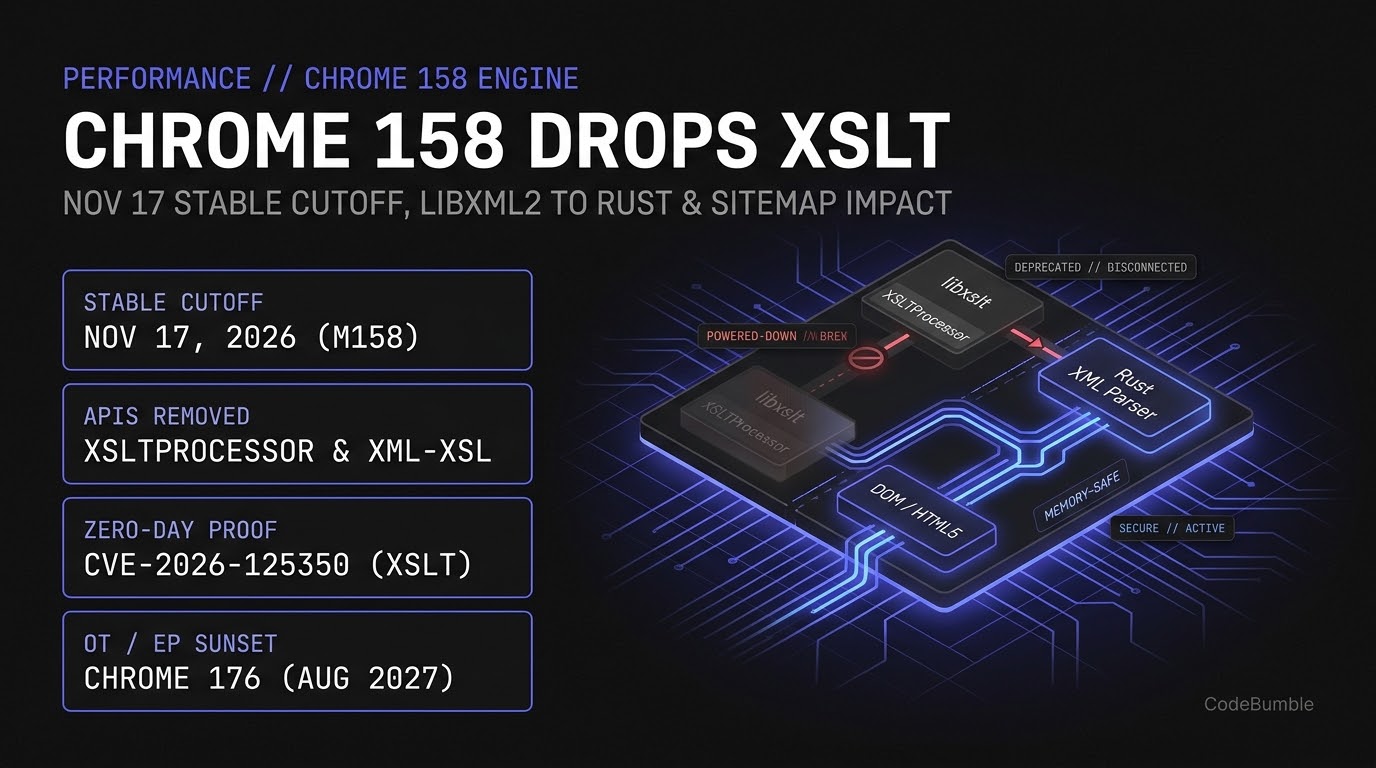
On November 17, 2026, Chrome 158 reaches its scheduled Stable cutoff for client-side XSLT (Extensible Stylesheet Language Transformations). As documented in Google's Removing XSLT for a more secure browser specification and Chrome Platform Status, Chromium is disabling both the XSLTProcessor JavaScript API and <?xml-stylesheet type="text/xsl" ...?> processing instructions on Stable releases for all users outside the Origin Trial and Enterprise Policy exceptions (which themselves expire in Chrome 176 on August 17, 2027).
The timing is underscored by recent threat intelligence: just days before the cutoff, ThreatDefence reported on CVE-2026-125350, an actively exploited Chrome zero-day vulnerability in XSLT (also added to CISA's Known Exploited Vulnerabilities catalog on November 10, 2026) that required emergency patches in Chrome 157.0.8103.50, Chrome 158 (158.0.8127.30 or later), and Microsoft Edge 157.0.4341.46. Alongside removing libxslt, the Chrome team plans to replace libxml2 XML parsing inside Chromium with a memory-safe XML parser written in Rust—leaving standard XML support intact while eliminating two legacy C attack surfaces.
Confidence level: High for Chrome 158's November 17, 2026 Stable cutoff, affected APIs, Origin Trial/Enterprise Policy sunset dates (Chrome 176, August 17, 2027), and CVE-2026-125350 patch versions, all verified against Chrome for Developers, Chrome Platform Status, and ThreatDefence. Downstream enterprise impact on third-party portals (such as RD Web Access and HCL Connections) is verified from vendor/community advisories; exact rollout percentages across Chrome 158 Stable channels vary by stepped rollout timing.
Technical Mechanics and Architecture
What Chrome 158 Removes—and What Stays
Client-side XSLT allows a browser to fetch a raw XML document containing an <?xml-stylesheet type="text/xsl" href="..."?> processing instruction—or invoke new XSLTProcessor() in JavaScript—and transform that XML into HTML on the client thread. Starting with Chrome 158 (November 17, 2026):
XSLTProcessorJavaScript API: Callingnew XSLTProcessor()fails because the interface is removed for standard Stable users, throwing aReferenceErrorin legacy web applications.<?xml-stylesheet ...?>XSLT processing instructions: Styled XML sitemaps, styled RSS/Atom feeds, and XML-backed hardware/enterprise dashboards no longer execute the.xslstylesheet; instead, browsers render raw XML text or unstyled tag trees.- Standard XML remains supported: As Chrome for Developers emphasizes, Chrome is not removing XML parsing, serialization, or
DOMParser(application/xml,text/xml). Only XSLT transformation is removed.
+-----------------------------------------------------------------------+
|             CHROMIUM XML & XSLT ENGINE TRANSITION (2026)              |
+-----------------------------------------------------------------------+
|                                                                       |
|  [Legacy Path: Chrome <= 157]                                         |
|   |-- XML Document + <?xml-stylesheet type="text/xsl"?>               |
|   |-- JS: new XSLTProcessor().transformToDocument()                   |
|   v                                                                   |
|  [C/C++ libxml2 + libxslt] --> High memory-safety risk (CVE-2026-125350)|
|                                                                       |
|  -------------------------------------------------------------------  |
|                                                                       |
|  [Hardened Path: Chrome 158+ (Nov 17, 2026)]                          |
|   |-- XSLTProcessor & xml-stylesheet DISABLED (unless OT / EP)        |
|   |-- XML Parsing: Migrating libxml2 -> Memory-safe Rust XML parser   |
|   |-- Recommended App Replacements:                                   |
|       1. Server-side XSLT -> HTML pre-rendering                       |
|       2. Pure HTML5 / CSS / JSON + DOM templates                      |
|       3. Client-side JS/WASM fallback (e.g., SaxonJS)                 |
|                                                                       |
+-----------------------------------------------------------------------+
Why libxslt and libxml2 Became Unacceptable Browser Attack Surfaces
As noted on Chrome Platform Status, client-side XSLT is a niche, rarely used feature whose underlying C libraries receive far less maintenance and fuzzing scrutiny than core JavaScript engines like V8. Yet XSLT exposes complex recursive tree transformations and memory-management paths directly to untrusted web content. Removing libxslt eliminates that attack surface immediately, while migrating Chromium's remaining XML parsing from libxml2 to a memory-safe Rust parser addresses memory-corruption classes (such as use-after-free and buffer overflows) transparently to web developers.
Safe Repository and Endpoint Audit Script
Because XSLT regressions often hide in forgotten /sitemap.xml, /feed.xml, or legacy admin endpoints—and analytics trackers rarely capture raw XML render failures—use this safe, read-only Python scanner to audit local repositories and live staging URLs for XSLTProcessor calls and xml-stylesheet headers:
#!/usr/bin/env python3
"""
Safe, read-only audit script to detect client-side XSLT usage
(XSLTProcessor API calls and <?xml-stylesheet?> instructions)
across local source trees before/after Chrome 158 rollout.
"""
import re
from pathlib import Path

PATTERNS = {
    "xslt_processor_js": re.compile(r"\bnew\s+XSLTProcessor\s*\("),
    "xml_stylesheet_pi": re.compile(r"<\?xml-stylesheet\b[^>]*type\s*=\s*['\"]text/xsl['\"]", re.IGNORECASE),
    "xsl_transform_tag": re.compile(r"<xsl:stylesheet\b|<xsl:transform\b", re.IGNORECASE),
}

TARGET_EXTENSIONS = {".js", ".ts", ".jsx", ".tsx", ".html", ".xml", ".xsl", ".xslt", ".php", ".jsp"}

def scan_repo(root_dir: str) -> list[dict]:
    findings = []
    for path in Path(root_dir).rglob("*"):
        if not path.is_file() or path.suffix.lower() not in TARGET_EXTENSIONS:
            continue
        if any(part in {"node_modules", ".git", "dist", "build"} for part in path.parts):
            continue
        try:
            text = path.read_text(encoding="utf-8", errors="replace")
        except OSError:
            continue
        for idx, line in enumerate(text.splitlines(), start=1):
            for rule_name, regex in PATTERNS.items():
                if regex.search(line):
                    findings.append({"file": str(path), "line": idx, "rule": rule_name})
    return findings
Evidence, Timeline, and Cross-Browser Status
The deprecation and removal schedule spans two years across Chromium, Microsoft Edge, Mozilla Firefox, and Apple WebKit, as compiled from Chrome for Developers, Microsoft Edge Web Platform, and ISO/TC 81:
| Milestone / Browser | Date | Action / Impact |
|---|---|---|
| Chrome 142 | October 28, 2025 | Early-warning console messages added |
| Chrome 143 | December 2, 2025 | Official deprecation warnings in DevTools console & Lighthouse |
| Chrome 146 | March 10, 2026 | Enterprise Policy (XSLTEnabled) available for testing/opt-in |
| Chrome 152 | August 25, 2026 | Origin Trial live for temporary site-level extension |
| Chrome 154 | September 22, 2026 | WebView Canary, Dev, and Beta disable XSLT by default |
| Chrome 158 (Stable) | November 17, 2026 | XSLT stops working on Stable (except OT & Enterprise Policy) |
| Microsoft Edge 158 / 159 | Nov–Dec 2026 | Follows Chromium XSLT removal (impacts RD Web Access without fix) |
| Mozilla Firefox | August 2027 (planned) | Planned removal of XSLT support |
| Chrome 176 | August 17, 2027 | Origin Trial & Enterprise Policy expire; XSLT disabled for all users |
In enterprise environments, the cutoff has already triggered visible compatibility work:
- Nintex K2 shipped Fix Packs for K2 5.7, 5.8, 5.9, and 5.9.1+ ahead of November 17, 2026.
- HCL Connections documented broken community, blog, forum, and search widgets that relied on browser-side XSLT.
- Microsoft RD Web Access and ISO 1750:2023 datasets required explicit migration plans or temporary enterprise policy overrides.
- Regulated enterprise feedback on Chromium Issue 435623334 noted active migrations to SaxonJS, while requesting additional runway beyond Chrome 158 for validated environments.
Hardening and Migration Playbook
Follow these six steps to audit, patch, and migrate away from browser-side XSLT cleanly.
1. Patch Browsers First Against CVE-2026-125350
Verify that all managed endpoints run Chrome 157.0.8103.50 or 158.0.8127.30+ (or Edge 157.0.4341.46+) so the actively exploited XSLT zero-day (CVE-2026-125350) is closed regardless of any temporary Enterprise Policy exceptions.
2. Scan Sitemaps, RSS Feeds, and Legacy Dashboards
Run a read-only curl check against your public XML endpoints to see if any return <?xml-stylesheet type="text/xsl"?>:
curl -s https://your-domain.example/sitemap.xml | head -n 10 | grep -i 'xml-stylesheet'
Note that search engine crawlers (Googlebot) parse the raw XML sitemap regardless of XSL styling, so removing <?xml-stylesheet?> from sitemaps does not harm SEO—it only removes the human-readable HTML styling in browsers.
3. Move Transformations Server-Side or to JSON + HTML5
For human-facing reports, RSS previews, and admin UIs, perform the XML-to-HTML transformation on the server (using hardened server libraries with external entity/DTD expansion disabled to prevent XXE) or serve JSON payloads rendered via standard DOM templates.
4. Use SaxonJS Only as a Transitional Client-Side Bridge
If an application cannot immediately rewrite its .xsl stylesheets, migrate new XSLTProcessor() calls to a maintained JavaScript/WebAssembly XSLT engine such as SaxonJS (as documented on Chromium Issue 435623334), avoiding native browser libxslt dependencies.
5. Use XSLTEnabled Enterprise Policy Strictly as Time-Boxed Mitigation
For regulated internal apps (such as legacy RD Web Access or HCL Connections) that break on November 17, 2026, IT admins can temporarily set the XSLTEnabled policy while completing server-side migration—but must schedule full retirement before Chrome 176 (August 17, 2027) when the policy stops functioning.
6. Rollback Note
If a production portal breaks immediately after Chrome 158 updates on managed desktops, do not downgrade Chrome to an unpatched pre-157 build (which re-exposes CVE-2026-125350). Instead, apply the temporary XSLTEnabled Enterprise Policy scoped strictly to affected internal origins via MDM/GPO while deploying the server-side or SaxonJS fix.
Frequently Asked Questions (FAQ)
1. Does Chrome 158 remove XML support from the browser?
No. According to Chrome for Developers, Chrome keeps XML parsing, serialization, and DOMParser intact, while migrating internal XML parsing from libxml2 to a memory-safe Rust parser. Only XSLT (XSLTProcessor and <?xml-stylesheet type="text/xsl"?>) is removed.
2. Will removing <?xml-stylesheet?> from sitemap.xml hurt SEO?
No. Search engines like Googlebot read the underlying <urlset> XML structure directly. Removing the XSL stylesheet only changes how the sitemap looks when opened manually in a browser tab.
3. How long do Origin Trials and Enterprise Policies keep XSLT working?
Per Google's published timeline, both the Origin Trial and the XSLTEnabled Enterprise Policy stop functioning in Chrome 176 on August 17, 2027, at which point XSLT is disabled for all users.
4. Are Firefox and Safari removing XSLT too?
Yes. Both Firefox and WebKit/Safari have indicated plans to remove XSLT; Mozilla is targeting August 2027, while Apple has not yet published a specific date (ISO/TC 81).
5. Why is Google removing XSLT now?
Legacy C libraries (libxslt and libxml2) have a long history of memory-safety vulnerabilities, including CVE-2026-125350, an actively exploited XSLT zero-day patched in November 2026. Removing XSLT eliminates a rarely used, high-risk attack surface.
Sources
- Chrome for Developers — Removing XSLT for a more secure browser (Published October 29, 2025; Chrome 158 milestone November 17, 2026)
- Chrome Platform Status — Deprecate and remove XSLT (Feature 4709671889534976) (Official Status Tracker)
- ThreatDefence — Chrome CVE-2026-125350 Zero-Day: Patching and Hunting (Published November 15, 2026)
- Chromium Issue Tracker — Deprecate and remove XSLT (Issue 435623334) (Updated September 10, 2026)
- Stacklumen — Chrome 158 turns off XSLT on 17 November (Published November 14, 2026)
- ISO/TC 81 — Warning message on ISO 1750:2023 (Browser XSLT Removal Timeline) (Published October 13, 2026)