

Web performance
CrUX Expands Soft Navigation Metrics With FCP and Navigation Types Ahead of May 2027 Core Web Vitals Cutover
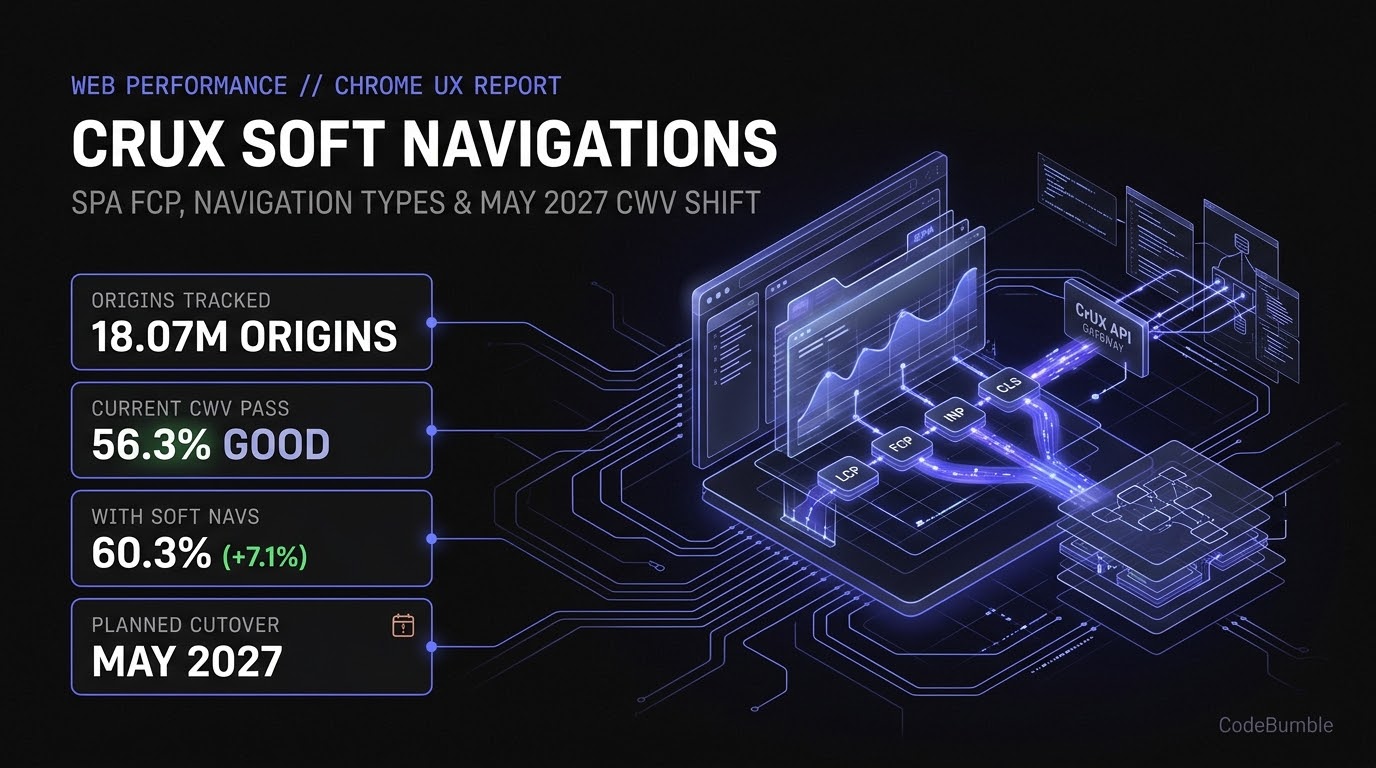
Published November 11, 2026, the October 2026 Chrome UX Report (CrUX) release expands experimental soft navigation telemetry to include FCP and Navigation Types in the CrUX APIs and CrUX Vis. Across 18,070,207 origins, including soft navigations—planned for May 2027—lifts good Core Web Vitals pass rates from 56.3% to 60.3%.
8 min read
CrUX Expands Soft Navigation Metrics With FCP and Navigation Types Ahead of May 2027 Core Web Vitals Cutover
Executive Summary
In the October 2026 Chrome UX Report (CrUX) release notes published November 11, 2026 (the latest significant official web performance release as of November 17, 2026), Google expanded its experimental soft navigation telemetry to include First Contentful Paint (FCP) and Navigation Types data inside the CrUX APIs and CrUX Vis, with BigQuery support slated for the following month.
Across 18,070,207 origins in the October 2026 dataset, 56.3% of origins currently pass Core Web Vitals under traditional "hard navigation" measurement (68.8% good LCP, 81.6% good CLS, 85.2% good INP). However, when experimental soft navigations are included—as Chrome plans to make standard starting in May 2027—global pass rates jump to 60.3% overall (+7.1% relative improvement), driven by 73.6% good LCP (+7.0%), 85.0% good CLS (+4.2%), and 87.0% good INP (+2.1%).
For Single Page Application (SPA) engineering teams using React, Next.js, Angular, or Vue, this marks a structural shift in how real-user field performance is attributed. Instead of lumping an entire multi-route user session onto the initial landing URL, Chrome's Soft Navigations API (PerformanceSoftNavigation and InteractionContentfulPaint) slices LCP, FCP, INP, and CLS per route transition. Confidence is high on all CrUX origin figures and API schemas (sourced directly from Chrome for Developers and web.dev), and partial on cross-browser parity because non-Chromium engines do not yet support these APIs.
Technical Mechanics and Architecture
Historically, Core Web Vitals only measured top-level document loads ("hard navigations"). When a user clicked a link in an SPA and JavaScript updated the DOM plus history.pushState(), metric values were never reset, and every layout shift or slow interaction remained attributed to the initial landing URL.
Beginning in Chrome 151, Chrome introduced two standardized performance primitives documented in How SPA architectures affect Core Web Vitals:
PerformanceSoftNavigation(soft-navigationentries): Emitted when a user action initiates both a visible URL change and a visible paint, attaching a uniquenavigationIdto subsequent performance entries.InteractionContentfulPaint(interaction-contentful-paintentries): Measures contentful paints following an interaction so FCP (paintTime/presentationTime) and LCP (getLargestInteractionContentfulPaint()) can be computed for each SPA route transition.
[Initial Document Load ("Hard Nav" — navigationId: A)]
   |--> Hard LCP finalized on first user interaction
   |--> Hard CLS & INP run until first soft navigation (in experimental CWV)
   |
   v  User Click / Tap -> DOM Update + URL Change + Visible Paint
+-------------------------------------------------------------------+
| PerformanceSoftNavigation Emitted (navigationId: B, name: /cart)  |
|  - Finalizes Hard Nav (A) CLS & INP and attributes to Landing URL |
|  - startTime = timestamp of initiating user interaction           |
+-------------------------------------------------------------------+
   |
   v  (Subsequent Paints & Interactions scoped to navigationId: B)
+-------------------------------------------------------------------+
| Soft Nav Telemetry Plane                                          |
|  - FCP: soft-navigation paintTime / presentationTime              |
|  - LCP: getLargestInteractionContentfulPaint() (subtract startTime)|
|  - INP: interactions between navigationId B and C                 |
|  - CLS: layout-shift windows between navigationId B and C         |
+-------------------------------------------------------------------+
   |
   v  Reported to CrUX & RUM Endpoints
[CrUX APIs (Oct 2026: FCP + Nav Types) -> CrUX Vis / BigQuery (May 2027 GA)]
Key Subtlety: startTime Offset and Interaction Attribution
When instrumenting Real User Monitoring (RUM) for soft navigations, engineers must account for two critical timing differences documented in Measuring soft navigations:
- Relative timestamps: All performance entries—even those emitted after a soft navigation—report
startTimerelative to the initial hard navigation. To compute soft-navigation LCP or FCP, you must subtractsoftNavEntry.startTimefrom the paint entry's timestamp. - Initiating interaction INP belongs to the previous route: The interaction that triggers a soft navigation (for example, clicking a product card) is typically attributed to the previous navigation (
navigationId: A), just as a traditional link click's INP is attributed to the origin page rather than the destination page. - Observer vs
getEntriesByType: Callingperformance.getEntriesByType('soft-navigation')is capped at the first 50 buffered entries, so long-lived SPAs must use aPerformanceObserverrather than pollinggetEntriesByType.
Defensive RUM Instrumentation Snippet (Read-Only Telemetry)
The JavaScript snippet below demonstrates how to safely feature-detect and observe soft-navigation entries alongside navigationId attribution without affecting main-thread responsiveness or breaking non-Chromium browsers:
// Safe, read-only PerformanceObserver for Chrome Soft Navigations (Chrome 151+)
(function initSoftNavTelemetry() {
  if (typeof PerformanceObserver !== 'function') return;

  const supported = PerformanceObserver.supportedEntryTypes || [];
  if (!supported.includes('soft-navigation')) {
    // Non-Chromium or older browsers: fall back to standard hard-nav web-vitals
    return;
  }

  const activeNavigations = new Map();

  const softNavObserver = new PerformanceObserver((list) => {
    for (const entry of list.getEntries()) {
      const navRecord = {
        navigationId: entry.navigationId,
        url: entry.name,
        startTime: entry.startTime,
        fcpRelativeMs:
          typeof entry.presentationTime === 'number'
            ? Math.max(0, entry.presentationTime - entry.startTime)
            : null,
      };
      activeNavigations.set(entry.navigationId, navRecord);

      // Compute soft-nav LCP relative to the initiating interaction's startTime
      if (typeof entry.getLargestInteractionContentfulPaint === 'function') {
        const lcpEntry = entry.getLargestInteractionContentfulPaint();
        if (lcpEntry) {
          navRecord.lcpRelativeMs = Math.max(0, lcpEntry.startTime - entry.startTime);
        }
      }

      // Send via navigator.sendBeacon or batch queue (never block main thread)
      console.debug('[RUM SoftNav]', navRecord);
    }
  });

  softNavObserver.observe({ type: 'soft-navigation', buffered: true });
})();
Evidence: CrUX Dataset Trends and Soft Navigation Impact
All figures in this section come directly from the Chrome UX Report Release Notes (updated November 11, 2026) and CrUX Metrics Documentation (updated October 13, 2026).
| Metric | Oct 2026 Standard (Hard Nav Only) | Oct 2026 With Soft Navs (May 2027 Target) | Delta |
|---|---|---|---|
| Origins Tracked | 18,070,207 (↓ 1.7% MoM) | 18,070,207 | — |
| Good LCP (≤ 2.5s at p75) | 68.8% (↑ 0.7% MoM) | 73.6% | +7.0% relative |
| Good CLS (≤ 0.1 at p75) | 81.6% (↓ 0.1% MoM) | 85.0% | +4.2% relative |
| Good INP (≤ 200ms at p75) | 85.2% (↓ 0.2% MoM) | 87.0% | +2.1% relative |
| Overall Good Core Web Vitals | 56.3% (↑ 0.7% MoM) | 60.3% | +7.1% relative |
Why Do Pass Rates Rise When Soft Navigations Are Included?
- Ending "hard nav" CLS and INP earlier: Under the experimental CrUX soft navigation methodology, the initial hard navigation's CLS and INP windows terminate when the first soft navigation occurs. Previously, an SPA user who stayed on a session for 20 minutes accumulated layout shifts and heavy interactions across dozens of views onto the single landing page's CLS/INP score.
- Cached client-side assets and warm connections: Soft navigations reuse already-parsed JavaScript bundles, warm TLS/HTTP/3 connections, and cached API responses, producing faster LCP (
73.6%good vs68.8%) and fewer unexpected layout shifts (85.0%good vs81.6%) across subsequent SPA views. - September vs. October 2026 trajectory: In the September 2026 dataset (published October 13, 2026 across 18,376,044 origins), including soft navigations lifted overall CWV pass rates by
+6.4%(55.9%to59.5%). In October 2026, that lift widened to+7.1%(56.3%to60.3%), confirming a consistent upward shift for SPA-heavy origins.
Experimental CrUX Field Names to Query Now
Teams querying the CrUX BigQuery dataset or CrUX API today can inspect both standard and soft-navigation variants side by side:
experimental_largest_contentful_paint_with_softnavsexperimental_interaction_to_next_paint_with_softnavsexperimental_cumulative_layout_shift_with_softnavs- Plus the newly added FCP and Navigation Types with soft navs in the CrUX APIs and CrUX Vis (November 11, 2026).
Optimization & Measurement Playbook
Use this step-by-step workflow to audit your SPA's soft-navigation readiness before CrUX graduates these metrics out of experimental status in May 2027:
1. Compare Hard-Nav vs. Soft-Nav CWV in CrUX Vis and CrUX API
Pull your origin's October 2026 data from CrUX Vis or query the CrUX API directly to compare your standard p75 LCP/INP/CLS against the _with_softnavs experimental fields:
# Query CrUX API for your origin (replace YOUR_API_KEY and origin)
curl -s -X POST "https://chromeuxreport.googleapis.com/v1/records:queryRecord?key=${CRUX_API_KEY}" \
  -H "Content-Type: application/json" \
  -d '{"origin":"https://example.com","formFactor":"PHONE"}' | jq '.record.metrics | keys'
2. Audit Route Transitions in Chrome DevTools Performance Panel
Chrome DevTools supports soft navigations directly in the Performance panel (and the November 2026 DevTools update adds smoother timeline navigation and preserved Call tree/Bottom-up state across panel switches). Record a multi-route SPA flow, confirm that each route change emits a soft-navigation marker, and inspect any task exceeding 50 ms during route rendering.
3. Yield Long Main-Thread Tasks During SPA Transitions
Because soft navigation startTime begins at the initiating click/tap—including event handler execution—heavy synchronous state hydration or DOM diffing directly inflates both INP and soft-navigation LCP:
- Break up synchronous route-transition tasks > 50 ms using
scheduler.yield(). - Avoid synchronous
getBoundingClientRect()/ layout-thrashing reads immediately after mutating the DOM on route change. - Reserve explicit
min-heightoraspect-ratiocontainers for asynchronously fetched route components so soft-navigation CLS stays ≤0.1.
4. Validate Framework history.pushState Timing
Chrome's soft navigation heuristic requires a user action, a visible URL change, and a visible paint. If your SPA updates the URL after an asynchronous fetch completes, or skips pushState on tabbed views, interaction-contentful-paint entries may occur before the soft navigation entry is finalized. Ensure route URLs update deterministically in response to user navigation events.
5. Maintain Dual Reporting Until Cross-Browser Parity Arrives
Because Safari (WebKit) and Firefox (Gecko) do not yet implement PerformanceSoftNavigation, keep your existing hard-navigation web-vitals reporting pipeline active alongside soft-navigation telemetry so non-Chromium traffic remains visible in your RUM dashboards.
Frequently Asked Questions (FAQ)
When will CrUX make soft navigation Core Web Vitals the default?
According to the Chrome UX Report release notes (November 11, 2026) and web.dev SPA FAQ, Chrome plans to graduate the experimental soft navigation Core Web Vitals metrics to stable metrics in May 2027.
What changed in the November 11, 2026 CrUX update?
For the October 2026 dataset published November 11, 2026, Chrome expanded soft navigation telemetry in the CrUX APIs and CrUX Vis to include First Contentful Paint (FCP) and Navigation Types data with soft navigations, with BigQuery inclusion following next month.
How much do soft navigations change global Core Web Vitals pass rates?
In the October 2026 dataset across 18,070,207 origins, including soft navigations increases good LCP from 68.8% to 73.6% (+7.0%), good CLS from 81.6% to 85.0% (+4.2%), good INP from 85.2% to 87.0% (+2.1%), and overall good Core Web Vitals from 56.3% to 60.3% (+7.1%).
Do Safari and Firefox support the Soft Navigations API?
No. As documented on web.dev, PerformanceSoftNavigation and InteractionContentfulPaint are currently Chromium-only (introduced in Chrome 151); other browser engines still measure Core Web Vitals across full page loads only.
Why should I use PerformanceObserver instead of performance.getEntriesByType('soft-navigation')?
getEntriesByType is limited to the first 50 buffered entries, so long-lived SPAs with more than 50 route transitions will miss later navigations unless they subscribe via PerformanceObserver.
Sources
- Chrome for Developers: Release notes | Chrome UX Report (Updated November 11, 2026)
- Chrome for Developers: Measuring soft navigations | Web Platform (Accessed November 17, 2026)
- web.dev: How SPA architectures affect Core Web Vitals (Published October 13, 2026)
- Chrome for Developers: Metrics | Chrome UX Report (Updated October 13, 2026)
- Chrome for Developers: New in DevTools - November 2026 (Published October 20, 2026)