

Technology
Cloudflare Search for Agents & RFC 10008 (HTTP QUERY): Architecture, Discovery & December 2026 Billing
Cloudflare launched Search for Agents on November 25, 2026, putting an automatic AI Search index and /.well-known/search endpoint behind a single toggle with native RFC 10008 HTTP QUERY support. Here is how discovery, Markdown passage retrieval, and December 1 site-owner billing work.
8 min read
Cloudflare Search for Agents & RFC 10008 (HTTP QUERY): Architecture, Discovery & December 2026 Billing
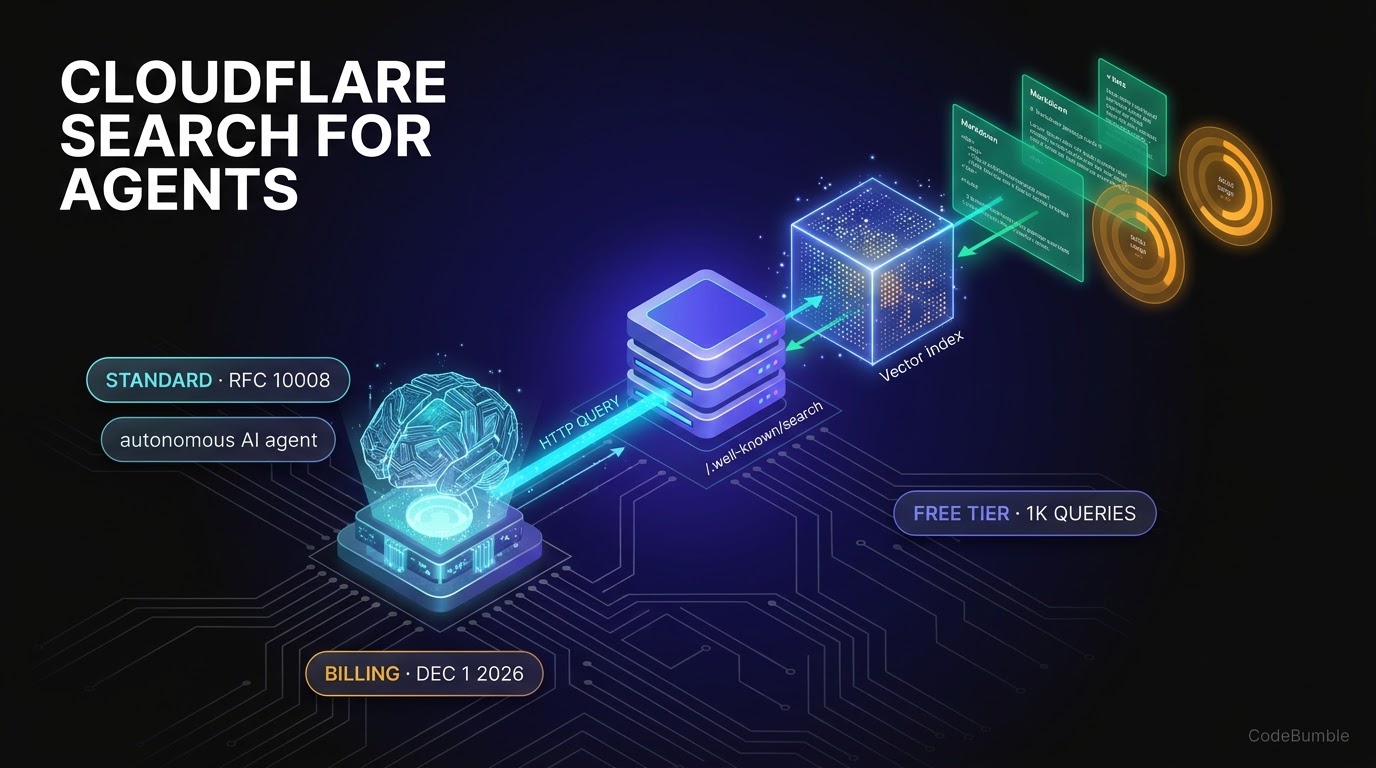
Executive Summary
On November 25, 2026, Cloudflare launched Search for Agents across all customer plans—a single-toggle network feature that automatically indexes a domain's content, advertises a machine-readable /.well-known/search endpoint in HTML <head> tags and Markdown YAML front matter, and returns scored Markdown passages rather than generated answers. Crucially, the endpoint natively supports HTTP QUERY, the new safe and idempotent request-body method standardized by the IETF in June 2026 as RFC 10008.
For web architects, API maintainers, and site owners, three verified facts define the trade-offs of enabling Search for Agents:
- Retrieval without answer synthesis: Search for Agents builds a hosted index using Qwen3 embeddings and 1,024-token chunks (per Emergent's technical coverage), returning up to 50 Markdown passages (default 10) with relevance scores so the calling agent's own LLM handles synthesis.
- First new standard HTTP method since 2010 (
PATCH): RFC 10008QUERYlets agents send natural-language questions or JSON payloads in the request body (keeping sensitive queries out of URLs and server access logs) while remaining safe, idempotent, and CDN-cacheable when the cache key includes the request body. - Site owners pay the query bill starting December 1, 2026: While available on Free and Paid Workers plans, usage is metered under Cloudflare AI Search pricing. Every account receives 5 million ingestion tokens, 10 GB-month of storage, 1,000 semantic queries, and 1,000 full-text queries per month before overage rates apply—making bot/WAF gating essential before December 1.
What Changed & How Search for Agents Works
For the past two years, AI agents looking up documentation or product specs on third-party websites relied on brute-force HTML scraping: fetching pages, stripping navigation bars and cookie banners, and burning context tokens on boilerplate. Cloudflare's earlier Markdown for Agents feature addressed page conversion via Accept: text/markdown content negotiation, but agents still had to guess which URLs to fetch.
Search for Agents moves site search to the edge network layer behind a single dashboard toggle (under Quick Actions on a zone page) or API call.
sequenceDiagram
    participant Agent as AI Agent (OpenCode / curl / undici)
    participant Edge as Cloudflare Edge + WAF
    participant Index as AI Search Instance (Qwen3)

    Agent->>Edge: GET / (Accept: text/html or text/markdown)
    Edge-->>Agent: Returns page + agent:endpoint meta / YAML front matter
    Agent->>Edge: QUERY /.well-known/search (JSON or plain-text body)
    Edge->>Edge: Checks Bot Management, AI Crawl Control & WAF
    Edge->>Index: Semantic / hybrid vector lookup (1,024-token chunks)
    Index-->>Edge: Scored Markdown passages (default 10, max 50)
    Edge-->>Agent: Returns retrieved Markdown passages for agent synthesis
Automatic Discovery via HTML <head> & YAML Front Matter
Once enabled, Cloudflare injects discovery metadata into every HTML response's <head> so any visiting agent immediately learns where to search instead of crawling link by link:
<meta name="agent:instructions" content="Use this search API to find relevant content across this site with keywords or natural-language queries, instead of crawling individual pages. Results are returned in Markdown.">
<meta name="agent:endpoint" content="https://developers.cloudflare.com/.well-known/search?q={query}">
<meta name="agent:method" content="GET">
<meta name="agent:documentation" content="https://developers.cloudflare.com/ai-search/how-to/search-for-agents/">
If Markdown for Agents is also enabled and the client sends Accept: text/markdown, Cloudflare serves the exact same discovery block as YAML front matter at the top of the Markdown document:
---
agent:
  instructions: "Use this search API to find relevant content across this site with keywords or natural-language queries, instead of crawling individual pages. Results are returned in Markdown."
  endpoint: "https://developers.cloudflare.com/.well-known/search?q={query}"
  method: "GET"
  documentation: "https://developers.cloudflare.com/ai-search/how-to/search-for-agents/"
---
Querying with GET vs. HTTP QUERY (RFC 10008)
Agents can query /.well-known/search using standard GET (?q=...) or the newly standardized HTTP QUERY method (RFC 10008, published June 2026 by Julian Reschke, Cloudflare's James M. Snell, and Mike Bishop). Cloudflare's announcement notes that curl and Node.js's undici already support QUERY, and major browser vendors are actively discussing RFC 10008 adoption:
# Plain-text natural-language query via HTTP QUERY
curl -X QUERY 'https://developers.cloudflare.com/.well-known/search' \
  --data 'What is the maximum payload size per ingestion request in Basin Pipelines?'

# JSON query via HTTP QUERY (keeps query out of URL/access logs)
curl -X QUERY 'https://developers.cloudflare.com/.well-known/search' \
  --header 'Content-Type: application/json' \
  --data '{"q":"How many bulk import requests per minute does Email Service allow?"}'
Why does RFC 10008 matter beyond Cloudflare? Historically, APIs faced an awkward protocol gap between GET and POST, as summarized below:
| HTTP Method | Request Body | Safe & Idempotent | CDN Cacheable | Primary Limitation for Agent Search |
|---|---|---|---|---|
GET |
No (standard) | Yes | Yes (URL key) | URL length limits; leaks query strings into proxy/access logs |
POST |
Yes | No | No (standard) | Prevents automatic retries and native CDN response caching |
QUERY (RFC 10008) |
Yes (Content-Type required) |
Yes | Yes (URL + body key) | Older WAFs/proxies may lack QUERY in method allowlists |
QUERY combines a structured request body (requiring a valid Content-Type header) with GET-like safety, idempotency, and cacheability—allowing intermediaries and CDNs to retry failed requests and cache identical queries when the normalized request body is included in the cache key.
Evidence, Pricing & Protocol Data
Cloudflare AI Search Limits & December 1, 2026 Billing
Search for Agents creates a standard Cloudflare AI Search instance under AI > AI Search in the account dashboard, meaning site owners can also expose REST API or MCP endpoints or tune reranking and caching. However, as Emergent and Maccus highlighted on November 26, 2026, usage billing begins December 1, 2026, and the site owner—not the querying AI agent—pays for overages.
| Pricing / Quota Dimension | Included Monthly Allowance (All Plans) | Overage Rate (Effective Dec 1, 2026) | Operational Notes |
|---|---|---|---|
| Content Ingestion | 5 million ingestion tokens | $0.75 per 1M tokens | Free tier capped at 500 crawled pages/day |
| Vector Index Storage | 10 GB-month | $2.00 per GB-month | Uses Qwen3 embeddings, 1,024-token chunks |
| Semantic / Hybrid Queries | 1,000 queries / month | $0.75 per 1,000 queries | Natural-language retrieval |
| Full-Text Queries | 1,000 queries / month | $0.10 per 1,000 queries | Keyword-based retrieval |
Sources: Cloudflare Blog (Nov 25, 2026) and Emergent / Medium technical breakdown (Nov 26, 2026).
Real-World Agent Telemetry & Middleware Gotchas
In Cloudflare's pre-launch testing on its own Developer Documentation, an OpenCode agent session discovered /.well-known/search on the homepage, queried for Cloudflare Artifacts push limits, and retrieved the exact 64 MiB limit within seconds—and Cloudflare observed agents reusing the search API multiple times within a single session instead of crawling individual HTML pages.
At the same time, Hive Security's RFC 10008 analysis and InfoQ's protocol coverage flag three infrastructure gotchas when adopting HTTP QUERY across non-Cloudflare stacks:
- WAF & proxy method allowlists: Older WAFs, API gateways, and load balancers often only allowlist
GET,POST,PUT,DELETE, andPATCH, causingQUERYrequests to be dropped or routed unexpectedly. - Cache-key poisoning risk: If an intermediary cache treats
QUERYas cacheable without hashing the normalized request body andContent-Typeinto the cache key, different queries can collide on the same cached response. - CORS preflight:
QUERYis not a CORS-safelisted method, so browser-based JavaScript calls trigger anOPTIONSpreflight request.
Practical Guidance & Next Steps
Before flipping Search for Agents on across production domains ahead of the December 1, 2026 billing start, run through four engineering checks:
- Audit your WAF, Bot Management, and AI Crawl Control rules: Search for Agents respects your existing zone security rules. Pair the endpoint with rate limiting on
/.well-known/searchso runaway third-party scrapers do not exhaust your 1,000 free monthly semantic queries and run up overage charges. - Test
GETvs.QUERYthrough your client stack: Verify that your HTTP client (curl,undici, or Rusthttpcrate) and any upstream proxies pass-X QUERYwith a validContent-Typeheader cleanly; fall back toGET /.well-known/search?q=...where legacy proxies stripQUERYbodies. - Tune chunking, reranking, and caching: Enable edge caching on
/.well-known/searchresponses and configure reranking inside your AI Search instance if your documentation has overlapping product names. - Evaluate alternatives for closed/monetized content: Because Search for Agents exposes indexed Markdown passages directly to any permitted caller and bills the site owner, sites that monetize via display ads or paywalls should restrict
/.well-known/searchto authenticated partners or stick to standard crawl controls rather than enabling open-access agent search.
FAQ
What is Cloudflare Search for Agents?
Launched on November 25, 2026, Search for Agents is a one-toggle Cloudflare feature that automatically crawls and indexes a zone's content via AI Search, advertises a /.well-known/search endpoint in HTML <head> metadata and Markdown YAML front matter, and returns scored Markdown passages to AI agents.
Does Search for Agents generate AI answers like a chatbot? No. Cloudflare explicitly returns retrieved Markdown passages with source references and relevance scores (default 10 results, up to 50 max), leaving answer synthesis to the calling AI agent's own model and user context.
What is the HTTP QUERY method (RFC 10008)?
Published by the IETF in June 2026, RFC 10008 defines QUERY as a safe, idempotent, and cacheable HTTP method that carries search parameters in the request body like POST, avoiding URL length limits and keeping query strings out of server access logs.
Who pays for Search for Agents queries? The Cloudflare site owner pays for ingestion, storage, and queries under AI Search pricing, with billing starting December 1, 2026. Each account includes 5M ingestion tokens, 10 GB-month storage, 1,000 semantic queries, and 1,000 full-text queries per month before overage fees ($0.75 per 1,000 semantic queries).
How does Search for Agents compare to llms.txt or MCP?
Unlike static llms.txt link lists, Search for Agents provides a live vector/full-text search API at /.well-known/search over your domain. Because it is backed by a Cloudflare AI Search instance, site owners can also expose the same index as a REST API or Model Context Protocol (MCP) endpoint.
Sources
- Cloudflare Blog — Introducing Search for Agents by Celso Martinho, Gabriel Massadas, and Nelson Duarte (Published November 25, 2026): https://blog.cloudflare.com/search-for-agents/
- IETF RFC Editor — RFC 10008: The HTTP QUERY Method by Julian Reschke, James M. Snell, and Mike Bishop (Published June 2026): https://www.rfc-editor.org/info/rfc10008/
- Emergent — Cloudflare Search for Agents Goes Live, Bills Site Owners (Published November 26, 2026): https://emergent.sh/news/cloudflare-search-agents-goes-live-bills-site
- Techzine Global & TechRepublic — Cloudflare makes websites searchable for AI agents / Cloudflare Launches Search for Agents Beta (Published November 26–27, 2026): https://www.techzine.eu/news/applications/146069/cloudflare-makes-websites-searchable-for-ai-agents/ and https://www.techrepublic.com/article/news-cloudflare-search-for-agents-website-index/
- InfoQ & Hive Security — IETF Publishes RFC 10008 (September 10, 2026) and RFC 10008: The New HTTP QUERY Method and the Attack Surface Still Catching Up (July 3, 2026): https://www.infoq.com/news/2026/09/http-query-method/ and https://hivesecurity.gitlab.io/blog/http-query-method-rfc-10008-attack-surface/