

Technology
US Air Force Cloud One Breach: Inside the 4-Vendor Multi-Cloud Architecture and Control Plane Risk
On November 27, 2026, Reuters reported that hackers breached the control plane of Cloud One, the US Air Force's flagship multi-cloud platform spanning AWS, Azure, Google Cloud, and Oracle. Here is a grounded breakdown of Cloud One's architecture, what operations were disrupted, and what remains unconfirmed.
9 min read
US Air Force Cloud One Breach: Inside the 4-Vendor Multi-Cloud Architecture and Control Plane Risk
Executive Summary
On November 27, 2026, Reuters (also syndicated via Cybernews) reported that hackers breached Cloud One, the U.S. Air Force's flagship multi-cloud computing platform. According to five people familiar with the matter who spoke on condition of anonymity, the intrusion was discovered within roughly the past month during system upgrade work and prompted U.S. Cyber Command to be called in to assess potential damage. One source stated that the intruders exploited an unspecified software vulnerability to reach Cloud One's control plane—the administrative layer governing cloud resources across the platform.
Because neither the U.S. Air Force nor U.S. Cyber Command has publicly confirmed technical forensics, confidence in specific attribution and data-exfiltration claims remains low: Reuters could not establish who carried out the intrusion, how deeply the attackers penetrated the environment, or whether any tactical, logistics, or personnel data was stolen. What is documented across multiple sources is the operational fallout: application migrations to Cloud One have been paused, software updates to running applications were blocked, and some users had their administrator privileges revoked.
From a technology architecture perspective, the incident highlights a structural trade-off at the heart of modern enterprise and defense computing: centralizing multi-cloud governance accelerates accreditation and deployment, but turns the shared control plane into a high-leverage single point of operational disruption.
Inside Cloud One’s 4-Vendor Multi-Cloud Architecture
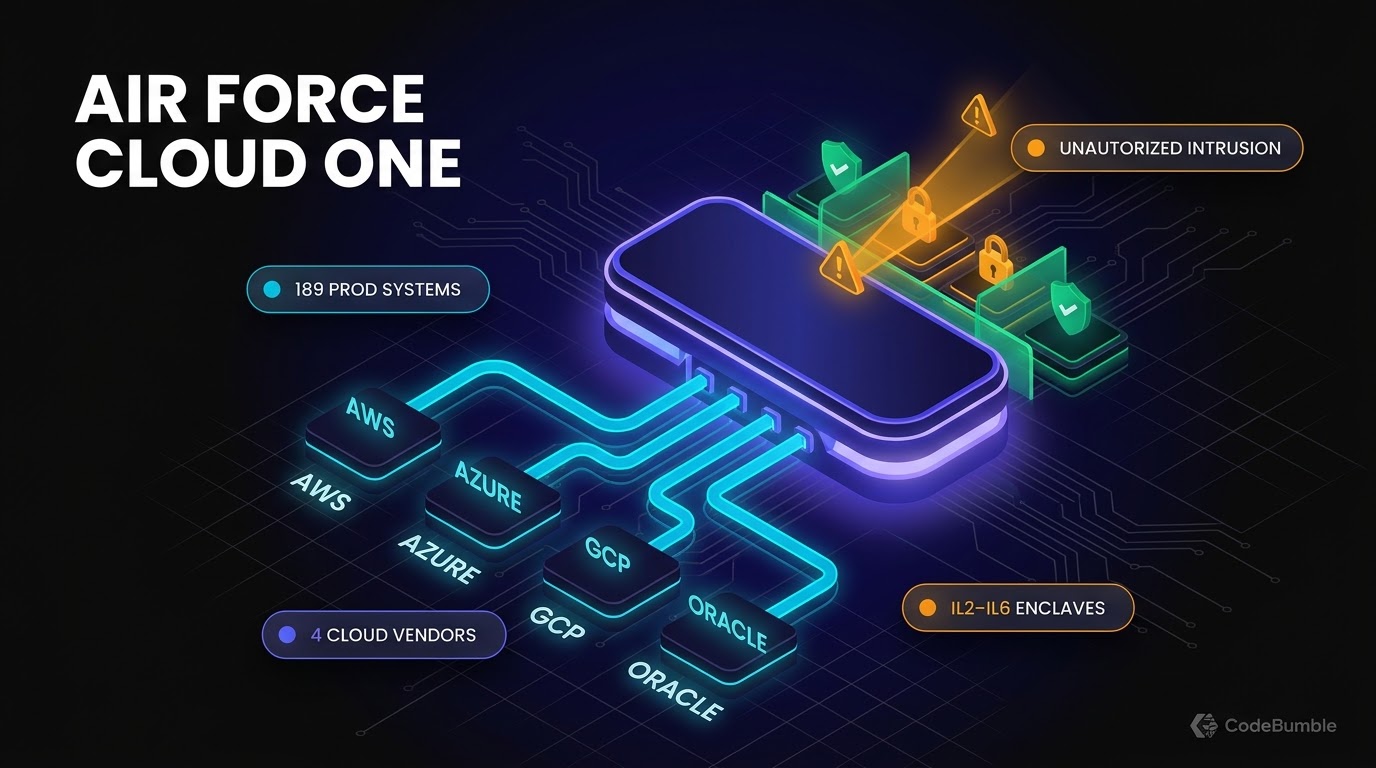
Initiated in 2017 and chartered by the Air Force Life Cycle Management Center (AFLCMC / HNII Division), Air Force Cloud One was built as a centralized Platform-as-a-Service (PaaS) and Infrastructure-as-a-Service (IaaS) hub for U.S. Air Force, U.S. Space Force, and broader Department of Defense (DoD) mission owners. Rather than requiring individual application teams to negotiate separate cloud contracts, build custom network boundaries, and complete full Authority to Operate (ATO) compliance packages from scratch, Cloud One standardizes those layers across four commercial cloud service providers (CSPs):
- Amazon Web Services (AWS)
- Microsoft Azure
- Google Cloud (Alphabet)
- Oracle Cloud
flowchart TB
    Users[Federated MFA Users & Mission System Owners] --> IAM[Single Federated MFA & Cloud One Control Plane]
    IAM --> Boundary[Cloud Boundary Protection: FIPS F5 VPN, Enterprise WAF, Access Points]
    Boundary --> Shared[ATO'd Shared Common Services & CSSP SIEM]
    Shared --> AWS[AWS Gov Enclaves]
    Shared --> Azure[Azure Gov / Secret Enclaves]
    Shared --> GCP[Google Cloud Enclaves]
    Shared --> Oracle[Oracle Cloud Enclaves]
    AWS --> Apps[189 Production Systems: IL2–IL6]
    Azure --> Apps
    GCP --> Apps
    Oracle --> Apps
Scale, Impact Levels, and Mission Workloads
According to Cloud One's official portal, the platform hosts 189 production systems spanning DoD Impact Levels IL2 through IL6 (covering unclassified, Controlled Unclassified Information, and Secret-level classified workloads). A separate Air Force software portal lists 171 mission systems, 71 in development, and 95 in migration—reflecting reporting snapshots across different portfolio cutoffs.
According to Reuters, workloads running on Cloud One span back-office personnel and pay systems as well as operational defense software, including:
- Cloud-Based Command and Control: Collates air defense radar and sensor feeds across North America.
- Theater Integrated Combat Munitions System: Tracks bombs, missiles, and munitions inventory across more than 200 U.S. Air Force locations worldwide.
Prime contractor responsibility for Cloud One transitioned in 2025 from SAIC to Leidos. When contacted by Reuters, SAIC did not respond and Leidos referred questions to the U.S. Air Force.
The "Sweet-Spot" Shared Services Model
To understand why a control-plane intrusion causes immediate platform-wide friction, it helps to examine what Cloud One centralizes versus what it delegates to Mission System Owners (MSOs):
| Architectural Layer | Managed By | Technical Components (Official Air Force Docs) | Operational Role |
|---|---|---|---|
| Underlying Compute & Storage | 4 Commercial CSPs (AWS, Azure, Google Cloud, Oracle) | Government & Secret cloud regions (IL2–IL6) | Physical infrastructure, hypervisors, raw cloud services |
| Control Plane & Automation | Cloud One Platform Team | Automated environment stand-up scripts, ServiceNow, single federated MFA tier | Provisions enclaves, enforces guardrails, manages admin access |
| Perimeter & Telemetry | Cloud One / CSSP | Enterprise Web Application Firewalls (WAFs), Internet & Cloud Access Points, FIPS-compliant F5 VPN, CSSP SIEM | Inspects ingress/egress traffic, aggregates audit logs |
| Application & Runtime | Mission System Owners (MSOs) | Custom containers, Kubernetes clusters, CAST Highlight code scanning | Mission logic, app-level security controls |
By inheriting CSP, USAF, DoD, and Cybersecurity Service Provider (CSSP) controls through eMASS, application teams can inherit roughly 30% to 40% of their required cybersecurity accreditation controls out of the box—or more under specialized fast-track initiatives—dramatically cutting time-to-deployment. However, that same shared-services architecture means that when the control plane's integrity is in doubt, administrators must freeze the deployment and patching pipeline across dependent tenants until forensic teams verify the boundary.
What Happened in the November 2026 Incident
Based on reporting published on November 27, 2026 by Reuters and Cybernews, the timeline and confirmed operational impacts are as follows:
- Detection During Upgrades: Two sources told Reuters that the intrusion was detected within roughly the past month during work to upgrade the Cloud One system.
- Control Plane Access: One source stated that attackers exploited a software vulnerability to reach the control plane, comparing that access to a "universal remote" that could theoretically allow an intruder to inspect operational status across hosted environments (such as aircraft readiness or spare-parts logistics), though Reuters emphasized it was unclear whether the intruders actually accessed those systems.
- Containment & Operational Freeze: Following discovery, the Air Force paused efforts to migrate additional back-office applications onto Cloud One, blocked updates to applications already running on the platform, and revoked administrator rights for some users.
- Damage Assessment: U.S. Cyber Command was brought in to assess potential damage. Neither Cyber Command nor the Air Force confirmed technical details; the Air Force stated only that it "does not comment on the security posture, vulnerabilities or operational status of specific networks and systems."
What Remains Unconfirmed (Confidence Assessment)
- Attribution (Unconfirmed): No threat actor, nation-state group, or cybercriminal syndicate has been publicly identified or claimed responsibility.
- Data Exfiltration (Unconfirmed): No source confirmed whether classified, tactical, personnel, or logistics data was copied or exfiltrated.
- Specific CVE / Vulnerability (Unconfirmed): Reuters could not identify the exact software vulnerability exploited during the upgrade window.
- Underlying Cloud Providers (No Evidence of Compromise): The reporting attributes the intrusion to Cloud One's platform/control plane rather than a breach of AWS, Microsoft Azure, Google Cloud, or Oracle Cloud themselves, and points to no impact on civilian commercial cloud customers.
Why Control Plane Compromises Disrupt Multi-Cloud Operations
The Cloud One disruption illustrates a broader engineering reality for any organization operating a multi-cloud hub-and-spoke or internal developer platform (IDP):
- Patching Deadlocks During Containment: Blocking application updates is a standard containment reflex when a deployment pipeline or CI/CD control plane may be compromised—you cannot safely push new artifacts through a potentially untrusted orchestrator. Yet as Reuters noted, freezing updates leaves hosted applications unable to apply patches for newly disclosed software vulnerabilities elsewhere in the stack, creating a painful security trade-off between containment and vulnerability remediation.
- Blast Radius of Federated Identity & Single Sign-On: Cloud One relies on a single, federated multi-factor authentication (MFA) tier so one authenticated session can manage environments without secondary machine accounts. While federated SSO eliminates password sprawl, it elevates the importance of strict privilege segmentation between control-plane operators, CI/CD runners, and tenant workload administrators.
- AI-Accelerated Vulnerability Discovery: Reuters highlighted heightened concern across government and enterprise networks over AI-assisted vulnerability scanning, which enables adversaries to probe wide, multi-vendor cloud surfaces far faster than manual reconnaissance—shortening the window between software deployment (or upgrade) and exploitation.
Practical Takeaways for Enterprise Multi-Cloud Teams
Even outside defense environments, engineering and platform teams running multi-cloud Kubernetes fleets, Terraform/IaC pipelines, or internal developer platforms can apply concrete architectural lessons from the Cloud One incident:
- Decouple Control Plane Upgrades from Runtime Patching: Ensure tenant workloads have an emergency, out-of-band patching path (such as immutable base-image rebuilds or isolated GitOps runners) that does not depend on the primary multi-cloud management portal remaining unlocked during an incident.
- Isolate Upgrade & Maintenance Planes: System upgrades are high-risk windows where temporary elevated permissions, new API endpoints, or staging runners are introduced. Enforce ephemeral, time-bounded just-in-time (JIT) admin elevation during upgrades rather than standing control-plane privileges.
- Segment Tenant Enclaves by Blast Radius: Even when sharing an Enterprise WAF, SIEM, or IAM identity provider, ensure control-plane compromise in one management tier cannot laterally read runtime secrets or storage volumes inside isolated tenant accounts/subscriptions.
- Verify Auditability Without Blocking Forensics: Maintain immutable, out-of-band telemetry (such as write-once SIEM forwarding to a separate security account) so incident responders can verify whether control-plane API calls touched runtime data—avoiding weeks of blind operational freezes.
Frequently Asked Questions (FAQ)
What is U.S. Air Force Cloud One?
Air Force Cloud One is a multi-cloud, multi-vendor enterprise computing platform initiated in 2017 and managed by the U.S. Air Force Life Cycle Management Center (AFLCMC/HNII). It hosts 189 production systems across DoD Impact Levels IL2 through IL6 using commercial cloud infrastructure from AWS, Microsoft Azure, Google Cloud, and Oracle.
Were AWS, Microsoft Azure, Google Cloud, or Oracle hacked?
There is no indication in the November 27, 2026 Reuters report that any of the four underlying commercial cloud providers were breached. The reported intrusion targeted Cloud One's own platform control plane, with no reported impact on civilian customers of those cloud vendors.
Did hackers steal classified military data from Cloud One?
As of November 27, 2026, data theft has not been confirmed. Reuters reported that it could not establish the hackers' identity, the full scope of the intrusion, or whether any tactical, personnel, or logistics data was exfiltrated. U.S. Cyber Command was called in to assess potential damage.
How did the Cloud One breach affect Air Force operations?
According to sources cited by Reuters, discovery of the intrusion during a system upgrade led the Air Force to pause back-office application migrations to Cloud One, block software updates to applications already running on the platform, and revoke administrator rights for some users.
Why is a cloud "control plane" breach considered high-risk?
The control plane acts as the central administrative layer that provisions environments, manages configurations, and orchestrates deployments across connected cloud accounts. If compromised, an attacker could potentially inspect or manipulate underlying resources—forcing defenders to freeze updates and migrations until integrity is restored.
Sources
- U.S. Air Force Cloud One — Air Force Cloud One Official Portal (Primary platform documentation: 189 production IL2–IL6 systems, 2017 initiation, AFLCMC/HNII, common services, accreditation inheritance)
- U.S. Air Force Software — software.af.mil — Department of the Air Force Enterprise Cloud (Primary Air Force documentation: 4 cloud service providers, 4 Impact Levels, 171 mission systems, Enterprise WAF, CSSP SIEM)
- Reuters (via Global News) — U.S. Air Force flagship Cloud One computing platform targeted in hack (Secondary reporting, published November 27, 2026)
- Cybernews (Reuters syndication) — US Air Force Cloud One Breach: Hackers Hit Military Cloud (Secondary reporting, published November 27, 2026)