

Web performance
SGLang v1.0 & Nine-Member Consortium: Cutting Agentic TTFT 60% and Hardening Multi-Tenant Serving
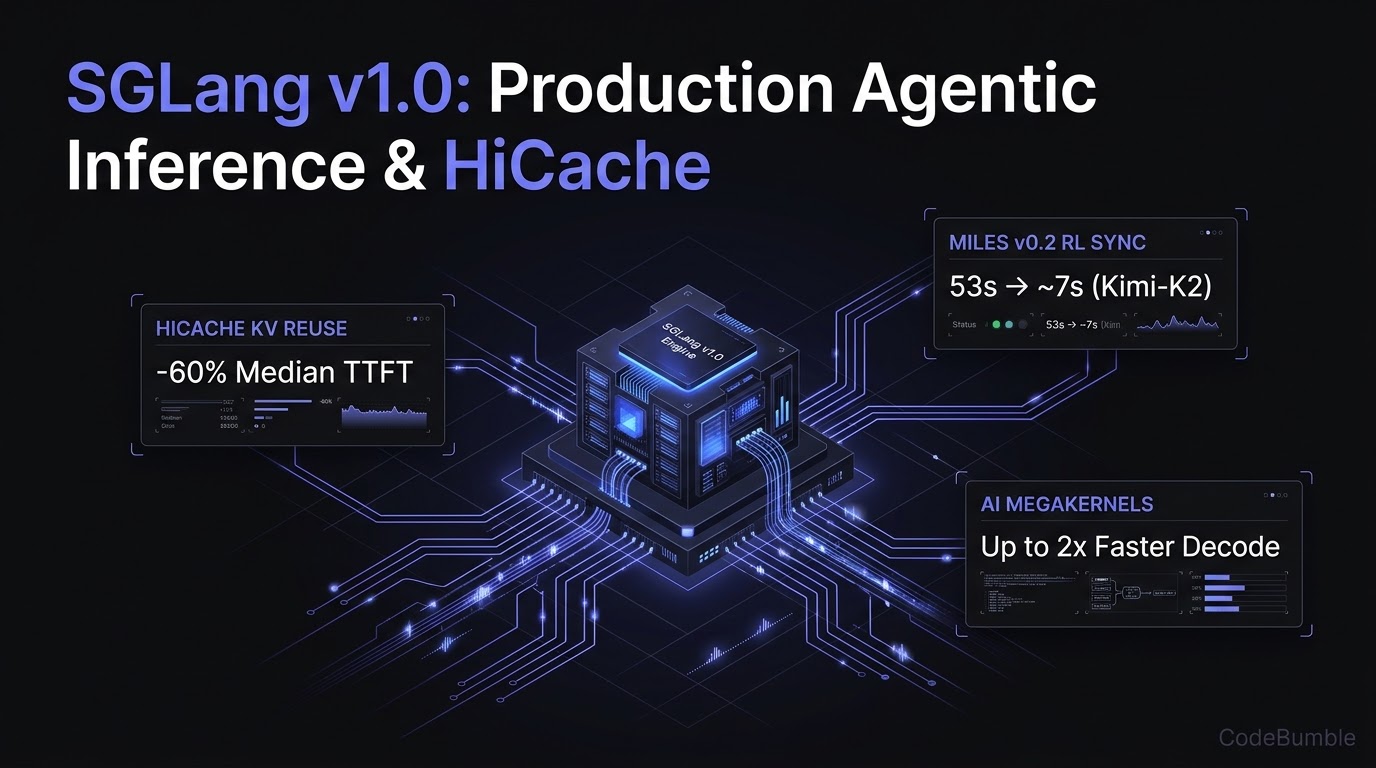
At the first SGLang Summit (recap published November 17, 2026), LMSYS announced SGLang v1.0 alongside a nine-member SGLang Consortium including NVIDIA, AMD, Intel, Google, Meta, Thinking Machines Lab, Cloudflare, Modal, and RadixArk. Built for hybrid model architectures and long-running agents, SGLang v1.0 pairs unified memory management and HiCache (-60% median TTFT in multi-turn benchmarks) with hardened request isolation and predictable configuration behavior.
9 min read
SGLang v1.0 & Nine-Member Consortium: Cutting Agentic TTFT 60% and Hardening Multi-Tenant Serving
Executive Summary
On November 17, 2026, LMSYS published its official recap of the inaugural SGLang Summit (held November 12–13 in San Francisco with more than 2,000 attendees), announcing SGLang v1.0, Miles v0.2 for reinforcement-learning (RL) post-training, SGLang-Neuron v0.1.0 for AWS Trainium, NVIDIA NIM Certified microservices powered by SGLang, and the SGLang Consortium—a nine-member industry group uniting NVIDIA, AMD, Intel, Google, Meta, Thinking Machines Lab, Cloudflare, Modal, and RadixArk.
Rather than chasing flashy feature checklists, SGLang v1.0 focuses on production stability, predictable configuration behavior, unified memory management, and hierarchical KV-cache reuse (HiCache) for hybrid model architectures and long-running agents whose conversation histories exceed GPU HBM. In summit benchmarks, HiCache reduced median time-to-first-token (TTFT) by 60% in a multi-turn agentic workload, while Meta reported more than 2× GPU savings after migrating production inference across its family of apps to SGLang.
Confidence & Evidence Caveats: Confidence in the organizational announcements, release scope, and architectural priorities is high based on primary documentation from LMSYS Org, the SGLang 1.0 Release Tracker (GitHub Issue #50045), and AWS Machine Learning Blog, corroborated by CellCog. However, as CellCog explicitly notes, the headline performance numbers (such as 60% TTFT reduction, 2× Meta GPU savings, and up to 6× Vera Rubin token throughput) are vendor- and conference-reported rather than derived from an independent, standardized third-party benchmark suite. Additionally, SGLang's keynote highlighted security vulnerabilities reported by Cloudflare and NEAR AI, underscoring that multi-tenant request isolation and administrative endpoint protection require active hardening alongside performance tuning.
Technical Mechanics and Architecture
Unified Memory, HiCache, and Predictable v1.0 Configuration
Modern agentic workloads break traditional stateless LLM serving assumptions in two ways:
- Context Growth Beyond GPU HBM: Multi-step coding and tool-use agents repeatedly re-read expanding histories (often exceeding 25,000 tokens per session). Without hierarchical KV-cache retention, every turn forces costly prefill recomputation.
- Hybrid State Management: Newer hybrid model architectures combine standard attention KV caches with recurrent/state-space or multimodal state, requiring a unified memory manager that can page and reuse heterogeneous state across GPU HBM, host DRAM, and storage tiers.
SGLang v1.0 addresses both through HiCache (hierarchical KV caching) and unified memory management, paired with a Rust-implemented radix tree, router, and experimental frontend server for lower scheduling overhead. Equally important for production operators, GitHub Issue #50045 documents a strict "predictable configuration" contract for v1.0: rejecting unsupported CLI flags explicitly with actionable error messages (rather than generic parser failures) and honoring user-specified flags such as --attention-backend and --page-size instead of silently overriding them with an info-level log.
+-----------------------------------------------------------------------+
|  Incoming Agentic / Multi-Turn Requests                               |
|  - Long tool-use histories, OpenAI-compatible API, multimodal inputs  |
+-----------------------------------+-----------------------------------+
                                    |
                                    v
+-----------------------------------------------------------------------+
|  Rust Router & Prefix-Aware Scheduler                                 |
|  - Rust radix tree tracks cached prefixes across workers              |
|  - Strict CLI/flag validation (v1.0 predictable config contract)      |
|  - Disaggregated Prefill / Decode (P/D) routing                       |
+-----------------------------------+-----------------------------------+
                                    |
          +-------------------------+-------------------------+
          |                                                   |
          v                                                   v
+-----------------------------+               +-----------------------------+
|  Prefill Workers            |               |  Decode Workers             |
|  - HiCache Tiered KV Reuse  |   NIXL /      |  - FlashInfer & AI-Authored |
|    (HBM <-> Host DRAM)      |== KV Xfer ===>|    GPU Megakernels          |
|  - Cuts median TTFT by 60%  |               |  - Speculative decoding &   |
|    in multi-turn benchmark  |               |    CUDA graph capture       |
+-----------------------------+               +-----------------------------+
          |                                                   |
          +-------------------------+-------------------------+
                                    |
                                    v
+-----------------------------------------------------------------------+
|  Cross-Hardware Execution Backends                                    |
|  - NVIDIA (NIM Certified / Dynamo), AMD Instinct, Intel, Google TPU   |
|  - AWS Trainium via out-of-tree SGLang-Neuron v0.1.0 (PyTorch native) |
+-----------------------------------------------------------------------+
AI-Driven Development & Security Posture
LMSYS disclosed that AI coding agents now produce most of SGLang's merged pull requests, and that AI-authored GPU megakernels (verified against original reference kernels) achieved up to 2× faster decoding, while two engineers paired with agents ported SGLang to a new AI accelerator in under a week within 1% of production performance. Because automated PR velocity can introduce subtle regressions or security gaps, the SGLang keynote explicitly called for security partners—highlighting vulnerabilities previously reported by Cloudflare and NEAR AI and prioritizing stricter request-to-request isolation and administrative endpoint protection.
Safe Deployment & Configuration Example
When deploying SGLang in production (for example, using the AWS SGLang-Neuron v0.1.0 pattern or standard GPU containers), bind the server to loopback (127.0.0.1) behind an authenticated reverse proxy/API gateway and pin explicit memory and context limits:
# Bind SGLang to localhost behind an authenticated gateway; pin static memory and context limits
python -m sglang.launch_server \
  --model-path <verified-local-or-pinned-model-path> \
  --tp-size 8 \
  --context-length 10240 \
  --chunked-prefill-size 8192 \
  --max-running-requests 64 \
  --mem-fraction-static 0.8 \
  --host 127.0.0.1 \
  --port 30000
Evidence: Consortium Governance, Benchmarks, and Ecosystem Releases
The Nine-Member SGLang Consortium
Announced at the summit opening keynote on November 12–13 (recapped November 17, 2026), the SGLang Consortium establishes a standing technical forum where each member appoints technical representatives to collaborate on frontier model support, multimodal/reasoning workloads, distributed inference, and hardware optimization. Critically, LMSYS states that SGLang's maintainers retain final authority over technical decisions and code acceptance, keeping the project open to the broader community.
| Founding Member | Primary Ecosystem Role Highlighted at Summit |
|---|---|
| NVIDIA | NIM Certified microservices powered by SGLang; Dynamo Snapshot, Model Express, FlashInfer, and Vera Rubin optimizations |
| AMD | Instinct MI355X/MI455 optimizations, day-zero Kimi K3.1 Pro support, 3.5× agentic RL throughput workshop |
| Intel | Joint collaboration with RadixArk to optimize SGLang across Intel CPUs, GPUs, and accelerators |
TorchTPU integration (torch_tpu and Pallas kernels) for TPU7x (Ironwood) and Miles RL |
|
| Meta | Production inference across Muse App, Muse Code, Model API, and Meta family of apps; >2× GPU savings |
| Thinking Machines Lab | Frontier model capabilities and ecosystem collaboration |
| Cloudflare | Production edge/inference perspective and security vulnerability reporting |
| Modal | Serverless GPU serving and first-principles inference systems design |
| RadixArk | Core SGLang stewardship, Intel collaboration, and co-development of SGLang-Neuron with AWS Annapurna Labs |
Reported Benchmarks & Production Telemetry
All figures below are sourced from LMSYS Org (November 17, 2026) and CellCog (November 18, 2026). Independent third-party benchmark verification is not yet published.
| Metric / Result | Reported Value | Workload / Context | Source |
|---|---|---|---|
| Ecosystem Adoption | 332 organizations |
Production/community growth over the past year | LMSYS Org |
| Meta Production Efficiency | >2× GPU savings |
Migration from prior inference stack across GPUs, TPUs, and MTIA | LMSYS Org |
| HiCache Multi-Turn TTFT | -60% median TTFT |
Reusing stored agent history instead of recomputing | LMSYS Org |
| Single-User Decode Speed | ~1,800 tokens/sec (1.8× vs stock) |
Optimized SGLang recipe on leading open model; accuracy unchanged | LMSYS Org |
| AI-Authored GPU Megakernels | Up to 2× faster decode |
Verified against original reference kernels | LMSYS Org |
| Miles v0.2 RL Weight Sync | 53s → ~7s |
Trillion-parameter Kimi-K2 across 32 training + 32 rollout nodes | LMSYS Org |
| Vera Rubin vs. GB300 NVL72 | Up to 6× total token throughput/GPU |
Kimi K3.1 Pro on AgentX (includes cached input tokens, matched interactivity) | LMSYS Org |
| Production Uptime | 500 days across 8 major upgrades |
Single production team reporting zero performance regressions | LMSYS Org |
Hardening Playbook & Production Rollout
Six-Step Hardening & Upgrade Playbook
- Isolate Administrative & Metrics Endpoints: As underscored by the Cloudflare and NEAR AI security disclosures highlighted at the summit, never expose SGLang's management, health, or cache-flush routes directly to untrusted networks. Bind
--host 127.0.0.1or an internal cluster interface and enforce mTLS or bearer authentication at an upstream gateway. - Enforce Tenant Isolation on Shared Prefix Caches: When serving multiple tenants with
HiCacheor radix-tree prefix sharing enabled, evaluate cross-tenant cache-timing side channels and separate sensitive workloads onto dedicated worker pools or disaggregated prefill/decode groups. - Audit Explicit Runtime Flags Before Upgrading to v1.0: Review launch scripts for deprecated
sgl-model-gatewayflags or model-specific overrides (--attention-backend,--page-size) tracked in Issue #50045 so startup validation does not halt rolling deployments. - Pin Tested Container Tags (or NIM Certified Images): For enterprise NVIDIA deployments, prefer signed NVIDIA NIM Certified or Dynamo SGLang Runtime containers (which include security scanning and VEX advisories) rather than tracking
maindirectly, especially given the high velocity of AI-authored PRs. - Verify Kernel Outputs After Enabling Custom Optimizations: If adopting experimental AI-generated kernels or non-default casting flags, run numerical equivalence checks against
forward_nativereference outputs in staging before promoting to production. - Monitor KV-Cache Eviction & Memory Pressure: Track host-RAM and GPU-HBM utilization (
--mem-fraction-static) alongside TTFT p50/p99 percentiles so HiCache spillover does not trigger OOM kills under concurrent long-context agent traffic.
Defensive Detection & Verification Commands
Verify that running SGLang servers are not bound to public interfaces (0.0.0.0) without authentication and confirm pinned container digests:
# 1. Check whether any sglang.launch_server process is listening on all interfaces (0.0.0.0)
ss -tulnp | grep -E "python|sglang" | grep "0.0.0.0"

# 2. Inspect active SGLang process arguments for explicit host binding and memory caps
pgrep -af "sglang.launch_server"

# 3. Verify installed sglang package version and origin in Python
python -c "import sglang; print(sglang.__version__, sglang.__file__)"
Rollback & Remediation Notes
Because SGLang v1.0 tightens CLI flag validation and deprecates legacy 0.5.x gateway options, keep your previous 0.5.x container image tag and launch manifest pinned in version control. If a canary replica fails startup validation or exhibits latency regressions under your specific model/GPU topology, drain the canary endpoint at the router/ingress layer and roll back the deployment manifest to the prior verified container digest.
Frequently Asked Questions
1. Who controls the SGLang codebase now that the nine-member Consortium has launched? According to LMSYS Org, Consortium members appoint technical representatives to participate in roadmap discussions, but SGLang's maintainers retain full responsibility for technical decisions and code acceptance.
2. What is the main architectural focus of SGLang v1.0 compared to 0.5.x?
Rather than adding net-new model families outside the release tracker, SGLang v1.0 hardens existing capabilities, enforces predictable CLI/flag behavior, and unifies memory management and HiCache hierarchical caching for hybrid architectures and long-running agents.
3. How much does HiCache improve agentic inference latency? In a multi-turn agentic benchmark reported at the SGLang Summit, HiCache reduced median time-to-first-token (TTFT) by 60% by reusing stored context instead of recomputing full conversation histories. Note that this is a conference-reported figure rather than an independent third-party benchmark.
4. Can SGLang run on non-NVIDIA hardware?
Yes. SGLang supports AMD Instinct GPUs, Google TPUs (SGLang-TorchTPU and SGL-JAX), Intel CPUs/GPUs/accelerators (via the Intel + RadixArk collaboration), and AWS Trainium via the open-source SGLang-Neuron v0.1.0 PyTorch-native plugin.
5. What security considerations were raised at the SGLang Summit? The keynote highlighted vulnerabilities reported by Cloudflare and NEAR AI and called for additional security partners to strengthen request-to-request isolation and protect administrative access—especially important as AI agents generate most merged PRs.
Sources
- LMSYS Org (Primary) — SGLang Summit 2026 Recap: Building Open AI Infrastructure Together (Published November 17, 2026)
- SGLang GitHub Repository (Primary) — SGLang 1.0 Release Tracker · Issue #50045 (Opened November 12, 2026; active November 2026)
- AWS Machine Learning Blog (Primary) — Deploy frontier AI models on AWS Trainium with SGLang-Neuron (Published November 13, 2026)
- CellCog (Secondary) — SGLang 1.0 and a Consortium With Nvidia, AMD, Google, Meta (Published November 18, 2026)