

Vulnerability
CISA Confirms Active Exploitation of CVE-2026-115731: Puppet Enterprise RCE Exposes Managed Fleets and CA Keys
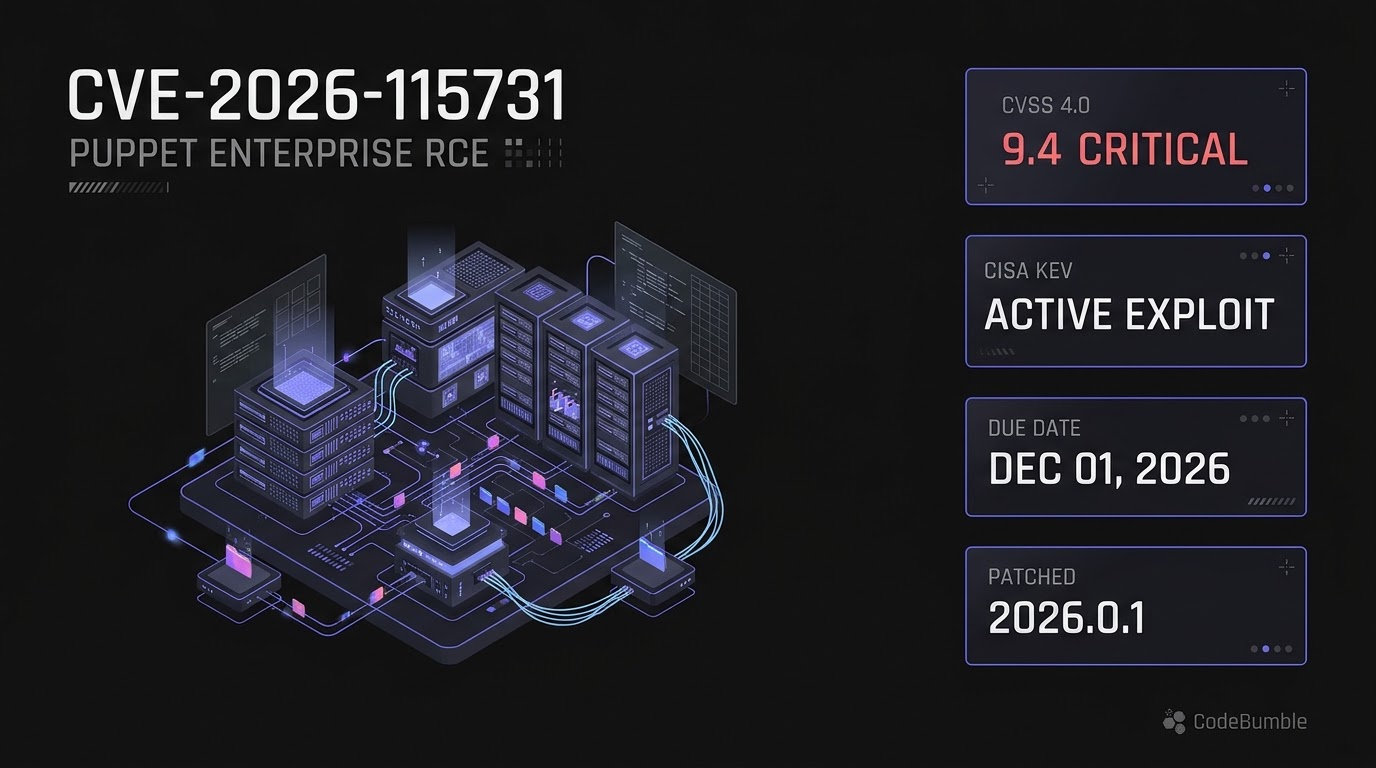
CISA added CVE-2026-115731 (CVSS 4.0: 9.4 Critical) in Perforce Puppet Enterprise to its Known Exploited Vulnerabilities catalog on November 17, 2026, setting a December 1 federal deadline. Any client with a CA-signed agent certificate—or an unauthenticated attacker where CA autosigning lacks strong verification—can execute arbitrary code on Puppet Server and threaten the CA signing key. Here is the technical breakdown, affected versions, and defensive hardening playbook.
9 min read
CISA Confirms Active Exploitation of CVE-2026-115731: Puppet Enterprise RCE Exposes Managed Fleets and CA Keys
Executive Summary
On November 17, 2026, the U.S. Cybersecurity and Infrastructure Security Agency (CISA) added CVE-2026-115731—a critical deserialization vulnerability in Perforce Puppet Enterprise and Puppet Core—to its Known Exploited Vulnerabilities (KEV) Catalog based on confirmed evidence of active exploitation in the wild. Scored 9.4 (Critical) on CVSS v4.0 by Perforce, the flaw allows any client holding a Certificate Authority (CA)-signed agent certificate to execute arbitrary code on the Puppet Server as its service user by submitting a crafted report via an HTTP PUT request.
Where a Puppet Certificate Authority is configured to autosign certificate signing requests (CSRs) without strong verification, an unauthenticated network attacker can obtain a valid agent certificate and trigger the vulnerability without prior credentials. Because Puppet Server manages configuration state across an organization's entire server fleet—and typically holds the CA signing key—a single compromised server can cascade into fleet-wide configuration tampering, credential harvesting, or ransomware deployment. Under CISA Binding Operational Directive (BOD) 26-04, Federal Civilian Executive Branch (FCEB) agencies face a mandatory remediation deadline of December 1, 2026.
Confidence Assessment:
- High Confidence: Affected and fixed product versions, CVSS v4.0 base score (
9.4) and vector, CWE classifications (CWE-502andCWE-94), CISA KEV addition date (November 17, 2026), and BOD 26-04 remediation deadline (December 1, 2026) are verified across primary advisories from Perforce, NIST NVD, and CISA. - Medium-Low Confidence (Attribution & Campaign IOCs): Neither CISA nor Perforce has publicly named the threat actors exploiting CVE-2026-115731, nor have they published campaign-specific IP addresses, file hashes, or ransomware attribution (CISA lists ransomware use as "Unknown").
Technical Mechanics & Architecture
1. Root Cause: Untrusted Report Deserialization (CWE-502 / CWE-94)
Puppet agents routinely submit execution reports to the Puppet Server over mutual TLS (mTLS) on TCP port 8140 using the /puppet/v3/report endpoint. According to the Perforce advisory and Mallory vulnerability analysis, CVE-2026-115731 resides in the report-processing deserialization pipeline used by Puppet Server and OpenVox Server.
When a report payload containing a crafted rich-data type is submitted via a PUT request, attacker-controlled type metadata reaches Puppet::Pops::Serialization::FromDataConverter.convert. Instead of strictly restricting deserialized objects to inert data structures, the converter can be coerced into dynamically generating Ruby classes with attacker-supplied RubyMethod annotations. Evaluating the generated class via class_eval executes arbitrary Ruby code in the security context of the server service user (typically puppet).
2. The Autosign Multiplier: Turning PR:L into Unauthenticated RCE
Perforce's CVSS v4.0 vector (CVSS:4.0/AV:N/AC:L/AT:N/PR:L/UI:N/VC:H/VI:H/VA:H/SC:H/SI:H/SA:H) scores Privileges Required as Low (PR:L) because the /puppet/v3/report endpoint requires an agent certificate signed by the Puppet CA. However, in real-world enterprise and cloud-autoscaling deployments, administrators frequently enable naive or permissive CA autosigning (such as wildcard entries in autosign.conf) so newly spun-up instances can enroll automatically.
As both NIST NVD and SecurityWeek emphasize, permissive autosigning allows any unauthenticated attacker with network reachability to port 8140 to request and receive a valid CA-signed certificate, immediately satisfying the prerequisite for CVE-2026-115731.
3. Post-Exploitation Blast Radius & Companion Flaw (CVE-2026-115732)
Executing code as the puppet service user on Puppet Server threatens the entire configuration-management trust boundary:
- CA Signing Key Exposure: Perforce warns that a successful attack can expose the server's certificate-signing key, enabling an attacker to mint trusted certificates for any identity.
- Fleet-Wide Configuration Tampering: With control over the server or CA key, an attacker can alter catalogs, Hiera secrets, and software packages delivered to every managed node on its next Puppet run.
- Companion Authorization Bypass (
CVE-2026-115732): Patched alongside CVE-2026-115731 on November 3, 2026,CVE-2026-115732(CVSS 4.0:9.0per Perforce) allows an attacker holding a certificate whose name extends an approved name (e.g.,evil.target.lab.localmatchingtarget.lab.local) to bypass certificate-name authorization and impersonate managed machines.
Architectural Attack & Trust Boundary Flow
+-----------------------------------------------------------------------------+
|                        UNTRUSTED / NETWORK PERIMETER                        |
|                                                                             |
|  [ Attacker / Rogue Client ]                                                |
|     |                                                                       |
|     +---> (1) Optional: CSR to Puppet CA (if permissive autosign enabled)   |
|     |<--- (2) Receives valid CA-signed agent certificate                    |
|     |                                                                       |
|     +---> (3) PUT /puppet/v3/report (Crafted rich-data payload, port 8140)  |
+------------------------------------+----------------------------------------+
                                     |
                                     v
+-----------------------------------------------------------------------------+
|                    PUPPET SERVER / OPENVOX SERVER (TCP 8140)                |
|                                                                             |
|  [ mTLS Verification ] --> Accepts any valid CA-signed agent certificate    |
|           |                                                                 |
|           v                                                                 |
|  [ Report Processor ]  --> Puppet::Pops::Serialization::FromDataConverter   |
|           |                (CWE-502 / CWE-94: class_eval on crafted type)   |
|           v                                                                 |
|  [ Service Context ]   --> Arbitrary Ruby execution as 'puppet' user        |
|           |                                                                 |
|           +---> Accesses CA Signing Key + Hiera Secrets + Catalog Pipeline  |
+------------------------------------+----------------------------------------+
                                     |
                                     v
+-----------------------------------------------------------------------------+
|                         MANAGED ENTERPRISE FLEET                            |
|                                                                             |
|  [ Node 1 ]   [ Node 2 ]   [ Node N ]  <-- Next Puppet run pulls tampered   |
|                                            catalogs / packages / commands   |
+-----------------------------------------------------------------------------+
Defensive Version & Configuration Audit Commands
Before patching or applying network mitigations, run these read-only inspection commands on your Puppet Server host to verify installed versions, CA autosign posture, and port 8140 exposure:
# 1. Check installed Puppet Enterprise / Puppet Server / Puppet Core versions
cat /opt/puppetlabs/server/pe_version 2>/dev/null || true
/opt/puppetlabs/bin/puppetserver --version 2>/dev/null || true
/opt/puppetlabs/bin/puppet --version

# 2. Audit CA autosign configuration (look for wildcard '*' or unauthenticated scripts)
sudo puppet config print autosign --section server
sudo cat /etc/puppetlabs/puppet/autosign.conf 2>/dev/null || echo "No autosign.conf found"

# 3. Verify which interfaces are listening on Puppet Server port 8140
ss -tlnp | grep 8140

# 4. Inspect custom auth.conf rules (relevant to companion CVE-2026-115732)
sudo ls -la /etc/puppetlabs/puppetserver/conf.d/auth.conf
If autosign.conf contains * or broad domain wildcards (e.g., *.corp.internal), treat your Puppet Server as unauthenticated-reachable to any host that can connect to port 8140.
Evidence & Production Impact
Disclosure and Exploitation Timeline
- November 3, 2026: Perforce publishes CVE-2026-115731 (
CVSS 4.0: 9.4 Critical) and companion CVE-2026-115732 (CVSS 4.0: 9.0), alongside patched releases for Puppet Enterprise and Puppet Core. - November 4–6, 2026: Public proof-of-concept trigger details targeting the OpenVox fork circulate following patch disclosure, and early exploitation flags appear in threat tracking.
- November 17, 2026: CISA adds CVE-2026-115731 to the Known Exploited Vulnerabilities (KEV) Catalog, citing confirmed active exploitation, and sets a December 1, 2026 remediation deadline for FCEB agencies under BOD 26-04.
Affected and Patched Versions Matrix
| Product Line | Affected Versions | Fixed / Unaffected Versions | Operational Note |
|---|---|---|---|
| Puppet Enterprise 2026.x | 2026.0.0 (before 2026.0.1) |
2026.0.1 (includes Puppet Core 9.1.3) |
Restart Puppet Server after upgrade. |
| Puppet Enterprise 2025.x | 2025.0.0 (before 2025.12.1) |
2025.12.1 (includes Puppet Core 8.22.2) |
Restart Puppet Server after upgrade. |
| Puppet Enterprise 2023.8.x | 2023.8.0 (before 2023.8.13) |
2023.8.13 (includes Puppet Core 8.22.2) |
Restart Puppet Server after upgrade. |
| Puppet Core 9.x / 8.x | 9.0.0 < 9.1.3; 8.x < 8.22.2 |
9.1.3 / 8.22.2 |
Also patched on downstream Azure Linux 4.0 (azl4). |
| OpenVox Server | 9.1.0 and 8.17.0 and earlier |
9.2.0 / 8.18.0 |
Open Source Puppet is EOL and will not receive security updates. |
Note: Exact victim counts, affected industry breakdowns, and specific threat-actor attribution have not been published by CISA or Perforce as of November 18, 2026.
Hardening Playbook
Execute the following six-step remediation and verification sequence across all Puppet Enterprise, Puppet Core, and OpenVox infrastructure:
- Upgrade and Restart Puppet Server Immediately: Deploy Puppet Enterprise
2026.0.1,2025.12.1, or2023.8.13(or Puppet Core9.1.3/8.22.2; OpenVox Server9.2.0/8.18.0). Perforce explicitly notes that applying the fix requires restarting thepuppetserverservice so the updated Ruby serialization code is loaded into memory. - Disable Naive CA Autosigning: Remove wildcard entries from
/etc/puppetlabs/puppet/autosign.conf. If automated cloud provisioning is required, transition to policy-based autosigning using a custom executable that validates cryptographic instance-identity documents (e.g., cloud provider signed metadata tokens) or pre-shared challenge passwords. - Restrict Port
8140Network Exposure: Enforce host-based firewalls, security groups, and zero-trust micro-segmentation so TCP port8140is reachable only from authorized managed subnets and never exposed to the public internet. - Audit Custom
auth.confRules (CVE-2026-115732): Because the November 3 updates also tighten certificate-name matching to block partial-match impersonation, validate custom/etc/puppetlabs/puppetserver/conf.d/auth.confrules in staging immediately after upgrading to confirm legitimate agent check-ins are not inadvertently blocked. - Triage for Prior Compromise & Rotate CA Keys if Exposed: Under CISA BOD 26-04, organizations must check whether threat actors compromised internet-exposed assets before patching. Inspect Puppet Server process trees, recently issued CA certificates, and Hiera/catalog commit histories. If unauthorized code execution or certificate issuance is suspected, treat the Puppet CA key as compromised and execute a full CA rotation and certificate revocation.
- Monitor and Prepare Rollback Safeguards: Snapshot VM disks or back up
/etc/puppetlabs/and/opt/puppetlabs/configuration states prior to upgrading. If an upgrade causesauth.confregressions for legitimate nodes, adjust rule matchers rather than rolling back to vulnerable2026.0.0/2025.12.0/2023.8.12binaries.
Defensive Detection Queries
Because neither Perforce nor CISA has released static IOCs, focus detection on HTTP PUT /puppet/v3/report anomalies, unexpected CA certificate issuance, and suspicious child processes spawned by the puppetserver JVM/JRuby runtime.
1. Linux Host Log & Certificate Audit (Bash):
# Inspect Puppet Server access logs for unusually large or failed PUT report requests
sudo grep -E "PUT /puppet/v3/report" /var/log/puppetlabs/puppetserver/puppetserver-access.log | tail -n 50

# List recently signed certificates from the Puppet CA inventory
sudo /opt/puppetlabs/bin/puppetserver ca list --all
2. Microsoft Sentinel / Defender KQL (Process Execution Anomaly):
DeviceProcessEvents
| where Timestamp > ago(7d)
| where InitiatingProcessAccountName == "puppet"
   or InitiatingProcessCommandLine has "puppetserver"
| where FileName in~ ("sh", "bash", "dash", "curl", "wget", "python", "python3", "nc", "socat")
| project Timestamp, DeviceName, AccountName, FileName, ProcessCommandLine, InitiatingProcessCommandLine
| order by Timestamp desc
Frequently Asked Questions (FAQ)
1. Is CVE-2026-115731 being actively exploited right now?
Yes. CISA added CVE-2026-115731 to the Known Exploited Vulnerabilities (KEV) Catalog on November 17, 2026, confirming active exploitation in the wild and setting a December 1, 2026 remediation deadline for federal agencies.
2. Can an attacker exploit CVE-2026-115731 without authentication?
By default, the /puppet/v3/report endpoint requires a CA-signed agent certificate (PR:L). However, if your Puppet CA is configured to autosign CSRs without strong verification (for example, using * in autosign.conf), an unauthenticated network attacker can obtain a valid certificate and exploit the flaw.
3. Does Open Source Puppet receive a patch for CVE-2026-115731?
No. According to OpenVox advisories cited in security reporting, Open Source Puppet is no longer receiving security updates. Organizations still running Open Source Puppet must migrate to a supported commercial Puppet Enterprise / Puppet Core release or upgrade to patched OpenVox Server (9.2.0 or 8.18.0).
4. Is restarting the Puppet Server mandatory after patching?
Yes. Perforce's CVE record solution text specifies that administrators must restart the Puppet Server service after installing the updated packages so the patched report-processing logic takes effect.
5. What should we do if we suspect our Puppet Server was compromised before patching?
If logs show unexpected PUT /puppet/v3/report activity, anomalous shell processes under the puppet user, or unauthorized certificates in puppetserver ca list --all, assume the CA signing key and Hiera secrets may be exposed. Isolate the server, perform forensic triage per BOD 26-04, rotate the CA and agent certificates, and rotate all secrets stored in Puppet catalogs.
Sources
- CISA Alert (Primary): CISA Adds One Known Exploited Vulnerability to Catalog — Published November 17, 2026.
- NIST National Vulnerability Database (Primary): NVD - CVE-2026-115731 Detail — Published November 3, 2026; Last Modified November 6, 2026.
- Perforce Support Advisory (Primary): CVE-2026-115731: Report Deserialization Code Execution — Resolution Date November 3, 2026.
- SecurityWeek (Secondary Press): Critical Perforce Puppet RCE Exploited in Attacks — Published November 18, 2026.
- Mallory Vulnerability Intelligence (Secondary Technical): CVE-2026-115731 Technical Analysis — Published November 3, 2026.