

Vulnerability
Apache Roller CVE-2026-129448 Actively Exploited: Why Disabling XML-RPC in the UI Fails to Stop RCE
The Apache Software Foundation confirmed on November 17, 2026 that CVE-2026-129448 (CVSS 3.1: 9.8 Critical) in Apache Roller is under active exploitation. Extending the affected range of earlier CVE-2026-82384 back to Roller 4.0.0 through 6.1.4, the flaw deserializes XML-RPC vendor extension types before authenticating the requester or checking the admin UI toggle. Here is how to verify exposure, apply the 6.1.6/6.1.7 upgrade, and hunt for exploitation.
8 min read
Apache Roller CVE-2026-129448 Actively Exploited: Why Disabling XML-RPC in the UI Fails to Stop RCE
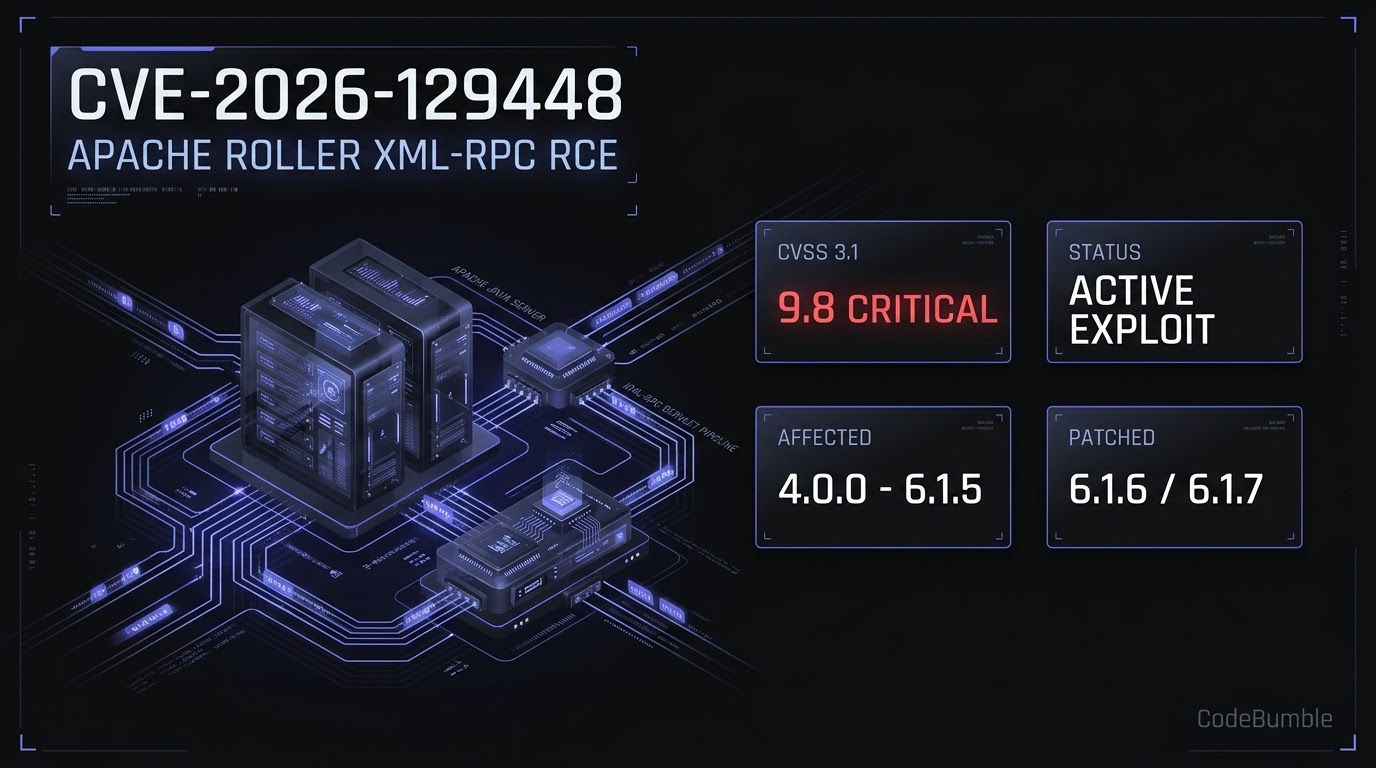
Executive Summary
On November 17, 2026, the Apache Software Foundation (ASF) disclosed CVE-2026-129448, a maximum-impact (CVSS v3.1: 9.8 Critical) unauthenticated remote code execution vulnerability in Apache Roller, an open-source Java-based group-blogging server. According to ASF's oss-security advisory and NIST NVD, the vulnerability is actively exploited in the wild.
Classified under CWE-502 (Deserialization of Untrusted Data), CVE-2026-129448 stems from Apache Roller's XML-RPC endpoint (/roller-services/xmlrpc) accepting vendor extension types and deserializing them before authenticating the requester—and, in older releases, before checking whether XML-RPC is disabled in the administration user interface. Crucially, ASF confirmed that CVE-2026-129448 is the exact same flaw previously tracked as CVE-2026-82384 (patched in September 2026), which had mistakenly listed only version 6.1.5 as affected. The newly issued CVE-2026-129448 extends the affected scope all the way back to Apache Roller 4.0.0 through 6.1.4.
Administrators must upgrade to Apache Roller 6.1.6 or later (Apache's download page recommends 6.1.7, released November 11, 2026, which also resolves additional flaws) and restart the application server. If immediate upgrading is not possible, teams must edit WEB-INF/web.xml directly rather than relying on the admin UI toggle.
Confidence Assessment:
- High Confidence: Affected version range (
4.0.0–6.1.4underCVE-2026-129448;6.1.5underCVE-2026-82384), fixed versions (6.1.6/6.1.7), CVSS v3.1 score (9.8 Critical),CWE-502classification, and active exploitation status are verified directly in primary advisories from the Apache Software Foundation and NIST NVD. - Medium-Low Confidence (Attribution & Campaign Scope): ASF did not disclose threat actor identities, victim counts, or specific network indicators of compromise (IOCs).
Technical Mechanics & Architecture
1. Root Cause: Pre-Authentication Deserialization in XML-RPC (CWE-502)
Apache Roller exposes an XML-RPC service mapped at /roller-services/xmlrpc for remote blogging clients. In affected versions (4.0.0 through 6.1.5), the underlying Apache XML-RPC servlet configuration enables vendor extension types (enabledForExtensions) by default.
When an HTTP POST request arrives at /roller-services/xmlrpc, the request parser deserializes XML-RPC vendor extension payloads into Java objects during request parsing, prior to verifying user credentials. Because untrusted Java deserialization occurs before authentication, any remote, unauthenticated attacker who can reach the Roller HTTP/HTTPS port can supply a crafted serialized payload to achieve arbitrary code execution inside the Java application server (e.g., Apache Tomcat) process.
2. Why Disabling XML-RPC in the Admin UI Fails
A dangerous operational trap highlighted by ASF is that toggling XML-RPC off inside Roller's web administration interface does not mitigate CVE-2026-129448 on 4.0.0 through 6.1.4 (or 6.1.5 prior to 6.1.6). Because the /roller-services/xmlrpc servlet remains mapped in WEB-INF/web.xml, the servlet container invokes the XML-RPC parser and deserializes the untrusted extension types before Roller's application logic checks the global administrative setting.
In Apache Roller 6.1.6 and later, maintainers both disabled vendor extension types and updated the handler to reject XML-RPC requests early when the XML-RPC feature is disabled.
3. Identifier Consolidation: CVE-2026-82384 vs. CVE-2026-129448
In September 2026, ASF disclosed CVE-2026-82384 (CVSS 3.1: 9.8) covering this exact XML-RPC deserialization flaw, but the initial record listed only 6.1.5 as affected. Subsequent investigation confirmed that every release from 4.0.0 through 6.1.4 carried the same vulnerable XML-RPC parsing path, prompting ASF to issue CVE-2026-129448 on November 17, 2026. Vulnerability management teams must treat both CVE IDs as a single remediation priority.
Architectural Request & Trust Boundary Flow
+-----------------------------------------------------------------------------+
|                        UNAUTHENTICATED REMOTE ATTACKER                      |
|                                                                             |
|  HTTP POST /roller-services/xmlrpc                                          |
|  (Crafted XML-RPC payload containing vendor extension serialized object)    |
+------------------------------------+----------------------------------------+
                                     |
                                     v
+-----------------------------------------------------------------------------+
|                  APACHE ROLLER / SERVLET CONTAINER (TOMCAT)                 |
|                                                                             |
|  [ WEB-INF/web.xml ] --> Maps /roller-services/xmlrpc servlet               |
|           |              (enabledForExtensions = true by default)           |
|           v                                                                 |
|  [ XML-RPC Parser ]  --> Deserializes vendor extension types FIRST          |
|           |              (CWE-502: Executes BEFORE Auth & Admin UI check!)  |
|           v                                                                 |
|  [ JVM Process ]     --> Arbitrary code execution as Tomcat / Roller user   |
+-----------------------------------------------------------------------------+
Defensive Version & Configuration Audit Commands
Run the following read-only commands on your application server hosting Apache Roller to verify the deployed version, inspect WEB-INF/web.xml for enabledForExtensions, and check whether /roller-services/xmlrpc is mapped:
# 1. Locate deployed Roller WAR / exploded webapps directory and check version metadata
find /opt /var/lib /usr/local -maxdepth 5 -name "*roller*" 2>/dev/null
unzip -p /path/to/roller.war META-INF/MANIFEST.MF 2>/dev/null | grep -iE "Implementation-Version|Bundle-Version"

# 2. Inspect WEB-INF/web.xml for enabledForExtensions and the XML-RPC servlet mapping
grep -nC 5 -E "enabledForExtensions|/roller-services/xmlrpc" /path/to/roller/WEB-INF/web.xml

# 3. Verify locally whether /roller-services/xmlrpc responds on the HTTP/HTTPS listener
curl -s -o /dev/null -w "%{http_code}\n" -X POST http://127.0.0.1:8080/roller/roller-services/xmlrpc
If web.xml maps /roller-services/xmlrpc and does not explicitly set enabledForExtensions to false, an unpatched 4.0.0–6.1.5 instance is directly exposed regardless of the admin UI toggle.
Evidence & Production Impact
Disclosure and Exploitation Timeline
- September 25, 2026: ASF publishes
CVE-2026-82384(CVSS 3.1: 9.8) alongside Apache Roller6.1.6, initially scoping the advisory to6.1.5. - November 11, 2026: ASF releases Apache Roller
6.1.7, addressing 15 additional issues includingCVE-2026-123374(unsafe deserialization in weblog update ping responses),CVE-2026-118405, andCVE-2026-108338. - November 17–18, 2026: ASF publishes
CVE-2026-129448(CVSS 3.1: 9.8), expanding the affected range to4.0.0–6.1.4and confirming active in-the-wild exploitation (BleepingComputer, The Hacker News).
Affected and Fixed Versions Matrix
| Apache Roller Version | CVE Identifier | Status & Action Required |
|---|---|---|
4.0.0 through 6.1.4 |
CVE-2026-129448 |
Vulnerable (Actively Exploited). Upgrade to 6.1.7 (or 6.1.6 minimum) or apply web.xml mitigation and restart. |
6.1.5 |
CVE-2026-82384 |
Vulnerable (Same Flaw). Upgrade to 6.1.7 (or 6.1.6 minimum) and restart. |
6.1.6 |
Fixed for 129448 / 82384 |
Patched for XML-RPC RCE, but still affected by CVE-2026-123374 (ping response deserialization). Upgrade to 6.1.7. |
6.1.7 or later |
Unaffected | Recommended Target Release. Fixes XML-RPC RCE plus 15 additional vulnerabilities. |
Note: Although Apache Roller has a smaller market share than mainstream CMS platforms, BleepingComputer notes that CISA has added 41 Apache flaws to its KEV catalog since November 2021, underscoring how rapidly attackers scan for newly disclosed Java deserialization endpoints.
Hardening Playbook
Execute these six steps to remediate CVE-2026-129448 and verify your Java servlet environment:
- Upgrade to Apache Roller
6.1.7(Minimum6.1.6) and Restart: Deploy the6.1.7release (which fixes both CVE-2026-129448 andCVE-2026-123374), then restart Tomcat or your servlet container so the updated WAR and libraries are loaded. - Apply Mandatory
WEB-INF/web.xmlMitigation if Patching Is Delayed: Do not rely on the Roller admin UI toggle. InWEB-INF/web.xml, explicitly setenabledForExtensionstofalseon the XML-RPC servlet or remove/comment out the/roller-services/xmlrpc<servlet-mapping>block, then restart Roller:<init-param> <param-name>enabledForExtensions</param-name> <param-value>false</param-value> </init-param> - Block
/roller-services/xmlrpcat the Reverse Proxy / WAF: Add an explicit deny rule on Nginx, Apache HTTP Server, or your cloud WAF for any external request targeting*/roller-services/xmlrpc*if remote XML-RPC publishing is not strictly required. - Reconcile
CVE-2026-82384andCVE-2026-129448in Asset Inventories: Update vulnerability scanners and ticketing rules so legacy4.0.0–6.1.4instances flagged underCVE-2026-129448are prioritized alongside6.1.5(CVE-2026-82384). - Hunt for Pre-Patch Exploitation: Review servlet container access logs for
POSTrequests to/roller-services/xmlrpc, inspect Tomcatcatalina.outfor deserialization stack traces, and check for unexpected child processes spawned by thetomcat/javaservice account. - Verify and Document Rollback Safeguards: Back up your Roller database,
roller-custom.properties, andWEB-INF/web.xmlbefore upgrading. If an upgrade introduces theme or plugin regressions, troubleshoot configuration compatibility rather than rolling back to vulnerable4.0.0–6.1.5builds; if you must temporarily keep an older build online, keep/roller-services/xmlrpcremoved fromweb.xmland blocked at the perimeter.
Defensive Detection Queries
1. Servlet Container / Reverse Proxy Access Log Hunt (Bash):
# Search Apache/Nginx/Tomcat access logs for POST requests to the XML-RPC endpoint
sudo grep -E "POST .*/roller-services/xmlrpc" /var/log/tomcat*/localhost_access_log*.txt /var/log/nginx/access.log 2>/dev/null

# Check Tomcat logs for Java deserialization or XML-RPC extension parsing errors
sudo grep -iE "xmlrpc|ex:serializable|ClassNotFoundException|InvalidClassException" /var/log/tomcat*/catalina.out 2>/dev/null
2. Microsoft Sentinel / Defender KQL (Suspicious Child Processes from Java/Tomcat):
DeviceProcessEvents
| where Timestamp > ago(14d)
| where InitiatingProcessFileName in~ ("java", "java.exe")
  and InitiatingProcessCommandLine has_any ("tomcat", "roller", "catalina")
| where FileName in~ ("sh", "bash", "dash", "cmd.exe", "powershell.exe", "curl", "wget", "python", "python3")
| project Timestamp, DeviceName, AccountName, FileName, ProcessCommandLine, InitiatingProcessCommandLine
| order by Timestamp desc
Frequently Asked Questions (FAQ)
1. Is CVE-2026-129448 being actively exploited?
Yes. On November 17, 2026, the Apache Software Foundation explicitly stated in its advisory that "This issue is being actively exploited," though ASF has not released threat-actor attribution or victim counts.
2. Why isn't disabling XML-RPC in the Apache Roller admin UI enough?
On versions 4.0.0 through 6.1.5, the XML-RPC servlet parses and deserializes incoming vendor extension types before checking the administrative UI setting. Only upgrading to 6.1.6+ or modifying WEB-INF/web.xml (plus restarting) closes the pre-authentication deserialization path.
3. What is the difference between CVE-2026-129448 and CVE-2026-82384?
They are the same underlying vulnerability. CVE-2026-82384 (published in September 2026) listed only Apache Roller 6.1.5 as affected, whereas CVE-2026-129448 (published November 17, 2026) corrects the affected range to include 4.0.0 through 6.1.4.
4. Should we upgrade to 6.1.6 or 6.1.7?
Upgrade to 6.1.7 (or later). While 6.1.6 fixes CVE-2026-129448, 6.1.7 (released November 11, 2026) also resolves 15 additional issues, including CVE-2026-123374, another deserialization flaw in weblog update ping responses.
5. Do we need to restart Roller after editing WEB-INF/web.xml?
Yes. Both ASF and NIST NVD specify that you must restart Roller after modifying enabledForExtensions or removing the /roller-services/xmlrpc servlet mapping in WEB-INF/web.xml for the change to take effect.
Sources
- NIST National Vulnerability Database (Primary): NVD - CVE-2026-129448 Detail — Published November 17, 2026.
- Apache Software Foundation / Openwall
oss-security(Primary): CVE-2026-129448: Apache Roller Unauthenticated deserialization in the XML-RPC endpoint — Published November 17, 2026. - BleepingComputer (Secondary Press): Apache warns of Roller RCE vulnerability exploited in attacks — Published November 18, 2026.
- The Hacker News (Secondary Press): Critical Apache Roller RCE Flaw Under Active Exploitation, No Authentication Required — Published November 18, 2026.