

Vulnerability
CVE-2026-129453: Critical DrayTek Vigor2960 Heap Overflow Has a Public Exploit—Upgrade to 1.5.1.7 Now
Published on November 15, 2026, CVE-2026-129453 (CVSS 9.4) exposes End-of-Support DrayTek Vigor2960 v1.5.1.6 routers to a heap-based buffer overflow in /cgi-bin/mainfunction.cgi with a public GitHub PoC. See the full breakdown, sibling 1.5.1.6 flaws, detection queries, and the 1.5.1.7 mitigation steps.
8 min read
CVE-2026-129453: Critical DrayTek Vigor2960 Heap Overflow Has a Public Exploit—Upgrade to 1.5.1.7 Now
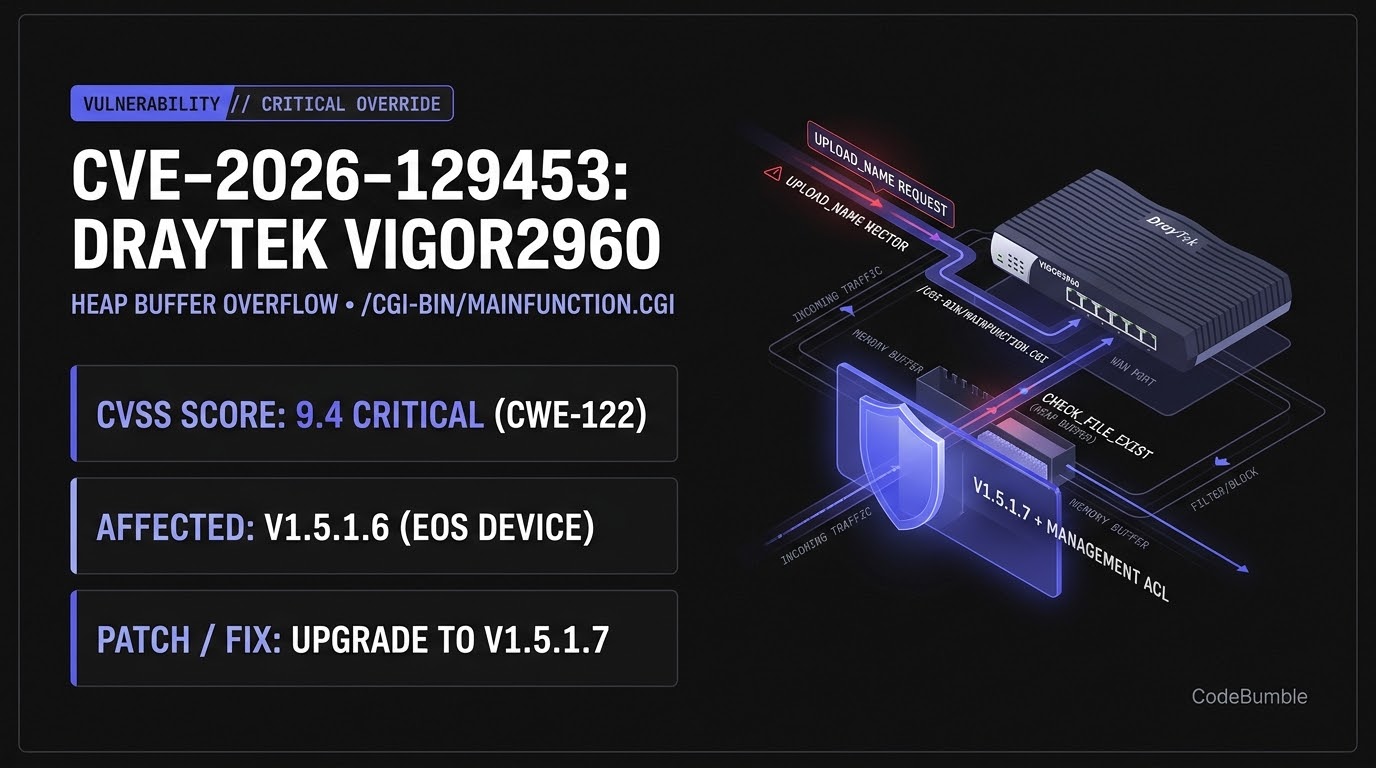
Executive Summary
On November 15, 2026, NVD, MITRE CVE, and OpenCVE published CVE-2026-129453, a critical heap-based buffer overflow (CWE-122) affecting DrayTek Vigor2960 routers running firmware version 1.5.1.6 (revision 8218). Rated CVSS 9.4 (Critical) by OpenCVE and SecurityOnline, the vulnerability resides in the check_file_exist function within /cgi-bin/mainfunction.cgi and is triggered by manipulating the upload_name parameter.
What elevates CVE-2026-129453 to immediate operational urgency is the combination of three factors: a publicly disclosed proof-of-concept exploit on GitHub, a wave of sibling critical flaws disclosed alongside it in the same 1.5.1.6 firmware (CVE-2026-129450 path traversal and CVE-2026-129449 command injection), and the fact that the DrayTek Vigor2960 hardware line is End-of-Support (EoS) (NVD CVE-2026-113397, FirewallScoop).
DrayTek has released firmware version 1.5.1.7 (Vigor2960_v1.5.1.7.zip) to remediate these vulnerabilities. Although CVE-2026-129453 is not yet listed in the CISA Known Exploited Vulnerabilities (KEV) catalog as of November 15–16, 2026, network defenders must treat any exposed Vigor2960 management interface as high risk and upgrade or isolate it immediately.
Threat Context: Why Vigor2960 Firmware 1.5.1.6 Is Under Immediate Pressure
CVE-2026-129453 did not arrive in isolation. On November 15, 2026, multiple vulnerabilities targeting /cgi-bin/mainfunction.cgi in DrayTek Vigor2960 1.5.1.6 were published simultaneously from security research disclosures:
| CVE ID | Component / Function | Weakness Type | Fixed In | Public Exploit |
|---|---|---|---|---|
CVE-2026-129453 |
/cgi-bin/mainfunction.cgi (check_file_exist, upload_name) |
Heap-based buffer overflow (CWE-122) |
1.5.1.7 | Yes (GitHub PoC) |
CVE-2026-129450 |
/cgi-bin/mainfunction.cgi?action=doWebBackup (sub_1E084, option) |
Path traversal (CVSS 9.4) | 1.5.1.7 | Yes (Public) |
CVE-2026-129449 |
/cgi-bin/mainfunction.cgi (sub_14914, swmconfigupload) |
OS command injection | 1.5.1.7 | Yes (Public) |
All three vulnerabilities target the same web management CGI binary (/cgi-bin/mainfunction.cgi) on Vigor2960 v1.5.1.6—and they follow closely behind an October 20, 2026 disclosure (CVE-2026-113397) affecting the IPsec handler (ruequest_certificate) in the exact same CGI binary (NVD).
Understanding the broader 1.5.1.6 attack surface is essential for defenders because an attacker who chains or pivots between these handlers can compromise the entire edge gateway:
CVE-2026-129450(Path Traversal, CVSS 4.09.4): Located insub_1E084of/cgi-bin/mainfunction.cgi?action=doWebBackup, manipulating theoptionparameter allows remote attackers to read or write files outside the intended directory (Mondoo, Rapid7). Its CVSS 4.0 vector (CVSS:4.0/AV:N/AC:L/AT:N/PR:L/UI:N/VC:H/VI:H/VA:H/SC:H/SI:H/SA:H/E:P) reflects low attack complexity, network reachability, and a publicly available exploit (E:P).CVE-2026-129449(OS Command Injection): Located insub_14914of/cgi-bin/mainfunction.cgi, manipulatingswmconfiguploadenables remote command execution (CVE.org).- End-of-Support (EoS) Policy Reality: In its response to
CVE-2026-113397, DrayTek stated explicitly: "2960 1.5.1.7 has corrected many security issues. And 2960 is EoS with limited support, only major issues would be reviewed(e.g. unauthenticated vuln.)" (NVD). Operators must therefore treat firmware1.5.1.7as an urgent stopgap while scheduling hardware replacement off the EoS Vigor2960 platform.
In addition, why does CWE-122 heap corruption carry Availability Impact: Complete on embedded router firmware? Unlike modern desktop and server Linux distributions compiled with full PIE/ASLR, RELRO, and hardened heap allocators, legacy embedded CGI binaries running on End-of-Support appliances frequently lack strict heap-chunk integrity validation. A single oversized upload_name string passed into check_file_exist can corrupt adjacent heap control structures, causing immediate daemon crashes or deterministic control-flow hijacking.
Technical Mechanics & Architecture
How check_file_exist and upload_name Corrupt Heap Memory
Per OpenCVE and VulDB (VDB-437464), the vulnerability stems from improper bounds restriction (CWE-119 / CWE-122) inside the File Existence Check handler (check_file_exist) of /cgi-bin/mainfunction.cgi:
- Request Ingestion: An HTTP request reaches
/cgi-bin/mainfunction.cgicarrying an attacker-controlledupload_nameargument. - Unbounded Heap Copy: The
check_file_existroutine allocates a heap buffer for file-existence verification but writes past the end of that allocated heap chunk when processing an oversized or manipulatedupload_namestring. - Control-Flow / Arbitrary Execution Impact: Overwriting adjacent heap metadata or function pointers inside the CGI process can crash the daemon (complete availability impact) or lead to arbitrary code execution on the router appliance.
Note on authentication context: while OpenCVE's analysis describes remote exploitation without authentication as a primary risk (and scores CVSS 9.4), the underlying VulDB submission title (Submit #1044963) references "Authenticated check_file_exist Heap Memory Corruption", and sibling CVE-2026-129450 carries a PR:L (Low Privileges) CVSS 4.0 vector (CVSS:4.0/AV:N/AC:L/AT:N/PR:L/UI:N/VC:H/VI:H/VA:H/SC:H/SI:H/SA:H/E:P) (Mondoo). Regardless of whether an attacker chains a low-privileged session, default credentials, or direct CGI access, exposing /cgi-bin/mainfunction.cgi to untrusted networks is unsafe.
+-----------------------------------------------------------------------+
|                    UNTRUSTED / EXTERNAL NETWORK                       |
|   Crafted HTTP Request -> /cgi-bin/mainfunction.cgi (upload_name=...) |
+-----------------------------------+-----------------------------------+
                                    |
                    [ Boundary / Mitigation Layer ]
                    * WAN Management ACL (Block TCP 80/443 on WAN)
                    * Reverse Proxy / WAF length check on upload_name
                                    |
                                    v (If Exposed on v1.5.1.6)
+-----------------------------------------------------------------------+
|              DRAYTEK VIGOR2960 (FIRMWARE 1.5.1.6 EoS)                 |
|                                                                       |
|  [ /cgi-bin/mainfunction.cgi ]                                        |
|   -> check_file_exist(upload_name)                                    |
|   -> Heap-Based Buffer Overflow (CWE-122) -> Heap Corruption / RCE    |
|                                                                       |
|  [ Remediation: Firmware v1.5.1.7 ]                                   |
|   -> Bounds-checked upload_name handling + fixes 129449 & 129450      |
+-----------------------------------------------------------------------+
Why Edge Router CGI Flaws Carry Disproportionate Blast Radius
Perimeter routers such as the DrayTek Vigor2960 terminate WAN links, host site-to-site IPsec and SSL VPN tunnels, and bridge untrusted external traffic into internal corporate VLANs. Unlike an isolated application container, a compromised gateway CGI process running with appliance-level privileges exposes:
- VPN & Tunnel Secrets: Stored IPsec pre-shared keys (PSKs), X.509 private keys, RADIUS/LDAP shared secrets, and remote-access user directories.
- Traffic Interception & DNS Manipulation: Full visibility into unencrypted north-south traffic, DHCP/DNS forwarding tables, and routing policies.
- Persistent Foothold Across Reboots: If an attacker chains
CVE-2026-129450(path traversal) orCVE-2026-129453(heap overflow) to modify startup configuration or firmware images, simple reboots will not evict the intrusion without a clean firmware re-flash and configuration audit.
Evidence & Risk Assessment
- Source Cross-Check (High Confidence): NVD, CVE.org, OpenCVE, Tenable, and VulDB all independently confirm
CVE-2026-129453affects DrayTek Vigor29601.5.1.6, targetscheck_file_exist/upload_namein/cgi-bin/mainfunction.cgi, is classified asCWE-122, has a public GitHub PoC, and is resolved by upgrading to firmware1.5.1.7. - Multi-Vendor Tracking: Tenable also indexed
CVE-2026-129453on November 16, 2026, referencing the official DrayTekVigor2960_v1.5.1.7.zipfirmware release. - KEV & EPSS Status: As of November 15–16, 2026, OpenCVE reports that
CVE-2026-129453is not in the CISA KEV catalog and has no EPSS score assigned yet. - Exploitation Scope & Benchmarks: Public telemetry on active in-the-wild exploitation volume for
CVE-2026-129453is not yet available, though the public GitHub PoC makes opportunistic scanning likely.
Defensive Hardening & Detection Playbook
If your organization operates DrayTek Vigor2960 edge routers, execute these five defensive steps immediately:
- Upgrade to Firmware
1.5.1.7Immediately: Download and verify the official DrayTek Vigor2960Vigor2960_v1.5.1.7.zipfirmware package and review the Vigor2960 v1.5.1.7 Release Notes. Upgrading to1.5.1.7simultaneously addressesCVE-2026-129453,CVE-2026-129450, andCVE-2026-129449. - Disable WAN Management Access & Enforce Management ACLs: Never expose
/cgi-bin/mainfunction.cgi(HTTP/HTTPS admin ports) to the public internet. Restrict management interfaces exclusively to a dedicated out-of-band management VLAN or authenticated VPN/bastion IP allowlist. - Hunt HTTP/Proxy/Syslog Telemetry for
upload_name&doWebBackup: Search upstream firewall, reverse-proxy, and router syslog archives for anomalous requests hitting/cgi-bin/mainfunction.cgiwithupload_name,swmconfigupload, oraction=doWebBackupparameters. - Rotate Credentials & Audit Configuration Backups: If a Vigor2960
1.5.1.6appliance had its web management port exposed to the internet prior to patching, assume potential compromise—rotate all local admin, VPN/IPsec PSK, and PPPoE credentials, and diff the current router config against a known-good offline backup. - Plan Hardware Migration Off EoS Vigor2960 Units: Because the Vigor2960 line is End-of-Support (NVD), schedule replacement with an actively supported gateway platform, and keep a validated
1.5.1.6config export offline prior to upgrading in case a rollback is required during maintenance. - Verify Firmware Checksum & Post-Patch Exposure: After applying
Vigor2960_v1.5.1.7.zip, confirm the web UI and CLI report firmware1.5.1.7(no longer1.5.1.6 revision 8218), verify WAN-side HTTP/HTTPS management remains disabled, and re-run an external port scan from outside your perimeter to confirm TCP 80/443 on the router's WAN interface are unreachable. - Forward Syslog Telemetry Off-Box: Configure your Vigor2960 appliances to stream syslog events immediately to an external, append-only SIEM or syslog collector. Because heap-overflow exploitation attempts (
CVE-2026-129453) frequently trigger CGI daemon restarts or anomalous HTTP500/connection-reset bursts before succeeding, off-box telemetry preserves forensic evidence even if an attacker later clears local router logs.
If your organization places a reverse proxy or WAF in front of internal management tools, you can also enforce strict path and parameter bounds at the proxy layer while scheduling the firmware maintenance window:
# Defensive Nginx location block for internal management proxy hardening
location = /cgi-bin/mainfunction.cgi {
    # Restrict exclusively to trusted management / bastion CIDR
    allow 10.250.0.0/24;
    deny all;

    # Reject overly long upload_name / option / swmconfigupload query strings
    if ($args ~* "(upload_name|swmconfigupload|option)=[^&]{128,}") {
        return 403;
    }
}
Below is a safe, defensive Sigma/log-hunting Python & regex check that SOC teams can run against exported HTTP access logs or syslog files to detect probing against CVE-2026-129453, CVE-2026-129450, and CVE-2026-129449 without sending any traffic to router endpoints:
#!/usr/bin/env python3
'''Read-only HTTP/syslog hunter for DrayTek Vigor2960 mainfunction.cgi exploit probes.'''
import re
from pathlib import Path

PROBE_PATTERN = re.compile(
    r"/cgi-bin/mainfunction\.cgi.*?(upload_name=|swmconfigupload=|action=doWebBackup)",
    re.IGNORECASE,
)

def scan_log_file(log_path: Path) -> list[str]:
    hits: list[str] = []
    with log_path.open("r", encoding="utf-8", errors="ignore") as fh:
        for lineno, line in enumerate(fh, start=1):
            if PROBE_PATTERN.search(line):
                hits.append(f"line {lineno}: {line.strip()[:220]}")
    return hits

if __name__ == "__main__":
    sample = Path("/var/log/nginx/access.log")
    if sample.exists():
        matches = scan_log_file(sample)
        print(f"Found {len(matches)} suspicious mainfunction.cgi probe(s).")
        for m in matches[:20]:
            print(" ", m)
    else:
        print("Pass your exported proxy/router access log path to scan_log_file().")
Frequently Asked Questions (FAQ)
What is CVE-2026-129453?
CVE-2026-129453 is a critical (CVSS 9.4) heap-based buffer overflow (CWE-122) in the check_file_exist function of /cgi-bin/mainfunction.cgi on DrayTek Vigor2960 routers running firmware 1.5.1.6, triggered by manipulating the upload_name parameter (OpenCVE, NVD).
Which DrayTek Vigor2960 firmware version fixes CVE-2026-129453?
Upgrading to DrayTek Vigor2960 firmware version 1.5.1.7 resolves CVE-2026-129453 as well as sibling 1.5.1.6 flaws CVE-2026-129450 and CVE-2026-129449 (CVE.org, OpenCVE).
Is there a public exploit for CVE-2026-129453?
Yes. Both OpenCVE and VulDB confirm that a proof-of-concept exploit has been published on GitHub.
Is CVE-2026-129453 in the CISA KEV catalog?
No. As of November 15–16, 2026, OpenCVE notes that CVE-2026-129453 is not listed in the CISA KEV catalog.
What if I cannot upgrade my Vigor2960 to 1.5.1.7 immediately?
Restrict external/WAN access to /cgi-bin/mainfunction.cgi via firewall rules or management ACLs, block untrusted upload_name requests, and monitor device and proxy logs for suspicious requests (OpenCVE).
Sources
- NVD — CVE-2026-129453 Detail (Published November 15, 2026)
- CVE.org — CVE-2026-129453 Record (Published November 15, 2026)
- OpenCVE — CVE-2026-129453 Vulnerability Details (Published November 15, 2026)
- VulDB — VDB-437464: DrayTek Vigor2960 1.5.1.6
check_file_existHeap Overflow (November 15, 2026) - SecurityOnline — CVE-2026-129453: DrayTek Vigor2960 Heap-based Buffer Overflow (November 15, 2026)
- DrayTek — Vigor2960 Firmware v1.5.1.7 Release Note