

Vulnerability
F5 BIG-IP TMM Flaws: Auditing Six Critical CVSS 9.8 Data-Plane Vulnerabilities
F5 published an out-of-band security advisory on November 18, 2026 disclosing six critical (CVSS v3.1 9.8 / v4.0 9.3) stack-based buffer overflows in the BIG-IP Traffic Management Microkernel (TMM). Because these flaws are reachable only when specific iRule commands or APM policy agents are enabled, default installations are not exposed—but affected systems require engineering hotfixes rather than standard software upgrades. This defensive briefing details the exact triggers, cross-source advisory discrepancies, read-only tmsh audit commands, TMM crash detection, and hotfix rollout safeguards.
10 min read
F5 BIG-IP TMM Flaws: Auditing Six Critical CVSS 9.8 Data-Plane Vulnerabilities
Executive Summary
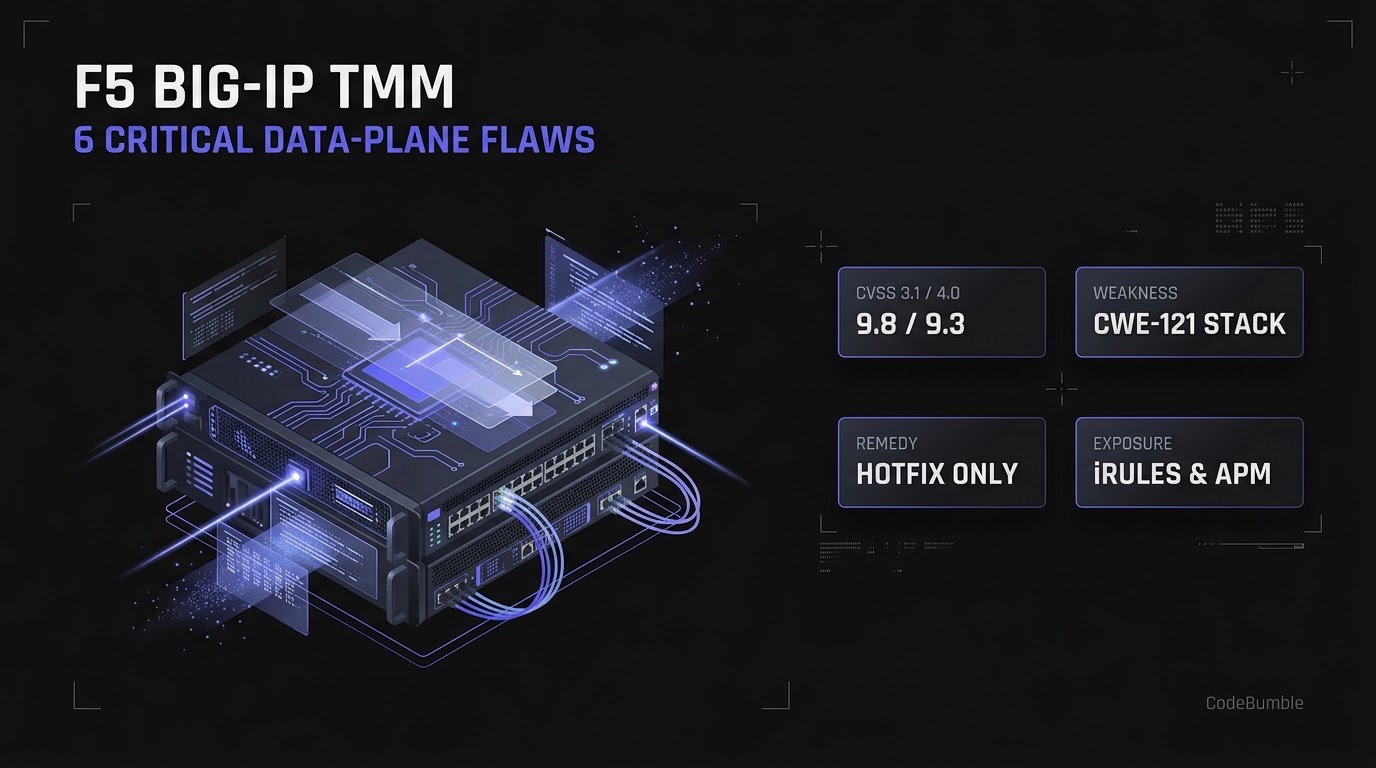
On November 18, 2026, F5 published an out-of-band security notification (K000164058) comprising 22 advisories across its application delivery and proxy portfolio, including 10 advisories covering NGINX and 12 covering BIG-IP and BIG-IQ. Six of the BIG-IP vulnerabilities are rated Critical (CVSS v3.1: 9.8; CVSS v4.0: 9.3) and affect the Traffic Management Microkernel (TMM)—the core data-plane engine responsible for processing client network traffic.
All six critical flaws stem from stack-based buffer overflows (CWE-121) that allow an unauthenticated remote attacker to crash TMM (causing a denial of service) or potentially execute arbitrary code on the data plane. Crucially, none of the six vulnerabilities can be triggered against a default BIG-IP installation. Each flaw requires a specific non-default configuration: either an iRule invoking one of five specific Tcl commands on client traffic, or an Access Policy Manager (APM) per-request policy combining two specific endpoint agents.
There is no scheduled regular release or documented configuration workaround for these six flaws. Remediation currently requires applying an Engineering Hotfix (EHF), which F5 notes does not undergo full regression QA and carries no warranty. As of November 19, 2026, no active in-the-wild exploitation has been reported for any of these six CVEs.
Confidence Level: High for CVE identifiers, CVSS scores, CWE-121 classification, trigger conditions, and hotfix-only remediation status (verified across F5 advisories and NIST NVD). Moderate for two platform-mapping edge cases—specifically BIG-IP Cloud-Native Network Functions (CNF) exposure on CVE-2026-120722 and BIG-IP Next module labeling on CVE-2026-121805—where F5 advisory text and CVE metadata diverge.
The Six Critical TMM Vulnerabilities at a Glance
Four of the six critical flaws were reported by WatchTowr researcher Sina Kheirkhah, while two were discovered internally by F5. All six share the same CVSS v4.0 vector (CVSS:4.0/AV:N/AC:L/AT:N/PR:N/UI:N/VC:H/VI:H/VA:H/SC:N/SI:N/SA:N), reflecting network-reachable, zero-privilege, zero-user-interaction exposure in the data plane with high confidentiality, integrity, and availability impact to the vulnerable component.
| CVE ID | F5 Advisory | CVSS v3.1 / v4.0 | Exact Configuration Trigger | Affected Products |
|---|---|---|---|---|
| CVE-2026-123637 | K000163937 | 9.8 / 9.3 | APM per-request policy with both Client Information and Endpoint Security agents | BIG-IP APM only |
| CVE-2026-121805 | K000163946 | 9.8 / 9.3 | iRule using PEM::subscriber on client traffic |
BIG-IP PEM, BIG-IP Next for Kubernetes, BIG-IP CNF |
| CVE-2026-120292 | K000163940 | 9.8 / 9.3 | HTTP profile + iRule using MR::message route |
BIG-IP (all modules), BIG-IP Next for Kubernetes |
| CVE-2026-120285 | K000163939 | 9.8 / 9.3 | HTTP profile + iRule using PSC::ip_address |
BIG-IP (all modules), BIG-IP Next for Kubernetes, BIG-IP CNF |
| CVE-2026-116953 | K000163941 | 9.8 / 9.3 | iRule using GENERICMESSAGE::route on client traffic |
BIG-IP (all modules), BIG-IP Next for Kubernetes |
| CVE-2026-120722 | K000163945 | 9.8 / 9.3 | iRule using DNS::scrape on client traffic |
BIG-IP DNS, BIG-IP Next for Kubernetes (CNF disputed) |
Technical Mechanics: Why TMM Stack Overflows Matter
BIG-IP separates its architecture into two distinct planes: the control plane (Linux host OS, tmsh, GUI, iControl REST/SOAP) and the data plane (TMM). Unlike management-plane vulnerabilities—which can often be mitigated by restricting management interfaces to an isolated out-of-band network—data-plane vulnerabilities sit directly on the public-facing virtual server path. Any client able to reach a vulnerable virtual server can send crafted packets or HTTP/DNS/generic-message payloads into TMM.
[Untrusted Client]
        │
        ▼  (Network Traffic to Virtual Server)
┌───────────────────────────────────────────────────────────┐
│                  BIG-IP TMM (Data Plane)                  │
│                                                           │
│  Virtual Server ──► HTTP / DNS / PEM / Message Profile    │
│                           │                               │
│                           ▼                               │
│             Triggered iRule / APM Policy                  │
│     (PEM::subscriber, MR::message route, PSC::ip_address, │
│      GENERICMESSAGE::route, DNS::scrape, or APM Agents)   │
│                           │                               │
│                           ▼                               │
│        [CWE-121 Stack-Based Buffer Overflow in TMM]       │
│              ├──► TMM Crash / Core Dump (DoS)             │
│              └──► Potential Remote Code Execution (RCE)   │
└───────────────────────────────────────────────────────────┘
        ▲
        │  (Separate Plane — Not Used by These 6 CVEs)
[Control Plane: Management Port / iControl REST & SOAP]
Exposure Conditions by Component
iRule Tcl Command Parsers (
CVE-2026-121805,CVE-2026-120292,CVE-2026-120285,CVE-2026-116953,CVE-2026-120722): iRules allow administrators to inspect, route, and rewrite traffic dynamically using Tcl scripts executed inside TMM. When an iRule invokesPEM::subscriber,MR::message route,PSC::ip_address,GENERICMESSAGE::route, orDNS::scrapeon untrusted client-side traffic, TMM copies or parses protocol fields into a fixed-size stack buffer without sufficient bounds checking (CWE-121). ForCVE-2026-120292andCVE-2026-120285, an HTTP profile must also be attached to the virtual server alongside the iRule.APM Per-Request Policy Agents (
CVE-2026-123637): Unlike the five iRule-driven bugs,CVE-2026-123637affects BIG-IP APM only and requires a per-request policy configured with both the Client Information agent and Endpoint Security agents. Per-request policies evaluate traffic continuously on each request rather than once at session establishment, widening the window during which malformed client attributes can reach the vulnerable stack parser.
Safe Read-Only Configuration Audit Commands
Before scheduling emergency hotfix windows, engineering teams should determine whether any active virtual server or policy actually uses the six triggers. The following read-only tmsh commands inspect local configuration without modifying system state:
# 1. Search all LTM iRules across partitions for the five vulnerable Tcl commands
tmsh -q -c "cd /; list ltm rule recursive" | grep -E -B 2 -A 2 \
  "PEM::subscriber|MR::message[[:space:]]+route|PSC::ip_address|GENERICMESSAGE::route|DNS::scrape"

# 2. List virtual servers that have iRules attached (cross-reference with matches above)
tmsh -q -c "cd /; list ltm virtual recursive rules profiles"

# 3. Inspect APM per-request policies for Client Information + Endpoint Security agents
tmsh -q -c "cd /; list apm policy per-request-policy recursive" | grep -E -B 3 -A 3 \
  "client-info|endpoint-security|epsec"
If none of these commands return matches across your active partitions—and you do not run BIG-IP Next for Kubernetes or BIG-IP CNF with equivalent policies—your immediate exposure to the six CVSS 9.8 TMM flaws is low, though you should still evaluate the companion control-plane and APM flaws detailed below.
Evidence, Advisory Discrepancies, and Companion Flaws
Cross-Source Verification and Discrepancies
Security teams tracking automated vulnerability feeds should note two documented discrepancies in the November 18–19, 2026 disclosures:
CVE-2026-120722(DNS::scrape) BIG-IP CNF Conflict: F5's primary advisory (K000163945) lists BIG-IP CNF as not vulnerable toCVE-2026-120722, whereas the published CVE record (NVD CVE-2026-120722) lists BIG-IP CNF as affected. Organizations running BIG-IP CNF with DNS iRules should verify build applicability directly with F5 Support before assuming non-exposure.CVE-2026-121805(PEM::subscriber) Next Module Labeling: Analysis by Brandefense highlighted that the BIG-IP Next rows in F5'sK000163946matrix carry a DNS module label that conflicts with the advisory'sPEM::subscribertechnical description. Treat any BIG-IP Next for Kubernetes or CNF deployment executingPEM::subscriberiRules as in scope regardless of the table label.- Exploitation Context: Neither F5 nor secondary threat intelligence reports (BastionZero, HoneyMex Lab, The Hacker News) indicate active exploitation of these six TMM flaws as of November 19, 2026. Do not confuse this disclosure with
CVE-2026-94127, an earlier BIG-IP APM OAuth heap-based buffer overflow exploited in September 2026 and added to CISA's Known Exploited Vulnerabilities (KEV) catalog.
Companion Lower-Rated BIG-IP & BIG-IQ Flaws (Same Batch)
Alongside the six critical TMM flaws, F5 disclosed six High-severity vulnerabilities in the same November 18, 2026 out-of-band release. Unlike the TMM bugs, several of these have fixes in regular maintenance releases:
| CVE ID | Component | CVSS v3.1 (v4.0) | Key Details / Fixed Versions |
|---|---|---|---|
| CVE-2026-125274 | iControl SOAP (K000163936) | 8.8 (8.7) | Fixed in BIG-IP 21.1.0.3, 17.5.1.10, 17.1.3.6; BIG-IQ 8.4.2.3 |
| CVE-2026-120718 | iControl REST | 8.1 | Authentication token expiry issue |
| CVE-2026-125272 | BIG-IP APM | 7.5 | Logon Page handling flaw |
| CVE-2026-126822 | BIG-IP APM | 7.5 | SAML Service Provider (SP) processing flaw |
| CVE-2026-126336 | BIG-IP APM | 7.5 | SAML encrypted assertions handling flaw |
| CVE-2026-121812 | BIG-IP APM & SSL Orchestrator | 7.5 | Triggered when tmm.access.policytrace is enabled |
Defensive Hardening Playbook & Hotfix Rollout
Because no scheduled point release or configuration workaround exists for the six critical TMM flaws, remediation requires disciplined Engineering Hotfix (EHF) management.
Step 1: Audit All Virtual Servers, iRules, and APM Policies
Run the read-only tmsh commands in the Technical Mechanics section across every HA pair, standalone appliance, and vCMP guest. For BIG-IP Next for Kubernetes and BIG-IP CNF, inspect deployed CRDs/iRule ConfigMaps for PEM::subscriber, MR::message route, PSC::ip_address, GENERICMESSAGE::route, and DNS::scrape.
Step 2: Check for Custom EHFs and EoTS Status
F5 explicitly warns that Engineering Hotfixes do not undergo extensive QA and carry no warranty. Furthermore:
- If a BIG-IP system already runs a custom EHF, installing a standard EHF from this batch can overwrite or conflict with prior fixes. Open a support case with F5 to request a new combined EHF.
- Software versions past End of Technical Support (EoTS) were not evaluated by F5 for these six CVEs and have no hotfixes available.
Step 3: Stage the Appropriate Engineering Hotfix (EHF)
Download the verified EHF matching your exact software branch and platform from MyF5:
- BIG-IP Next for Kubernetes:
BNK-2.4.2-EHF1(for2.4.0–2.4.2),BNK-2.3.4-EHF1(for2.3.0–2.3.4), orBNK-2.2.5-EHF1(for2.2.0–2.2.5). - BIG-IP CNF (
CVE-2026-121805,CVE-2026-120285):CNF-2.4.2-EHF1,CNF-2.3.4-EHF1, orCNF-2.2.5-EHF1. - BIG-IP DNS (
CVE-2026-120722example builds):BIGIP-21.1.0.4.0.19.3-ENG,BIGIP-17.5.1.11.0.61.12-ENG/17.5.1.10.0.80.35-ENG, orBIGIP-17.1.3.7.0.21.4-ENG/17.1.3.6.0.14.20-ENG.
Step 4: Deploy Telemetry & Crash Detection Rules
While staging hotfixes, monitor /var/log/ltm and system core directories for signs of TMM instability or exploitation attempts:
# Check for recent TMM core dumps (indicates TMM crash / SIGSEGV)
ls -lh /var/core/

# Inspect /var/log/ltm for TMM restarts, watchdog triggers, or Tcl execution errors
grep -E "tmm\[|SOD|core dumped|TCL error|stack" /var/log/ltm | tail -n 50

# Check TMM process uptime and memory/restart counters
tmsh show sys tmm-info | grep -E "TMM|Restart|Uptime"
In your SIEM, alert on sudden drops in TMM uptime, unexpected HA failover events paired with /var/core/tmm* creation, or repeated client connections from a single source IP immediately preceding a TMM restart.
Step 5: Execute Safe Rollout & Preserve Rollback Capability
Always install EHFs into an inactive boot volume (e.g., HD1.2 while running on HD1.1) rather than overwriting the active volume:
# 1. Save a full encrypted/unencrypted UCS archive before any change
tmsh save sys ucs /var/local/ucs/pre-ehf-nov2026.ucs

# 2. Verify available boot locations before installing the EHF ISO
tmsh show sys software status
Fail over traffic cleanly to the peer HA unit, boot the standby unit into the patched volume, verify virtual server health and iRule execution against synthetic test traffic, and then repeat on the remaining unit. If an EHF introduces regression in your iRules or traffic profiles, you can roll back immediately by rebooting into the prior untouched boot volume.
Frequently Asked Questions (FAQs)
1. Are default BIG-IP installations vulnerable to these six CVSS 9.8 flaws?
No. All six critical TMM vulnerabilities require non-default configurations—specifically an iRule using one of five Tcl commands (PEM::subscriber, MR::message route, PSC::ip_address, GENERICMESSAGE::route, or DNS::scrape) or an APM per-request policy with both Client Information and Endpoint Security agents.
2. Can I mitigate these vulnerabilities by restricting access to the BIG-IP management port?
No. These six flaws reside in the TMM data plane, not the control/management plane. Any untrusted client able to reach an affected virtual server IP can trigger the vulnerable parser. (By contrast, companion flaws like CVE-2026-125274 in iControl SOAP and CVE-2026-120718 in iControl REST are control-plane issues.)
3. Why does F5 only offer Engineering Hotfixes (EHFs) instead of a standard point release? Because these vulnerabilities were disclosed in an out-of-band security notification on November 18, 2026, F5 released targeted EHFs ahead of scheduled maintenance releases. F5 advises that EHFs do not undergo full regression testing and carry no warranty, so staging them on a standby HA unit and keeping a clean rollback boot volume is essential.
4. Are any of the six critical TMM flaws being exploited in the wild?
As of November 19, 2026, neither F5 nor public threat intelligence trackers have reported active exploitation of these six CVEs. They are distinct from CVE-2026-94127, an APM OAuth flaw exploited in September 2026.
5. What should I do if my BIG-IP appliance already runs a custom Engineering Hotfix? Do not apply a generic EHF directly over a custom EHF, as doing so can break existing fixes. Contact F5 Support to request a combined EHF that incorporates both your existing custom patches and the November 2026 TMM security fixes.
Sources
- F5 Security Notification (Out-of-Band Release Overview): K000164058 — Out-of-band security notification (November 2026) (Published November 18, 2026)
- F5 Individual Advisories:
- K000163937 — CVE-2026-123637 (BIG-IP APM) (November 18, 2026)
- K000163946 — CVE-2026-121805 (PEM::subscriber) (November 18, 2026)
- K000163939 — CVE-2026-120285 (PSC::ip_address) (November 18, 2026)
- K000163945 — CVE-2026-120722 (DNS::scrape) (November 18, 2026)
- K000163936 — CVE-2026-125274 (iControl SOAP) (November 18, 2026)
- NIST National Vulnerability Database (NVD):
- NVD — CVE-2026-120285 (Published November 19, 2026)
- NVD — CVE-2026-121805 (Published November 18, 2026)
- NVD — CVE-2026-120722 (Published November 19, 2026)
- Technical Analysis & Press Reporting:
- BastionZero — F5 BIG-IP Six Critical Vulnerabilities Crash TMM, Remote Code Execution (Published November 19, 2026)
- HoneyMex Lab — F5 Warns 6 Critical BIG-IP Flaws Can Crash Traffic, In Specific Setups May Allow RCE (Published November 18, 2026)
- The Hacker News — F5 Warns 6 Critical BIG-IP Flaws Can Crash Traffic (Published November 19, 2026)