

SEO
Google GoTo Throttling and Poisoned SERPs Quietly Break Rank Trackers
Google's page-level google.com/goto redirect throttling now adds delays of up to 120 seconds per URL, compounding SERP poisoning that peaked at 68.6% in early November 2026. Learn why third-party rank trackers diverge from Google Search Console and how to audit your SEO telemetry.
8 min read
Google GoTo Throttling and Poisoned SERPs Quietly Break Rank Trackers
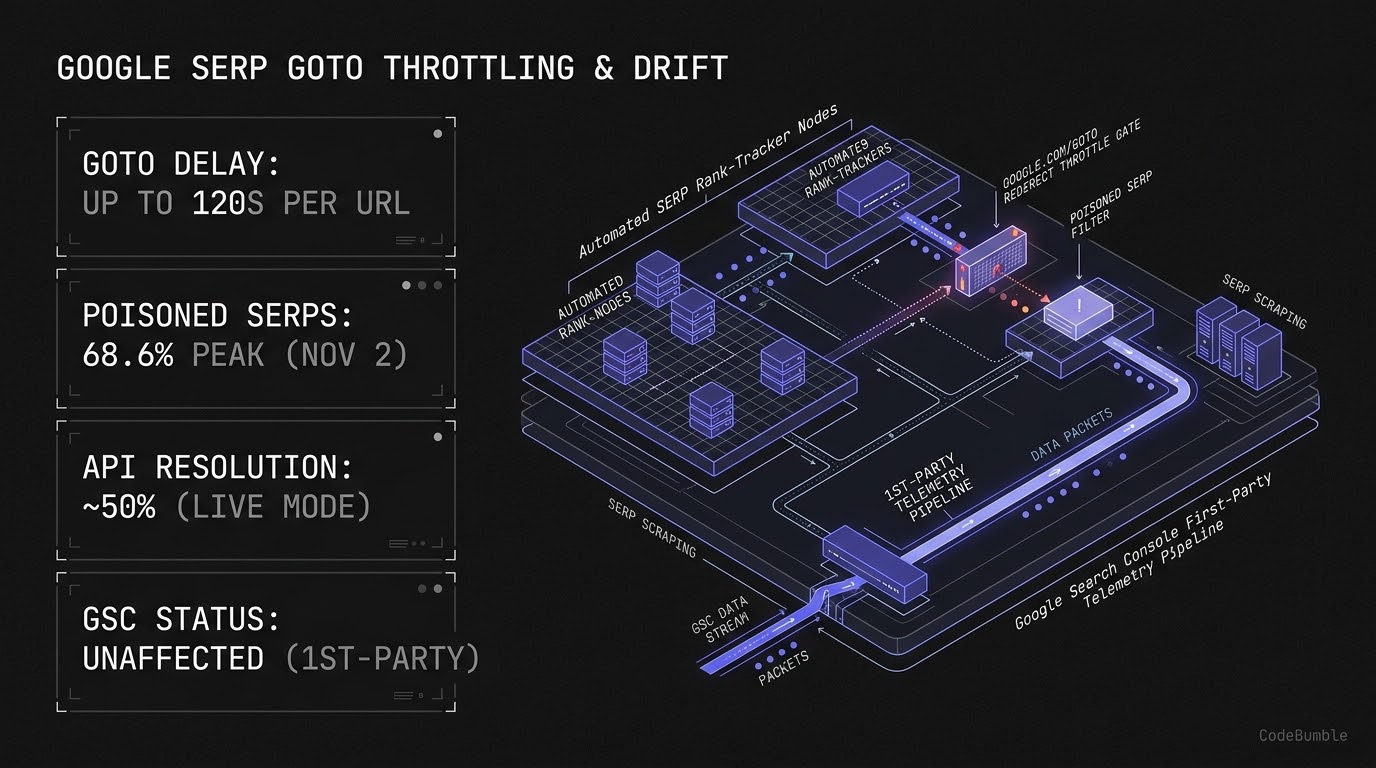
Executive Summary
Between September and November 2026, automated search measurement underwent a structural shift. Google's deployment of google.com/goto passthrough redirect URLs, combined with page-level redirect throttling and "poisoned" Search Engine Results Pages (SERPs) served to suspected automated scrapers, has caused third-party rank trackers and SERP APIs to diverge sharply from what human searchers see in a browser (DataForSEO, Polaris7 Intelligence).
According to DataForSEO's November 2, 2026 technical update, Google now enforces a page-level limit on how fast google.com/goto links from a single SERP can resolve to their destination URLs: after the first 5–6 links resolve immediately, Google serves an interstitial with a "Continue" button that imposes escalating delays—1 second on the 7th URL, 3 seconds on the 8th, 40 seconds by the 15th, and up to 120 seconds per URL—cutting resolution in DataForSEO's fastest API modes to roughly 50% (DataForSEO). Meanwhile, Nozzle's ongoing study (updated November 3, 2026) documented "poisoned" SERPs—normal-looking pages with a keyword's usual domains swapped out—peaking at 68.6% across page 1 or page 2 on November 2, 2026 (Nozzle Research).
Confidence Level: High for vendor-reported measurements, GoTo throttling mechanics, and Search Console independence (verified directly against DataForSEO, Nozzle, and Keywords Everywhere's November 13, 2026 log). Note that Google has not commented publicly on SERP poisoning or GoTo throttling, and vendor percentages cannot be compared 1:1 because each provider samples different keywords and applies different post-collection filters (Keywords Everywhere).
Architectural Context: Anti-Scraping vs. First-Party Telemetry
For SEO engineers and analytics teams, the critical distinction in late 2026 is between scraped third-party SERP telemetry and first-party Google Search Console (GSC) data:
- Scraped SERP APIs & Rank Trackers: Operate from automated infrastructure subject to JavaScript challenges (
SearchGuard),google.com/gotopassthrough redirects, page-level interstitial delays, and poisoned or one-word-truncated SERP responses (Seeberger Solutions, Nozzle). - Google Search Console: Records actual user impressions and clicks directly from Google's serving stack. While GSC experienced isolated reporting anomalies (including a November 9–11, 2026 Generative AI performance logging error), GSC is completely unaffected by SERP poisoning or GoTo throttling (Keywords Everywhere).
Compounding the diagnostic challenge, Google's November 2026 Core Update began rolling out on November 10, 2026 (estimated up to 2 weeks). Teams reacting to a single-day rank-tracker drop risk misattributing automated collection artifacts to a core ranking shift.
Technical Mechanics & Architecture
1. Page-Level google.com/goto Redirect Throttling
Introduced at the end of August 2026, google.com/goto replaces direct destination href links in automated or flagged SERP responses with opaque passthrough URLs that cannot be decoded statically and must be followed via HTTP/browser redirects (DataForSEO).
Automated SERP Fetch & GoTo Resolution Pipeline:
  [Rank Tracker / SERP API] ──(Query)──> [Google Search Frontend]
                                               │
            ┌──────────────────────────────────┴──────────────────────────────────┐
            ▼                                                                     ▼
  [A. Poisoned / One-Word SERP]                                        [B. Masked google.com/goto Links]
   • Normal HTML shell & title                                          • URLs 1–6: Instant 302/redirect
   • Usual top domains swapped out                                      • URL 7: ~1s | URL 8: ~3s
   • Or query truncated to 1 word                                       • URL 15: ~40s | Max: 120s/URL
                                                                        • Bound to SERP ID (IP swap fails)
Because each google.com/goto link embeds an identifier tied to the specific SERP page instance, DataForSEO confirmed that rotating IP addresses, changing subsequent queries, or waiting an hour before resolving the links does not reset the throttle (DataForSEO). In High Priority and Live API modes where strict timeouts apply, roughly half of GoTo URLs remain unresolved unless routed through slower Standard Priority queues.
2. Two Distinct SERP Degradation Modes
Nozzle's research team isolated two separate failure modes affecting automated SERP fetches (Nozzle Poisoned SERPs, Nozzle Google Plays Dumb):
- Poisoned SERPs (Swapped Domains): A full SERP with 10 organic slots, ads, and People Also Ask loads normally, but fewer than half of the keyword's usual domains (those present on ≥60% of baseline pages) appear anywhere on the page. Across Nozzle's tracked sample, a project's own site misses the top 10 on 63.7% of poisoned SERPs (vs. 2.6% baseline), with 45.1% returning to normal within 3 days and 89.0% within 2 weeks (Nozzle).
- One-Word Query Truncation ("Google Plays Dumb"): The SERP
<title>displays the full multi-word query on 99.9% of affected pages, and panels like AI Overviews or price charts still answer the full query, yet the organic results answer only a single word of the query (e.g.,"easy strawberry jam"returning results for the TV series Easy). Nozzle observed this on 13.1% of judged page 1/2 SERPs since September 16 (peaking at 39.9% on September 28), while SE Ranking independently observed one-word results on 57.3% of 10,000 US desktop keywords on September 17 and 67.2% by September 24, with 96.5% of unrelated blocks starting at position 9 or lower (Nozzle, Keywords Everywhere).
Evidence & Cross-Vendor Measurement Comparison
Because each SEO platform uses different keyword samples, retry thresholds, and validation filters, their reported percentages measure different stages of the collection pipeline (Keywords Everywhere, Seeberger Solutions):
| Provider / Study | Metric Scope & Sample | Reported Impact | Key Operational Takeaway |
|---|---|---|---|
| Nozzle (Updated Nov 3, 2026) | Page 1 or 2 poisoned (vs. Aug 20–Sep 9 baseline) | 27.6% avg since Sep 13; 68.6% peak (Nov 2); 34.8% P1 peak (Oct 27) | Page 2 is poisoned 1.5x more often than Page 1 |
| Nozzle (Updated Nov 3, 2026) | One-word query truncation (since Sep 16) | 13.1% avg; 39.9% peak (Sep 28); 10.7% early Nov | 62% of the time, the very next SERP check is normal |
| DataForSEO (Nov 2, 2026) | google.com/goto redirect resolution |
Up to 120s delay/URL; ~50% resolved in Live/High Priority | Page-level throttle; IP rotation does not bypass it |
| SE Ranking (Nov 3, 2026) | 10,000 US desktop keywords (one-word results) | 57.3% (Sep 17) → 67.2% (Sep 24); ~2% post-fix residual | 96.5% of unrelated blocks started at position 9+ |
| AccuRanker (Oct 26, 2026) | First desktop fetches vs. post-filter sample | 40% first fetches poisoned (Oct 24); 0.6% desktop post-filter (Oct 25) | Sandwich-check filtering strips most bad fetches |
| Keyword.com (Oct 16, 2026) | Customer sample (Sep 13–Oct 14 vs. Aug) | 13.1% avg (34% peak Sep 30) vs. 0.3% in August | 78% of poisoned SERPs recovered within 3 days |
Benchmark Availability Note: Google has published no official telemetry, rate-limit thresholds, or latency benchmarks for google.com/goto interstitials or anti-scraping defenses. All quantitative figures above come from third-party vendor studies and API status disclosures.
SEO Telemetry & Verification Playbook
Before escalating a sudden ranking drop during the November 2026 Core Update window, SEO and data engineering teams should validate rank-tracker anomalies against first-party data and detect unresolved goto links automatically.
Step 1: Cross-Check Against Google Search Console (GSC) First
- Verify Clicks & Impressions in GSC: If a third-party rank tracker shows a sudden drop out of the top 10 for a core keyword, inspect that exact URL and query in GSC Performance. If GSC impressions and average position remain flat, the rank-tracker reading is a collection artifact (Keywords Everywhere).
- Account for GSC Logging Anomalies: Annotate November 9–11, 2026 in dashboards if reporting on Generative AI in Search, as Google confirmed a logging-only impression drop during that window (Keywords Everywhere).
Step 2: Quarantine Unresolved goto Links & Poisoned Fetches in Python
When ingesting SERP API JSON payloads into internal BigQuery or Postgres warehouses, never treat unresolved google.com/goto URLs or single-day domain wipeouts as real ranking losses. Use a defensive validation gate before writing to production reporting tables:
from urllib.parse import urlparse

def validate_serp_snapshot(
    organic_urls: list[str],
    baseline_domains: set[str],
    min_overlap_ratio: float = 0.40,
) -> tuple[bool, str]:
    # Flag unresolved google.com/goto redirects and suspected poisoned SERPs.
    unresolved_goto = sum(
        1 for u in organic_urls
        if urlparse(u).netloc.endswith("google.com") and urlparse(u).path.startswith("/goto")
    )
    if unresolved_goto > 0:
        return False, f"QUARANTINE: {unresolved_goto} unresolved google.com/goto URLs detected."

    fetched_domains = {urlparse(u).netloc.lower().lstrip("www.") for u in organic_urls if u}
    if baseline_domains:
        overlap = len(fetched_domains & baseline_domains) / len(baseline_domains)
        if overlap < min_overlap_ratio:
            return False, f"QUARANTINE: Domain overlap {overlap:.1%} below {min_overlap_ratio:.0%} (suspected poisoned SERP)."

    return True, "PASS: Snapshot passed GoTo and baseline-overlap validation."
Step 3: Tune Rank-Tracker Schedules & Rollback Notes
- Shift Non-Urgent Crawls to Standard Priority Queues: If your pipeline uses DataForSEO or similar SERP APIs, route daily rank checks through Standard Priority queues rather than Live/High Priority modes so
gotoresolution completes without timing out at ~50% (DataForSEO). - Require Multi-Day Confirmation: Require 3 consecutive days of position loss before triggering automated SEO alerts or rolling back content changes, since 45.1%–78% of poisoned SERPs and 62% of one-word truncations revert within 1–3 days (Nozzle).
Frequently Asked Questions (FAQs)
1. Does google.com/goto throttling or SERP poisoning affect real human users or organic rankings?
No. DataForSEO and Polaris7 note that google.com/goto preserves the normal click experience for human users, and SERP poisoning specifically targets automated scraper traffic. Real organic rankings and Google Search Console metrics remain unaffected (Polaris7 Intelligence, Keywords Everywhere).
2. Can rotating residential proxies or changing IP addresses bypass google.com/goto delays?
No. DataForSEO confirmed that Google enforces the google.com/goto redirect limit at the SERP page level using an identifier embedded in each link, so changing IP addresses, changing queries, or waiting an hour does not reset the delay (DataForSEO).
3. Why do different SEO tools report such different percentages of poisoned SERPs (from 0.6% to 68.6%)? Each vendor measures a different stage and sample. Nozzle's 68.6% peak measures raw page 1 or page 2 poisoning on November 2, while AccuRanker's 0.6% desktop figure reflects what remained after its own "sandwich check" filtering discarded bad fetches (Keywords Everywhere).
4. Why is Page 2 hit harder than Page 1 in rank trackers? Nozzle's data shows Page 2 is poisoned 1.5 times as often as Page 1, and one-word query truncation frequently hits Page 2 under a completely normal Page 1—meaning deep-rank tracking (positions 11–20+) is disproportionately noisy (Nozzle, Nozzle Google Plays Dumb).
5. How can I tell a poisoned SERP from the November 2026 Core Update? Check Google Search Console clicks and impressions first, and re-check the keyword 24–72 hours later. A poisoned or one-word SERP typically snaps back to the keyword's usual domains within 1–3 days without a corresponding drop in GSC impressions (Nozzle).
Sources
- DataForSEO — Google's New GoTo URL Limits and How This Affects Your Results (Nov 2, 2026): https://dataforseo.com/update/new-goto-url-limits-and-how-this-affects-your-results
- Nozzle Research — Poisoned Google SERPs (Oct 10, 2026; Updated Nov 3, 2026): https://nozzle.io/research/poisoned-google-serps/
- Nozzle Research — Google Plays Dumb (Oct 22, 2026; Updated Nov 3, 2026): https://nozzle.io/research/google-plays-dumb/
- Polaris7 Intelligence — Google deploys 'goto' redirect URLs (Nov 15, 2026): https://www.polaris7.io/signals/google-deploys-goto-redirect-urls-signal
- Keywords Everywhere — Google Search Console and Googlebot Changes 2026 (Updated Nov 13, 2026): https://keywordseverywhere.com/news/google-algorithm-updates/search-console-changes/
- Seeberger Solutions — Poisoned SERPs: Why Your Rank Tracker Is Wrong (Nov 7, 2026): https://seeberger-solutions.com/poisoned-serps/