

SEO
SEO Rank #1 Clicks Drop in AI Search: Why Share of Voice Fails and the 6 AI KPIs That Matter
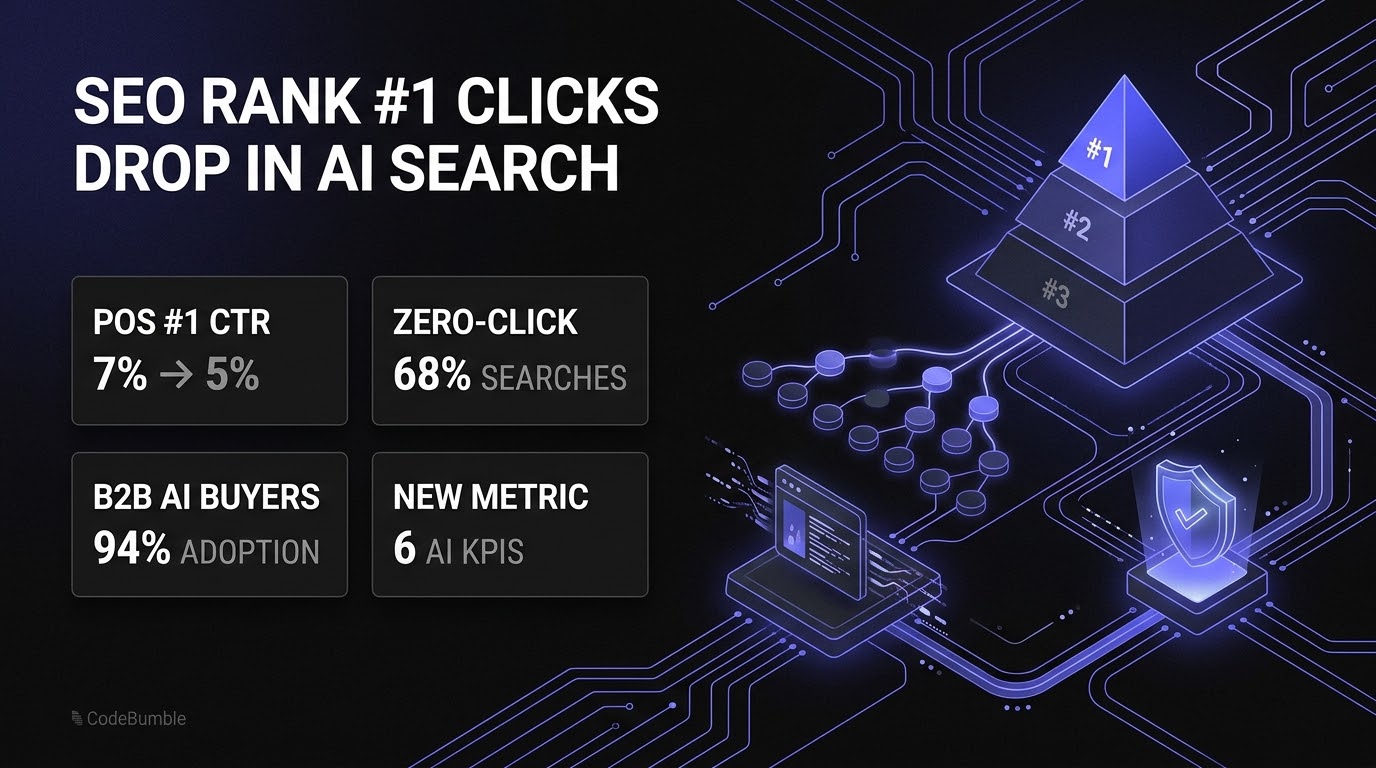
A 166-brand iPullRank study shows Google Position #1 unbranded CTR fell from 7% to 5% while 68% of searches now end without a click. Learn why traditional SEO Share of Voice fails in AI search, how to instrument the 6 AI KPIs, and how to segment GSC CTR decay.
9 min read
SEO Rank #1 Clicks Drop in AI Search: Why Share of Voice Fails and the 6 AI KPIs That Matter
Executive Summary
Holding the #1 organic ranking on Google no longer delivers the click volume it did a year ago. Between November 12 and November 14, 2026, three independent datasets converged on the same structural shift in search engineering and organic acquisition:
- Top-Position CTR Compression: An iPullRank study analyzing 166 brands and 272 verified Google Search Console properties (March 2025 through mid-July 2026) found that the leading unbranded result (
Position 1) dropped from roughly 7 clicks per 100 impressions in 2025 to 5 in 2026, whilePosition 3fell by more than 50%. - Zero-Click & Referral Erosion: In a Search Engine Land analysis published November 13, 2026, Rand Fishkin reported that 68% of Google searches now end without a click, even as Forrester found 94% of B2B buyers use AI during their purchasing process. Meanwhile, Similarweb and Reddit disclosures (November 12, 2026) showed Reddit's global visits down 13% year-over-year (losing more than 1 million weekly search referrals in October) as Google's AI Overviews absorbed logged-out discovery queries.
- Model & Telemetry Shifts: On November 12–13, Google pushed Gemini 4 Hydrogen into Google Search—upgrading query fan-out and citation linking—while simultaneously publishing new Search Central guidance on identifying Google Search traffic via the HTTP
Refererheader (Search Engine Roundtable).
Because traditional SEO Share of Voice (SOV) assumes fixed 10-blue-link SERPs and stable CTR curves, engineering and growth teams must retire static rank-only forecasting and instrument the 6 AI Search KPIs alongside Search Console brand/non-brand segmentation and edge log attribution.
The 6 AI Search KPIs Replacing Traditional Share of Voice
In Search Engine Land's November 13 breakdown, Seer Interactive Chief AI Officer Alisa Scharf outlines a 6-KPI framework organized around three commercial stages—Be Seen, Be Believed, and Be Chosen:
| Stage | KPI | Measurement Formula | Operational Signal |
|---|---|---|---|
| 1. Be Seen | AI Share of Voice | % of tracked AI answers naming your brand / total answers |
Measures raw entity presence across bottom-funnel buyer prompts |
| 2. Be Seen | AI Shortlist Rate | Fan-out searches naming your brand / total fan-out searches |
Tracks whether Gemini/LLM retrieval queries explicitly seek your brand |
| 3. Be Believed | Message Pull-Through | Answers repeating key positioning / answers mentioning you |
Verifies whether RAG snippets preserve your intended product narrative |
| 4. Be Believed | Brand Accuracy | Answers with accurate product facts / answers mentioning you |
Detects pricing, compliance, or feature hallucinations before buyers see them |
| 5. Be Chosen | Recommendation Rate | Answers definitively picking your brand / total buyer-prompt answers |
Measures commercial conversion inside zero-click LLM shortlists |
| 6. Be Chosen | Pipeline Contribution | Correlated branded search + direct traffic + demo requests |
Connects dark-funnel AI recommendations to measurable revenue |
Technical Mechanics and Architecture
How Query Fan-Out and Zero-Click Retrieval Bypass Traditional Rankings
With Google's Gemini 4 Hydrogen rollout and AI Mode, a single complex user prompt is no longer matched to one inverted-index SERP. Instead, the search engine executes latent query fan-out—rewriting one multi-constraint buyer prompt into several parallel sub-queries—retrieves passage-level chunks rather than whole pages, and synthesizes a direct answer:
+-----------------------------------------------------------------------------+
|        TRADITIONAL SERP FUNNEL VS. AI FAN-OUT & DARK SEO ATTRIBUTION        |
+-----------------------------------------------------------------------------+
|                                                                             |
|  [ CLASSIC 10-BLUE-LINK SERP ]                                              |
|   Short Query ("best CRM") -> Rank #1 (~7% CTR in 2025 -> ~5% in 2026)      |
|     +---> Direct Click -> HTTP Referer -> Google Analytics / GSC Click      |
|                                                                             |
|  [ AI OVERVIEWS / GEMINI 4 HYDROGEN FAN-OUT ]                               |
|   Long Context Prompt (budget + stack + team size)                          |
|     +---> Query Fan-Out (Sub-queries A, B, C) -> Passage-Level Retrieval    |
|     +---> Synthesized Answer (68% Zero-Click; <1% to ~3% direct AI traffic) |
|     +---> Buyer Shortlists Brand -> Later Navigates via Branded Search      |
|                                                                             |
|  [ TECHNICAL SEO INSTRUMENTATION ]                                          |
|   1. Segment GSC Branded vs. Unbranded CTR Curves (BigQuery / Python)       |
|   2. Inspect HTTP Referer & AI Bot Crawls at Edge / Reverse Proxy           |
|   3. Score Passage Clarity (Entity Anchors + Schema + Fact Density)         |
+-----------------------------------------------------------------------------+
Defensive & Technical SEO Code 1: Segmenting Unbranded vs. Branded GSC CTR Decay in Python
Because blended Search Console averages hide unbranded CTR collapse behind rising branded navigation, engineering teams should programmatically separate branded and unbranded queries from Search Console exports and compute position-level CTR drift:
import csv
import re
from collections import defaultdict

def analyze_gsc_ctr_decay(csv_path: str, brand_pattern: str) -> dict[str, dict[int, float]]:
    """
    Computes unbranded vs. branded CTR by rounded integer position (1-10)
    from a Google Search Console Performance CSV export.
    """
    brand_re = re.compile(brand_pattern, re.IGNORECASE)
    buckets = {
        "unbranded": defaultdict(lambda: {"clicks": 0.0, "impressions": 0.0}),
        "branded": defaultdict(lambda: {"clicks": 0.0, "impressions": 0.0}),
    }

    with open(csv_path, newline="", encoding="utf-8") as fh:
        reader = csv.DictReader(fh)
        for row in reader:
            query = row.get("Top queries") or row.get("query", "")
            clicks = float(row.get("Clicks") or row.get("clicks", 0))
            impressions = float(row.get("Impressions") or row.get("impressions", 0))
            pos = round(float(row.get("Position") or row.get("position", 0)))

            if not (1 <= pos <= 10) or impressions <= 0:
                continue

            segment = "branded" if brand_re.search(query) else "unbranded"
            buckets[segment][pos]["clicks"] += clicks
            buckets[segment][pos]["impressions"] += impressions

    return {
        seg: {
            p: round((vals["clicks"] / vals["impressions"]) * 100, 2)
            for p, vals in sorted(pos_map.items())
            if vals["impressions"] > 0
        }
        for seg, pos_map in buckets.items()
    }
Defensive & Technical SEO Code 2: Edge Log Attribution & Clean Semantic Passage Structure
Following Google's November 2026 help documentation on identifying Google Search traffic via Referer headers, you can log Search referrals cleanly at Nginx without relying solely on client-side JavaScript tags that ad-blockers drop:
# Log HTTP Referer and User-Agent on HTML document responses for Search attribution
log_format seo_attribution '$remote_addr - [$time_local] "$request" '
                           '$status $body_bytes_sent "$http_referer" "$http_user_agent"';

server {
    listen 443 ssl http2;
    access_log /var/log/nginx/seo_attribution.log seo_attribution;

    # Ensure clean canonical and noindex hygiene on faceted/duplicate parameter URLs
    if ($args ~* "(utm_|fbclid=|gclid=|sort=)") {
        add_header X-Robots-Tag "noindex, follow" always;
    }
}
Evidence: Portfolio Data, Zero-Click Rates, and Caveats
| Metric / Finding | Observed Value | Source & Date |
|---|---|---|
| Position 1 unbranded CTR (2025 → 2026) | ~7% → ~5% (-28.6% relative drop across 166 brands) |
iPullRank / State of AI Marketing (Nov 12–14, 2026) |
| Position 3 CTR drop | > 50% decline | iPullRank / AI Search Brief (Nov 12–13, 2026) |
| Marginal click gain (Pos 4→3 vs Pos 8→7) | +18 clicks/1k impr vs +1 click/1k impr | AI Search Brief (iPullRank summary) (Nov 13, 2026) |
| Zero-click Google searches | 68% of searches end without a click | Search Engine Land (Rand Fishkin) (Nov 13, 2026) |
| B2B buyers using AI in purchase flow | 94% (Forrester) | Search Engine Land (Nov 13, 2026) |
| Direct AI referral share (enterprise brands) | < 1% (Booking Holdings, Etsy); ~3% (LegalZoom) | Search Engine Land (Nov 13, 2026) |
| Reddit global traffic & search referrals | -13% YoY visits (Similarweb); >1M/week lost in Oct | MLQ.ai / Business Insider (Nov 12, 2026) |
- Confidence Level: High on the Search Console CTR compression, Reddit referral trends, and November 13 Gemini 4 Hydrogen rollout.
- Methodology & Causation Caveats: As State of AI Marketing notes, iPullRank's dataset spans March 2025 through mid-July 2026 across 272 properties and is observational—it does not isolate what percentage of the Position 1 click drop was caused specifically by AI Overviews versus other SERP features. Similarly, Reddit reported that its weekly active uniques rose 16% YoY in October even as Similarweb's total-visit estimate dropped 13%, because the lost visits were overwhelmingly logged-out searchers while logged-in users (>80% of monetization) continued to grow.
Technical SEO & AI Visibility Playbook
Step 1: Recalibrate 2026–2027 Traffic Forecasts Using Fresh CTR Curves
Stop projecting organic traffic with 2024–2025 click-curve assumptions. Export the last 12 months of Google Search Console data, run analyze_gsc_ctr_decay() separately for branded and unbranded queries, and replace legacy Position 1–3 CTR assumptions with your property's actual 2026 unbranded rates.
Step 2: Build a Bottom-of-Funnel Prompt Test Set (Not Just Short Keywords)
Pull 25–50 real, multi-constraint buyer questions from sales call transcripts and CRM notes—covering ICP/use-case prompts, pain/problem prompts, head-to-head comparisons, and brand-perception prompts. Run each prompt dozens of times per month across Google AI Mode, ChatGPT, and Gemini to account for LLM non-determinism.
Step 3: Track the 6 AI Search KPIs in Monthly Reporting
Instrument dashboards for AI Share of Voice, AI Shortlist Rate, Message Pull-Through, Brand Accuracy, Recommendation Rate, and Pipeline Contribution (correlating branded search lift and direct demo requests against AI visibility trends).
Step 4: Harden Crawlability, Canonical Hygiene, and Passage Fact Density
Ensure core product documentation, pricing pages, and comparison tables render clean server-side HTML (avoiding client-only hydration barriers), link entities to authoritative Knowledge Graph anchors (JSON-LD Organization, Product, FAQPage), and trim narrative bloat so passage-level retrievers extract accurate facts.
Step 5: Audit Analytics & Attribution Rollback Notes
When updating Nginx X-Robots-Tag headers or Referer logging for attribution, verify in staging that valid paginated category URLs or canonicalized product variants are not accidentally marked noindex. Keep parameter-stripping rules scoped strictly to tracking parameters (utm_, gclid=, fbclid=) and revert immediately if Search Console's Index Coverage report shows unintended exclusions.
Frequently Asked Questions
1. Why did Google Position 1 CTR drop from 7% to 5% in iPullRank's study?
Across 166 brands and 272 Search Console properties (March 2025–July 2026), unbranded Position 1 CTR fell from ~7 clicks per 100 impressions to ~5, while Position 3 dropped over 50%. iPullRank attributes this to snippets, answer boxes, and AI summaries satisfying more queries directly on the SERP, though the observational study did not isolate AI Overviews from other SERP elements.
2. Why is traditional SEO Share of Voice (SOV) insufficient in 2026?
Traditional SOV divides your organic clicks by total market keyword volume based on fixed SERP rankings. Because 68% of Google searches now end without a click and 94% of B2B buyers consult AI during research, you can hold #1 rankings and still be excluded from the AI-generated shortlist buyers actually use.
3. Does Reddit's 13% traffic drop mean AI Overviews hurt all publishers equally?
No. Reddit's decline came from logged-out search referrals (losing >1M weekly referrals in October), whereas logged-in in-app users—who drive over 80% of Reddit's monetization—continued to grow, with weekly active uniques up 16% YoY. Sites dependent on top-of-funnel logged-out informational clicks face the steepest exposure.
4. What changed in Google Search with Gemini 4 Hydrogen?
Rolled out on November 12–13, 2026 alongside the November 2026 Core Update, Gemini 4 Hydrogen delivers faster responses, improved query fan-out, richer visual layouts, and updated citation linking inside Google Search's AI experiences.
5. How much direct referral traffic do major brands currently get from AI platforms?
According to data cited by Search Engine Land on November 13, 2026, direct inbound AI traffic remains small—under 1% for Booking Holdings and Etsy, and around 3% for LegalZoom—meaning AI search primarily influences revenue indirectly through the "dark SEO funnel" (brand shortlisting followed by branded search or direct visits).
Sources
- Search Engine Land: Your SEO share of voice doesn't tell you if AI recommends your brand — Published November 13, 2026.
- State of AI Marketing: iPullRank Finds Fewer Clicks at Google's Top Rankings — Published November 14, 2026 (covering iPullRank's November 12, 2026 study).
- MLQ.ai: Reddit's traffic falls 13% as Google's AI Overviews cut search referrals, Similarweb says — Published November 12, 2026.
- Search Engine Roundtable: Daily Search Forum Recap: November 13, 2026 — Published November 13, 2026.