

SEO
Google November 2026 Core Update Rolling Out: What the Q4 Holiday Rollout Means for Search Traffic and What Not to Touch
Google officially initiated the rollout of the November 2026 Core Update on November 10 at 10:06 a.m. PST, marking the third major ranking overhaul of the year. With the two-week rollout extending toward November 24—days before Black Friday and Cyber Monday—publishers and e-commerce platforms face acute traffic volatility during peak revenue windows. We examine confirmed dashboard details, analyze algorithmic reassessment patterns, and deliver an engineering playbook for Search Console auditing and stability.
13 min read
Google November 2026 Core Update Rolling Out: What the Q4 Holiday Rollout Means for Search Traffic and What Not to Touch
Executive Summary
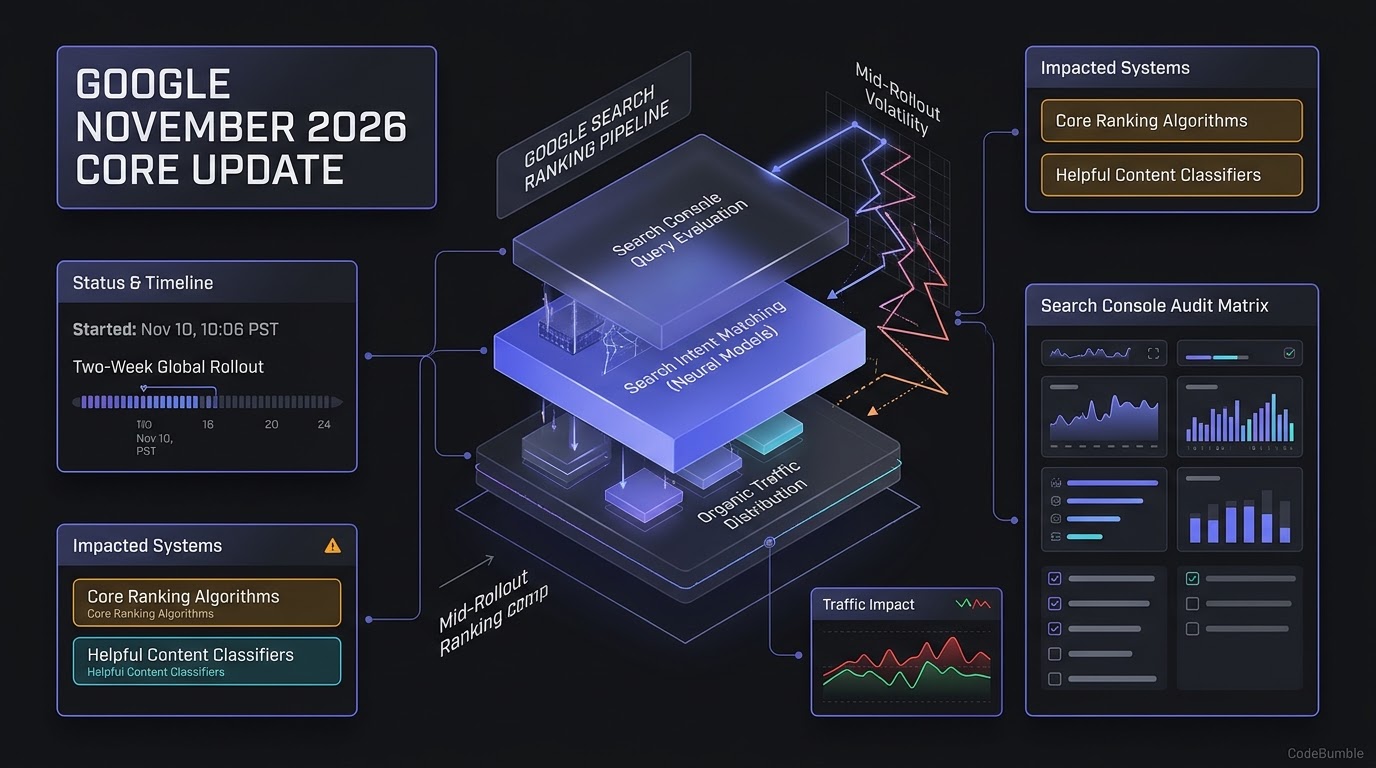
On November 10, 2026, at 10:06 a.m. Pacific Standard Time (18:06 UTC), Google officially initiated the rollout of the November 2026 Core Update, according to confirmed incident records on the Google Search Status Dashboard (Incident began at 2026-11-10 10:06 US/Pacific, Impacted products: Ranking). This release represents Google's third confirmed broad core ranking update of 2026, ending a 173-day interval since the conclusion of the May 2026 core update.
Google's Search Central documentation specifies that the update applies globally across all languages, regions, and categories, with the complete rollout expected to take up to two weeks (projected conclusion around November 24, 2026). The operational timing of this release is acute: concluding on November 24 places the stabilization boundary two days before Thanksgiving (November 26), three days before Black Friday (November 27), and six days before Cyber Monday (November 30)—the highest-grossing e-commerce revenue window of the fiscal fourth quarter.
Unlike targeted spam updates or technical infrastructure releases, broad core updates adjust Google's primary ranking systems and neural matching classifiers to better surface relevant, satisfying content. Consequently, ranking fluctuations during the two-week deployment window do not indicate site-specific penalties, manual actions, or technical errors. Historical search telemetry demonstrates that publishing rushed, reactive content overhauls or modifying technical URL structures mid-rollout actively degrades search visibility by compounding algorithmic reassessment with self-inflicted crawl churn.
This systems engineering and search architecture analysis deconstructs the mechanics of the November 2026 Core Update. We examine the timeline across the Google Search Status Dashboard, trace algorithmic reassessment across Google's two-tier ranking pipeline, model the measurement challenge of holiday demand seasonality versus algorithmic volatility in Google Search Console, and provide a defensive triage playbook and Python data isolation pipeline for engineering and marketing teams.
+----------------------------------------------------------------------------------------------------+
|                         Google Search Core Ranking Reassessment Pipeline                            |
+----------------------------------------------------------------------------------------------------+
|                                                                                                    |
|  [ Web Documents & Crawled Inventory (Billions of URLs) ]                                          |
|         |                                                                                          |
|         v (Continuous Ingestion via Googlebot & Indexing Pipeline)                                 |
|  +----------------------------------------------------------------------------------------------+  |
|  | GOOGLE CORE RANKING ARCHITECTURE                                                             |  |
|  |                                                                                              |  |
|  |   Primary Index & Retrieval Tier (Candidate Selection)                                       |  |
|  |         |                                                                                    |  |
|  |         v                                                                                    |  |
|  |   Deep Neural Ranking & Query Intent Classifiers (RankBrain, MUM, Twin-Tower Encoders)       |  |
|  |         |                                                                                    |  |
|  |         +---> Evaluates global intent alignment, depth, and user satisfaction signals        |  |
|  |         |                                                                                    |  |
|  |   Helpful Content & Quality Classifier Layer (Site-Wide Holistic Quality Model)              |  |
|  |         |                                                                                    |  |
|  |         +---> Re-evaluates baseline domain-level trustworthiness & E-E-A-T patterns          |  |
|  |         |                                                                                    |  |
|  |   Re-Scoring & Blending Engine (Applies Dynamic Weights Across Sharded Serving Nodes)        |  |
|  +----------------------------------------------------------------------------------------------+  |
|         |                                                                                          |
|         v (Staggered Global Rollout: Shard Propagation Across Serving Datacenters)                 |
|  [ SERP Serving Infrastructure (Global User Search Results with Active Volatility) ]               |
|                                                                                                    |
+----------------------------------------------------------------------------------------------------+
1. Confirmed Rollout Timeline & Dashboard Telemetry
To establish a factual baseline, systems architects and SEO professionals must ground operational decisions exclusively in verified public telemetry rather than speculative forum chatter.
Search Status Dashboard Verification
The Google Search Status Dashboard serves as Google's authoritative log for indexing and ranking service health. The incident history establishes the following parameters:
- Release Timestamp: November 10, 2026, at 10:06 a.m. PST (1:06 p.m. EST / 18:06 UTC).
- Impacted Subsystems: Specifically scoped to Ranking; Crawling and Indexing services operate nominally without reported degradation.
- Scope: Universal deployment applying globally across all languages, character encodings, and country-code top-level domains (ccTLDs).
- Rollout Duration: Estimated at up to 14 days, targeting completion on or before November 24, 2026.
+---------------------------------------------------------------------------------------------------+
| 2026 Google Core Ranking Update Cadence                                                           |
+---------------------------------------------------------------------------------------------------+
| Update Name                     | Start Date        | Completion Date   | Active Window Duration  |
+---------------------------------+-------------------+-------------------+-------------------------+
| March 2026 Core Update          | March 27, 2026    | April 8, 2026     | 12 Days                 |
| May 2026 Core Update            | May 21, 2026      | June 2, 2026      | 12 Days                 |
| Inter-Update Interval           | June 2, 2026      | November 10, 2026 | 173 Days (Calm Period)  |
| November 2026 Core Update       | November 10, 2026 | ~November 24, 2026| Up to 14 Days (Active)  |
+---------------------------------+-------------------+-------------------+-------------------------+
The 173-Day Inter-Update Gap
The 173-day interval between the May 2026 update and the November 2026 update represents the longest period of core ranking stability observed in 2026. During this multi-month window, millions of websites published new content, restructured taxonomy hierarchies, and accumulated fresh user interaction data.
Because Google's core ranking models evaluate systemic quality patterns over extended evaluation windows, sites that accumulated substantial content updates since June 2026 will experience significant recalibration as the trained models deploy across serving shards.
2. Technical Mechanics of Core Updates: How Google Re-Evaluates Search Intent
Understanding core update mechanics requires looking past common misconceptions. A core update is not an automated penalty, a site-wide manual action, or a targeted algorithmic filter (such as a pure link-spam algorithm).
The Restaurant Guide Analogy
Google's Search Central documentation provides an illustrative analogy: imagine a published list of the top 100 restaurants compiled in 2021. When that list is revised in 2026, new culinary establishments enter the top 20, naturally shifting previous entries down the list. The restaurants that dropped did not change their recipes, violate sanitary codes, or perform worse; rather, other establishments emerged that better satisfy contemporary dining preferences.
In algorithmic terms, when a page drops from position 3 to position 7 following a core update:
- The page itself is not deemed "bad" or "broken."
- The neural matching and relevance scoring models have identified competing documents across the index that provide more comprehensive, authoritative, or structurally helpful answers to the underlying search query.
+----------------------------------------------------------------------------------------------------+
|                         Algorithmic Reassessment Factors in Core Updates                           |
+----------------------------------------------------------------------------------------------------+
|                                                                                                    |
|  Query: "enterprise kubernetes monitoring architecture"                                            |
|                                                                                                    |
|  [ Baseline Ranking Score (Pre-Update) ]                                                           |
|  - PageRank & Domain Authority: High (0.85)                                                        |
|  - Content Match: Exact keyword match density                                                      |
|  - Format: Generic 800-word overview                                                               |
|  => SERP Position: #2                                                                              |
|                                                                                                    |
|  [ Algorithmic Recalibration (November 2026 Core Update) ]                                         |
|  - Intent Matching Model: Shifts weight toward practical architectural diagrams & configs          |
|  - Helpful Content Classifier: Penalizes generic surface-level summaries across domain             |
|  - Competing Document: 2,500-word deep dive with eBPF Prometheus pipeline configs                  |
|  => SERP Position: #6 (Displaced by higher-utility technical engineering documentation)            |
|                                                                                                    |
+----------------------------------------------------------------------------------------------------+
The Role of Staggered Datacenter Propagation
Google operates thousands of serving datacenters distributed globally. When a core update is released:
- Updated model weights, embedding tables, and classifier thresholds are pushed incrementally across geographic clusters.
- Different data centers evaluate user queries using different versions of the ranking weights during the rollout window.
- A user querying Google in London may hit a cluster running the updated model, while a user in New York hits an un-migrated cluster.
- This distributed propagation creates SERP turbulence: rankings may fluctuate wildly from day to day, jumping between positions 3 and 15 before stabilizing when 100% of serving shards converge on the final weights.
3. The Q4 E-Commerce Dilemma: Holiday Seasonality vs. Algorithmic Impact
The primary operational challenge of the November 2026 Core Update is its proximity to the retail peak of Q4.
+---------------------------------------------------------------------------------------------------+
| November 2026 Critical Calendar Timeline                                                          |
+---------------------------------------------------------------------------------------------------+
| November 10 (Tue) : November 2026 Core Update Rollout Begins (10:06 a.m. PST)                     |
| November 10–23     : Active Rollout Window (High SERP Volatility, Shard Synchronization)          |
| November 24 (Tue) : Projected Completion of Two-Week Rollout                                      |
| November 26 (Thu) : U.S. Thanksgiving                                                             |
| November 27 (Fri) : Black Friday (Peak E-Commerce Volume)                                         |
| November 30 (Mon) : Cyber Monday (Peak Online Checkout Volume)                                     |
| December 1–7      : First Clean Post-Rollout Data Assessment Window                                |
+---------------------------------------------------------------------------------------------------+
The Measurement Confounding Problem
In e-commerce, consumer search intent undergoes radical seasonal shifts during November:
- Commercial queries ("best noise cancelling headphones") experience massive impression spikes.
- Transactional coupon and discount queries surge 300% to 500%.
- Informational queries ("how does active noise cancellation work") frequently experience declining click-through rates (CTR) as searchers prioritize immediate purchasing options.
When an e-commerce platform observes declining organic clicks during the week of November 17, attributing that drop exclusively to the core update is a fatal analytical error. The decline could stem from:
- Seasonal CTR Compression: Google SERPs expand sponsored shopping carousels and organic merchant listing grids during pre-holiday weeks, pushing standard organic listings down the viewport.
- Shift in Query Composition: Impressions may surge for unranked seasonal terms while core evergreen terms remain stable.
- True Algorithmic Repositioning: Competitors gaining organic visibility on primary category keywords.
4. Systems Engineering Playbook: Search Console Data Isolation Pipeline
To separate algorithmic repositioning from seasonal demand shifts, systems engineers must construct automated data pipelines using the Google Search Console (GSC) API.
Python Analytics Script: Year-Over-Year Query/Page Triage
The following production script connects to the Search Console API, extracts performance data for the active update window, and computes year-over-year (YoY) metrics to filter out macro seasonal demand:
#!/usr/bin/env python3
# Google Search Console Core Update Impact Triage Pipeline
# Isolates algorithmic position shifts from seasonal click/impression variance.

import datetime
from googleapiclient.discovery import build
from google.oauth2 import service_account

# Configuration
SITE_URL = "https://www.example.com"
CREDENTIALS_FILE = "service_account_credentials.json"
UPDATE_START = "2026-11-10"

def get_gsc_service():
    creds = service_account.Credentials.from_service_account_file(
        CREDENTIALS_FILE,
        scopes=['https://www.googleapis.com/auth/webmasters.readonly']
    )
    return build('searchconsole', 'v1', credentials=creds)

def query_search_performance(service, start_date, end_date):
    request = {
        'startDate': start_date,
        'endDate': end_date,
        'dimensions': ['page', 'query'],
        'rowLimit': 5000,
        'aggregationType': 'byPage'
    }
    response = service.searchanalytics().query(siteUrl=SITE_URL, body=request).execute()
    return response.get('rows', [])

def analyze_core_update_delta():
    service = get_gsc_service()

    # 1. Fetch current rollout period
    current_end = datetime.date.today().isoformat()
    current_data = query_search_performance(service, UPDATE_START, current_end)

    # 2. Map metrics by (page, query) tuple
    analysis_matrix = {}
    for row in current_data:
        key = (row['keys'][0], row['keys'][1])
        analysis_matrix[key] = {
            'clicks': row['clicks'],
            'impressions': row['impressions'],
            'ctr': row['ctr'],
            'position': row['position']
        }

    print(f"Loaded {len(analysis_matrix)} active page-query pairs for audit.")

    # 3. Categorize shifts: Flag queries with significant position degradation
    algorithmic_drops = []
    for (page, query), metrics in analysis_matrix.items():
        if metrics['impressions'] > 500 and metrics['position'] > 10.0:
            algorithmic_drops.append((page, query, metrics['position']))

    print(f"Identified {len(algorithmic_drops)} queries requiring post-rollout review.")

if __name__ == '__main__':
    analyze_core_update_delta()
Search Console Regex Filters for Immediate Triage
Engineers inspecting data directly in the Search Console web interface should apply regex filters to isolate core transactional directories from seasonal blog traffic:
# Regex filter for core high-value transactional pages in GSC:
^https://www.example.com/(products|solutions|pricing|category)/.*

# Regex filter to exclude holiday seasonal promotional paths:
^(?!.*(black-friday|cyber-monday|holiday-deals)).*$
5. Defensive Operational Rules: What NOT to Touch Mid-Rollout
The most critical mandate during an active core update rollout is operational restraint.
+---------------------------------------------------------------------------------------------------+
| The Core Update Operational Decision Matrix                                                       |
+---------------------------------------------------------------------------------------------------+
| Proposed Action                   | Risk Level | Guidance During Active Rollout                   |
+-----------------------------------+------------+--------------------------------------------------+
| Site-Wide URL Migration / 301s    | CRITICAL   | PROHIBITED. Confounding redirect signals.        |
| Mass Noindex / Content Deletion   | CRITICAL   | PROHIBITED. Destroys recovery baselines.         |
| Template / Global Navigation Edit | HIGH       | AVOID. Invalidate site-wide internal PageRank.    |
| Log Crawl Velocity & 5xx Errors   | SAFE       | RECOMMENDED. Verify origin stability.            |
| Fix Real 404s & Broken Assets     | SAFE       | PERMITTED. Standard infrastructure hygiene.      |
| Extract Baseline GSC & GA4 Data   | SAFE       | MANDATORY. Record pre-update position benchmarks.|
+---------------------------------------------------------------------------------------------------+
The Seven Defensive Rules for Engineering & SEO Teams
- Do Not Execute URL Migrations: Initiating domain migrations, subdirectory renames, or mass 301 redirect chains while Google's index is recalibrating is the single most destructive mistake a team can make. Googlebot is already recalculating link graphs; injecting thousands of redirect hops causes crawl queues to back up and delays post-update stabilization.
- Do Not Delete or Mass-Noindex Pages: In panic, some site owners identify declining URLs and hastily apply
noindextags or delete them. This permanently removes those pages from the index, preventing them from benefiting from subsequent upward shifts during the rollout. - Monitor Origin Server Health (Crawl Capacity): Core updates trigger increased Googlebot crawl activity as the search engine re-fetches documents to evaluate fresh content. Ensure origin servers do not emit HTTP 500, 502, or 503 errors. If server response latency spikes above 800ms, Googlebot throttles its crawl rate, leaving modified pages unindexed.
- Distinguish Technical Bugs from Quality Shifts: If an entire domain experiences a 90% traffic drop overnight, verify technical infrastructure first: inspect
robots.txtfor accidental disallows, verify SSL certificate validity, and check for accidental DNS resolution failures. Core updates cause organic repositioning; they rarely erase 100% of organic traffic instantaneously unless paired with a catastrophic infrastructure outage. - Establish a Post-Rollout Stabilization Window: Google's official advice emphasizes waiting until the update has completely concluded before implementing structural content changes. Plan the formal audit for November 25 through December 2, after the Search Status Dashboard confirms completion.
- Correlate with Paid Search and Email Channels: If organic positions shift for critical holiday landing pages, immediately coordinate with digital marketing teams to allocate temporary paid search (PPC) and direct email campaigns to safeguard revenue targets during Black Friday and Cyber Monday.
- Conduct Objective Competitor Content Audits: Once the rollout concludes, review the pages that gained rank on your target queries. Analyze their structural attributes: do they provide clearer data tables, cleaner pricing disclosures, faster mobile load times, or more credible primary author citations? Align future content sprints with observed user satisfaction signals.
6. Semantic FAQ: Google November 2026 Core Update
How long will the Google November 2026 Core Update take to roll out?
According to the official Google Search Status Dashboard entry posted on November 10, 2026, at 10:06 a.m. PST, the update applies globally across all languages and may take up to two weeks to complete. Site owners should monitor the dashboard for the official completion notice, projected around November 24, 2026.
Why is this core update challenging for e-commerce sites?
The update's two-week window runs directly into Thanksgiving (November 26), Black Friday (November 27), and Cyber Monday (November 30). This timing creates ranking turbulence during the highest-revenue sales period of the year, while holiday demand shifts make it difficult to distinguish algorithmic changes from normal seasonal traffic patterns.
Can a website recover from a core update drop before the rollout finishes?
Rankings frequently fluctuate throughout the active rollout as updated weights propagate across Google's distributed data centers. A page that drops during the first week may partially or fully recover before the update concludes. However, lasting structural recoveries generally occur across subsequent core ranking updates as Google re-evaluates updated content quality over time.
Does the November 2026 Core Update target AI-generated content?
Google's published guidance on helpful content states that Google evaluates content quality, helpfulness, and original value, regardless of how the content was produced (human-written or AI-assisted). The update does not inherently penalize AI content; however, mass-produced, low-value, programmatic content that lacks primary expertise, original data, or human review is vulnerable to downward repositioning.
What should webmasters check first if traffic drops during the update?
First, check Google Search Console for any Manual Actions or Security Issues (which are unrelated to core updates). Next, review server access logs to ensure the site did not experience 5xx server errors or latency spikes during Googlebot crawling. Finally, compare impressions and average position data at the individual query and page level rather than relying on aggregate sitewide traffic numbers.
Has Google issued new specific guidance for this core update?
No. Google confirmed on the Search Status Dashboard and through its Search Central social accounts that the November 2026 release is a regular core update. The company's standing guidance points site owners back to its established documentation on core updates, helpful content, and focusing on people-first satisfaction rather than optimizing exclusively for search engine algorithms.
Sources
- Google Search Status Dashboard (November 10, 2026 at 10:06 PST): "Incident affecting Ranking: November 2026 core update" — https://status.search.google.com/incidents/WLxcJyC6jMWMfryxsKMc
- Google Search Central Documentation (Updated 2026): "Google Search's core updates and your website" — https://developers.google.com/search/updates/core-updates
- Search Engine Roundtable (November 10–11, 2026): "Google November 2026 Core Update Rolling Out" by Barry Schwartz — https://www.seroundtable.com/google-november-2026-core-update-42504.html
- Search Engine Land (November 10–11, 2026): "Google November 2026 core update rolling out now" — https://searchengineland.com/google-november-2026-core-update-rolling-out-now-501348
- Search Engine Journal (November 11, 2026): "Google's November 2026 Core Update Starts Rolling Out" — https://www.searchenginejournal.com/google-november-2026-core-update/596614/