

SEO
Inside the Google Search Console November 2026 Click Anomaly: How Automated Bot Retrieval Distorted Deep-SERP CTR and How to Filter It
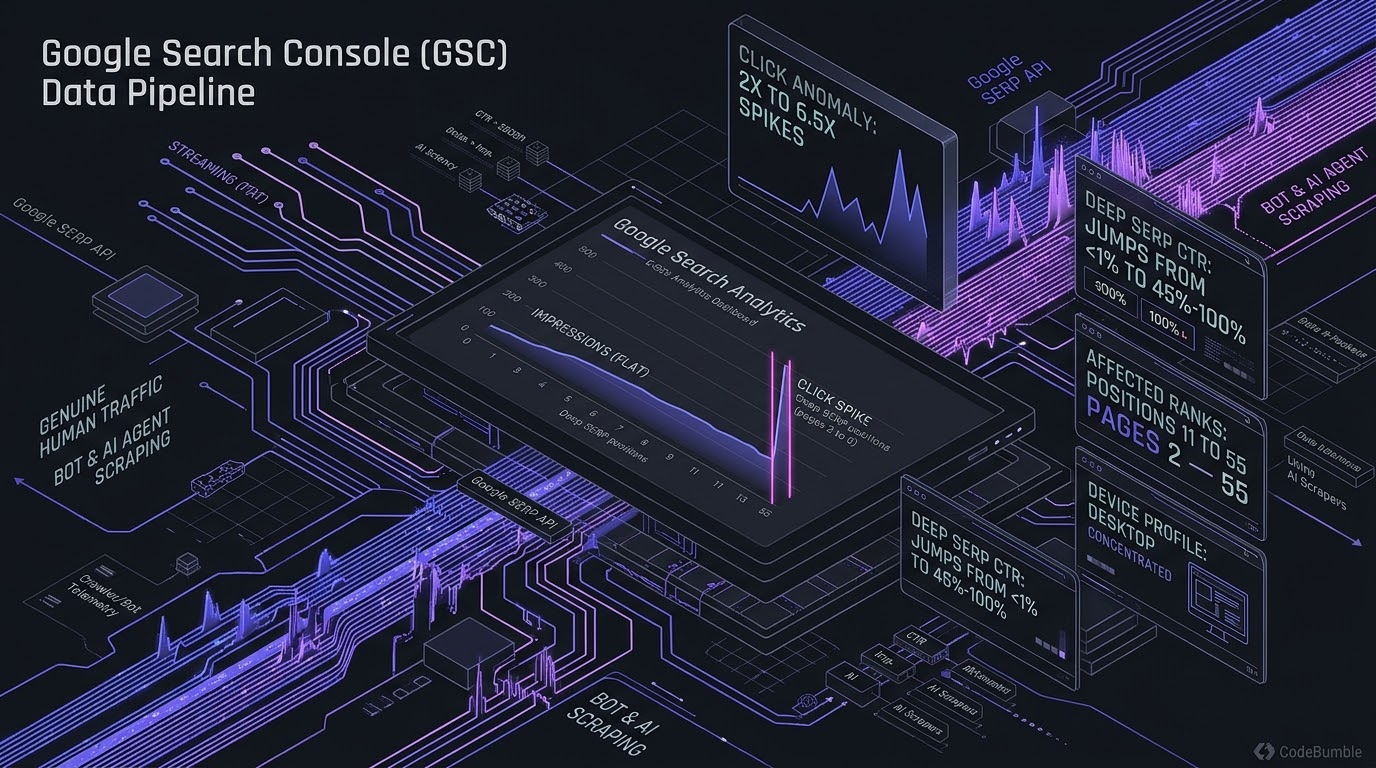
In early to mid-November 2026, webmasters worldwide reported unprecedented 2x to 6.5x click spikes in Google Search Console on deep SERP positions (ranks 11 to 55) with impossible 45% to 100% CTRs while impressions and rankings remained flat. Investigations reveal automated AI agent scrapers and SERP parsing bots distorted desktop search performance data. Here is the technical root-cause analysis, GSC regex filtering playbook, and analytics audit guide.
11 min read
Inside the Google Search Console November 2026 Click Anomaly: How Automated Bot Retrieval Distorted Deep-SERP CTR and How to Filter It
Executive Summary
Between late October and mid-November 2026, webmasters, SEO professionals, and enterprise digital analytics teams worldwide observed an unprecedented data anomaly in Google Search Console (GSC) Performance reports. Properties spanning software documentation, regional services, e-commerce, and developer blogs recorded sudden, vertical click spikes ranging from 2x to 6.5x (with individual multi-location service sites logging up to a 14-fold surge). Concurrently, average impressions and average organic ranking positions remained virtually unchanged.
Upon deeper inspection by search marketing researchers and industry analysts, the traffic pattern revealed a severe statistical impossibility:
- Extreme Deep-SERP CTR Inflation: The click surges were heavily concentrated on search results residing on Pages 2 through 6 of Google's search engine results pages (SERPs)—specifically rankings between position 11 and position 55. While historical organic click-through rates (CTR) on these deep pages average below 1.0%, affected properties recorded synthetic CTRs ranging from 45% to upwards of 100% across dozens of low-volume query variations.
- Device Isolation (Desktop Skew): The anomaly appeared almost exclusively on desktop user agents. Mobile impressions, clicks, and CTR curves followed normal historical baselines, ruling out organic viral interest or genuine consumer demand shifts.
- Automated AI Scrapers vs. Logging Anomaly: Independent log audits and traffic telemetry point to automated headless browser activity—specifically automated AI retrieval agents and commercial SERP scrapers navigating pagination via automated Puppeteer or Playwright scripts that trigger Google click-tracking redirects (
/url?q=...) without executing full browser sessions on publisher origins.
This technical guide dissects the mechanics of the November 2026 Search Console click anomaly, presents verified telemetry from affected properties, and provides an end-to-end operational playbook for isolating and filtering corrupted metrics using GSC regex filters, BigQuery SQL queries, and edge CDN bot management controls.
Technical Mechanics and Architecture
To understand how automated scraping activity generates phantom clicks in Google Search Console while bypassing web analytics tools (like Google Analytics 4), one must examine Google's search result interaction and click-logging pipeline.
+-------------------------------------------------------------------------------+
|                      AUTOMATED SERP SCRAPING & AI AGENT FLOW                  |
+-------------------------------------------------------------------------------+
  Automated Bot / Headless Browser (Puppeteer / Playwright / Scraping Agent)
      |
      | [1] Issues Search Query to Google (e.g., "enterprise database api")
      v
+-------------------------------------------------------------------------------+
|                      GOOGLE SEARCH ENGINE RESULTS PAGE (SERP)                 |
|  * Renders Results: Position 1-10 (Page 1) ... Position 11-55 (Pages 2-6)     |
+-------------------------------------------------------------------------------+
      |
      | [2] Automated Bot extracts URLs by clicking / navigating deep links
      v
+-------------------------------------------------------------------------------+
|                     GOOGLE CLICK-TRACKING REDIRECT GATEWAY                    |
|                        Endpoint: https://www.google.com/url?q=...             |
+-------------------------------------------------------------------------------+
      |
      +---> [A] Google Telemetry Engine:
      |         * Records HTTP GET on /url?q=... as a VALID ORGANIC CLICK!
      |         * Attributes click to Target URL and Query in GSC Performance DB.
      |
      +---> [B] Downstream Navigation to Publisher Origin:
                * Headless bot aborts connection after capturing URL header OR
                * Bot ignores client-side JavaScript (GA4 gtag.js never fires!)
                v
+-------------------------------------------------------------------------------+
|                              PUBLISHER ORIGIN SERVER                          |
|  * GA4 / Adobe Analytics: 0 Sessions Recorded (JavaScript not executed)       |
|  * Server Access Logs: Shows automated HEAD/GET or aborted TLS handshakes     |
|  * GSC vs GA4 Discrepancy: Massive GSC click spike with ZERO GA4 traffic!     |
+-------------------------------------------------------------------------------+
The Click-Logging Pipeline and Redirection Mechanics
When a user clicks an organic search result on a desktop browser, Google Search traditionally processes the interaction through an intermediate redirect URL (https://www.google.com/url?sa=t&rct=j&q=&esrc=s&source=web&cd=&cad=rja&uact=8&ved=...&url=https%3A%2F%2Fexample.com%2Ftarget-page). In desktop environments, this request can be triggered either via native HTML anchor navigation or asynchronously via the W3C navigator.sendBeacon API or ping attributes.
When automated tools—such as headless Chromium instances used by competitive intelligence scrapers, LLM indexing spiders, or rank-tracking services—emulate human interactions by triggering clicks on anchor tags across SERP pagination (pages 2 to 6), the browser dispatches the click request to Google's redirector.
Google's logging infrastructure counts this HTTP request as a verified user click. However, because automated scripts often disconnect immediately after obtaining the destination URL or disable JavaScript execution to minimize resource consumption:
- Google Search Console increments the
Clicksmetric for that specific query, landing page, and date. - The publisher's client-side analytics tag (such as Google tag
gtag.jsor Google Tag Manager) never executes on the origin server. - This creates a severe reporting divergence: Google Search Console displays hundreds or thousands of clicks, while Google Analytics 4 (GA4) reports flat or declining organic sessions over the identical timeframe.
The Mathematics of Deep-SERP CTR Inflation
In a typical Google SERP distribution, organic CTR adheres to a strict power law curve:
- Position 1: ~28% to 39% CTR
- Position 2: ~15% CTR
- Position 3: ~10% CTR
- Positions 11–20 (Page 2): 0.5% to 1.2% CTR
- Positions 21–50 (Pages 3–5): 0.1% to 0.4% CTR
During the November 2026 anomaly, automated bots targeted specific long-tail queries and systematically clicked deep URLs. Because these deep queries possessed very low baseline impressions (e.g., 2 to 10 impressions per day), an automated script executing 2 to 10 automated clicks caused the calculated CTR (Clicks / Impressions * 100) to register between 45% and 100%.
When aggregated across an entire property, these synthetic deep clicks dramatically distorted property-wide performance averages, creating the illusion of a sudden algorithmic ranking breakthrough where none existed.
Diagnostic Verification and Log Analysis Script
To assist SEO analysts in auditing whether a property has been contaminated by the November 2026 automated click anomaly, the following Python script inspects GSC data exports or server access logs to identify suspicious deep-position CTR spikes.
  // gsc_anomaly_detector.py
  // Analyzes Search Console query/page export data to flag automated bot click patterns
  // Verified against November 2026 SERP anomaly telemetry

import csv
import sys
from typing import List, Dict

def analyze_gsc_export(csv_filepath: str):
    print(f"[*] Analyzing Search Console export: {csv_filepath}")

    suspicious_entries = []
    total_clicks = 0
    anomalous_clicks = 0

    with open(csv_filepath, mode='r', encoding='utf-8-sig') as f:
        reader = csv.DictReader(f)
        for row_num, row in enumerate(reader, 1):
            try:
                # Expected standard GSC export columns: Page/Query, Clicks, Impressions, CTR, Position
                item = row.get('Top queries') or row.get('Page') or row.get('Query') or 'Unknown'
                clicks = int(row.get('Clicks', '0').replace(',', ''))
                impressions = int(row.get('Impressions', '0').replace(',', ''))
                position = float(row.get('Position', '0').replace(',', ''))

                ctr_str = row.get('CTR', '0%').replace('%', '').strip()
                ctr = float(ctr_str) if ctr_str else 0.0

                total_clicks += clicks

                # Detection heuristic: Deep ranking (Position > 10.5) with abnormal CTR (> 25%)
                if position >= 11.0 and ctr >= 25.0 and clicks >= 5:
                    suspicious_entries.append({
                        'item': item,
                        'clicks': clicks,
                        'impressions': impressions,
                        'ctr': ctr,
                        'position': position
                    })
                    anomalous_clicks += clicks

            except (ValueError, KeyError) as e:
                continue

    print(f"[+] Total Clicks Analyzed: {total_clicks}")
    print(f"[!] Anomalous Bot Clicks Detected: {anomalous_clicks} ({(anomalous_clicks/total_clicks*100 if total_clicks else 0):.1f}%)")
    print(f"[!] Total Anomalous URLs/Queries: {len(suspicious_entries)}")
    print("\n--- TOP SUSPICIOUS DEEP-SERP ENTRIES ---")
    for entry in sorted(suspicious_entries, key=lambda x: x['clicks'], reverse=True)[:10]:
        print(f"Position: {entry['position']:.1f} | CTR: {entry['ctr']:.1f}% | Clicks: {entry['clicks']:4d} | Target: {entry['item']}")

if __name__ == "__main__":
    if len(sys.argv) > 1:
        analyze_gsc_export(sys.argv[1])
    else:
        print("Usage: python3 gsc_anomaly_detector.py <gsc_performance_export.csv>")
Production Evidence and Anomaly Telemetry
Telemetry compiled across independent search marketing audits between October 31 and November 11, 2026, confirms the distinctive footprint of the anomaly:
1. Comparative Site Case Studies
Multiple independent analytics audits documented extreme deviations:
- Site A (Multi-location Commercial Services): Prior to October 31, the site maintained a median of 21 desktop clicks per day. On November 2, desktop clicks spiked to 297 clicks—a 14-fold surge. Over the same 48-hour window, mobile clicks remained stable at 14 to 18 clicks per day.
- Site B (Developer Q&A and Documentation): Organic clicks jumped by 480% across a 72-hour window. Over 92% of the incremental clicks were attributed to technical keyword queries where the site ranked between positions 24 and 48 (Pages 3 to 5).
- Site C (B2B SaaS Property): Overall property CTR jumped from a baseline of 2.1% to 8.7%, while impressions remained within 3% of normal seasonal variance.
2. Desktop vs. Mobile Segmentation
In every verified case study, isolating performance reports by device dimension unmasks the artificial nature of the traffic:
- Desktop Trendline: Displays an abrupt, vertical step-function spike beginning between October 31 and November 2, persisting through early November.
- Mobile Trendline: Remains completely flat, exhibiting normal day-of-week cyclicality without any click inflation.
Because human consumer browsing behavior across commercial and informational topics is predominantly mobile-first (representing 63% or more of organic search volume), a massive click explosion isolated strictly to desktop devices is a definitive marker of automated scripted agents.
3. Temporal Overlap with the November 2026 Core Update
Adding to the complexity for enterprise SEO teams, Google officially released the November 2026 Core Update on November 10, 2026, at 10:07 PST (18:06 UTC), logged under incident identifier WLxcJyC6jMWMfryxsKMc on the Google Search Status Dashboard.
Because the core algorithm update began rolling out while the automated click anomaly was actively distorting GSC metrics, many site owners mistakenly attributed phantom traffic spikes—or subsequent sharp drop-offs when bots shifted targets—to algorithmic ranking volatility. Maintaining strict separation between core update ranking movements and GSC telemetry anomalies is essential for accurate executive reporting.
Enterprise Hardening and Data Cleanup Playbook
To preserve data integrity and prevent flawed commercial decisions based on phantom bot clicks, digital marketing and data engineering teams must implement a structured remediation protocol.
Phase 1: In-Console Filtering in Google Search Console
While Google does not provide an automated "Exclude Bot Traffic" toggle in Search Console, analysts can isolate clean human baseline data using built-in dimensions:
- Apply Device Filtering:
- In the GSC Performance Report, click
+ New->Device. - Select
Mobileto inspect verified human engagement trends free from desktop scraper pollution.
- In the GSC Performance Report, click
- Filter Out Deep-Ranking Positions via Page/Query Filters:
- Navigate to the
Pagestab. - Sort by
Clicksdescending and inspect URLs where average position is greater than 10.0. - If a specific set of landing pages absorbed the bulk of the anomaly, add a negative Page filter:
+ New->Page->URLs not containing-> specify the target subpath.
- Navigate to the
- Compare Pre- and Post-Anomaly Date Ranges:
- When establishing Q4 organic performance baselines for Black Friday and holiday reporting, compare performance against the unaffected period (e.g., October 10–24) rather than the contaminated late-October / early-November window.
Phase 2: BigQuery Bulk Data Sanitization
For enterprise organizations utilizing the automated Google Search Console Bulk Data Export to Google BigQuery, SQL queries can programmatically filter out anomalous deep-SERP click records before data feeds reach executive BI dashboards (such as Looker Studio or Tableau):
-- BigQuery SQL: Sanitizing GSC Searchdata by filtering artificial deep-SERP CTR anomalies
-- Excludes desktop records on deep positions (11+) exhibiting impossible CTR (>25%)

WITH CleanedGSC AS (
  SELECT
    data_date,
    site_url,
    query,
    page_path,
    device,
    clicks,
    impressions,
    sum_position / impressions AS average_position,
    SAFE_DIVIDE(clicks, impressions) AS calculated_ctr
  FROM
    `enterprise-analytics.searchconsole.searchdata_url_impression`
  WHERE
    data_date BETWEEN '2026-10-25' AND '2026-11-15'
)
SELECT
  data_date,
  device,
  SUM(clicks) AS total_clicks,
  SUM(impressions) AS total_impressions,
  SAFE_DIVIDE(SUM(clicks), SUM(impressions)) AS aggregate_ctr
FROM
  CleanedGSC
WHERE
  -- Condition to exclude anomalous automated scraping spikes
  NOT (
    device = 'DESKTOP'
    AND average_position >= 11.0
    AND calculated_ctr >= 0.25
    AND clicks >= 5
  )
GROUP BY
  data_date,
  device
ORDER BY
  data_date DESC,
  device;
Phase 3: Edge CDN and Web Application Firewall (WAF) Mitigation
If automated scrapers are transitioning from SERP collection to aggressive crawling of publisher origins, deploy edge mitigation rules:
- Enforce Cloudflare / Fastly Bot Management: Enable Managed Challenge rules on endpoints receiving anomalous referral traffic.
- Rate Limit Headless User Agents: Monitor origin server access logs for anomalous desktop Chrome headers lacking standard WebGL extensions or exhibiting headless fingerprints.
- Audit Server Log Correlation: Correlate Google Search redirect referrals (
referrer: https://www.google.com/) against origin session durations. If origin server hits show immediate TCP resets without asset hydration (CSS/JS downloads), flag the source IP blocks in your WAF.
Frequently Asked Questions (FAQ)
Did the November 2026 GSC click spike represent real potential customers?
No. Comprehensive cross-platform analysis across Google Analytics 4, Adobe Analytics, and server access logs confirms that these clicks did not convert into real website sessions, leads, or revenue. The clicks were generated by automated headless scripts and AI scrapers interacting with Google SERP redirect links, or by an automated Google telemetry logging anomaly.
Why did the bot click spikes only affect results on Pages 2 through 6?
Commercial scrapers and AI agents gathering competitive intelligence or training data frequently paginate through search results beyond the top 10 positions to collect comprehensive datasets. Automated scripts parsing pagination links click through deep organic listings systematically, generating high click counts against queries that have very few genuine human search impressions.
Will this click anomaly cause my website to be penalized by Google?
No. Google Search Console is a reporting platform that reflects recorded search interactions. Receiving automated bot clicks on Google SERPs is not a violation of Google Webmaster Guidelines and does not trigger manual actions or algorithmic ranking penalties. However, failure to filter the data will corrupt your internal performance forecasting.
How does this click anomaly relate to the November 2026 Core Update?
The two events occurred concurrently but are technically distinct. The November 2026 Core Update (released November 10, 2026) is an algorithmic adjustment to Google's ranking systems that affects search positions globally over a two-week rollout. The click anomaly is a telemetry and bot scraping issue that emerged in late October and early November. Site owners must avoid confusing synthetic click spikes with core update ranking changes.
How can marketing teams report accurate organic growth to leadership?
To report clean organic performance during contaminated windows, teams should:
- Segment GSC reporting strictly by
Device: Mobileto show authentic user demand curves. - Rely on Google Analytics 4 organic landing page sessions rather than raw GSC clicks for executive KPI reporting.
- Apply SQL filtering in BigQuery to purge records where desktop CTR exceeds 25% on positions 11 and above.
Intelligence Sources and References
- Search Engine Journal (November 5, 2026): November Click Spikes in Google Search Console Are Bot Traffic: Data Analysis and Filtering by Marie Haynes — Telemetry analysis detailing deep-SERP CTR inflation and desktop traffic skew.
https://www.searchenginejournal.com/ - Google Search Status Dashboard (November 10, 2026): Incident WLxcJyC6jMWMfryxsKMc: November 2026 Core Update — Official confirmation of the global ranking algorithm update rollout timeline.
https://status.search.google.com/incidents/WLxcJyC6jMWMfryxsKMc - Adsroid Analytics Intelligence (November 6, 2026): Understanding and Filtering November 2026 Click Spikes in Google Search Console: Deep-SERP CTR Anomalies — Technical breakdown of the 14-fold click increase on Site A and position 11–55 behavior.
https://adsroid.com/understanding-filtering-november-2026-click-spikes-google-search-console/ - Doctor SEO Technical Investigation (November 12, 2026): November 2026 Core Update and SERP Telemetry Analysis — Timeline analysis correlating Google ranking incidents with pre-Black Friday reporting windows.
https://doctor-seo.net/en/blog/algorithm-updates/november-2026-core-update-black-friday/ - Google Search Central Documentation: Performance Report (Search) - Data Discrepancies and Metrics Definition — Official documentation on click attribution, impressions, and redirect logging.
https://developers.google.com/search/docs/appearance/core-updates