

SEO
Google November 2026 Core Update Hits Before Black Friday: SERP Volatility, Search Console Baselines, and E-Commerce Site Freeze Protocols
Google has initiated the global rollout of its November 2026 core update (Incident WLxcJyC6jMWMfryxsKMc), concluding a record 173-day hiatus between core ranking adjustments. Landing exactly two weeks before Black Friday, the 14-day deployment introduces critical SERP volatility for digital retailers and enterprise publishers. Here is the technical breakdown of the timeline arithmetic, Search Console baseline isolation protocols, and defensive site freeze strategies.
12 min read
Google November 2026 Core Update Hits Before Black Friday: SERP Volatility, Search Console Baselines, and E-Commerce Site Freeze Protocols
Executive Summary
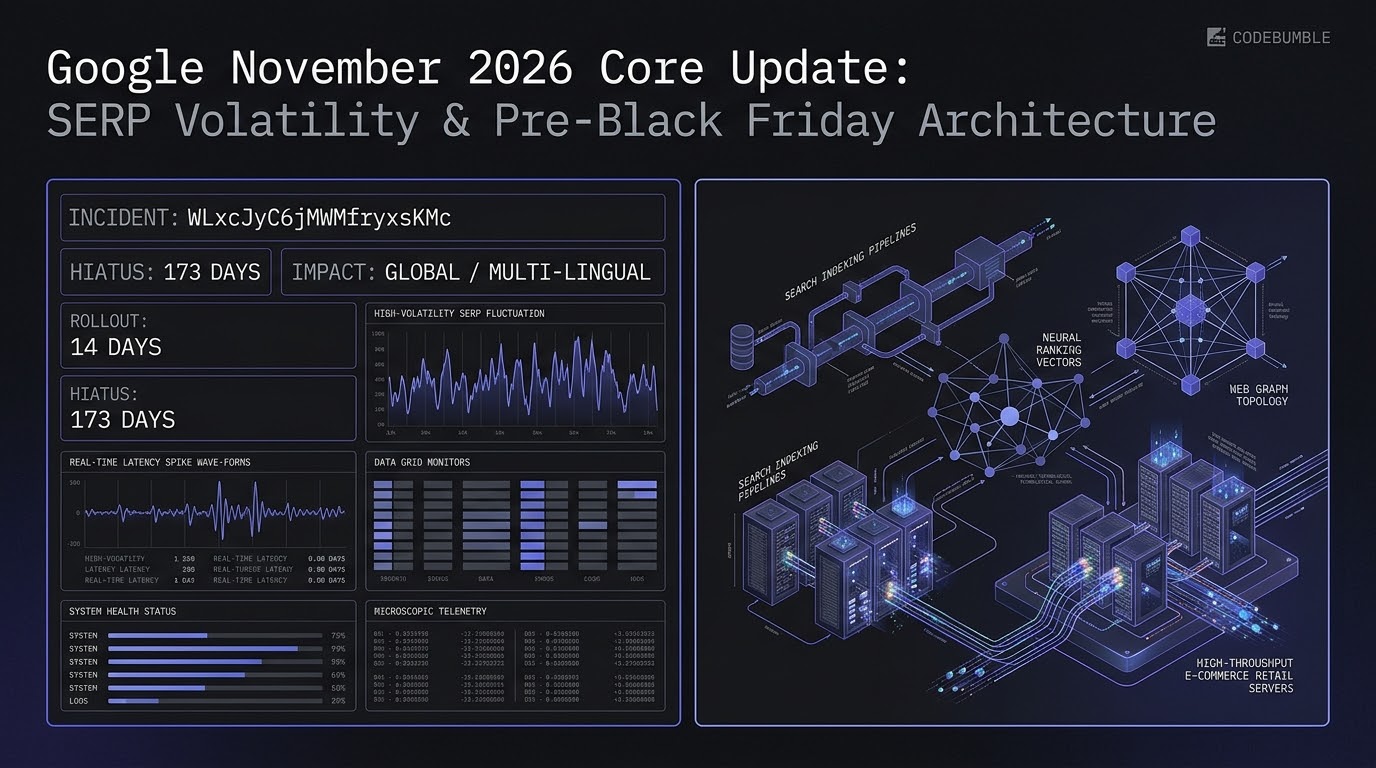
On November 10, 2026, Google initiated the global rollout of the November 2026 Core Update. Registered on the Google Search Status Dashboard as Incident WLxcJyC6jMWMfryxsKMc, the deployment began at 18:06:00 UTC (10:06 AM PST) across all languages and regions. Google's advisory notes that the rollout may take up to two weeks to complete. If the schedule adheres strictly to this 14-day projection, the update will conclude on November 24, 2026, at 18:06 UTC—precisely three days before Black Friday (November 27, 2026).
This deployment concludes a 173-day hiatus since the May 2026 core update, representing the longest quiet period between core ranking adjustments in recent Search history. In an ecosystem preparing for peak fourth-quarter retail transaction volumes, the timing introduces severe operational risks as technical teams navigate organic SERP volatility alongside high-velocity holiday demand swings.
Two core operational realities govern this release:
- The Arithmetic Ceiling and Retail Overlap: While Google outlines a two-week window, historical precedents show rollouts can exceed estimates. The December 2025 core update ran for 18 days, 1 hour, and 35 minutes. A similar overrun during November 2026 will push active ranking shifts directly into Black Friday weekend.
- The Measurement Void: As of November 13, 2026, third-party tracking suites show visual turbulence spikes, yet zero verified numerical sample sizes or affected-site percentages have been published. Furthermore, late-2026 SERP scraping anomalies make external scrapers unreliable.
Enterprise teams must rely on first-party telemetry from Google Search Console (GSC). Organizations should enforce an immediate production code freeze, extract pre-update baseline datasets spanning October 13 through November 9, 2026, and avoid reactionary architectural modifications while ranking shards synchronize.
Timeline Arithmetic and Historical Cadence Analysis
To understand the strategic significance of Incident WLxcJyC6jMWMfryxsKMc, systems architects must examine the cadence of Google's core updates across 2025 and 2026. The interval preceding this release constitutes the longest period of algorithmic stability observed in years, creating a substantial backlog of indexed content evaluations and neural embedding recalibrations.
+-----------------------------------------------------------------------------+
|                      GOOGLE CORE UPDATE CADENCE (2025-2026)                 |
+-----------------------------------------------------------------------------+
|  Dec 2025 Core: [=== 18d 01h 35m ===]                                       |
|           \                                                                 |
|            +--- 105 Days Hiatus ---> Mar 2026 Core: [== 14 Days ==]         |
|                                             \                               |
|                                              +--- 55 Days ---> May 2026     |
|                                                                [== 14d ==]  |
|                                                                      \      |
|  +-----------------------------------------------------------------+  \     |
|  | HISTORIC HIATUS: 173 Days, 02 Hours, 26 Minutes                 |   |    |
|  +-----------------------------------------------------------------+   |    |
|                                                                        /    |
|  Nov 10, 2026 (18:06 UTC): Incident WLxcJyC6jMWMfryxsKMc <------------+    |
|  [====================== 14-Day Published Ceiling =====================]   |
|  |                                                                     |    |
|  v                                                                     v    |
|  Nov 10 (Launch)                                                Nov 24 (End)|
|                                                                 +--- 3 Days |
|                                                                 v           |
|                                                        Black Friday (Nov 27)|
+-----------------------------------------------------------------------------+
Comparative Release Metrics
| Core Update Event | Launch Timestamp (UTC) | Completion Timestamp (UTC) | Active Duration | Preceding Interval (Hiatus) |
|---|---|---|---|---|
| December 2025 Core | Dec 12, 2025, 17:14 UTC | Dec 30, 2025, 18:49 UTC | 18 days, 01 hr, 35 min | 84 days |
| March 2026 Core | Apr 14, 2026, 16:30 UTC | Apr 28, 2026, 17:00 UTC | 14 days, 00 hr, 30 min | 105 days |
| May 2026 Core | Jun 22, 2026, 15:40 UTC | Jul 06, 2026, 16:00 UTC | 14 days, 00 hr, 20 min | 55 days |
| November 2026 Core | Nov 10, 2026, 18:06 UTC | Estimated Nov 24, 2026 | Up to 14 days (Pending) | 173 days, 02 hr, 26 min |
Key scheduling realities:
- 173-Day Hiatus: Between July 6 and November 10, 2026, zero global core updates deployed, creating a 5.7-month backlog of recomputed document representations.
- November 24 Ceiling vs. November 27 Peak: If the update completes within 14 days, engineering teams have under 72 hours to review baselines before Black Friday traffic surges.
- Risk of Overruns: The December 2025 core update ran for 18 days (4 days past estimate). A similar delay pushes active ranking shifts into Cyber Week.
Technical Mechanics and Architectural Implications
Google's official declaration regarding Incident WLxcJyC6jMWMfryxsKMc on the Google Search Status Dashboard reads:
"Released the November 2026 core update, which applies globally and to all languages. The rollout may take up to 2 weeks to complete."
Secondary trade statements published via Search Engine Roundtable and Search Engine Journal quote Google's standard guidance: "This is a regular update designed to better surface relevant, satisfying content for searchers from all types of sites."
Behind this administrative language lies a distributed systems architecture where core updates represent asynchronous batch processing, neural weight deployment, and document scoring adjustments across thousands of serving clusters.
+-----------------------------------------------------------------------------+
|                   DISTRIBUTED CORE UPDATE PIPELINE FLOW                     |
+-----------------------------------------------------------------------------+
|  [ Web Graph Shards ] ---> [ Offline Quality Models ]                       |
|   - 173 Days of Crawl       - Deep Transformer Ranking Re-weights           |
|   - Document Extraction     - E-E-A-T & Helpfulness Neural Tensors          |
|                                     |                                       |
|                                     v                                       |
|                         [ Global Scoring Matrices ]                         |
|                          - Unified Representation Ingestion                 |
|                          - Vector Space Document Clustering                 |
|                                     |                                       |
|                                     v                                       |
|                 +---------------------------------------+                   |
|                 | STAGED SERVING SHARD PROPAGATION      |                   |
|                 | (14-Day Global Datacenter Convergence)|                   |
|                 +---------------------------------------+                   |
|                        /            |            \                          |
|                       v             v             v                         |
|                [ Datacenter A ] [ Datacenter B ] [ Datacenter C ]           |
|                (US-East)        (EU-Central)     (Asia-East)                |
|                       \             |             /                         |
|                        v            v            v                          |
|                     [ Edge Query Processing & Reranking ]                   |
|                      - Dynamic SERP Blend & AI Overviews                    |
+-----------------------------------------------------------------------------+
Core Architectural Vectors
- Quality Classifier Tensor Updates: Core updates refresh machine learning models evaluating domain helpfulness and content integrity, re-weighting shallow syndication across full directories.
- Datacenter Shard Synchronization: Asynchronous replication across global Bigtable and Spanner shards during rollout leads to temporary discordant scoring models, causing "SERP fluttering."
- Intent Shift Calibration: Core updates recalculate commercial versus informational boundaries, re-weighting affiliate review roundups against direct merchant storefronts.
The Measurement Void: Why Third-Party Trackers Cannot Be Trusted
A critical reality during this release is the absence of empirical, quantified external data. As documented by independent technical analyses on Doctor SEO, forty-eight hours into the update, zero published measurements existed detailing:
- The aggregate percentage of indexed URLs experiencing position changes.
- Statistically normalized volatility scales cross-referenced with historic baselines.
- Controlled domain cohort evaluations across specific vertical industries.
While commercial rank-tracking utilities publish visual gauges indicating high volatility, these tools scrape fixed keyword samples and remain vulnerable to:
- Personalized SERP Blends: Google serves variant layouts across regional nodes during rollouts.
- Proxy Inconsistencies: Scraping proxies can retrieve corrupted or geographically mismatched pages, injecting artificial volatility.
- Zero Conversion Telemetry: Rank scrapers measure rank positions, not impressions, click-through rates (CTR), or revenue.
Enterprise decisions must rely exclusively on first-party Google Search Console API extractions, reflecting authoritative impression logs recorded by Google's serving infrastructure.
Defensive Site Freeze and Infrastructure Protocols
During an active core update, reactive engineering introduces massive risk. When rankings shift mid-rollout, organizations frequently panic: marketing demands immediate content overhauls, while developers attempt site structure migrations, internal linking redesigns, or canonical tag restructurings.
Executing site architecture changes while Google's scoring shards synchronize creates severe analytical ambiguity, making it impossible to separate algorithmic effects from self-inflicted technical defects.
The E-Commerce Freeze Rules
To maintain analytical integrity and safeguard retail throughput, engineering teams must enforce a strict change moratorium across four operational tiers:
- Tier 1: Core Infrastructure (Strict Freeze): Prohibit domain migrations, protocol adjustments, and CDN cutovers. Lock reverse proxy rules, rewrite maps, and HTTP/2 transport configs.
- Tier 2: Information Architecture & CMS (Strict Freeze): Freeze taxonomy structures, breadcrumb hierarchies, and internal links. Disallow batch URL renames, category deletions, or bulk schema markup alterations.
- Tier 3: Content Operations (Selective Restriction): Permit standard transactional updates (price changes, inventory levels). Allow standard holiday promotion publishing on existing canonical paths. Prohibit wholesale rewriting or pruning of existing indexed articles.
- Tier 4: Defensive Monitoring (Active Engagement): Track 5xx error rates at origin and CDN edge. Run automated daily Search Console baseline snapshotting. Monitor Googlebot crawl frequency and response latencies.
Production Edge Protection: Reverse Proxy Configuration
To ensure zero origin latency regressions during crawl-intensive re-evaluations, engineers should verify reverse proxy caching:
// /etc/nginx/conf.d/search_stability_freeze.conf
upstream backend_cluster {
    server 10.0.1.10:8080 max_fails=3 fail_timeout=10s;
    keepalive 64;
}
server {
    listen 443 ssl http2;
    server_name www.example.com;
    ssl_certificate /etc/ssl/certs/example_com.crt;
    ssl_certificate_key /etc/ssl/private/example_com.key;

    location / {
        proxy_pass http://backend_cluster;
        proxy_set_header Host $host;
        proxy_connect_timeout 5s;
        proxy_read_timeout 15s;

        location ~* \.(css|js|jpg|png|webp|svg|woff2)$ {
            expires 30d;
            add_header Cache-Control "public, no-transform, immutable";
        }
        location ~* /(search|filter|sort)/ {
            add_header X-Robots-Tag "noindex, follow" always;
            proxy_pass http://backend_cluster;
        }
    }
}
Search Console Telemetry: Baseline Isolation Script
To evaluate the November 2026 core update accurately, data teams must isolate performance metrics before holiday search intent distorts organic traffic.
The baseline period must cover the 28 days preceding the rollout: October 13, 2026, through November 9, 2026. Data gathered after November 24 cannot be directly compared against November 10 because Thanksgiving, Black Friday, and Cyber Monday create massive, non-algorithmic swings in search volume and impression counts.
Below is a Python utility utilizing the official Google Search Console API to extract clean pre-update baseline dimensions at the query and page level:
    #!/usr/bin/env python3
    # GSC Baseline Isolation Utility for Incident WLxcJyC6jMWMfryxsKMc
import os, csv
from googleapiclient.discovery import build
from google.oauth2 import service_account

SITE_URL = os.environ.get('GSC_SITE_URL', 'https://www.example.com/')
KEY_FILE = os.environ.get('GOOGLE_APPLICATION_CREDENTIALS', 'service_account.json')

def export_baseline():
    creds = service_account.Credentials.from_service_account_file(
        KEY_FILE, scopes=['https://www.googleapis.com/auth/webmasters.readonly']
    )
    service = build('searchconsole', 'v1', credentials=creds)
    req = {
        'startDate': '2026-10-13',  # 28-day pre-update baseline window
        'endDate': '2026-11-09',
        'dimensions': ['page', 'query'],
        'rowLimit': 25000
    }
    rows = service.searchanalytics().query(siteUrl=SITE_URL, body=req).execute().get('rows', [])
    with open('gsc_baseline_WLxcJyC6jMWMfryxsKMc.csv', 'w', newline='', encoding='utf-8') as f:
        w = csv.writer(f)
        w.writerow(['page', 'query', 'clicks', 'impressions', 'ctr', 'position'])
        for r in rows:
            w.writerow([r['keys'][0], r['keys'][1], r['clicks'], r['impressions'], f"{r['ctr']:.4f}", f"{r['position']:.2f}"])
    print(f"Exported {len(rows)} rows to baseline CSV.")

if __name__ == '__main__':
    export_baseline()
Step-by-Step Incident Response Playbook
When an enterprise experiences visibility movement during an active core update, technical leaders must execute a disciplined incident management procedure across five sequential phases:
Phase 1: Triage and Technical Fault Verification
- Rule Out Internal Outages: Verify origin server availability, CDN edge cache status, SSL certificate validity, and DNS resolution latency. A drop in impressions caused by origin timeouts or 502 Bad Gateway errors during high traffic must not be misdiagnosed as an algorithmic penalty.
- Inspect Robots.txt and HTTP Response Headers: Ensure automated deployments did not inadvertently deliver
noindexmeta headers or disallow directives to Googlebot:curl -s -I -A "Googlebot" https://www.example.com/ | grep -iE "(robots|x-robots-tag|status)"
Phase 2: Baseline Telemetry Snapshotting
- Run the GSC baseline isolation script to archive pre-update search performance.
- Segment performance by page type: homepages, category hubs, product detail pages (PDPs), and informational editorial assets.
- Identify whether visibility losses are domain-wide or localized to specific programmatic templates.
Phase 3: Infrastructure Lockdown
- Restrict CMS access to prevent editorial teams from mass-updating titles, headings, or internal link structures in a panic.
- Halt scheduled redesigns, international hreflang reconfigurations, and URL taxonomy migrations.
- If an urgent security vulnerability or checkout bug requires remediation, deploy targeted patches with zero alterations to HTML semantic structure or canonical link elements.
Phase 4: Intent Shift and Competitor Delta Mapping
- When rankings stabilize, evaluate which competitors gained the visibility surrendered by your URLs.
- Analyze newly elevated pages: did Google prioritize transactional product grids over editorial buyer guides, or did Reddit and manufacturer domains gain prominence?
Phase 5: Post-Rollout Forensic Audit and Remediation
- The Seven-Day Quiet Rule: Wait at least one full week following Google's official completion announcement before establishing a remediation plan.
- Holiday Noise Window: With the earliest completion date being November 24, 2026, forensic analysis should not begin until December 1, 2026, allowing Thanksgiving and Cyber Week demand spikes to clear.
- Remediation Priorities: Focus on genuine information gain: primary research, up-to-date specifications, transparent commerce disclosures, and real user utility.
Frequently Asked Questions
1. When will the Google November 2026 core update finish rolling out?
Incident WLxcJyC6jMWMfryxsKMc began on November 10, 2026, at 18:06:00 UTC with an estimated two-week rollout, targeting completion around November 24, 2026, at 18:06 UTC. Official completion is confirmed only when Google posts an end timestamp on the Google Search Status Dashboard. As seen in December 2025 (which ran 18 days), rollouts can exceed initial windows.
2. Is the November 2026 core update an algorithmic penalty or manual action?
No. Core updates are not punitive penalties or manual actions. They are broad recalculations of automated ranking models across the web. A decline in position indicates other pages were judged more relevant or satisfying for that query, not that the site violated spam policies.
3. Should e-commerce stores rewrite product or category pages before Black Friday?
No. Altering content, metadata, or link architecture during an active rollout creates severe operational risk. SERPs fluctuate as datacenters synchronize, obscuring whether rank changes stem from algorithm shifts or site edits. Retailers should maintain a code freeze and prioritize checkout fulfillment.
4. How can businesses differentiate core update rank shifts from holiday traffic fluctuations?
To distinguish algorithmic shifts from seasonal demand changes, teams must evaluate Search Console metrics at the query and URL level. A core update manifests primarily as a sustained shift in Average Position across broad keyword clusters. In contrast, seasonal holiday demand causes dramatic fluctuations in Impressions and Clicks while average ranking positions remain relatively stable. Isolating the pre-update baseline (October 13 through November 9, 2026) ensures an uncorrupted comparison point.
5. Why do third-party rank tracking tools show high volatility while Search Console looks steady?
Third-party tracking tools scrape SERPs from fixed geographic locations using automated proxy networks, making them susceptible to localized layout experiments, personalization tests, and IP block variations. Google Search Console measures actual aggregated impressions and clicks served directly to authentic human searchers worldwide. When discrepancies arise, Search Console impression data is the authoritative source of record.
6. What should a site owner do if organic traffic drops significantly during the rollout?
First, verify that server logs, SSL certificates, and robots.txt files are functioning properly to rule out technical outages. Second, preserve pre-update baseline telemetry. Third, avoid reactionary content purges or URL redirects. Wait until the rollout officially concludes on the Search Status Dashboard and allow a seven-day stabilization period before conducting an in-depth content audit against Google's helpful content criteria.
References and Authoritative Sources
- Google Search Status Dashboard: Incident WLxcJyC6jMWMfryxsKMc (November 2026 Core Update) - Official incident tracking began November 10, 2026, at 18:06:00 UTC; status note logged at 18:07:10 UTC.
- Google Search Status Dashboard: Ranking Incidents History - Historical incident log documenting prior core updates, including December 2025, March 2026, and May 2026.
- Google Search Central: What Site Owners Should Know About Google Core Updates - Authoritative guidance regarding non-punitive re-evaluations, rollout observation periods, and recovery cycles.
- Doctor SEO: November 2026 Core Update Lands Before Black Friday - Detailed empirical analysis of the 173-day hiatus, timeline arithmetic, retail impact, and the absence of third-party measurement data (published November 12, 2026).
- Search Engine Roundtable: Google November 2026 Core Update Rolling Out - Documentation of the initial rollout confirmation and pre-announcement volatility tracking (published November 10, 2026).
- Search Engine Journal: Google's November 2026 Core Update Starts Rolling Out - Coverage of global multilingual scope and official communication statements (published November 10, 2026).