

SEO
The Unified robots.txt Standard for AI Training: How Google, OpenAI, Microsoft, and Anthropic Are Ending Crawler Chaos
For three years, webmasters and enterprise publishing teams struggled to manage sprawling, conflicting robots.txt directives across dozens of proprietary AI scrapers. In a historic cross-industry standardization effort, Google Search Central, OpenAI, Microsoft, and Anthropic announced support for a unified AI training control token anchored in the IETF AIPREF working group. This specification allows websites to express machine-readable model training preferences with a single directive without disrupting web search indexation, Googlebot crawl budgets, or AI Overview grounding. This systems analysis deconstructs the IETF policy token grammar, crawler precedence hierarchies, legal GPAI compliance frameworks, and an enterprise implementation guide.
13 min read
The Unified robots.txt Standard for AI Training: How Google, OpenAI, Microsoft, and Anthropic Are Ending Crawler Chaos
Executive Summary
For three years, webmasters, digital publishers, and enterprise engineering teams navigated a chaotic, fragmented web scraping ecosystem. To prevent artificial intelligence labs from harvesting proprietary content for large language model (LLM) pre-training, site administrators were forced to maintain sprawling, brittle robots.txt files containing dozens of vendor-specific user-agent tokens: GPTBot, ClaudeBot, Google-Extended, CCBot, PerplexityBot, Bytespider, and Diffbot. This administrative sprawl introduced severe operational risks, including crawl budget exhaustion, syntax collisions, and accidental de-indexing from primary search engines.
On October 30–31, 2026, a historic cross-industry standardization effort established a single path forward. Google Search Central—via an announcement authored by Google Search Advocate John Mueller—alongside OpenAI, Microsoft, and Anthropic announced collective backing for a unified AI training control directive anchored in the Internet Engineering Task Force (IETF AIPREF working group).
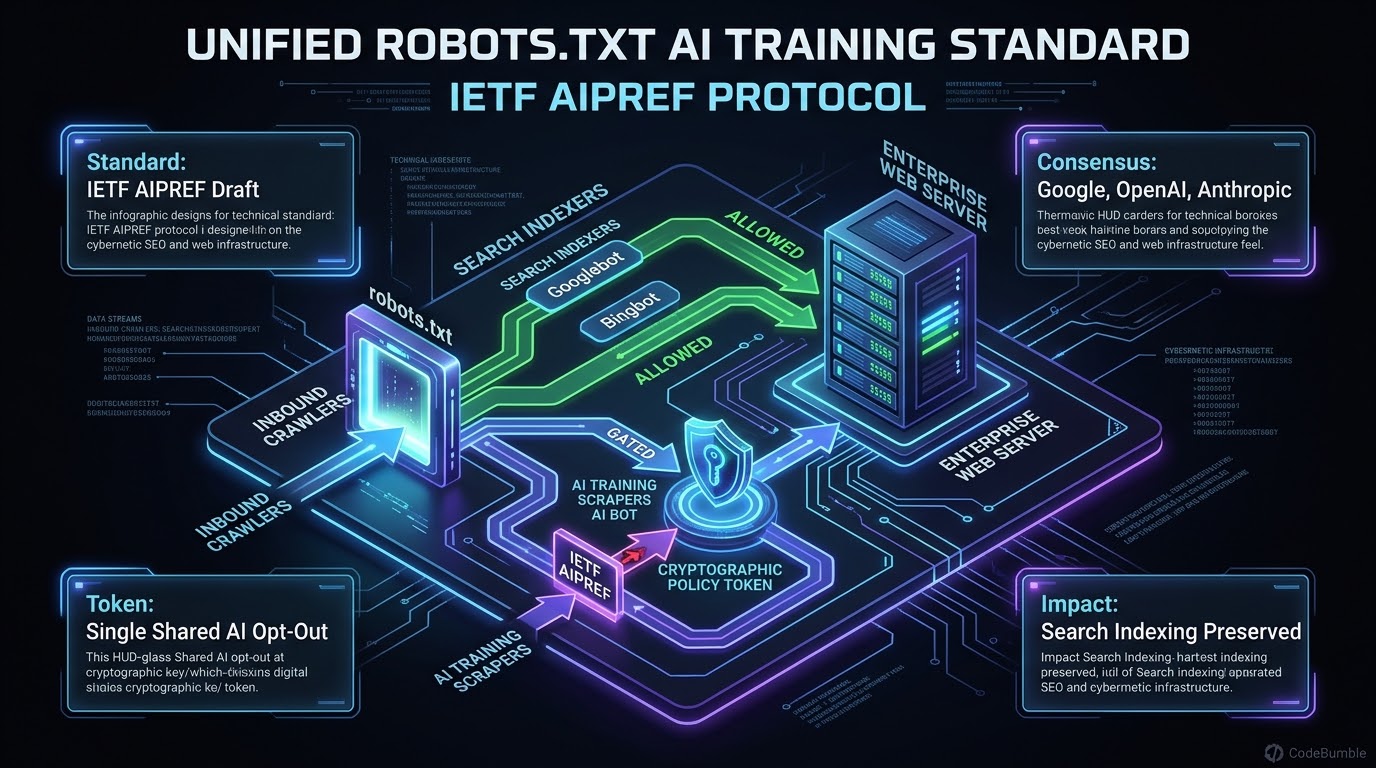
Specified under draft-kelley-aipref-training-preference-signal, the new protocol introduces a single, standardized machine-readable policy token that allows websites to opt out of AI model training across all participating frontier AI labs with one clean directive. Crucially, the protocol resolves the long-standing conflation between model pre-training and search indexing: opting out of AI model training does not suppress organic search indexation in Google Search or Bing, nor does it block real-time retrieval-augmented generation (RAG) in AI search products.
Furthermore, this unified mechanism directly aligns web crawling governance with the European Union's AI Act Code of Practice for General-Purpose AI (GPAI) model providers, establishing a legally recognized, machine-readable opt-out standard for intellectual property rights reservation.
This technical systems analysis dissects the microarchitecture of the IETF AIPREF standard. We evaluate the policy token grammar, analyze crawler precedence hierarchies, examine the technical boundary between training ingestion and search citation, and deliver an enterprise implementation playbook for engineering and SEO teams.
1. The Crawler Proliferation Crisis: Why Vendor-Specific Directives Failed
1.1 The Explosion of Proprietary AI User-Agents
The Robots Exclusion Protocol—formalized in RFC 9309—was engineered in an era when web crawlers acted almost exclusively as discoverability conduits. Webmasters allowed search engine bots (Googlebot, Bingbot, Slurp) to index content because that crawl yielded downstream referral traffic.
The advent of commercial generative AI fundamentally disrupted this reciprocal value exchange. AI labs deployed high-frequency web scrapers to harvest billions of web pages for offline model training, generating zero direct search referral traffic for the underlying publisher. In response, webmasters demanded granular controls to block training scraping while maintaining organic search visibility.
Lacking an industry standard, each AI vendor introduced its own proprietary user-agent token:
- OpenAI deployed
GPTBotfor model training andOAI-SearchBotfor search retrieval. - Anthropic deployed
ClaudeBotfor model training andClaude-Webfor real-time user browsing. - Google introduced
Google-Extendedas a dedicated token to control Gemini and Vertex AI training without affecting Googlebot. - Independent crawlers (
CCBot,PerplexityBot,Bytespider,Meta-ExternalAgent) proliferated independently.
By mid-2026, enterprise publishers maintained robots.txt files exceeding 50 lines of vendor-specific disallow rules.
+----------------------------------------------------------------------------------------------------+
|                         The Vendor-Specific Crawler Proliferation Crisis                            |
+----------------------------------------------------------------------------------------------------+
|                                                                                                    |
|  LEGACY FRAGMENTED APPROACH (50+ Lines of Brittle Rules):                                          |
|  User-agent: GPTBot              User-agent: ClaudeBot            User-agent: Google-Extended     |
|  Disallow: /                     Disallow: /                      Disallow: /                     |
|                                                                                                    |
|  User-agent: CCBot               User-agent: PerplexityBot        User-agent: Bytespider          |
|  Disallow: /                     Disallow: /                      Disallow: /                     |
|                                                                                                    |
|  Result: Administrative sprawl, syntax collisions, and accidental search de-indexing.              |
|                                                                                                    |
|  UNIFIED IETF AIPREF STANDARD (Single Machine-Readable Directive):                                 |
|  [ Inbound AI Crawlers ] ===> [ Single IETF AIPREF Policy Token ] ===> [ Unified Opt-Out Honored ]  |
|                                                                                                    |
+----------------------------------------------------------------------------------------------------+
1.2 Accidental De-Indexing and Crawl Budget Collisions
The proliferation of proprietary tokens created catastrophic configuration hazards for search engine optimization (SEO):
- Accidental Wildcard Disallow Overrides: Many site administrators attempted to block unlisted AI scrapers using broad wildcard blocks:
User-agent: * / Disallow: /. However, under RFC 9309 precedence rules, specific crawler blocks override wildcards, while poorly ordered records frequently resulted in Googlebot being inadvertently blocked from indexing core product categories. - Search Console Errors: Webmasters blocking
Googlebotor blocking asset directories (/assets/,/_next/) under the mistaken belief they were blocking AI scrapers saw massive spikes in "Indexed, though blocked by robots.txt" errors in Google Search Console, stripping snippet descriptions and search rich results. - The Search vs. Scraping Conflation: When publishers blocked
GPTBot, they often assumed they were also blocking ChatGPT Search from citing their content. In reality, OpenAI routes search retrieval queries throughOAI-SearchBot. Publishers desiring AI search visibility while protecting training data were forced to navigate contradictory rules.
2. Microarchitecture of the IETF AIPREF Standard
2.1 The IETF Working Group and RFC 9309 Foundation
To end the fragmentation, representatives from Google, Anthropic, OpenAI, and Microsoft collaborated under the Internet Engineering Task Force (IETF) AIPREF (AI Preferences) working group. The formal specification—authored by Anthropic's Kevin Kelley and supported by Google's John Mueller—is documented in draft-kelley-aipref-training-preference-signal.
The core architectural breakthrough of the AIPREF standard is that it separates crawling mechanics from data usage rights:
- RFC 9309 (Crawl Gating): Governs whether an HTTP client is permitted to make a network GET request to fetch bytes from a specified URL path.
- AIPREF (Usage Rights): Governs how an authorized or public data consumer is permitted to use the retrieved content, specifically regarding offline neural network training and parameter optimization.
+----------------------------------------------------------------------------------------------------+
|                         IETF AIPREF Dual-Layer Access Governance Architecture                       |
+----------------------------------------------------------------------------------------------------+
|                                                                                                    |
|  [ INBOUND HTTP REQUEST: Crawler / Fetcher / Indexer ]                                             |
|         |                                                                                          |
|         v                                                                                          |
|  +----------------------------------------------------------------------------------------------+  |
|  | LAYER 1: CRAWL PERMISSION (RFC 9309 Protocol Evaluation)                                     |  |
|  |   - Checks User-agent and Disallow/Allow URL path patterns                                   |  |
|  |   - Is the crawler allowed to fetch the HTTP bytes?                                          |  |
|  +----------------------------------------------------------------------------------------------+  |
|         |                                                                                          |
|         +---> [ DISALLOWED ] ===> HTTP Connection Terminated / URL Skipped                         |
|         |                                                                                          |
|         v [ ALLOWED ]                                                                              |
|  +----------------------------------------------------------------------------------------------+  |
|  | LAYER 2: USAGE GOVERNANCE (IETF AIPREF Policy Token Evaluation)                              |  |
|  |   - Evaluates policy token directives: __usage_ai-training                                    |  |
|  |   - Determines data rights: Model Training vs. Search Retrieval Grounding                     |  |
|  +----------------------------------------------------------------------------------------------+  |
|         |                                                      |                                   |
|         | (Opt-Out Active)                                     | (Retrieval / Indexing Active)     |
|         v                                                      v                                   |
|  [ AI MODEL TRAINING EXCLUDED ]                         [ SEARCH ENGINE INDEXING PERMITTED ]       |
|  - Content excluded from LLM pre-training               - Googlebot ingests into search index      |
|  - Parameter weights not updated                        - AI Overviews / SearchBot cites source    |
|                                                                                                    |
+----------------------------------------------------------------------------------------------------+
2.2 Policy Token Grammar and Directive Syntax
The specification introduces a standardized policy token directive that fits cleanly into existing robots.txt syntax without breaking legacy parsers that ignore unrecognized tokens.
The unified directive establishes a machine-readable opt-out across all participating frontier AI labs:
# Unified AI Training Opt-Out Standard (IETF AIPREF)
# Applies universally across Google, OpenAI, Microsoft, and Anthropic
User-agent: *
Disallow: /__usage_ai-training/
Under this grammar:
- The path identifier
/__usage_ai-training/operates as a standardized policy token. - Participating AI model crawlers recognize this path token as an explicit legal and technical reservation of rights under Article 4(3) of the EU Copyright Directive and the EU AI Act Code of Practice.
- Non-AI search engine parsers (such as standard web indexers) simply treat it as a path rule preventing crawling of a non-existent directory
/__usage_ai-training/, causing zero disruption to general website crawling.
3. Crawler Precedence, Inheritance, and Conflict Resolution
3.1 Precedence Hierarchies: Shared Defaults vs. Vendor Overrides
A major strength of the IETF AIPREF specification is its deterministic conflict resolution hierarchy. Site owners can define broad, universal policies while retaining granular exceptions for specific AI providers.
The precedence rule operates on three distinct priority tiers:
- Tier 1 (Specific Vendor Explicit Directive): A specific directive declared for a named crawler always takes absolute precedence. For example, if a site specifies
User-agent: Google-Extended / Allow: /, Google will use the site's content for Gemini training, even if a shared opt-out is declared. - Tier 2 (Shared AIPREF Policy Token): If no vendor-specific override is declared, all participating providers (
Google-Extended,GPTBot,ClaudeBot, Microsoft Copilot) inherit the shared opt-out token. - Tier 3 (General User-agent Wildcard): General path rules under
User-agent: *apply only to fetch permissions, not AI training usage rights.
+----------------------------------------------------------------------------------------------------+
|                         AIPREF Precedence Hierarchy and Inheritance Flow                            |
+----------------------------------------------------------------------------------------------------+
|                                                                                                    |
|  Does an explicit rule exist for the vendor's specific token (e.g., Google-Extended / GPTBot)?    |
|         |                                                                                          |
|         +--- YES ===> ENFORCE SPECIFIC RULE (Vendor override takes precedence)                     |
|         |                                                                                          |
|         +--- NO                                                                                    |
|               |                                                                                    |
|               v                                                                                    |
|  Is the shared AIPREF policy token (/__usage_ai-training/) declared?                               |
|         |                                                                                          |
|         +--- YES ===> ENFORCE UNIFIED OPT-OUT (All participating AI providers honor block)         |
|         |                                                                                          |
|         +--- NO                                                                                    |
|               |                                                                                    |
|               v                                                                                    |
|  Default to standard permissive crawl policies under RFC 9309                                      |
|                                                                                                    |
+----------------------------------------------------------------------------------------------------+
3.2 Adoption and Implementation Timeline
Google Search Central announced that it plans to transition its internal ingestion pipelines to fully support the shared AI training control throughout 2027, aligning with the rollout schedules of OpenAI, Microsoft, and Anthropic. During the 2026–2027 transition phase, engineering teams are advised to deploy hybrid configurations that pair the new shared token with existing legacy tokens to ensure seamless protection across both modern and legacy scraping infrastructure.
4. Search Engine Indexing and GEO Impact: What Does and Doesn't Change
4.1 Zero Penalty on Organic Search Rankings
A primary concern among enterprise digital marketing executives is whether opting out of AI model training harms organic rankings in Google Search.
Google Search Central has repeatedly clarified that AI model training controls do not affect search ranking or indexing:
Googlebotvs.Google-Extended: Googlebot handles search indexing, Web Rendering Service (WRS) execution, and search snippet generation. Google-Extended handles generative AI model training. Blocking training does not alter Googlebot's crawl behavior or search ranking algorithms.- Search Console Indexation: Pages protected by the shared AI training directive will continue to report normal
Valid (Indexed)status in Google Search Console.
4.2 Generative Engine Optimization (GEO) and AI Grounding
In conversational search environments (Google AI Overviews, ChatGPT Search, Microsoft Copilot, and Perplexity), a critical distinction exists between offline model weights and real-time RAG grounding:
- Offline Model Training: An LLM learns semantic patterns, vocabulary, and facts during pre-training. Content blocked via AIPREF will not be incorporated into the model's neural weights.
- Real-Time Grounding (RAG): When a user asks a question in Google Search or ChatGPT, the search engine fetches relevant web pages in real-time to generate a summarized answer with source citations.
Under the AIPREF standard, opting out of AI training does not disqualify a website from being cited in Google AI Overviews or ChatGPT Search. As long as Googlebot and OAI-SearchBot are permitted to crawl the website, the site's content can be retrieved and cited as a verified source, preserving high-value conversational referral traffic.
5. Enterprise Implementation and Verification Playbook
The following step-by-step playbook guides web engineering and SEO teams through auditing, deploying, and validating the unified AI training standard.
Step 1: Auditing Existing robots.txt Directives
Inspect your root /robots.txt file to identify redundant, conflicting, or overly broad crawler directives:
# Fetch and inspect active robots.txt configuration
curl -sL https://example.com/robots.txt | grep -E "User-agent|Disallow|Allow"
Look for common anti-patterns:
- Wildcard blocks (
User-agent: * / Disallow: /) that inadvertently block search engine discovery. - Inconsistent disallows that block
GPTBotwhile accidentally allowing third-party proxy scrapers likeCCBot.
Step 2: Deploying the Dual-Layer Production Configuration
Implement the standardized IETF AIPREF policy token while maintaining legacy compatibility for crawlers that have not yet updated their parsing engines:
# ==============================================================================
# ENTERPRISE ROBOTS.TXT: UNIFIED AI TRAINING & SEARCH GOVERNANCE
# ==============================================================================

# 1. Primary Search Engine Crawlers (Full Search Indexation Allowed)
User-agent: Googlebot
Allow: /

User-agent: Bingbot
Allow: /

# 2. AI Search Retrieval & Real-Time Grounding (Permitted for Citations)
User-agent: OAI-SearchBot
Allow: /

# 3. Universal AI Training Opt-Out (IETF AIPREF Standard)
# Supported by Google, OpenAI, Microsoft, and Anthropic
User-agent: *
Disallow: /__usage_ai-training/

# 4. Legacy AI Training Scraper Fallbacks (Transition Phase 2026-2027)
User-agent: Google-Extended
Disallow: /

User-agent: GPTBot
Disallow: /

User-agent: ClaudeBot
Disallow: /

User-agent: CCBot
Disallow: /

User-agent: PerplexityBot
Disallow: /

User-agent: Bytespider
Disallow: /

# 5. Global Crawl Exclusions for Internal Endpoints
User-agent: *
Disallow: /api/
Disallow: /checkout/
Disallow: /admin/

# 6. XML Sitemap Discovery
Sitemap: https://example.com/sitemap.xml
Step 3: Edge CDN Validation and Header Injection
In enterprise architectures utilizing Cloudflare, Fastly, or AWS CloudFront, engineering teams can enforce AI training governance directly at the edge by evaluating incoming User-Agent headers and returning automated HTTP 403 Forbidden responses for uncooperative scrapers:
# Python / Edge Worker: Validate AI Scraper User-Agents against robots.txt Policy
def evaluate_crawler_request(user_agent: str, request_path: str) -> dict:
    ai_training_bots = {
        "gptbot", "claudebot", "ccbot", "bytespider",
        "diffbot", "meta-externalagent", "applebot-extended"
    }

    ua_clean = user_agent.lower()

    # Check if visitor is a dedicated AI training scraper
    is_training_bot = any(bot in ua_clean for bot in ai_training_bots)

    if is_training_bot:
        return {
            "action": "BLOCK",
            "http_status": 403,
            "reason": "AI training scraping disallowed by IETF AIPREF policy token."
        }

    return {"action": "ALLOW", "http_status": 200}
Step 4: Automated Testing with Python Robots Parser
Validate that your deployed robots.txt correctly denies AI training scrapers while allowing search indexers:
import urllib.robotparser

def test_robots_compliance(robots_url: str):
    rp = urllib.robotparser.RobotFileParser()
    rp.set_url(robots_url)
    rp.read()

    # Test Search Indexers
    assert rp.can_fetch("Googlebot", "https://example.com/blog/article-1"), "Googlebot erroneously blocked!"
    assert rp.can_fetch("Bingbot", "https://example.com/blog/article-1"), "Bingbot erroneously blocked!"

    # Test Legacy Training Scrapers
    assert not rp.can_fetch("GPTBot", "https://example.com/blog/article-1"), "GPTBot erroneously allowed!"
    assert not rp.can_fetch("Google-Extended", "https://example.com/blog/article-1"), "Google-Extended erroneously allowed!"

    print("Robots.txt verification passed: Search indexers allowed, AI scrapers blocked.")
6. Semantic FAQ: Unified robots.txt AI Training Standard
What is the new unified robots.txt AI training standard?
It is a standardized machine-readable directive developed under the IETF AIPREF working group and supported by Google, OpenAI, Microsoft, and Anthropic. It allows website operators to opt out of AI model training across all participating frontier AI labs using a single policy token instead of managing dozens of individual crawler rules.
Does opting out of AI training remove my website from Google Search?
No. Google Search indexing is governed by Googlebot, whereas AI model training is governed by Google-Extended and the new AIPREF token. Blocking AI training has zero impact on your site's search rankings, organic impressions, or indexing status in Google Search.
Will my content still appear in Google AI Overviews and ChatGPT Search?
Yes. Conversational AI search features rely on real-time retrieval-augmented generation (RAG) rather than offline training weights. As long as retrieval bots like Googlebot and OAI-SearchBot are permitted to crawl your content, your pages can be cited with links in AI Overviews and ChatGPT search results.
What is the difference between RFC 9309 and the IETF AIPREF proposal?
RFC 9309 governs crawl permission—whether a bot is allowed to make an HTTP request to download a file. The AIPREF proposal governs data usage rights—establishing a machine-readable opt-out that prohibits participating AI labs from using retrieved public content to train artificial intelligence models.
How does the shared policy token interact with existing tokens like Google-Extended?
Vendor-specific tokens take precedence over the shared token. If a site declares specific rules for Google-Extended or GPTBot, those specific rules apply. If no vendor-specific rule is present, the participating crawler automatically falls back to honoring the shared AIPREF token.
When will the unified standard take effect across AI labs?
Google, OpenAI, Microsoft, and Anthropic announced plans to transition their training ingestion systems to support the standard throughout 2027. During the 2026–2027 transition, websites should maintain a hybrid robots.txt configuration that pairs the shared token with legacy vendor tokens.
Sources
- Google Search Central Blog (October 30, 2026): "Supporting a shared AI training control for websites" by John Mueller — https://developers.google.com/search/blog/2026/10/ai-training-control
- OpenAI Research Bulletin (October 30, 2026): "Making it easier for websites to express AI training preferences" — https://openai.com/index/helping-websites-express-ai-training-preferences/
- IETF Internet Draft (October 30, 2026): "A Machine-Readable AI Training Preference Signal (AIPREF)" by Kevin Kelley (Anthropic) — https://datatracker.ietf.org/doc/draft-kelley-aipref-training-preference-signal/
- The Next Web Technology News (October 31, 2026): "Google, Microsoft, OpenAI and Anthropic back one AI training opt-out in robots.txt" — https://thenextweb.com/news/ai-training-opt-out-robots-txt-google-openai-microsoft-anthropic
- Search Engine Roundtable Intelligence (November 2, 2026): "November 2026 Google Webmaster Report: Unified AI Training Controls & Crawler Standards" — https://www.seroundtable.com/november-2026-google-webmaster-report-42431.html