

AI
GPT-6.2 Astra vs. Claude Fable 5.2 and Gemini 4 Neon: Benchmarks, Pricing & API Trade-Offs
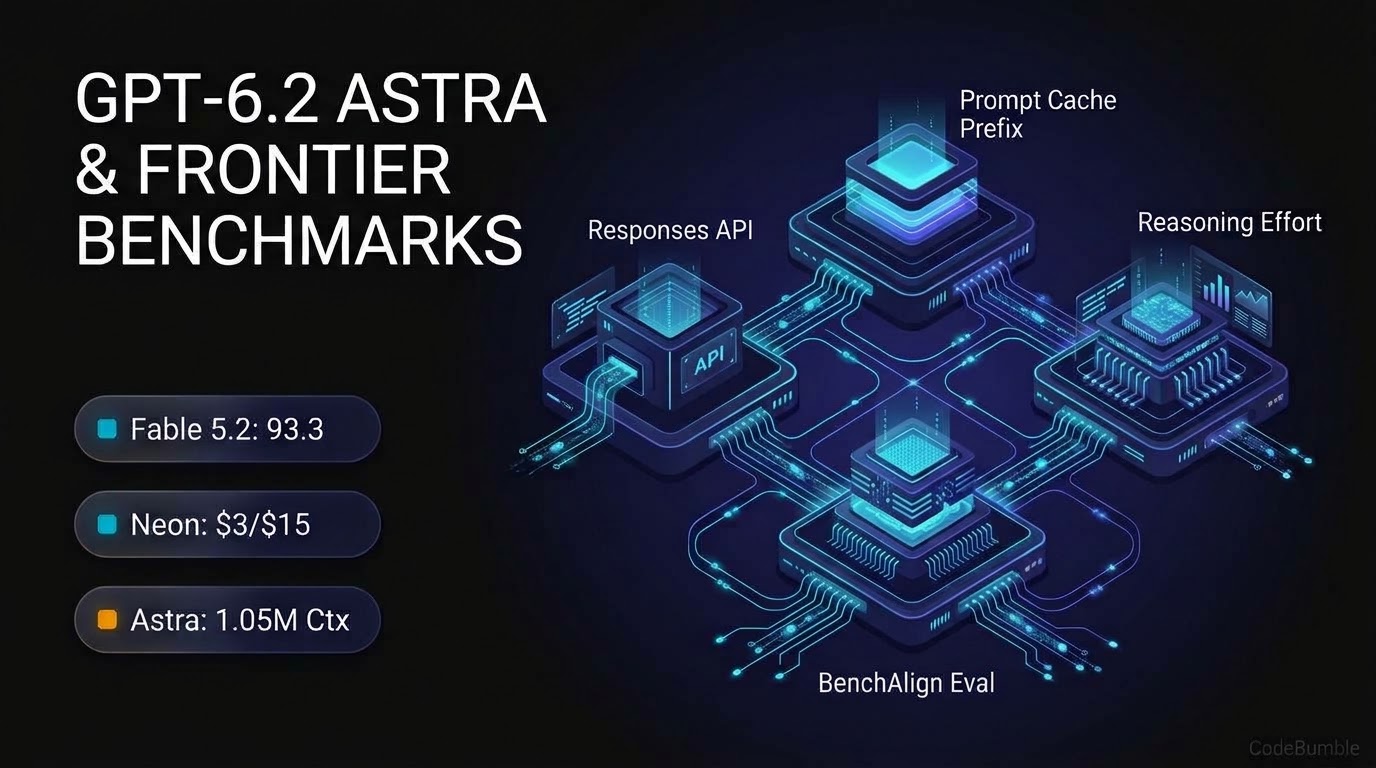
OpenAI's GPT-6.2 Astra and Sol (Nov 17, 2026) arrive alongside an updated Using GPT-6.2 prompting and Responses API migration guide (Nov 18–21, 2026). Evaluated against BenchLM's November 21, 2026 rankings—where Claude Fable 5.2 leads at 93.3, Gemini 4 Neon hits 91.3 at $3/$15 per 1M tokens, and GPT-6.2 Astra scores 90.8 at $8/$40—here is what changes for prompt caching, reasoning effort, and production model selection.
8 min read
GPT-6.2 Astra vs. Claude Fable 5.2 and Gemini 4 Neon: Benchmarks, Pricing & API Trade-Offs
Executive Summary
- Frontier rankings as of November 21, 2026: On BenchLM's BenchAlign v6.0 leaderboard (216 ranked models), GPT-6.2 Astra (released November 17, 2026) places #3 at 90.8 (
1.05Mcontext,$8.00 / $40.00per 1M input/output tokens), behind #1 Claude Fable 5.2 (93.3,$8.00 / $40.00,109 tok/s) and #2 Gemini 4 Neon (released November 18, 2026;91.3,$3.00 / $15.00,110 tok/s). - Breaking Responses API caching & prefix rules: Starting with GPT-6.2, OpenAI's Using GPT-6.2 guide (updated November 18–21, 2026) appends top-level
instructionsafterinputand drops saved reasoning items if earlier conversation prefixes, models, or user/org IDs are edited mid-session. - Prompting overhead vs. out-of-the-box behavior: Live side-by-side tests published November 22, 2026 show GPT-6.2 Astra defaults to terse replies (
39words on a client notice vs.162words from Claude Fable 5.2), prompting OpenAI to ship verbatim system-prompt templates to curb premature task pauses (GPTunneL). - Price-to-performance alternatives: Google's
Gemini 4 Carbon(88.3at$2.00 / $10.00) and open-weightDeepSeek V4.1 Flash 1017(70.0at$0.30 / $1.20,163 tok/s) offer steep output-cost reductions for teams that do not need frontier reasoning ceilings (BenchLM).
Architecture & How It Works
Model Specifications and API Surface
OpenAI positions gpt-6.2-astra for maximum reasoning and coding workloads and gpt-6.2-sol (82.3 BenchAlign, $2.00 / $10.00) for lower-cost production tasks (Using GPT-6.2, BenchLM). Neither model discloses total parameter counts publicly; both ship with a 1.05M-token context window and require the Responses API for tool calling (Chat Completions is supported for plain text/reasoning, but tool calling is Responses-only).
In a separate November 22, 2026 research essay (Perplexity and Intelligence), OpenAI Chief Scientist Jakub Pachocki framed frontier model capability jumps around pretraining cross-entropy loss (log-perplexity) on held-out codebase snapshots: ~0.99 (GPT-3.5), ~0.91 (GPT-4), below 0.8 (emergent math and cybersecurity capabilities), and ~0.76 (solving open math problems), while cautioning that chain-of-thought reasoning improves downstream performance without lowering base-model perplexity.
Responses API Prefix Preservation & Cache Boundaries
The most consequential engineering change in GPT-6.2 is how the Responses API orders prompts and manages reasoning state:
flowchart LR
    A["Developer Message (First in input[])"] --> B["User & Assistant History (Immutable Prefix)"]
    B --> C["Top-Level instructions (Appended After input[])"]
    C --> D{"Prefix Edited or Model/Org Changed?"}
    D -->|No| E["Prompt Cache Hit + Saved Reasoning Items Preserved"]
    D -->|Yes| F["Saved Reasoning Items Dropped + Cache Miss"]
Per OpenAI's migration quickstart, teams upgrading from GPT-5.5, GPT-6, or GPT-6.1 must adjust four integration patterns:
- Move stable rules into
input[0]: Because top-levelinstructionsis now appended afterinput, reusable system rules placed ininstructionswill miss prefix caching. Put static policies in adevelopermessage at index0ofinput, and reserveinstructionsfor per-request overrides. - Update cache TTL syntax: Replace
prompt_cache_retention(used in GPT-5.5 and earlier) withprompt_cache_options.ttlset to"30m". - Strip unsupported sampling parameters: Remove
temperature,top_p,top_logprobs, andmessage.output_text.logprobsfrom Responses requests (andlogprobsfrom Chat Completions). Map legacyreasoning.effortvalues ofnoneorminimaltolow, or start atmedium. - Replace Flex with Background Mode:
gpt-6.2-astraandgpt-6.2-soldo not supportservice_tier: flex. Long-running jobs must use Background mode (public beta) with 2-hour or 8-hour completion windows on Standard processing.
{
  "model": "gpt-6.2-astra",
  "reasoning": { "effort": "medium" },
  "prompt_cache_options": { "ttl": "30m" },
  "input": [
    {
      "role": "developer",
      "content": "Reusable project rules and task-completion constraints (cached prefix)."
    },
    {
      "role": "user",
      "content": "Audit the Responses API payload for cache invalidation."
    }
  ],
  "instructions": "Per-request formatting guidance only."
}
For organizations approved for Zero Data Retention (ZDR), the Responses API treats store as false; multi-turn workflows must pass all prior output items—including encrypted reasoning items—back in exact order (Using GPT-6.2).
Benchmarks, Cost & Latency Analysis
November 2026 Frontier & Open-Weight Comparison
Data below reflects BenchLM's BenchAlign v6.0 leaderboard (refreshed November 21, 2026 across 835 benchmarks; Supported indicates sufficient independent evidence, while open-weight pricing reflects hosted API rates):
| Rank | Model | Provider | BenchAlign Score | Context | Price ($/1M In / Out) | Speed / Latency | Weights |
|---|---|---|---|---|---|---|---|
| #1 | Claude Fable 5.2 | Anthropic | 93.3 (88.5–98.1) | 1M | $8.00 / $40.00 |
109 tok/s / 245.87s |
Closed |
| #2 | Gemini 4 Neon | 91.3 (85.0–97.5) | 1M | $3.00 / $15.00 |
110 tok/s / 56.51s |
Closed | |
| #3 | GPT-6.2 Astra | OpenAI | 90.8 (84.5–97.2) | 1.05M | $8.00 / $40.00 |
Not measured | Closed |
| #4 | Gemini 4 Carbon | 88.3 | 1M | $2.00 / $10.00 |
55 tok/s / 71.28s |
Closed | |
| #6 | Claude Opus 5.5 | Anthropic | 82.8 | 1M | $4.00 / $20.00 |
113 tok/s / 352.74s |
Closed |
| #7 | GPT-6.2 Sol | OpenAI | 82.3 | 1.05M | $2.00 / $10.00 |
Not measured | Closed |
| #13 | Claude Sonnet 5.5 | Anthropic | 77.7 | 1M | $2.00 / $10.00 |
144 tok/s / 267.56s |
Closed |
| #17 | Qwen4 Max | Alibaba | 74.8 | 1M | $1.50 / $4.50 |
58 tok/s / 131.40s |
Closed |
| #22 | Kimi K3.1 Pro | Moonshot AI | 70.0 (2800B/104B) |
1.05M | $2.00 / $10.00 |
31 tok/s / 156.89s |
Open |
| #23 | DeepSeek V4.1 Flash 1017 | DeepSeek | 70.0 | 1M | $0.30 / $1.20 |
163 tok/s / 44.28s |
Open |
Independent Prompting & Latency Tests
While BenchLM's conditional intervals for the top three models overlap (88.5–98.1 for Fable 5.2 vs. 84.5–97.2 for GPT-6.2 Astra), real-world developer feedback immediately after the November 17 launch flagged overly terse responses and mid-task confirmation pauses (GPTunneL). In live A/B tests conducted November 22–23, 2026 on a client-delay email task:
- GPT-6.2 Astra (no system prompt):
39words,73completion tokens,2.8slatency—retaining raw jargon ("database migration failed"). - GPT-6.2 Astra + OpenAI's Writing Style B template:
44words,84completion tokens,7.1slatency—translated jargon to plain language but remained brief. - Claude Fable 5.2 (no system prompt):
162words,612completion tokens,7.6slatency—produced a complete client email plus a shorter messenger variant without system-prompt scaffolding.
Benchmark Caveats & Confidence: Note that GPT-6.2 Astra and Sol throughput/latency (tok/s) are not yet measured on BenchLM's November 21 snapshot, and GPTunneL's two live experiments were originally executed in Russian before translation (N=2 tasks; Confidence: Moderate for qualitative behavioral patterns, not statistically generalizable across all domains). Additionally, older coding benchmarks like SWE-bench Verified reached saturation by September 2026 (97.0% Claude Opus 5 vs. 96.4% DeepSeek V4 Pro 0813), shifting industry evaluation toward SWE-bench Pro and Terminal-Bench 4.0 (DataCamp).
Production Deployment & Trade-Offs
Model Selection Framework
- Choose
Claude Fable 5.2($8 / $40) when maximum reasoning (94), knowledge (93), and instruction following (88) justify premium output pricing, or when you want thorough, self-contained prose with minimal system-prompt scaffolding. - Choose
Gemini 4 Neon($3 / $15) orGemini 4 Carbon($2 / $10) for cost-sensitive frontier coding and agentic pipelines: Neon delivers93on coding and92on agentic evals at 62.5% lower token cost than Fable 5.2 and GPT-6.2 Astra, with56.51smeasured latency. - Choose
GPT-6.2 Astra($8 / $40) orGPT-6.2 Sol($2 / $10) if your stack is already standardized on OpenAI's Responses API, Background mode (2h/8h windows), or ZDR encrypted reasoning items—provided you embed OpenAI's task-completion and writing-style templates intoinput[0](developerrole) and strip legacytemperature/top_pparameters. - Choose
DeepSeek V4.1 Flash 1017($0.30 / $1.20) orKimi K3.1 Profor high-volume worker loops, CI triage, or self-hosted data residency where163 tok/sthroughput and open weights outweigh the ~21-point BenchAlign gap against closed frontier models.
Production Gotchas
- Silent Reasoning Loss on Prefix Edits: Editing any earlier turn, developer message, or tool output in a multi-turn Responses session invalidates saved reasoning items on GPT-6.2, degrading accuracy and inflating token spend as the model re-derives context (Using GPT-6.2).
- Ultrafast Tier Residency & Multiplier:
Ultrafastmode for GPT-6.2 Astra and Sol bills at 3x standard rates and supports US data residency only, whereas Standard, Fast, and Batch support both US and EU residency (OpenAI Pricing, Using GPT-6.2). - Production Typo in Official Prompt Block: OpenAI's published Task Completion Option A template contains a missing space (
maketoinstead ofmake to); sanitize before committing to production configs (GPTunneL).
Frequently Asked Questions
1. What is the difference between GPT-6.2 Astra and GPT-6.2 Sol?
GPT-6.2 Astra ($8.00 / $40.00 per 1M tokens, 90.8 BenchAlign) targets maximum reasoning, coding, and multimodal accuracy, while GPT-6.2 Sol ($2.00 / $10.00, 82.3 BenchAlign) offers a 4x lower price point for routine complex workloads (Using GPT-6.2, BenchLM).
2. Why did prompt caching break after migrating to GPT-6.2 in the Responses API?
Starting with GPT-6.2, OpenAI appends top-level instructions after the input array. Move static system instructions into a developer message at input[0] and replace prompt_cache_retention with prompt_cache_options.ttl: "30m" (Using GPT-6.2).
3. Does GPT-6.2 Astra support temperature, top_p, or Flex processing?
No. Both gpt-6.2-astra and gpt-6.2-sol reject temperature, top_p, top_logprobs, and service_tier: flex. Use reasoning.effort (low, medium, or higher) and Background mode (2h/8h) for discounted asynchronous jobs (Using GPT-6.2).
4. How does Gemini 4 Neon compare to GPT-6.2 Astra on price and benchmarks?
On BenchLM's November 21, 2026 leaderboard, Gemini 4 Neon scores 91.3 overall (93 coding, 92 agentic) at $3.00 / $15.00 per 1M tokens, compared to GPT-6.2 Astra at 90.8 (92 coding, 93 agentic) at $8.00 / $40.00—though conditional confidence intervals overlap (BenchLM).
5. Which open-weight model offers the best cost-throughput ratio in November 2026?
DeepSeek V4.1 Flash 1017 scores 70.0 on BenchAlign (matching Kimi K3.1 Pro) while delivering 163 tok/s at $0.30 / $1.20 per 1M tokens with a 1M context window (BenchLM).
Sources
- OpenAI — Using GPT-6.2 (API Guide & Migration Quickstart) (Updated November 18–21, 2026): https://developers.openai.com/api/docs/guides/latest-model
- OpenAI (Jakub Pachocki) — Perplexity and Intelligence (November 22, 2026): https://openai.com/index/perplexity-and-intelligence/
- BenchLM — LLM Leaderboard & AI Model Benchmarks (BenchAlign v6.0) (Refreshed November 21, 2026): https://benchlm.ai/
- BenchLM — New AI Models: Live Release Tracker (Updated November 20–23, 2026): https://benchlm.ai/model-updates
- GPTunneL (Viner Shakirov) — How to Prompt GPT-6.2 Astra and Sol: OpenAI's Official Guide (November 22, 2026): https://www.gptunnel.ru/en/blog/gpt-6-2-astra-sol-prompting
- DataCamp — Best LLM for Coding in 2026: 9 Models Ranked (September 25, 2026): https://www.datacamp.com/blog/best-llm-for-coding