

AI
OpenAI’s Perplexity and Intelligence: What Internal Pretraining Loss Reveals (And Misses)
On November 22, 2026, OpenAI Chief Scientist Jakub Pachocki published internal log-perplexity measurements spanning GPT-3.5 (~0.99) through GPT-4 (~0.91) to models below 0.8, proposing cross-entropy loss as a shared industry pacing metric. Here is what the numbers actually measure, why Microsoft AI's MAI-2 Base (0.819) highlighted tokenizer caveats, and where perplexity fails to capture chain-of-thought reasoning.
8 min read
OpenAI’s Perplexity and Intelligence: What Internal Pretraining Loss Reveals (And Misses)
Executive Summary
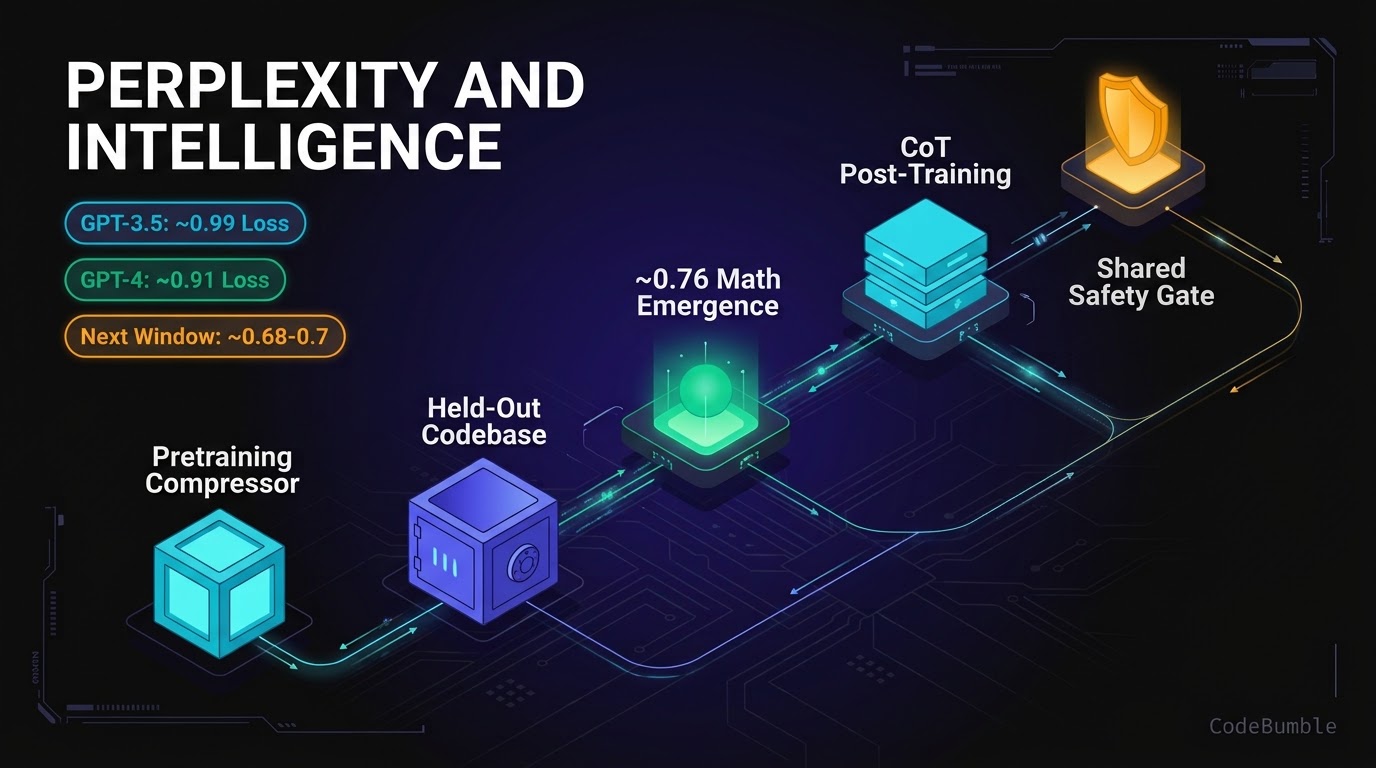
- Core Release: On November 22, 2026, OpenAI Chief Scientist Jakub Pachocki published Perplexity and Intelligence, disclosing internal base-model log-perplexity (cross-entropy loss) measurements from GPT-3.5 through November 2026 frontier models on a held-out snapshot of OpenAI's internal codebase.
- Key Numbers: Log-perplexity dropped from ~0.99 (
0.986) on GPT-3.5 (March 2022) and ~0.91 (0.913) on GPT-4 (March 2023) to below 0.8, with models near ~0.76 (0.761on GPT-6.2 Astra) resolving open math problems and an unnamed November 2026 internal model reaching 0.732. Pachocki projects further transformative capabilities in the ~0.68–0.7 window. - Cross-Lab Reaction: Within hours, Microsoft AI's Mustafa Suleyman reported Microsoft's
MAI-2 Basescored 0.819 on OpenAI's test set—comparable to theGPT-5.6 Solbase model (0.828)—while noting that direct comparability depended on sharing OpenAI's tokenizer and receiving private dataset access. - Primary Developer Takeaway: Log-perplexity is a strong internal measure of pretraining compression and quantization loss, but it omits post-training reinforcement learning and chain-of-thought (CoT) reasoning gains—and cannot serve as an independent cross-lab standard until labs agree on a neutral test set, bits-per-byte normalization, and fixed evaluation strides.
Frontier AI labs rarely publish raw pretraining loss curves. Downstream benchmarks saturate rapidly—tests that separated GPT-2 from GPT-3 were largely maxed out by GPT-4—forcing engineers and safety teams to chase moving evaluation targets. In Perplexity and Intelligence, Pachocki argues for anchoring capability and pacing discussions on perplexity (specifically cross-entropy loss on held-out data) and proposes "common limits" that developers would commit not to cross until alignment and monitoring tools (such as successors to chain-of-thought monitors) reach concrete milestones.
Architecture and How It Works: Pretraining Compression vs. Elicitation
Pachocki frames modern frontier AI development as a two-stage pipeline rather than a collection of bespoke, task-specific modules:
- Pretraining a Compressor: A large compute cluster trains a base model to predict the next token over a massive unstructured corpus. Lower cross-entropy loss (log-perplexity) corresponds directly to better statistical compression of the data distribution.
- Targeted Elicitation: Prompting, fine-tuning, and reinforcement learning (RL) elicit latent capabilities already encoded during pretraining—such as chain-of-thought reasoning or tool use.
flowchart LR
    Corpus["Unstructured Training Corpus"] -->|"Pretraining Compute"| Base["Base Model Compressor<br/>(Minimizes Cross-Entropy Loss)"]
    Base -->|"Evaluated on Fixed Held-Out Set"| Loss["Log-Perplexity Curve<br/>(e.g., 0.99 -> 0.76 -> 0.68-0.70)"]
    Base -->|"Post-Training: RL, CoT, Fine-Tuning"| Elicited["Elicited Reasoning Model<br/>(Capabilities Not Visible in Loss)"]
    Loss -->|"Proposed Threshold"| Gate["Shared Lab Pacing Gate<br/>(Requires CoT Monitor Successor)"]
The Math Behind Log-Perplexity and Bits Per Byte
As detailed in DEV Community's technical breakdown and Hugging Face's evaluation documentation, perplexity is the exponentiated average negative log-likelihood of a token sequence. When a model assigns probability $p_i$ to the actual next token, its negative log-likelihood is $-\ln(p_i)$ (in nats). Averaging across tokens yields log-perplexity (cross-entropy loss), and exponentiating returns perplexity:
import math

# Probabilities the model assigned to the actual next tokens
token_probs = [0.50, 0.25, 0.80, 0.10, 0.60]
nll = [-math.log(p) for p in token_probs]
log_ppl = sum(nll) / len(nll)   # Cross-entropy loss (nats/token)
ppl = math.exp(log_ppl)         # Perplexity

# Normalize by UTF-8 bytes to remove tokenizer vocabulary effects
text_bytes = 22
bits_per_byte = sum(nll) / math.log(2) / text_bytes

print(f"log-perplexity: {log_ppl:.3f} nats/token | perplexity: {ppl:.2f} | BPB: {bits_per_byte:.3f}")
Two properties matter for engineers:
- Heavy Penalty for Surprises: Assigning
0.10probability to a true token adds ~2.30nats, whereas0.80adds ~0.22nats. - Tokenizer Dependence: Per-token log-perplexity depends on how a tokenizer chunks text. Dividing total loss by UTF-8 byte count (bits per byte, or BPB) removes vocabulary bias when comparing models from different labs.
Benchmarks, Loss Trajectory, and Evaluation Gaps
OpenAI's published chart ("Base model log-perplexity" on a fixed snapshot of its internal codebase) illustrates both how emergent capabilities correlated with loss thresholds and how rapidly pretraining loss fell during 2026:
| Model / Milestone | Chart Date | Log-Perplexity | OpenAI / Source Milestone Note |
|---|---|---|---|
| GPT-3.5 | March 2022 | 0.986 (~0.99) |
"Fluent conversation" |
| GPT-4 | March 2023 | 0.913 (~0.91) |
"Benefits from thinking before answering" |
| GPT-4.5 | February 2025 | 0.876 |
Base pretraining step |
| GPT-4.1 / o3 | April 2025 | 0.902 |
Higher base loss than GPT-4.5 despite strong reasoning |
| GPT-5.3-Codex / 5.4 | February 2026 | 0.871 |
"Useful coder" |
| GPT-5.5 | April 2026 | 0.848 |
Pretraining progression |
| GPT-5.6 Sol | July 2026 | 0.828 |
"Cybersecurity expert" |
| Microsoft MAI-2 Base | November 2026 | 0.819 |
Tested on OpenAI's set (shared tokenizer) |
| GPT-6 Astra | September 2026 | 0.783 |
Below 0.8 emergence threshold |
| GPT-6.2 Astra | November 2026 | 0.761 (~0.76) |
Groundbreaking results on open math problems |
| Unnamed Internal Model | November 2026 | 0.732 |
Latest internal checkpoint plotted |
| Projected Window | 2027+ | ~0.68–0.70 |
Expected window for further transformative capabilities |
From GPT-4 (March 2023) to GPT-5.2 (December 2025), log-perplexity fell by 0.025. Between February 2026 (GPT-5.3-Codex / 5.4) and November 2026 (GPT-6.2 Astra), it fell by 0.110. Pachocki attributes this 2026 acceleration primarily to long-term research and compute investments, alongside "meaningful design contributions coming from AI" in the most recent models, warning that automated AI research on pretraining could trigger a similar capability jump as soon as 2027 while alignment monitoring lags behind.
Six Technical Caveats Limiting Cross-Lab Adoption
Both OpenAI's own caveats and independent technical critiques highlight why raw log-perplexity cannot yet function as an industry-wide speed limit:
- Private Held-Out Dataset: OpenAI's figures come from an internal codebase snapshot that has not been released publicly. External auditors and competing labs cannot independently reproduce the numbers without privileged access.
- Tokenizer Incompatibility: Microsoft's
MAI-2 Base(0.819) was only directly comparable because it happened to use the same tokenizer as OpenAI. Labs with different vocabularies must convert to bits per byte (BPB). - Evaluation Stride Sensitivity: Sliding-window stride and context length drastically alter perplexity on identical weights. As Hugging Face's GPT-2 WikiText-2 benchmark demonstrates, evaluating in disjoint 1,024-token chunks yields
19.44, while a 512-token stride drops the score by ~15% to16.44. - Invisibility of Post-Training Reasoning: Chain-of-thought RL does not lower base-model perplexity. On OpenAI's own chart,
GPT-4.1 / o3(0.902) has a higher loss thanGPT-4.5(0.876) despite superior reasoning performance—meaning a lab could stay under a perplexity cap while shipping major capability leaps via RL and agent scaffolding. - Unknown Entropy Floor: Natural language and code have a non-zero irreducible entropy floor. As models approach that floor, smaller numerical drops in loss correspond to disproportionately larger capability jumps, making static numeric caps brittle over time.
- Codebase Snapshot Staleness: Using a fixed historical snapshot prevents data contamination, but as real-world repositories incorporate more AI-generated code, a frozen snapshot drifts from modern software distributions.
Production Deployment and Engineering Trade-Offs
For applied ML and software engineers—who do not have access to OpenAI's internal evaluation snapshot—the immediate value of perplexity lies in local model verification rather than frontier governance:
- Auditing Quantized Local Weights: When deploying GGUF models in
llama.cppor quantized checkpoints invLLM, measure perplexity on a fixed domain corpus before and after quantization (e.g., FP16 vs. Q4_K_M) using identical context windows and strides. A sharp perplexity spike signals severe compression degradation. - Separating Base Compression from Fine-Tune Behavior: As
llama.cppdocumentation notes, instruction fine-tuning or RLHF often increases perplexity slightly on raw text even while improving human-rated task utility. Never reject a fine-tune solely because its raw perplexity rose. - Scrutinizing Vendor Claims: Whenever a model provider cites a perplexity or BPB figure, verify three parameters before comparing it to another model: the exact held-out dataset, the tokenizer (or BPB normalization), and the context window/stride protocol.
Frequently Asked Questions
1. Can outside developers reproduce OpenAI's log-perplexity numbers?
No. OpenAI evaluated its models on a held-out snapshot of its internal codebase and published the plotted values without releasing the dataset or evaluation code. Microsoft AI's 0.819 score on MAI-2 Base required special access from OpenAI.
2. Why did GPT-4.1 / o3 have higher log-perplexity (0.902) than GPT-4.5 (0.876)?
Because log-perplexity measures base-model next-token prediction during pretraining, whereas reasoning models like o3 gain their performance from post-training reinforcement learning and test-time chain-of-thought compute—which do not reduce base cross-entropy loss.
3. Why did Microsoft suggest bits per byte (BPB) instead of per-token perplexity?
Different model families use different tokenizers. A tokenizer that merges more characters into a single token makes each next-token prediction harder per token, inflating per-token perplexity even for identical compression quality. Dividing loss by UTF-8 bytes removes tokenizer bias.
4. What capability milestones did OpenAI link to specific loss thresholds?
In its November 22, 2026 post, OpenAI linked ~0.99 (GPT-3.5) to fluent conversation, ~0.91 (GPT-4) to chain-of-thought responsiveness, <0.8 to strong cybersecurity and math performance, ~0.76 (GPT-6.2 Astra) to solving open mathematics problems, and projected ~0.68–0.7 as the next transformative window.
5. What would a cross-lab perplexity standard require to work in practice?
To serve as an auditable standard, labs would need a neutral, non-contaminated test set managed by a third party, bits-per-byte normalization, a standardized context/stride protocol, independent run verification, and companion metrics covering post-training RL and agent scaffolding.
Sources
- OpenAI (Primary Announcement) — Perplexity and Intelligence by Jakub Pachocki: https://openai.com/index/perplexity-and-intelligence/ (Published November 22, 2026)
- DEV Community (Secondary Technical Analysis & Python/Chart Extraction) — OpenAI Wants Perplexity as an AI Speed Limit: What the Number Really Measures by
jamilxt: https://dev.to/jamilxt/openai-wants-perplexity-as-an-ai-speed-limit-what-the-number-really-measures-5bba (Published November 22, 2026) - AI/TLDR (Secondary Release Summary) — Perplexity and Intelligence — OpenAI publishes its internal pretraining loss: https://ai-tldr.dev/releases/openai-perplexity-and-intelligence/ (Published November 23, 2026)
- The Next Web (Secondary Industry Coverage) — OpenAI's chief scientist calls for industry-wide limits on AI models: https://thenextweb.com/news/openai-chief-scientist-shared-ai-limits (Published November 23, 2026)