

AI
Inkling 2 Mini: Looped MoE Architecture, Benchmarks & Local Deployment
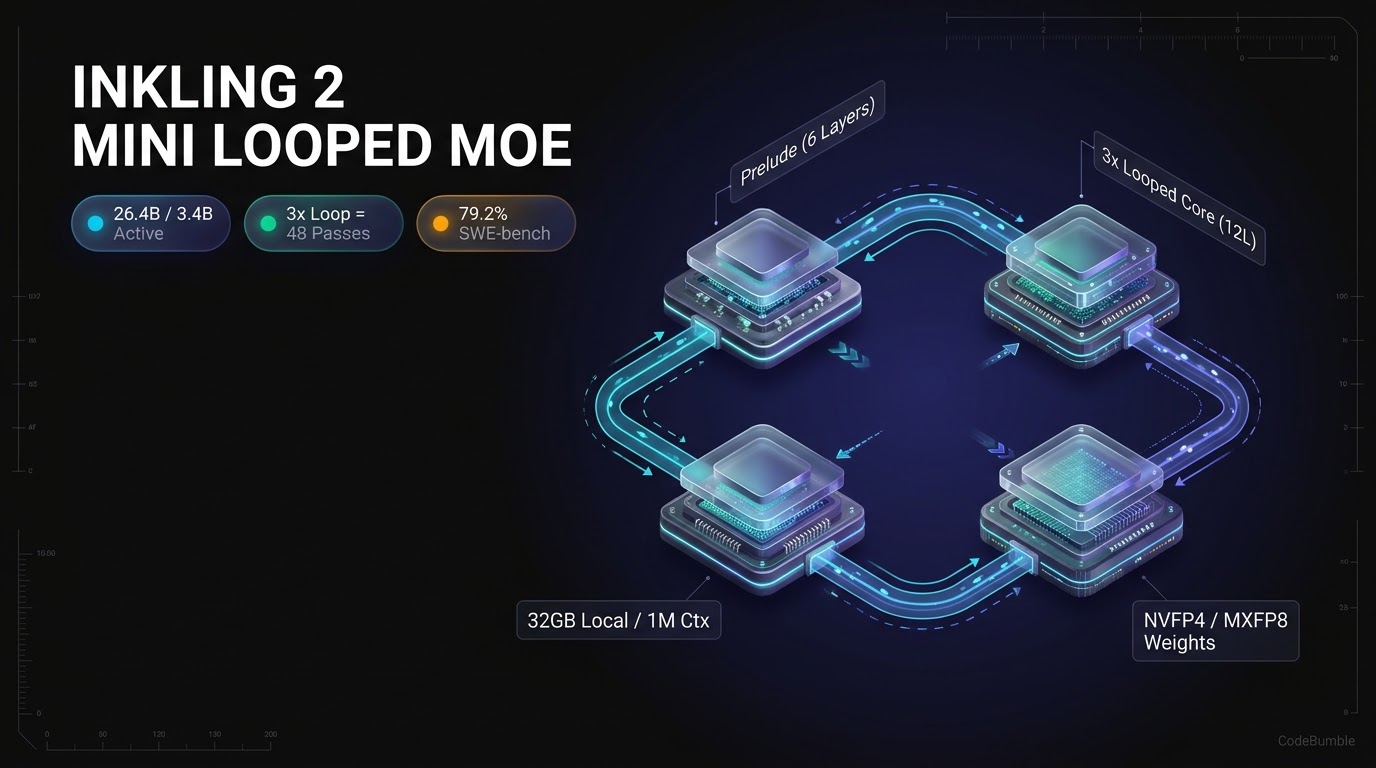
Thinking Machines Lab's Inkling 2 Mini (Nov 20–21, 2026) is an Apache 2.0, 26.4B-parameter looped Mixture-of-Experts model (3.4B active, ~20GB NVFP4/MXFP8 checkpoint) that runs middle layers 3x to reach 79.2% on SWE-bench Verified from a 32GB laptop. Here is the architectural breakdown, Qwen3.8-27B benchmark comparison, API pricing, and production limitations.
8 min read
Inkling 2 Mini: Looped MoE Architecture, Benchmarks & Local Deployment
Executive Summary
- Looped local-first release: Thinking Machines Lab released Inkling 2 Mini on November 20–21, 2026 under an Apache 2.0 license (
thinkingmachines/Inkling-2-Minion Hugging Face), pairing a26.4B-parameter sparse Mixture-of-Experts (MoE) backbone (3.4Bactive per pass,5.4Beffective active across loops) with a ~20 GB mixedNVFP4/MXFP8checkpoint that fits on a 32 GB Apple Silicon laptop or a single NVIDIA DGX Spark. - Coding-focused benchmark gains (self-reported): On Thinking Machines Lab's model card, Inkling 2 Mini ties
Qwen3.8-27Bat20.1on the Artificial Analysis Intelligence Index v5.0, leadsQwen3.8-27BonDeepSWE v1.1(48.2%vs.42.2%) andSWE-bench Pro v2 (Hard)(77.9%vs.73.8%), and posts79.2%onSWE-bench Verified(bash only), while trailingQwen3.8-27BonTerminal Bench v2.1(71.6%vs.73.0%) and multi-turn chat (MarkTechPost). - Hosted API pricing & latency: On third-party inference router OrcaRouter,
thinkingmachines/inkling-2-minilists at$0.075 / 1Minput tokens,$0.300 / 1Moutput tokens, and$0.015 / 1Mcached read tokens with460 msp50 time-to-first-token (Zero Data Retention available). - Skeptical engineering caveat: All benchmark tables in the launch materials are self-reported across varying harnesses, and looping does not expand factual recall—Inkling 2 Mini scores
-8.6onAA-Omniscience v1.1(63.4%non-hallucination rate) and50.0%onMultiChallenge(Thinking Machines Lab).
Architecture & How It Works
Looped Transformer Topology and Attention Residuals
Standard decoder-only transformers pass each token through a fixed stack of layers once. Inkling 2 Mini stores 24 physical decoder layers (text decoder width 2,304, expert intermediate width 1,152) arranged in four 6-layer blocks, but executes 48 logical layer visits per token by looping the two middle blocks (layers 6–17) three times with shared weights (Hugging Face Blog, Thinking Machines Lab).
flowchart LR
    A["Input: Text + Image (1M Context)"] --> B["Prelude Block: Layers 0–5 (1 Pass)"]
    B --> C["Looped Core: Layers 6–17 (Pass 1 of 3)"]
    C -->|"Cross-Pass Message + Rank-64 Gate"| D["Looped Core: Layers 6–17 (Pass 2 of 3)"]
    D -->|"Cross-Pass Message + Rank-64 Gate"| E["Looped Core: Layers 6–17 (Pass 3 of 3)"]
    E --> F["Final Block: Layers 18–23 (1 Pass)"]
    F --> G["Output: Text + Tool Calls (Up to 65K Tokens)"]
Each six-layer block combines five sliding-window attention layers (1,024-token local window) with one full-attention layer using 24 query heads, 8 KV heads, learned relative position logits, and dynamic key/value convolutions (Hugging Face Blog). Every layer routes tokens to 8 of 128 SwiGLU experts (pruned mid-training from 384 experts, then healed via 1T tokens of distillation from a larger internal Inkling model and 2.2T tokens of reinforcement learning).
Crucially, Inkling 2 Mini replaces standard additive residual streams with Attention Residuals: during passes 2 and 3, each core layer reads the previous pass's outputs through four rank-64 learned gates targeting query, key, value, and MoE inputs. Each of the 48 visits maintains its own KV and short-convolution state. In Thinking Machines Lab's scaling-ladder ablations, looping the middle 12 layers outperformed looping the last 12 layers on 27 of 28 evaluations (1.51–1.91x compute-equivalent gain vs. 1.24–1.36x), and an unlooped baseline required 140% more inference compute to match the looped model's loss on 512K-token agentic traces (Thinking Machines Lab).
Native NVFP4/MXFP8 Quantization and Inference Code
Rather than post-training quantizing a BF16 checkpoint, Thinking Machines Lab trained and deployed the first 20 layers' expert forward passes natively in 4-bit NVFP4 and the final 4 layers in 8-bit MXFP8, eliminating conversion loss on NVIDIA Blackwell/GB300 and MLX runtimes (Thinking Machines Lab). Alongside the fixed-loop model, the team released thinkingmachines/TML-d24-varloop-research so researchers can vary loop depth (1 to 5 trained passes, testable up to 10):
from transformers import AutoModelForMultimodalLM, AutoProcessor

model_id = "thinkingmachines/Inkling-2-Mini"
processor = AutoProcessor.from_pretrained(model_id)
model = AutoModelForMultimodalLM.from_pretrained(model_id)

messages = [
    {"role": "user", "content": [{"type": "text", "text": "Audit this Dockerfile for root privileges."}]}
]
inputs = processor.apply_chat_template(
    messages,
    reasoning_effort="medium",  # Supports: none (0.0), minimal (0.1), low (0.2), medium (0.7), high (0.9), xhigh (0.99)
    tokenize=True,
    add_generation_prompt=True,
    return_dict=True,
    return_tensors="pt",
).to(model.device)

input_len = inputs["input_ids"].shape[-1]
outputs = model.generate(**inputs, max_new_tokens=1024)
print(processor.decode(outputs[0][input_len:], skip_special_tokens=False))
For local serving, Hugging Face ships IQ4_NL and Q8_0 GGUFs (llama serve -hf ggml-org/Inkling-2-Mini-GGUF:IQ4_NL), native mlx_lm support, and SGLang Day-0 support with a three-layer DSpark speculative drafter (--speculative-algorithm DSPARK) (Hugging Face Blog).
Benchmarks, Cost & Latency Analysis
Open-Weight Local & Mid-Sized Model Comparison
The table below compiles vendor-reported model-card figures from Thinking Machines Lab and MarkTechPost (note: evaluation harnesses differ across vendors, so cross-vendor gaps should be treated as directional):
| Metric | Inkling 2 Mini | Qwen3.8-27B | Qwen3.6-35B-A3B | Gemma 4 31B | Nemotron 3.5 Super VL |
|---|---|---|---|---|---|
| Architecture | Looped MoE | Dense | MoE | Dense | MoE |
| Total / Active Params | 26.4B / 3.4B (5.4B eff.) |
27.0B / 27.0B |
35B / 3B |
30.7B / 30.7B |
124.5B / 12.0B |
| Max Context | 1,048,576 (1M) |
262,144 (to 1M) |
262,144 (to 1.01M) |
Not disclosed | Not disclosed |
| AA Index (v5.0) | 20.1 (tied) | 20.1 (tied) | Not reported | 4.4 |
13.6 |
| SWE-bench Verified | 79.2% (bash only) | 77.8% |
73.4% |
46.1% |
71.1% |
| SWE-bench Pro v2 (Hard) | 77.9% | 73.8% |
Not reported | 14.2% |
44.1% |
| DeepSWE v1.1 | 48.2% | 42.2% |
Not reported | 0.3% |
24.7% |
| Terminal Bench v2.1 | 71.6% |
73.0% | Not reported | 43.4% |
60.7% |
| GPQA Diamond | 86.6% |
89.2% | 86.0% |
Not reported | Not reported |
| MCP Atlas (Public) | 82.7% | 77.3% |
Not reported | 54.2% |
67.7% |
| AA-Omniscience v1.1 | -8.6 (63.4% non-halluc.) |
-6.4 (71.4%) |
Not reported | -48.5 (14.5%) |
-2.9 (69.5%) |
Energy Efficiency, Token Pricing, and Monitorability Caveats
- Intelligence per Watt: In early testing by Stanford's Hazy Research Lab and Scaling Intelligence Lab on an NVIDIA DGX Spark (
128 GB,MXFP8, low reasoning effort), Inkling 2 Mini scored0.703, ahead ofQwen3.6-35B-A3B(0.430atNVFP4),Gemma-4-26B-A4B(0.159atNVFP4), andQwen3.5-27B(0.036atINT4) (Thinking Machines Lab). - API Cost & Latency: Hosted inference via OrcaRouter prices Inkling 2 Mini at
$0.075 / $0.300per 1M input/output tokens ($0.015cached reads) with460 msp50 TTFT and471 msp95 TTFT. Thinking Machines Lab's own Tinker Playground pricing for Mini is not disclosed in the launch post. - Monitorability & Benchmark Caveats: On the variable-loop research variant (
TML-d24-varloop-research), no-CoT 50% time horizon on Think Fast tasks rose from16s(1 pass) to37s(3 passes) and42s(5 passes), whileN-Hop Lookupimproved out to10passes without degrading chain-of-thought legibility or increasing covert sabotage rates (8.3%covert misbehavior vs.33.2%forQwen3.8-27B). However, Confidence: Moderate on independent generalization: as of November 23, 2026, OrcaRouter public design-arena benchmarks remainpending, and Hugging Face's own blog notes that broader independent validation is still needed (Hugging Face Blog).
Production Deployment & Trade-Offs
When to Choose Inkling 2 Mini vs. Alternatives
- Local Agentic Coding & Tool Loops: Inkling 2 Mini is an unusually strong fit for offline or privacy-sensitive developer workstations (
32 GB+Apple Silicon,32 GB+VRAM GPUs, or4–16 GiBcards viallama.cpp/ Strata offloading), where its3.4Bper-pass active footprint and82.7%MCP Atlas /79.2%SWE-bench Verified scores outperform dense27Bpeers on memory bandwidth. - Long-Context Document & Vision Parsing: With
1Mcontext,92.8%onOmniDocBench v1.6, and66.9%onLongBench v2, it handles PDFs, UI screenshots (87.7%ScreenSpot Pro with Python), and multi-file repo context well—provided factual gaps are grounded via search or RAG tools. - When to Skip It: Do not deploy Inkling 2 Mini for closed-book factual Q&A, multi-turn customer chat (
50.0%MultiChallenge), or complex multi-constraint instruction following (33.4%ComplexConstraints v1.1).Qwen3.8-27Bremains stronger onGPQA Diamond(89.2%),AutomationBench-AA(48.2%), and non-hallucination rate (71.4%), while closed frontier models (Claude Fable 5.2,Gemini 4 Neon) remain necessary for high-stakes general reasoning.
Operational Gotchas
- Reasoning Loop Traps: The official model card warns that Inkling 2 Mini can get stuck in repetitive debugging loops or re-check its own work indefinitely; always enforce
max_new_tokensand agent turn budgets. - Unconfirmed Destructive Tool Calls: The model card explicitly notes lower instruction-following reliability than larger models during tool use—including potential unconfirmed file deletions or inaccurate outcome reporting. Gate filesystem and shell tools behind deterministic confirmation hooks.
- Non-English Degradation: Outside English, output quality drops, with observed clipped phrasing and mixed-language artifacts in Chinese testing.
Frequently Asked Questions
1. What hardware do I need to run Inkling 2 Mini locally?
The native NVFP4/MXFP8 Safetensors checkpoint is roughly 20 GB, fitting on Apple Silicon Macs with 32 GB+ unified memory, a single NVIDIA DGX Spark, or 32 GB+ VRAM GPUs. Quantized GGUF builds (IQ4_NL, Q8_0) via llama.cpp and Strata packs allow running on smaller GPUs (4–16 GiB VRAM) with system RAM offloading (MarkTechPost, Hugging Face Strata).
2. How does a "looped transformer" differ from a standard Mixture-of-Experts (MoE) model?
In a standard MoE, each token passes through every layer once. Inkling 2 Mini stores 24 physical layers but executes its middle 12 layers (6–17) three times with shared weights and cross-pass Attention Residual gates, achieving 48 logical layer passes per token without storing 48 layers of weights (Thinking Machines Lab).
3. Does looping make Inkling 2 Mini better at memorizing facts?
No. Thinking Machines Lab's variable-loop experiments show that while extra passes improve serial reasoning and long-context retrieval (GraphWalks BFS, MRCR v2), knowledge-intensive benchmarks (AA-Omniscience, SimpleQA Verified) do not improve with more loops. Pair the model with search or MCP tools for factual tasks (Thinking Machines Lab).
4. What is the difference between Inkling-2-Mini and TML-d24-varloop-research?
Inkling-2-Mini runs a fixed 3-pass loop for production and local inference. TML-d24-varloop-research is an open research checkpoint trained with 1 to 5 variable passes (loop_num_passes in text_config) so researchers can study compute-vs-accuracy scaling and chain-of-thought monitorability (Hugging Face Blog).
5. What does Inkling 2 Mini cost via hosted APIs?
Third-party router OrcaRouter lists thinkingmachines/inkling-2-mini at $0.075 / 1M input tokens, $0.300 / 1M output tokens, and $0.015 / 1M cached input reads (with Zero Data Retention support). Thinking Machines Lab's Tinker Playground pricing for Mini was not published in the launch post.
Sources
- Thinking Machines Lab — Introducing Inkling 2 Mini (November 20–21, 2026): https://thinkingmachines.ai/news/inkling-2-mini/
- Hugging Face Blog — Welcome Inkling 2 Mini, Cutting-edge Performance for your Local Setup (November 20–21, 2026): https://huggingface.co/blog/inkling2mini
- Thinking Machines Lab (Hugging Face) —
thinkingmachines/Inkling-2-MiniModel Card (November 19–21, 2026): https://huggingface.co/thinkingmachines/Inkling-2-Mini - MarkTechPost — Meet Thinking Machines Inkling 2 Mini: 26B Looped MoE Runs on a 32GB Mac (November 21, 2026): https://www.marktechpost.com/2026/11/21/thinking-machines-inkling-2-mini-looped-transformer/
- OrcaRouter — Inkling 2 Mini API — Pricing & Benchmarks (November 21, 2026): https://www.orcarouter.ai/models/thinkingmachines/inkling-2-mini