

SEO
Search Console Generative AI Report: Why Clicks, CTR, and Queries Are Still Missing Before the Dec 3 CMA Deadline
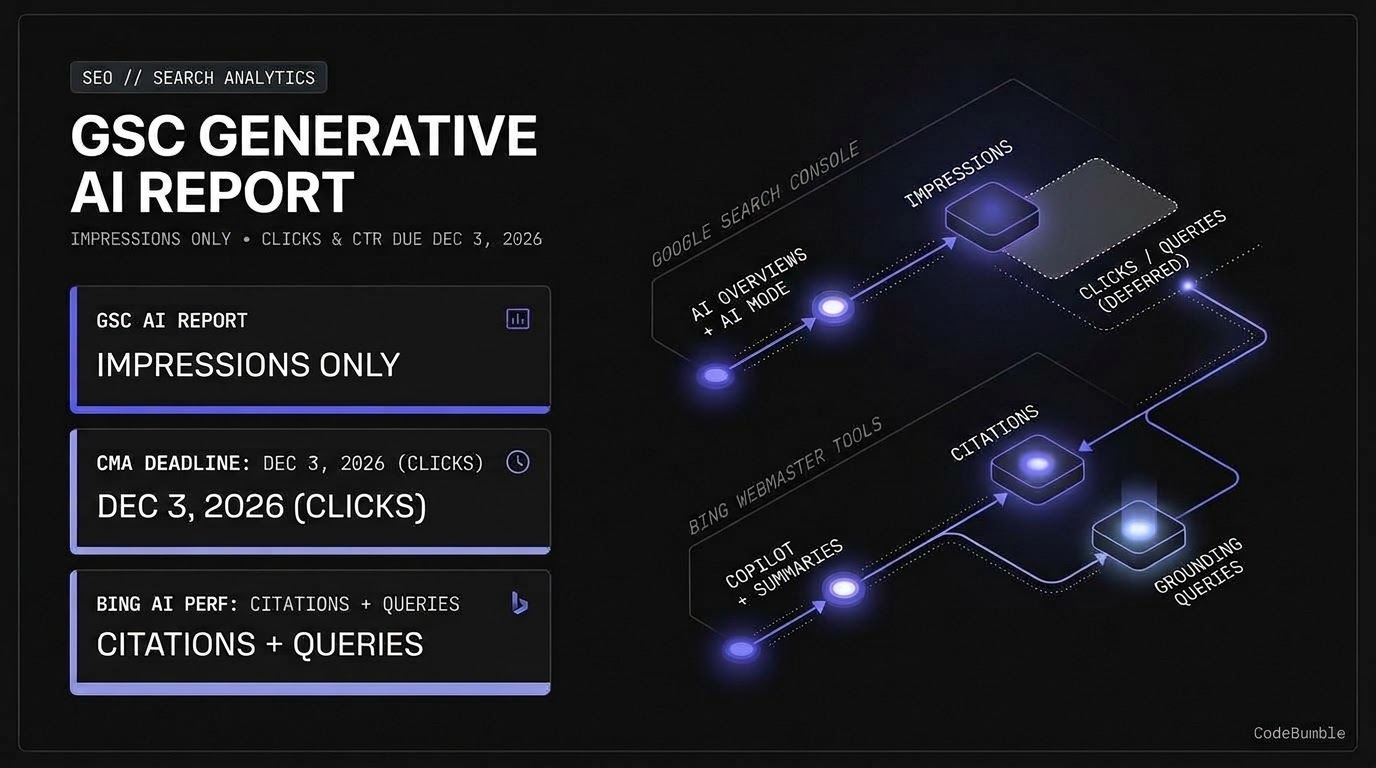
Google's Generative AI report in Search Console has been live for all sites since August 31, 2026—but it still only counts impressions, leaving clicks, CTR, and queries out. With the UK CMA's December 3, 2026 deadline approaching, see how GSC compares to Bing Webmaster Tools and how to audit AI search visibility today.
9 min read
Search Console Generative AI Report: Why Clicks, CTR, and Queries Are Still Missing Before the Dec 3 CMA Deadline
Executive Summary
Since August 31, 2026, Google's Generative AI performance report in Google Search Console (GSC) has been available to websites worldwide, following its initial announcement on June 3, 2026. Yet as fresh November 14–15, 2026 technical analyses from Ewelina Podrez-Siama (Fox Strategy) and Ultralab highlight, the report remains surprisingly spartan: it separates impressions from AI Overviews and AI Mode, but omits clicks, CTR, user queries, and query fan-out.
Even more striking for technical SEOs and data engineers, tests against the Search Console searchAnalytics API on November 14, 2026 confirm that AI-specific search types are not yet exposed programmatically—only web, image, video, news, discover, and googleNews are accepted, while any AI-related type parameter returns HTTP 400. Meanwhile, Google's November 12, 2026 documentation update on identifying Search traffic via Referer headers still offers no separate referrer signal for AI Overviews or AI Mode.
That telemetry gap is about to face a hard regulatory test. On June 3, 2026—the exact day Google announced the GSC Generative AI report—the UK Competition and Markets Authority (CMA) imposed a binding publisher conduct requirement obligating Google to provide separated impressions, clicks, and CTR for generative AI features by December 3, 2026. Until those metrics ship, site owners must combine GSC's impression counts, Bing Webmaster Tools' AI Performance report (which already exposes citations and grounding queries), and server-side or API diagnostics to measure real AI search impact.
What Google's Generative AI Report Shows—and What It Hides
According to Google's official announcement and November 15, 2026 Search Console documentation analysis, the Generative AI report lives under Performance → Search results → Generative AI (or by appending /ai to the Performance report URL if hidden from the sidebar). A parallel Generative AI (Discover) report is rolling out gradually to properties with sufficient AI Discover impressions.
| Telemetry Dimension | GSC Performance → Search results |
GSC Generative AI (Search) |
Bing Webmaster Tools AI Performance |
|---|---|---|---|
| Scope Covered | Classic Search + AI Overviews + AI Mode combined | AI Overviews + AI Mode only | Copilot, Bing AI summaries, select partners |
| Impressions | Yes (blended) | Yes (by page, country, device, date) | Replaced by Citations & Citation Share |
| Clicks & CTR | Yes (blended; cannot isolate AI) | No (deferred until Dec 3, 2026 CMA deadline) | No |
| Queries / Prompts | Standard queries + some leaked AI Mode prompts | No | Yes (sample of grounding queries) |
| Search Type Filter | web, image, video, news |
Web: text-based & Web: multimodal (since Sept 24, 2026) |
Intents, Topics & Topics Portfolio (beta) |
API (searchAnalytics) |
Supported | No (returns HTTP 400 as of Nov 14, 2026) |
N/A |
How Google Counts Generative AI Impressions
In AI Overviews and AI Mode, standard Search Console impression rules apply. As Podrez-Siama notes from Search Console Help documentation, a link inside a carousel or collapsed section generally counts as an impression only once it is scrolled into view or expanded; merely sitting unexpanded in the background of a generated answer does not register. On the chart, Google aggregates by property—meaning two URLs from the same property cited inside a single AI answer still count as one impression.
The Search generative AI Opt-Out Trap
Alongside the report, Google added a Search generative AI control in Search Console Settings with three states: Include (default), Exclude, and Inherit control from parent (for URL-prefix child properties such as /blog/). Per Google's Generative AI optimization guide, excluding a site removes it from AI Overviews, AI Mode, and AI Discover features within a few days without affecting classic organic rankings. However, it does not block AI model training—that requires Google-Extended or the shared __usage_ai-training robots.txt directive.
Technical Mechanics & Architecture
Why AI Search Telemetry Breaks Traditional Analytics Pipelines
Under Google's AI search architecture, AI Overviews and AI Mode rely on Retrieval-Augmented Generation (RAG) and query fan-out—issuing multiple concurrent sub-queries against Google's core Search index to ground a single conversational response. Because the final click still originates from https://www.google.com/, Google Analytics 4 (GA4) classifies AI Overview and AI Mode visits as standard organic Google traffic (not the AI assistant channel), and server logs see only a generic Google Referer.
+-------------------------------------------------------------------------+
|                    USER QUERY IN GOOGLE SEARCH / AI MODE                |
+-----------------------------------+-------------------------------------+
                                    |
                    Query Fan-Out & RAG Grounding
                                    |
        +---------------------------+---------------------------+
        v                                                       v
+-------------------------------+               +-------------------------------+
|  Classic Organic Results      |               |  AI Overviews / AI Mode       |
|  (Standard Search Index)      |               |  (Grounded Citations)         |
+---------------+---------------+               +---------------+---------------+
                |                                               |
                +-----------------------+-----------------------+
                                        |
              +-------------------------+-------------------------+
              |                         |                         |
              v                         v                         v
+--------------------------+ +------------------------+ +-----------------------+
| GSC: Search Results      | | GSC: Generative AI     | | GA4 / Server Logs     |
| * Blended Clicks & CTR   | | * Impressions ONLY     | | * Generic google.com  |
| * Blended Impressions    | | * No Clicks/Queries    | |   Referer (No AI tag) |
| * API: searchAnalytics   | | * No API Support (400) | | * Blended Organic     |
+--------------------------+ +------------------------+ +-----------------------+
Regulatory Pressure: The UK CMA Timeline
The reason GSC's Generative AI report is expected to gain clicks and CTR soon is not purely voluntary product iteration. On June 3, 2026, the UK Competition and Markets Authority (CMA) imposed a binding publisher conduct requirement on Google, mandating transparent engagement metrics for search generative AI features:
- June 3, 2026: CMA imposes publisher conduct requirement; Google announces the Generative AI report the same day.
- August 31, 2026: GSC Generative AI report and exclusion settings roll out to all properties globally.
- December 3, 2026: Six-month CMA compliance deadline takes effect, requiring Google to provide impressions, clicks, and CTR for generative AI features separated from classic Search.
- Around March 3, 2027: Nine-month deadline for page-level grounding controls.
Although the CMA order formally governs the UK market, Google does not maintain separate Search Console feature sets per country, meaning global publishers are expected to receive clicks and CTR separation as well.
Evidence: Real-World AI Impression Share & Data Anomalies
- Early AI Impression Share (<20%): Across client properties analyzed by Fox Strategy where the Generative AI report is populated, total impressions from AI Overviews and AI Mode represent less than 20% of total Search impressions. Classic organic results still drive the majority of Google Search visibility.
- November 2026 Logging Anomaly & Core Update Overlap: According to Google's official Search Console Data Anomalies log, a logging error caused an artificial decrease in reported impressions on the Generative AI performance report from November 9 to November 11, 2026 (affecting data logging only, not live serving). Because Google also began rolling out its November 2026 Core Update on November 10, 2026 (taking up to two weeks) alongside Gemini 4 Hydrogen in Search, Ultralab and Seonix warn teams not to misread Nov 9–11 logging dips as ranking losses.
- Historical YoY Comparison Trap (May 2025 – April 2026): Google's Data Anomalies page also documents a separate logging bug from May 13, 2025 to April 27, 2026 that distorted Search Console impressions, CTR, and average position (while leaving clicks unaffected). Any November 2026 year-over-year comparison against November 2025 must therefore rely on clicks, not impressions or CTR.
- API Limitations: Direct probing of the Search Console
searchAnalyticsendpoint on November 14, 2026 confirmed that passing any AI-specifictypereturns HTTP400(Ultralab).
Technical SEO & Analytics Playbook
To avoid misdiagnosing logging bugs, prepare for the December 3, 2026 CMA metrics rollout, and capture real AI visibility data today, follow this five-step workflow:
- Cross-Check Every Traffic Dip Against Google's Data Anomalies Log: Before escalating an AI impression drop from Nov 9–11, 2026 (or Aug 13–17, 2026), verify Google's Data Anomalies page and confirm whether GA4 organic sessions remained flat.
- Audit Blended Clicks vs. AI Impressions Weekly: Export
Performance → Search resultsalongsidePerformance → Search results → Generative AI(using/aiif missing from the menu). Prioritize updating pages with high Generative AI impressions using explicit HTML<table>comparisons, descriptive image alt text, and unique first-party benchmarks. - Use Bing Webmaster Tools for Grounding Queries: Import your GSC properties into Bing Webmaster Tools and inspect AI Performance to extract the actual grounding queries and Citation Share that Google's current report hides.
- Scope Exclusions via URL-Prefix Properties: Never toggle
Excludeon a root Domain property blindly. If specific sections require opt-out, register a URL-prefix child property (e.g.,/legal/or/premium/) and override only that subtree. - Instrument API Queries Safely: Keep automated
searchAnalyticspipelines restricted to supportedtypevalues (web,image,video,news,discover,googleNews) and annotate dashboards covering May 13, 2025 – April 27, 2026.
Below is a safe, defensive Python validation helper for Search Console API pipelines that prevents HTTP 400 failures and flags known 2026 GSC data-anomaly windows before reporting:
#!/usr/bin/env python3
"""Validate Search Console searchAnalytics parameters and flag 2026 GSC anomaly windows."""
from datetime import date

SUPPORTED_SEARCH_TYPES = frozenset({"web", "image", "video", "news", "discover", "googleNews"})

# Verified from https://support.google.com/webmasters/answer/6211453?hl=en
ANOMALY_WINDOWS = [
    (date(2025, 5, 13), date(2026, 4, 27), "Impressions/CTR/Position distorted; clicks unaffected"),
    (date(2026, 11, 9), date(2026, 11, 11), "Generative AI in Search impressions logging drop only"),
]

def build_safe_query(start: date, end: date, search_type: str = "web") -> dict:
    if search_type not in SUPPORTED_SEARCH_TYPES:
        raise ValueError(
            f"Unsupported search_type '{search_type}'. "
            f"GSC API currently rejects AI types with HTTP 400; use one of {sorted(SUPPORTED_SEARCH_TYPES)}."
        )
    warnings = [
        note for win_start, win_end, note in ANOMALY_WINDOWS
        if start <= win_end and end >= win_start
    ]
    return {
        "startDate": start.isoformat(),
        "endDate": end.isoformat(),
        "type": search_type,
        "anomaly_warnings": warnings,
    }
Frequently Asked Questions (FAQ)
Why can't I see clicks or queries in the Search Console Generative AI report?
As of November 15, 2026, Google's Generative AI report in Search Console tracks impressions only (broken down by page, country, device, date, and text vs. multimodal search). Clicks from AI Overviews and AI Mode remain blended into the standard Performance → Search results report (Podrez-Siama).
When will Google add clicks and CTR to the Generative AI report?
Under the UK CMA's June 3, 2026 publisher conduct requirement, Google faces a December 3, 2026 deadline to provide separated impressions, clicks, and CTR for generative AI search features (Podrez-Siama).
Can I pull Generative AI report data through the Search Console API?
No. Testing on November 14, 2026 confirmed that the searchAnalytics API only accepts web, image, video, news, discover, and googleNews as type values, returning HTTP 400 for AI-specific parameters (Ultralab).
Did the November 9–11, 2026 drop in Generative AI impressions affect real traffic?
No. Google's Data Anomalies in Search Console log confirms that the November 9–11, 2026 drop in the Generative AI in Search report was a data logging error only and did not impact live search serving or traffic.
How does Bing Webmaster Tools' AI Performance report differ from Google's?
Google reports URL impressions in AI Overviews and AI Mode without queries, whereas Bing's AI Performance report provides Citations, Citation Share, Topics Portfolio, and a sample of actual grounding queries used by Copilot and Bing AI summaries (Podrez-Siama).
Sources
- Ewelina Podrez-Siama — Search Console Generative AI Report: What It Shows (and Doesn't) (November 14–15, 2026)
- Google Search Console Help — Data anomalies in Search Console (Updated November 2026)
- Google Search Central — Optimizing your website for generative AI features on Google Search
- Google Search Central Blog — Introducing Search Generative AI performance reports in Search Console (June 3, 2026)
- Ultralab — Gemini 4 Hydrogen in Google Search: 5 SEO, GEO and AEO Takeaways (November 14, 2026)
- Seonix — Search Console Data Anomalies: Glitch or Real Drop? (November 14, 2026)