

Security
Inside Anthropic's Zero Trust Model for AI Agents: Tiers, Controls, and Analyst Trade-Offs
Anthropic's 36-page Zero Trust for AI Agents framework adapts NIST SP 800-207 for autonomous systems that invoke tools, hold memory, and coordinate across sessions. Independent security analysts at Safeguard and Permit.io recently mapped its three tiers and nine control families against real infrastructure boundaries. Here is how the "impossible versus tedious" test reshapes agent identity, sandboxing, and MCP authorization.
9 min read
Inside Anthropic's Zero Trust Model for AI Agents: Tiers, Controls, and Analyst Trade-Offs
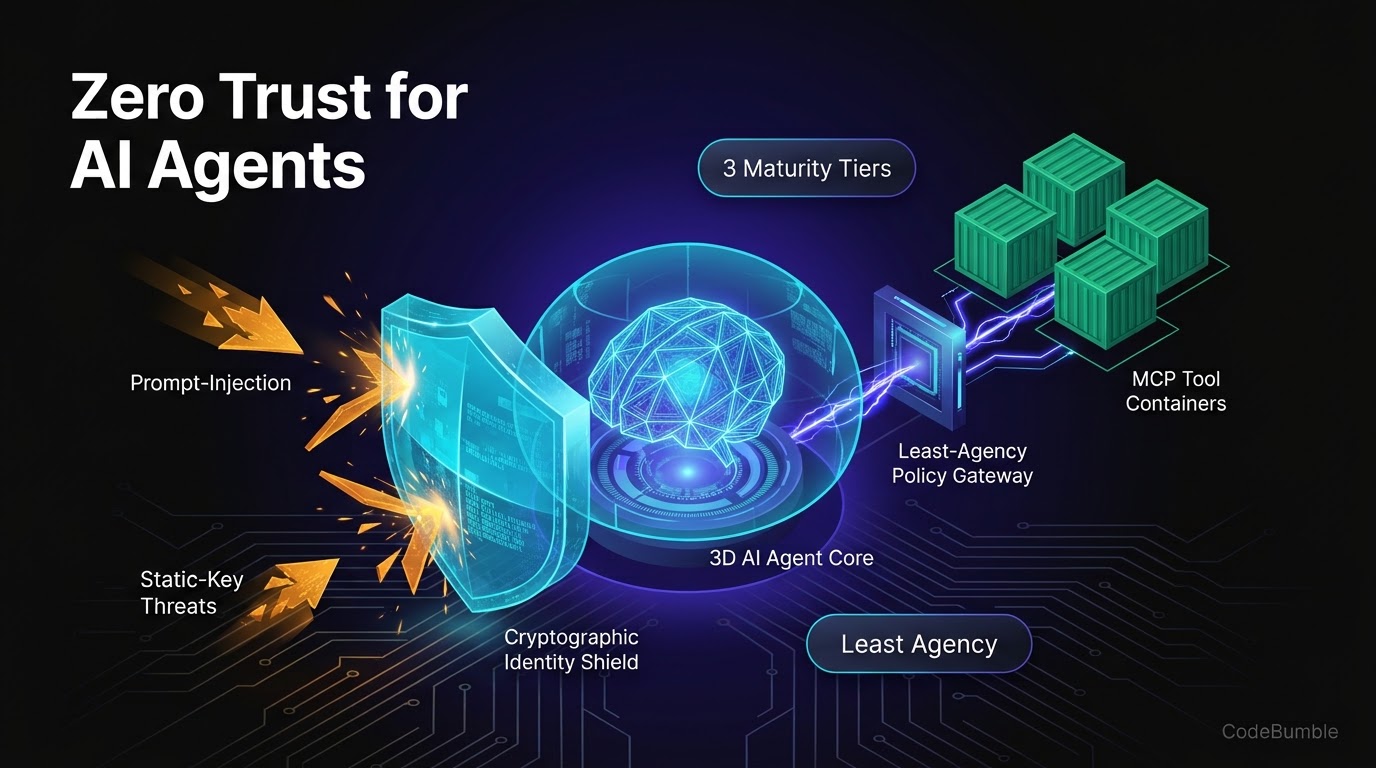
Executive Summary
- Core Defensive Framework: Anthropic's 36-page Zero Trust for AI Agents framework (guide, PDF) adapts NIST SP 800-207 for autonomous AI systems that interpret goals, invoke Model Context Protocol (MCP) tools, persist memory, and coordinate across multi-agent workflows.
- Target Architecture: Organizes defensive controls into three maturity tiers (
Foundation,Enterprise,Advanced) across nine control families and an eight-phase implementation workflow, anchored by OWASP's principle of Least Agency. - Analyst Consensus (November 2026): Independent technical analyses published between November 20 and November 22, 2026 by Permit.io, Safeguard, and explainx.ai characterize the framework as a practical enterprise blueprint—while stressing that roughly half of its controls belong to underlying cloud, PKI, and hypervisor infrastructure rather than standalone AI security tools.
- Primary Trade-Off: Eliminating static API keys and enforcing per-action authorization, gVisor/microVM sandboxing, and short-lived cryptographic identities raises operational complexity and requires tight coordination between identity providers, platform teams, and runtime gateways.
Trust Model & Architecture
Traditional perimeter security assumes that workloads inside a corporate network or VPC can be trusted. Autonomous AI agents break that assumption in two ways: they run on infrastructure exposed to AI-accelerated offense, and they make multi-step tool calls without a human approving every action. Anthropic's framework extends the three pillars of NIST SP 800-207—never trust and always verify, assume breach, and least privilege—with Least Agency: restricting not only what data an agent can access, but what each tool can do, how often it can run, and where it can reach.
The "Impossible vs. Tedious" Design Test
Every tier recommendation in the framework is filtered through a single architectural question: does a control make an attack impossible, or merely tedious?
- Friction-only controls fail: Rate limits, obscure ports, extra network hops, and SMS MFA only slow down human operators. As Permit.io and Safeguard note, an AI-assisted attacker with near-zero per-attempt cost and unlimited patience grinds through friction-based defenses.
- Capability-removing controls survive: Cryptographically rooted agent identities, short-lived tokens measured in minutes, hardware-bound credentials (HSM/TPM), and absent network routes remove the attack path rather than throttling it. Consequently, Anthropic's Foundation tier explicitly bans static API keys and shared service-account passwords, treating them as already compromised.
Trust-Boundary & Data-Flow Architecture
flowchart LR
    User["User / Trigger Event"] -->|Untrusted Input| Sanitizer["Input Validation & Spotlighting"]
    Sanitizer --> Agent["Agent Runtime (Unique Cryptographic ID)"]
    subgraph Sandbox["Isolated Execution Boundary (gVisor / MicroVM / Confidential Compute)"]
        Agent -->|"Short-Lived OAuth2 / mTLS Token"| Gateway["Policy Gateway (Least Agency: RBAC / ABAC / Continuous)"]
    end
    Gateway -->|Allow / Redact| MCP["Vetted MCP Tool Server"]
    Gateway -->|High-Risk Action| HITL["Human-in-the-Loop Approval"]
    Gateway -->|Deny / Anomaly| Revoke["Session Termination & SIEM Audit Trail"]
    MCP --> Data["Enterprise APIs & Databases"]
The Three Maturity Tiers Across Nine Control Families
Anthropic structures implementation across Foundation (minimum viable security with a raised floor), Enterprise (target posture for most organizations running multiple agents), and Advanced (baseline for regulated or high-risk environments):
| Control Family | Foundation (Raised Floor) | Enterprise (Target Standard) | Advanced (High-Risk Baseline) |
|---|---|---|---|
| 1. Agent Identity | Unique cryptographic IDs in all logs | X.509 certificates + lifecycle rotation | HSM/TPM-backed identity + remote attestation |
| 2. Service Auth | Short-lived OAuth 2.0 tokens (minutes) | Mutual TLS (mTLS) with certificate pinning | Hardware-bound credentials with attested issuance |
| 3. Access Control | Deny-by-default RBAC + static least-privilege | Context-aware ABAC + dynamic task elevation | Continuous per-action authz + JIT/JEA auto-expiry |
| 4. Resource Boundaries | Identity-based isolation + network segmentation | Sandboxed containers with syscall filtering (e.g., gVisor) |
Hardware isolation (AMD SEV, Intel TDX, microVMs) |
| 5. Observability & Audit | Tool/data logs + request IDs | Immutable append-only logs + OpenTelemetry tracing | Real-time SIEM streaming + full reasoning provenance |
| 6. Behavioral Monitoring | Manual baselines + automated first-pass triage | Automated statistical baselines + session termination | Continuous drift detection + orchestrated SOAR |
| 7. Input / Output Controls | Schema/length checks + PII redaction | Injection pattern filtering + semantic output checks | Constitutional classifiers, spotlighting + HITL approval |
| 8. Integrity & Recovery | Version-controlled configs + tested rollback | Signed configs + automated health-check rollback | Attested immutable images + self-healing circuit breakers |
| 9. AI Governance | Acceptable-use policy + Shadow AI coverage | Cross-functional AI governance committee | Automated CI/CD policy gates + compliance metrics |
What Researchers & Analysts Say
Between November 20 and November 22, 2026, independent security engineering teams published detailed evaluations mapping Anthropic's 36-page framework against production tooling and infrastructure boundaries.
1. The Infrastructure vs. Security-Tooling Split
In its November 22, 2026 architectural breakdown, Safeguard characterized the guide as "the most practical public blueprint we have seen for putting autonomous agents into a company without handing them the keys," while drawing a hard line between what security software can enforce and what must live in underlying infrastructure:
- Infrastructure primitives (cloud, PKI, hypervisor, IdP): Hardware-bound credentials (HSM/TPM), certificate authorities and mTLS pinning, syscall-filtered sandboxes (
gVisoror microVMs), and just-in-time (JIT) token expiry. Safeguard noted that if a third-party security tool claims to provide hardware attestation or sandboxing above the workload layer, that guarantee shrinks to a policy promise rather than cryptographic proof. - Security tooling layer: Software bill of materials (SBOM) and AI-BOM inventory, install-time package firewalls, runtime MCP tool-call gateways, audit trails, and compliance evidence mapping (SOC 2, GDPR, HIPAA, EU AI Act).
2. Why RBAC Stops at Foundation—and Where Model-Graded Checks Fall Short
In its November 20, 2026 review, Permit.io highlighted that traditional session-start RBAC is only a Foundation starting posture. Because tool chaining and confused-deputy delegation happen mid-session, Enterprise and Advanced deployments require per-call authorization (ABAC or ReBAC) that evaluates the initiating human, the agent's identity, the target tool's risk level, and delegation chains at every hop.
At the same time, Permit.io documented an important caveat regarding behavioral guardrails: while LLM-based judges can score calls for intent drift or prompt injection, model-graded checks are probabilistic and can still miss crafted payloads. Deterministic policy enforcement at the MCP gateway and OS-level sandboxing remain mandatory backstops.
3. Operational Speed and "Automate Bookkeeping, Keep Humans on Decisions"
Both explainx.ai and Permit.io emphasized Anthropic's rule for defensive operations (Part V): automate incident bookkeeping—evidence collection, artifact capture, alert enrichment, and postmortem drafting—while keeping human operators on containment, disclosure, and customer communication decisions. Before investing in complex ML anomaly detectors, Anthropic recommends instrumenting two baseline metrics: dwell time (time from anomaly to human awareness) and alert coverage (percentage of alerts investigated), targeting under-one-hour detection for critical agentic systems.
4. Quantified Mitigation Context
Anthropic's framework cites Microsoft Research showing that spotlighting—clearly delimiting untrusted external content from system instructions—reduced indirect prompt injection success from over 50% to under 2% in test evaluations, while also referencing Anthropic research demonstrating that as few as 250 malicious documents can backdoor models ranging from 600 million to 13 billion parameters.
Hardening & Implementation Blueprint
Anthropic pairs its nine control families with an eight-phase implementation workflow: (1) identify regulatory and business requirements, (2) manage supply-chain risk (SBOM/AI-BOM and OpenSSF Scorecard), (3) define agent boundaries and blast radius, (4) defend against prompt injection, (5) enforce least-agency tool access, (6) inject short-lived credentials at runtime, (7) isolate and validate agent memory, and (8) measure dwell time and behavioral conformance.
Safe Least-Agency Policy Example (MCP Tool Boundary)
Below is a declarative, safe policy pattern illustrating how an organization enforces Least Agency at an MCP gateway—allowing read-only order lookups while blocking unbounded queries, schema writes, and unapproved outbound egress:
# Example Least-Agency Policy for a Support Agent MCP Boundary
version: "1.0"
agent_identity:
  id: "agent-support-triage-01"
  auth_method: "oauth2-short-lived-jwt"
  max_token_ttl_seconds: 300
  require_human_delegation_claim: true

tool_permissions:
  default_action: "deny"
  rules:
    - server: "orders-mcp"
      tool: "get_order_by_id"
      action: "allow"
      constraints:
        require_exact_param: "order_id"
        redact_fields: ["ssn", "payment_token", "other_customer_email"]
    - server: "orders-mcp"
      tool: "list_all_orders"
      action: "deny"
    - server: "ticketing-mcp"
      tool: "draft_reply"
      action: "allow"
    - server: "ticketing-mcp"
      tool: "issue_refund"
      action: "require_human_approval"

network_egress:
  default_action: "deny"
  block_metadata_endpoints: true   # e.g., 169.254.169.254
  allowlist:
    - "https://api.internal.example/orders"
Operational Overhead & Rollout Gotchas
- Latency & Token Overhead: Evaluating per-action ABAC/ReBAC policies adds deterministic sub-10ms gateway overhead, whereas running secondary LLM input/output classifiers adds noticeable latency and token cost. Apply deterministic schema/policy checks to every call, and reserve model-graded checks for untrusted external ingestion.
- Approval Fatigue: Placing a human-in-the-loop gate on every tool call trains reviewers to rubber-stamp requests. Restrict manual approvals to high-blast-radius mutations (refunds, schema changes, production deploys, external sends).
- Shared Credentials Across Multi-Agent Chains: Splitting one workflow into planner and worker agents that share a single service-account token creates multi-agent complexity without compartmentalization. Each agent instance must carry its own cryptographic identity and propagate delegation bounds at every hop.
- Auto-Updates vs. Signature Verification: Anthropic advises enabling automatic updates where an automated update outage is acceptable—pairing auto-updates with mandatory cryptographic signature verification so patch delay does not become the primary vulnerability.
Frequently Asked Questions
What is "Least Agency" in Anthropic's Zero Trust framework?
Least Agency extends classic least privilege to autonomous agents. Instead of only restricting what data an identity can read, Least Agency limits what each tool can do, how often it can be invoked, and which destinations it can reach—such as allowing an email summarizer to read messages while blocking send and delete calls.
Are static API keys allowed at the Foundation tier?
No. Anthropic's Foundation tier explicitly rules out static API keys and shared service-account passwords, stating they should be treated as already compromised. Even initial deployments require short-lived, narrowly scoped tokens (with lifetimes measured in minutes) issued by an identity provider.
Which maturity tier should most enterprises target?
Anthropic recommends that most organizations with meaningful production deployments target the Enterprise tier—which adds X.509 certificates with mTLS pinning, ABAC authorization, sandboxed execution (gVisor or restricted containers), immutable append-only audit logs, and automated containment. Foundation is the entry floor for small teams, while Advanced targets high-risk or heavily regulated environments.
Can an MCP gateway or security platform alone satisfy the framework?
No. As Safeguard and Permit.io both note, security platforms cover inventory (SBOM/AI-BOM), runtime tool-call policies, and audit trails, while hardware-bound credentials (HSM/TPM), certificate authorities, kernel/hypervisor sandboxes, and just-in-time token brokers must be provided by your cloud and identity infrastructure.
How does the framework handle AI-accelerated security operations?
Part V recommends using defensive AI agents to automate incident bookkeeping—collecting artifacts, enriching alerts, and drafting postmortems—while keeping human responders in charge of containment, disclosure, and customer communications.
Sources
- Anthropic (Claude Resources) — Applying Zero Trust to agentic AI services (Primary Guide): https://claude.com/resources/guides/zero-trust-for-ai-agents/applying-zero-trust-to-agentic-ai-services (Companion article published May 27, 2026; full 36-page PDF: Claude-eBook-Zero-Trust-for-AI-Agents-05182026.pdf)
- NIST — SP 800-207: Zero Trust Architecture: https://www.nist.gov/publications/zero-trust-architecture (Published August 10, 2020)
- Safeguard Security Team — Zero Trust for AI Agents: Anthropic's Framework Explained, and Where a Security Platform Fits: https://safeguard.sh/resources/blog/zero-trust-for-ai-agents-anthropic-framework-explained-and-how-a-security-platform-maps-to-it (Published November 22, 2026)
- Permit.io (Or Weis) — Anthropic's Zero Trust for AI Agents Guide: We Read It So You Don't Have To: https://www.permit.io/blog/zero-trust-for-ai-agents-anthropic-guide-highlights (Published November 20, 2026)
- explainx.ai — Zero Trust for AI Agents: Anthropic's 3-Tier Guide: https://explainx.ai/blog/anthropic-zero-trust-ai-agents-enterprise-framework-november-2026 (Published November 22, 2026)