

Security
NIST to Revise SP 800-52 Rev. 2: TLS 1.3 RFC 9846 Alignment, Post-Quantum Support, and GAO Readiness Reality Check
On November 19, 2026, NIST confirmed it will revise Special Publication 800-52 Rev. 2 to align with TLS 1.3 (RFC 9846), add post-quantum algorithms, raise minimum security to 128 bits, and downgrade TLS 1.2 from "should" to "may"—even as a GAO audit warns federal agencies are behind on the 2030 PQC deadline.
9 min read
NIST to Revise SP 800-52 Rev. 2: TLS 1.3 RFC 9846 Alignment, Post-Quantum Support, and GAO Readiness Reality Check
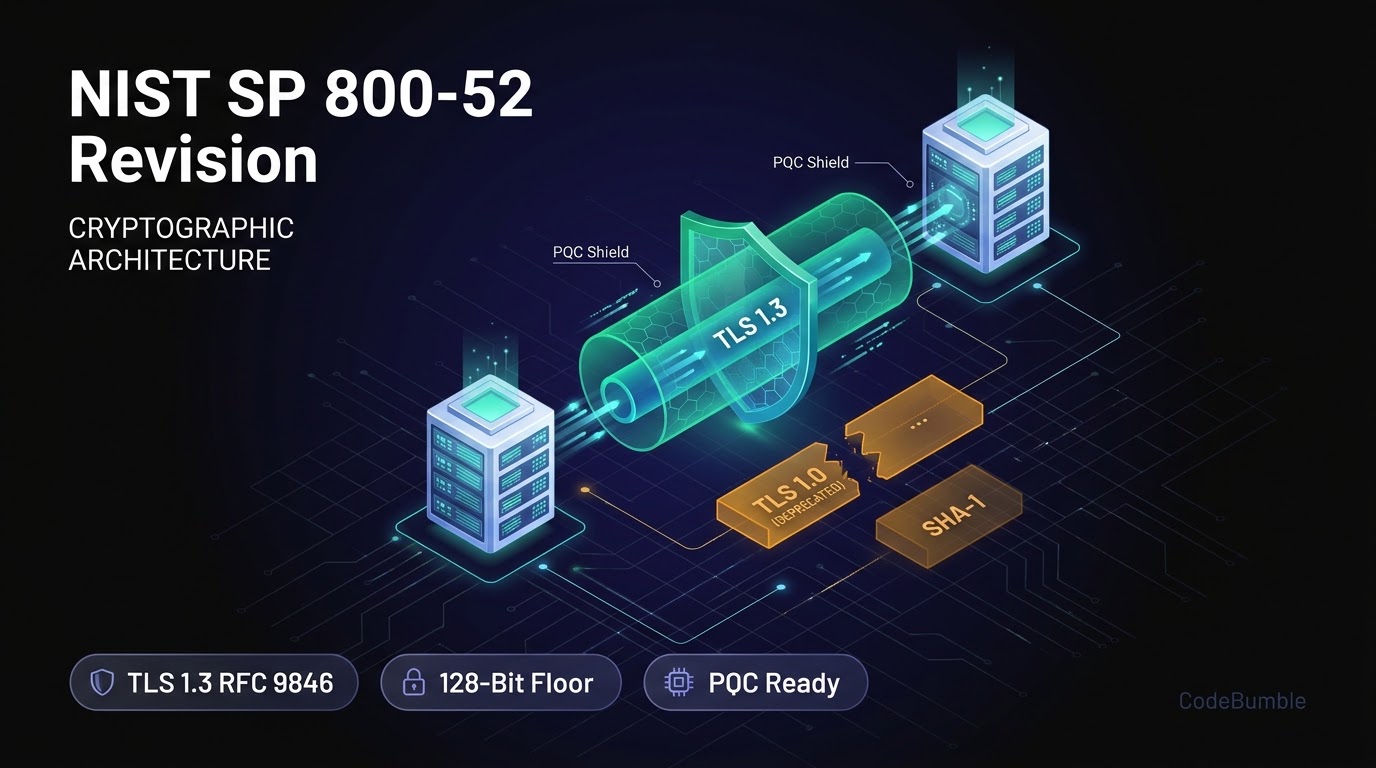
Executive Summary
- Core Defensive Update (November 19, 2026): The National Institute of Standards and Technology (NIST) formally announced on NIST CSRC that it will revise Special Publication (SP) 800-52 Rev. 2 (Guidelines for the Selection, Configuration, and Use of Transport Layer Security (TLS) Implementations, 2019) without further pre-draft comment calls after public feedback aligned with its modernization plan.
- Target Architecture & Protocol Shift: The planned revision aligns federal and enterprise TLS guidance with TLS 1.3 (
RFC 9846), adds support for post-quantum cryptography (PQC) algorithms, raises the minimum security floor to 128 bits, mandates Authenticated Encryption with Associated Data (AEAD) modes, downgrades TLS 1.2 from "should" to "may," and disallows TLS 1.0 and TLS 1.1. - Analyst & Auditor Reality Check: While NIST's recent PQC transition report (NIST IR 8547, October 27, 2026) sets a December 31, 2030 deadline to mitigate quantum risks, a U.S. Government Accountability Office (GAO) evaluation of 24 major agencies reported by Dark Reading (November 16, 2026) warns that agencies remain unprepared and only half fully agreed with GAO's recommendations.
- Confidence Note: As SITG Consulting noted on November 21, 2026, NIST has not yet published the draft revision text, so specific PQC hybrid extension parameters and CMVP cutoff dates remain pending until the draft drops.
Trust Model and Cryptographic Architecture
Transport Layer Security (TLS) is the primary confidentiality and authenticity boundary for data in transit across cloud services, APIs, and government networks. Under the 2019 edition of SP 800-52 Rev. 2, federal servers were required to support TLS 1.2 with FIPS-approved cipher suites and to enable TLS 1.3 by January 1, 2024. However, two structural shifts have rendered the 2019 baseline insufficient for modern threat models:
- Harvest Now, Decrypt Later (HNDL) Adversaries: Nation-state and advanced threat actors intercept and archive encrypted TLS sessions today—particularly static or non-quantum-resistant key exchanges—with the expectation that cryptanalytically relevant quantum computers will decrypt that traffic later (Dark Reading).
- Legacy TLS 1.2 Downgrade & Key-Exchange Weaknesses: TLS 1.2 deployments that still permit RSA key exchange (RSA KEX), static key exchange, SHA-1, or non-AEAD ciphers lack forward secrecy or expose padding-oracle and downgrade surfaces.
flowchart TD
    A[Client Initiates TLS Handshake] --> B{Negotiated Protocol Version?}
    B -->|TLS 1.0 / TLS 1.1| C[Rejected: Disallowed in SP 800-52 Revision]
    B -->|TLS 1.2| D{CMVP Justified & AEAD >= 128-bit?}
    D -->|SHA-1 / DSA / RSA KEX / Static KEX| E[Deprecated / Disallowed]
    D -->|ECDHE + AEAD| F[Permitted Only as 'May' Fallback]
    B -->|TLS 1.3 RFC 9846| G[Mandatory AEAD + >= 128-bit Security]
    G --> H[Post-Quantum / Hybrid Key Exchange Extensions]
    H --> I[Encrypted Session with Forward Secrecy & HNDL Mitigation]
Planned Architectural Changes in the SP 800-52 Revision
According to the November 19, 2026 NIST CSRC announcement, the revised publication will incorporate both policy-level protocol deprecations and cryptographic enforcement rules:
- Protocol Version Policy & CMVP Enforcement: Servers will transition from "should" support TLS 1.2 to "may" support TLS 1.2, while TLS 1.0 and TLS 1.1 will not generally be allowed. Crucially, NIST's Cryptographic Module Validation Program (CMVP) will define a formal timeline after which cryptographic modules must provide a "strong justification" to retain TLS 1.2 in general and an "exceptional justification" to include TLS 1.0 or TLS 1.1 in non-governmental servers.
- TLS 1.3 (
RFC 9846) Alignment: The revision updates references from the older TLS 1.3 specification toRFC 9846and elaborates on TLS 1.3 supported algorithms negotiated inside protocol extensions. - 128-Bit Floor and Mandatory AEAD: Minimum cryptographic strength rises to 128 bits of security, and symmetric encryption and authentication guidance will require AEAD modes (such as AES-GCM or ChaCha20-Poly1305 where FIPS-validated), eliminating legacy CBC-mode constructions.
- TLS 1.2 Cipher Pruning: Cipher suites relying on
SHA-1,DSA, static key exchange, orRSA KEX(which lacks forward secrecy) will be deprecated or disallowed. - Post-Quantum Algorithm Support & Lifecycle Controls: The revision will add support for post-quantum algorithms alongside updated guidance on certificate profiles, certificate revocation, session resumption and early data (
0-RTT), and supported TLS extensions.
What Researchers and GAO Analysts Say
While NIST's roadmap establishes clear cryptographic targets, independent oversight and governance analysts highlight a wide gap between written standards and production readiness.
GAO's Assessment of Federal Readiness
In a report examined by Dark Reading (November 16, 2026), the U.S. Government Accountability Office (GAO) audited cryptographic inventories, funding assessments, and migration planning across all 24 agencies covered by the 1990 Chief Financial Officers (CFO) Act—including NASA, the Nuclear Regulatory Commission, and the Social Security Administration. GAO's conclusion was blunt, titling a chapter: "Agencies Have Not Fully Implemented Preparatory Practices for Addressing Quantum Cyber Threats."
Key findings from the GAO review underscore the operational friction facing defenders:
- Incomplete Buy-In: Only half of the 24 audited agencies fully agreed with GAO's PQC readiness recommendations; the remaining agencies pushed back, hedged, or failed to respond.
- Cryptographic Talent & Legacy Debt: GAO attributed missed milestones in part to a shortage of specialized cryptography and cybersecurity engineering talent, warning that legacy systems incapable of software-only upgrades may require full hardware or platform replacement before the December 31, 2030 mitigation deadline.
- Baseline Hygiene Backlog: Beyond quantum readiness, GAO noted that out of more than 4,400 cybersecurity recommendations issued since 2010 (including 48 priority recommendations), over 730 remained unimplemented as of February 2026.
Governance Analysts on Pending Draft Specifics
In its November 21, 2026 governance digest, SITG Consulting emphasized that while post-quantum support and CMVP module timelines are now explicitly on NIST's revision list, "no draft has been released, so the post-quantum provisions are not yet known." For security architects, this means planning around crypto-agility—ensuring TLS terminators, load balancers, and PKI pipelines can swap key-exchange groups and certificate chains without architectural rewrites once the draft revision specifies exact PQC parameters.
Hardening and Implementation Blueprint
Security and platform teams do not need to wait for the final SP 800-52 Rev. 3 text to eliminate the cipher suites and protocol versions NIST is phasing out. The table below contrasts the 2019 Rev. 2 baseline against the November 19, 2026 revision plan:
| Security Control | SP 800-52 Rev. 2 (2019) | Planned Revision (Nov 19, 2026) | Immediate Hardening Action |
|---|---|---|---|
| TLS 1.3 Support | Required by Jan 1, 2024 (RFC 8446) |
Aligned with RFC 9846 + extension negotiation |
Enable TLS 1.3 across all edge proxies and internal mTLS meshes |
| TLS 1.2 Support | "Should" support with FIPS suites | "May" support; CMVP strong justification timeline | Audit clients; restrict TLS 1.2 to ECDHE + AEAD only |
| TLS 1.0 / 1.1 | Not allowed for gov servers | Generally disallowed; CMVP exceptional justification | Disable TLSv1 and TLSv1.1 on all listeners immediately |
| Symmetric Encryption | FIPS-approved suites | AEAD modes required; min 128 bits security | Remove CBC suites, SHA-1, DSA, static KEX, and RSA KEX |
| Post-Quantum (PQC) | Not included | PQC algorithm support added | Inventory TLS endpoints & test hybrid key exchange in staging |
| Session Resumption | Legacy Rev. 2 guidance | Updated resumption & early data (0-RTT) rules |
Disable 0-RTT early data on state-changing APIs to prevent replay |
Safe Hardening Configuration Example (NGINX / OpenSSL)
For ingress controllers, reverse proxies, and API gateways, the following baseline configuration enforces TLS 1.3 (RFC 9846 AEAD suites), restricts optional TLS 1.2 fallback strictly to forward-secret AEAD ciphers with at least 128-bit security, and disables 0-RTT early data replay exposure:
# Hardened TLS Ingress Baseline aligned with NIST SP 800-52 Rev. 2 Revision Plan
server {
    listen 443 ssl http2;
    server_name api.example.internal;

    # Disallow TLS 1.0 and 1.1; prefer TLS 1.3 (TLS 1.2 only if legacy clients require it)
    ssl_protocols TLSv1.3 TLSv1.2;

    # TLS 1.2: AEAD + ECDHE only (no RSA KEX, no SHA-1, no CBC, no static KEX)
    ssl_ciphers 'ECDHE-ECDSA-AES256-GCM-SHA384:ECDHE-RSA-AES256-GCM-SHA384:ECDHE-ECDSA-AES128-GCM-SHA256:ECDHE-RSA-AES128-GCM-SHA256';
    ssl_prefer_server_ciphers off;

    # TLS 1.3 AEAD suites (>= 128-bit security)
    ssl_conf_command Ciphersuites TLS_AES_256_GCM_SHA384:TLS_CHACHA20_POLY1305_SHA256:TLS_AES_128_GCM_SHA256;

    # Disable 0-RTT early data to prevent replay attacks on non-idempotent endpoints
    ssl_early_data off;

    # Enforce HSTS and OCSP stapling (monitor certificate revocation updates)
    add_header Strict-Transport-Security "max-age=63072000; includeSubDomains" always;
    ssl_stapling on;
    ssl_stapling_verify on;
}
Operational Overhead and Migration Trade-Offs
- CMVP Validation Lag: Regulated environments that must run FIPS 140-3 / CMVP-validated cryptographic modules should expect a lag between NIST publishing the draft revision and vendors shipping validated modules that support PQC key exchange and drop legacy TLS 1.2 algorithms.
- Handshake & Certificate Size Overhead: Post-quantum key exchange and signature schemes carry larger public keys and signatures than classical ECDHE/ECDSA, which can increase TLS handshake packet counts and affect UDP/QUIC MTU fragmentation or embedded IoT clients with constrained buffers.
- Cryptographic Inventory First: Before enforcing a strict TLS 1.3-only cutover, run passive telemetry on load balancers to identify legacy B2B partners or internal cron jobs still negotiating TLS 1.2 with RSA key exchange, and migrate those clients before CMVP deadlines take effect.
Frequently Asked Questions
What did NIST announce on November 19, 2026 regarding SP 800-52 Rev. 2?
NIST announced on CSRC that it will formally revise SP 800-52 Rev. 2 without requesting further pre-draft comments, aligning the standard with TLS 1.3 (RFC 9846), adding post-quantum algorithm support, requiring AEAD modes, and raising minimum security to 128 bits.
Is TLS 1.2 completely banned in the planned SP 800-52 revision?
Not immediately, but it is downgraded. Servers "may" support TLS 1.2 rather than "should" support it, weak TLS 1.2 cipher suites (SHA-1, DSA, static KEX, RSA KEX) are deprecated or disallowed, and the CMVP will set a timeline requiring strong justification to include TLS 1.2 in cryptographic modules.
Has NIST published the exact post-quantum TLS cipher suites in the new draft?
No. As of November 21, 2026, NIST has only published the revision decision and scope list; the draft text itself has not yet been released for public comment.
What did the GAO report find about federal post-quantum readiness?
According to Dark Reading, GAO audited 24 CFO Act agencies and found they have not fully implemented preparatory practices for quantum cyber threats, with only half of the agencies fully agreeing with GAO's recommendations ahead of the December 31, 2030 deadline.
What should AppSec and platform teams change in their TLS configs today?
Disable TLS 1.0 and TLS 1.1, remove all non-AEAD and non-forward-secret TLS 1.2 cipher suites (such as RSA KEX and SHA-1), enforce TLS 1.3 as the primary protocol, disable 0-RTT early data on state-changing routes, and complete a cryptographic inventory of all TLS endpoints.
Sources
- TLS | NIST Will Revise SP 800-52 Rev. 2 — NIST CSRC — November 19, 2026
- CSRC Updates 2026 (including NIST IR 8547 Transition to PQC Standards) — NIST CSRC — November 19, 2026
- NIST Finalizes Post-Quantum Cryptography Guidance, GAO Offers a Reality Check — Dark Reading — November 16, 2026
- PQC Governance Digest: Cut-off 20 November 2026 — SITG Consulting — November 21, 2026