

Engineering
LSM-Tree Storage Engine Architecture: Compaction Mechanics, Write Amplification, and NVMe Kernel Bypass
A rigorous systems engineering analysis of Log-Structured Merge-tree (LSM) storage architectures: exploring MemTable lock-free skiplists, Write-Ahead Logs, SSTable block formats, Leveled vs. Tiered compaction write amplification trade-offs, and modern NVMe io_uring kernel-bypass storage engines.
12 min read
LSM-Tree Storage Engine Architecture: Compaction Mechanics, Write Amplification, and NVMe Kernel Bypass
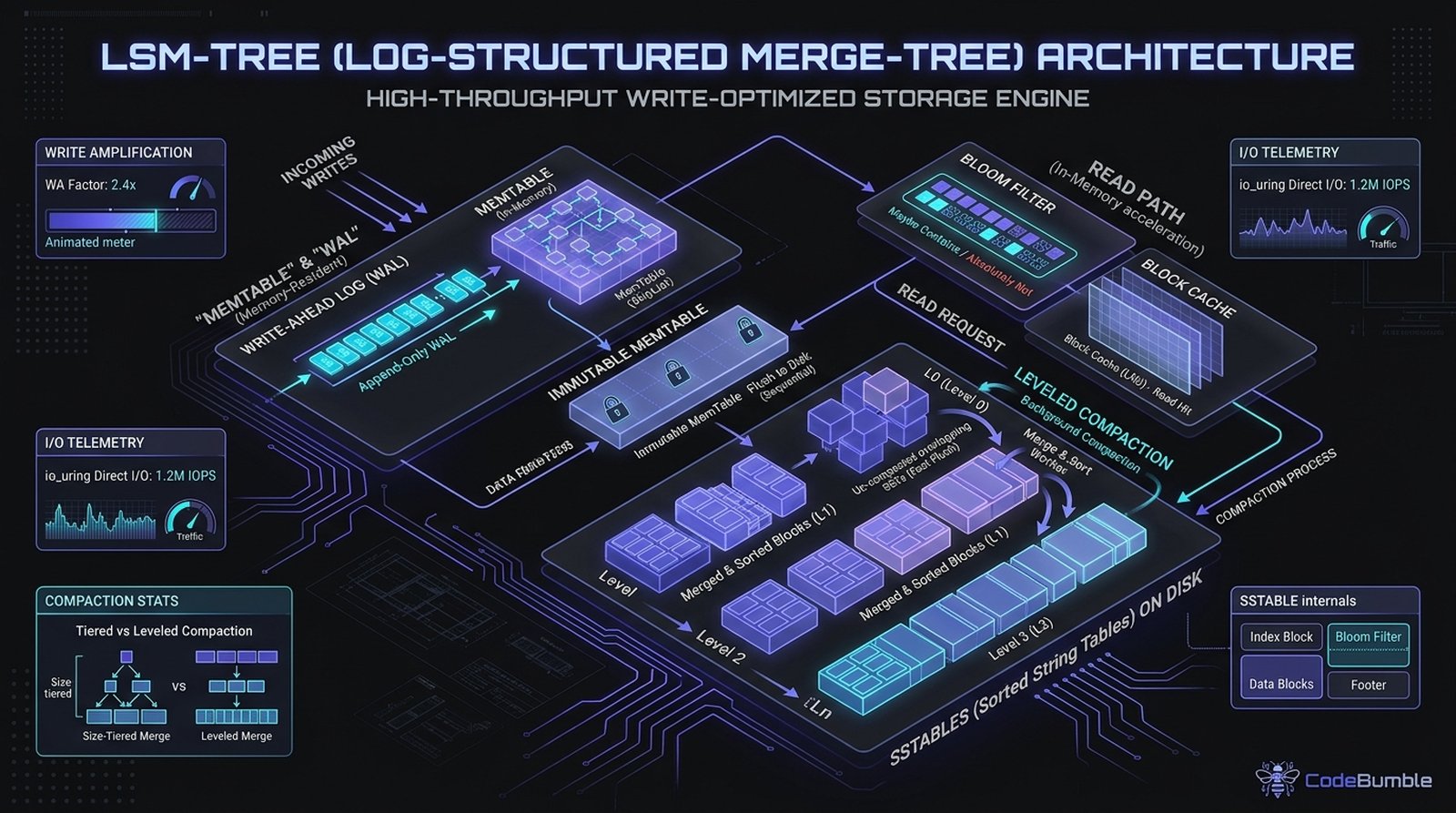
In distributed databases and key-value stores—such as RocksDB, Apache Cassandra, ScyllaDB, CockroachDB, and SurrealDB—traditional B-Tree storage engines encounter severe physical limits under write-heavy ingestion. B-Trees execute in-place updates across fixed 8KB–16KB pages. Under random key distributions, in-place updates cause random write penalties, page splits, and heavy write amplification (WA) that degrade SSD endurance.
The Log-Structured Merge-tree (LSM-tree) resolves this imbalance by transforming random writes into sequential appends. By batching mutations in memory before flushing immutable structures to persistent storage, LSM architectures maximize flash write bandwidth while deferring sorting to background compaction.
Operating production LSM engines requires balancing the RUM Conjecture trade-off space—Read amplification, Update (write) amplification, and Memory overhead. With PCIe 5.0/6.0 NVMe drives delivering millions of IOPS at microsecond latencies, kernel context switching, VFS page cache locks, and compaction stall bubbles now define the primary performance frontier.
+---------------------------------------------------------------------------------------------------+
|                     END-TO-END LSM-TREE HARDWARE & LOGICAL PIPELINE ANATOMY                       |
+---------------------------------------------------------------------------------------------------+
|  [Client Ingestion: Put(Key, Value)] ===> [Concurrent Write Buffer Manager]                       |
|        |                                                    |                                     |
|        v (Synchronous Append)                               v (Atomic In-Memory Insert)           |
|  [Write-Ahead Log (WAL)]                       [Active MemTable (Lock-Free SkipList)]             |
|  - Append-only, Direct I/O                     - Concurrent point lookups                         |
|  - Crash recovery durability                   - Bounded memory footprint (e.g. 64MB)              |
|                                                             | (Threshold Exceeded)                |
|                                                             v                                     |
|                                                [Immutable MemTable (Read-Only)]                   |
|                                                             | (Sequential Flush)                  |
|                                                             v                                     |
|  [LEVEL 0 (L0) SSTABLES: Overlapping Key Ranges, Direct Flush Output]                             |
|  - SSTable 0: (A..M)           - SSTable 1: (C..Z)            - SSTable 2: (E..T)                 |
|                                                             | (Leveled Compaction Merge Sort)     |
|                                                             v                                     |
|  [LEVEL 1 (L1) SSTABLES: Partitioned, Non-Overlapping Key Ranges (Strict Key Ordering)]           |
|  - SSTable L1-A: (A..D)        - SSTable L1-B: (E..H)         - SSTable L1-C: (I..L)              |
|                                                             | (Cascade Compaction: 10x Ratio)     |
|                                                             v                                     |
|  [LEVEL 2 (L2) SSTABLES: High-Density NVMe Blocks with Block Cache & Bloom Filters]               |
|  - SSTable L2-A: (A..B)        - SSTable L2-B: (C..D)         - SSTable L2-C: (E..F)              |
+---------------------------------------------------------------------------------------------------+
1. The Core Anatomy: MemTable, WAL, and SSTable Structural Mechanics
To dissect an LSM storage engine, one must trace the end-to-end lifecycle of a mutation through its memory-resident and storage-resident subsystems:
The In-Memory Layer: Write-Ahead Log (WAL) and MemTable
When a mutation (Put or Delete) reaches the engine, it executes a two-phase ingestion path guaranteeing atomicity and durability:
- Append-Only Write-Ahead Log (WAL): The payload is serialized and appended sequentially to an on-disk WAL file. Because writes are sequential, NVMe controllers avoid expensive random block reallocation. If power fails, uncommitted memory mutations are recovered by replaying the active WAL.
- Active MemTable: Simultaneously, the key-value pair is inserted into the active memory table (MemTable), an ordered in-memory buffer supporting concurrent insertions and logarithmic point/range lookups.
In production engines like RocksDB and Pebble, the default MemTable is a Concurrent Lock-Free SkipList providing $\mathcal{O}(\log N)$ insertion and search performance. Unlike balanced binary search trees, a SkipList avoids recursive rebalancing and global locks, enabling concurrent threads to execute atomic CAS updates with minimal cache contention.
The Immutable Transition and SSTable Generation
When the active MemTable reaches its capacity limit (e.g., write_buffer_size = 64MB), it transitions to Immutable state and enters a flush queue, while a fresh active MemTable and WAL are initialized to accept incoming traffic without pause.
A dedicated background flush thread traverses the immutable MemTable sequentially, generating a permanent Sorted String Table (SSTable) file on Level 0 (L0) storage.
+-----------------------------------------------------------------------------------------+
|                       ANATOMY OF AN IMMUTABLE SSTABLE FILE LAYOUT                       |
+-----------------------------------------------------------------------------------------+
| [Data Blocks]    : [Key 0, Val 0], [Key 1, Val 1] (Prefix-Compressed, 4KB-64KB Blocks)  |
+-----------------------------------------------------------------------------------------+
| [Filter Block]   : Fast Full Bloom Filters / Ribbon Filters (Bits per Key)              |
+-----------------------------------------------------------------------------------------+
| [Meta Index]     : Pointers and Byte Offsets to Filter Block and Property Tables        |
+-----------------------------------------------------------------------------------------+
| [Index Block]    : 2-Level Binary Search Index (Separating Keys & Data Block Offsets)   |
+-----------------------------------------------------------------------------------------+
| [Footer]         : 48-Byte Fixed Struct (Magic Number, Table Handles)                   |
+-----------------------------------------------------------------------------------------+
SSTable File Layout Anatomy
An SSTable is an immutable disk file partitioned into logical blocks:
- Data Blocks: Sequential chunks of key-value pairs. Keys within each block are delta-encoded (prefix-compressed) to eliminate redundant string prefixes, terminated by a restart array that enables binary searching inside the block.
- Filter Block: Houses Bloom or Ribbon filters, enabling queries to verify probabilistically whether a key exists within a data block before initiating storage I/O.
- Index Block: An ordered directory of separator keys and byte offsets for data blocks, organized as a two-level binary search index.
- Footer: A fixed 48-byte trailer containing verification magic numbers and handles to index blocks.
2. The Compaction Engine: Leveled vs. Size-Tiered vs. FIFO Compaction
Because SSTables are immutable, updates and deletions do not overwrite data in place. Updates create newer key versions, while deletions append tombstone markers.
Without ongoing consolidation, duplicate records and tombstones accumulate, causing read amplification to surge and storage space to exhaust. The background engine that consolidates SSTables, purges dead records, and restores global key sorting is Compaction.
+-----------------------------------------------------------------------------------------+
|                    COMPACTION ALGORITHMS: TRADE-OFF CHARACTERISTICS                     |
+-----------------------------------------------------------------------------------------+
| Compaction Strategy  | Write Amp (WA) | Read Amp (RA) | Space Amp (SA) | Workload Fit   |
+----------------------+----------------+---------------+----------------+----------------+
| Leveled (Classic)    | High (10x-30x) | Low (1x-3x)   | Low (~10-20%)  | Read-Intensive |
| Size-Tiered (STCS)   | Low (2x-8x)    | High (10x-40x)| High (~50-100%)| Bulk Ingestion |
| Universal (Tiered)   | Medium (4x-12x)| Medium (5x-15x| High (~30-60%) | Hybrid/Analytics
| FIFO (Time-Eviction) | Ultra-Low (1x) | N/A (Append)  | Zero Overhead  | Time-Series TTL|
+-----------------------------------------------------------------------------------------+
Leveled Compaction Mechanics
Leveled Compaction arranges SSTables into hierarchical layers $L_0, L_1, L_2, \dots, L_k$:
- Level 0 (L0): Houses raw SSTables flushed directly from memory. Because each flush is independent, L0 files have overlapping key boundaries.
- Levels 1 through K: Every level above L0 enforces a strict invariant: no two SSTables within the same level contain overlapping key boundaries.
- Level Capacity Sizing: The total byte capacity of each level grows exponentially by factor $T$ (typically $T = 10$). If $L_1$ is capped at 100MB, $L_2$ holds 1GB, and $L_3$ holds 10GB.
+---------------------------------------------------------------------------------------------------+
|                        LEVELED COMPACTION MERGE SORT WORKFLOW                                     |
+---------------------------------------------------------------------------------------------------+
|  L1 Level Exceeds Capacity (110MB > 100MB Limit)                                                  |
|  Select Victim File in L1: [Key Range: 100 .. 250]                                                |
|                                                                                                   |
|  Identify Overlapping Files in Target Level L2:                                                   |
|  L2 Files: [SST 1: 050..120]  [SST 2: 121..190]  [SST 3: 191..280]  [SST 4: 281..350]             |
|                               |-----------------------------------|                               |
|                                     Overlapping Range (3 Files)                                   |
|                                                                                                   |
|  Execute Streaming K-Way Merge Sort:                                                              |
|  Input: 1 File from L1 (10MB) + 3 Files from L2 (30MB) = 40MB Total                              |
|  - Discards superseded versions (retaining latest sequence numbers)                               |
|  - Purges tombstones if keys do not exist in deeper levels (L3+)                                 |
|  Output: 4 Fresh Disjoint SSTables Written to L2 (Replaces Old SST 1, 2, 3)                       |
+---------------------------------------------------------------------------------------------------+
The Amplification Trade-Offs (RUM Conjecture)
- Write Amplification (WA): The ratio of total bytes written to storage versus raw bytes written by the user: $$\text{WA} = \frac{\text{Bytes Written to Storage (WAL + Flushes + Compactions)}}{\text{Bytes Written by Application}}$$ In Leveled Compaction, moving an SSTable from $L_i$ to $L_{i+1}$ requires merging with overlapping files in a 10x larger level, driving aggregate write amplification to $15\times\text{--}30\times$.
- Read Amplification (RA): The ratio of bytes read from disk to satisfy a single user query. Because Leveled Compaction guarantees disjoint files from $L_1$ upwards, a point lookup inspects at most one file per level plus overlapping L0 files, maintaining low read amplification ($1\times\text{--}3\times$).
- Space Amplification (SA): The ratio of physical disk usage versus live user data size. Leveled Compaction maintains low space amplification ($1.1\times\text{--}1.2\times$), pruning dead versions rapidly.
3. The Query Path: Bloom Filters, Block Cache, and Point vs. Range Lookups
The multi-tiered update architecture of an LSM-tree requires structured query resolution across multiple physical layers.
Point Lookup Execution Hierarchy
To execute a point read Get(Key), the query engine follows a prioritized hierarchy:
- Active MemTable Search: The engine inspects the concurrent SkipList in memory ($\mathcal{O}(\log N)$). On hit, the value or tombstone is returned with sub-microsecond latency.
- Immutable MemTable Search: If missed, the engine checks immutable MemTables in the flush queue.
- Level 0 SSTable Traversal: Because L0 files have overlapping key boundaries, the engine inspects all L0 SSTables in reverse chronological order.
- Levels 1 to K Binary Search: For each deeper level ($L_1 \dots L_k$), the engine executes a binary search across level metadata to locate the single candidate SSTable covering the key range $[K_{\min}, K_{\max}]$.
+-----------------------------------------------------------------------------------------+
|                        POINT LOOKUP (GET) RESOLUTION HIERARCHY                          |
+-----------------------------------------------------------------------------------------+
| [1. Active MemTable]       ===> Hit? ===> Return Value / Tombstone                      |
|            | Miss                                                                       |
| [2. Immutable MemTables]   ===> Hit? ===> Return Value / Tombstone                      |
|            | Miss                                                                       |
| [3. L0 SSTables (All)]     ===> Hit? ===> Return Value / Tombstone                      |
|            | Miss (Check Bloom Filters First)                                           |
| [4. L1 Single SSTable]     ===> Hit? ===> Return Value / Tombstone                      |
|            | Miss (Check Bloom Filter)                                                  |
| [5. L2 Single SSTable]     ===> Hit? ===> Return Value / Tombstone                      |
|            | ... Cascades through Levels ...                                            |
| [Final] Key Not Found      ===> Return KeyNotFound Status                               |
+-----------------------------------------------------------------------------------------+
Bloom Filter Mechanics and False Positive Ratios
To avoid storage reads for absent keys, LSM engines attach a Bloom Filter to each SSTable. A Bloom filter is a bit array of $m$ bits with $k$ independent hash functions. For inserted key $x$: $$h_1(x), h_2(x), \dots, h_k(x) \pmod m \leftarrow 1$$
When querying key $y$, if any bit $h_i(y)$ is zero, the engine proves that the key does not reside in the SSTable, bypassing storage I/O. For optimal configurations where $k = \frac{m}{n} \ln 2$, allocating 10 bits per key ($m/n = 10$) yields $k \approx 7$ hashes and a $0.84%$ false positive rate, eliminating over 99% of unnecessary disk lookups.
Range Lookups and Merging Iterators
A range scan Scan(StartKey, EndKey) cannot use Bloom filters because filters cannot evaluate arbitrary range boundaries. Instead, the engine instantiates a Merging Iterator combining iterators from the active MemTable, immutable buffers, all L0 files, and candidate SSTables across $L_1\dots L_k$.
The Merging Iterator maintains a min-heap priority queue over all child iterators. Advancing the iterator (Next()) resolves duplicate versions in real time, emitting keys in sorted lexicographical order while filtering obsolete records.
4. Modern Storage Engineering: NVMe, io_uring, and Kernel Bypass
Early LSM engines targeted spinning disks with 5–10ms seek penalties. Modern enterprise servers deploy PCIe 5.0/6.0 NVMe SSDs delivering over 1.5 million random IOPS at sub-15us latencies, shifting the primary bottleneck from flash media to kernel storage layers.
+-----------------------------------------------------------------------------------------+
|                    TRADITIONAL KERNEL STORAGE VS. IO_URING DIRECT I/O                   |
+-----------------------------------------------------------------------------------------+
|  TRADITIONAL POSIX READ/WRITE PIPELINE:                                                 |
|  App Thread ===> Syscall (read/write) ===> Kernel Trap ===> Page Cache Lock             |
|       |                                                             |                   |
|       v                                                             v                   |
|  Context Switch Overhead (2-4us) ===> Copy Data Buffer ===> Storage Block Driver        |
|  [Result: High CPU saturation, lock contention on NVMe high queue depths]               |
|                                                                                         |
|  MODERN ASYNCHRONOUS IO_URING DIRECT I/O PIPELINE:                                      |
|  App Thread (User Space)                                                                |
|       | (Lock-free Ring Buffer Write: 0 Syscalls)                                       |
|       v                                                                                 |
|  Submission Queue (SQ) ===> Kernel Worker Polling Thread ===> NVMe Hardware Submission  |
|                                                                     | (Direct DMA)      |
|  Completion Queue (CQ) <=== Hardware Interrupt / Polling    <=======+                   |
|  [Result: Zero-copy DMA, zero context switches, handles 1M+ IOPS on single core]        |
+-----------------------------------------------------------------------------------------+
Inefficiencies of the Traditional POSIX Stack
Standard synchronous pread() and pwrite() calls introduce compounding overheads:
- System Call Context Switching: Crossing the user-to-kernel boundary incurs 1.5 to 3us latency per call, consuming CPU cycles on kernel traps at high IOPS.
- Page Cache Lock Contention: The Linux VFS serializes page cache access via inode semaphores, causing lock contention during concurrent flushes and compactions.
The io_uring High-Throughput Solution
Modern LSM engines (RocksDB async I/O, SurrealKV) leverage Linux io_uring with O_DIRECT:
- Shared Ring Buffers: Lock-free Submission (SQ) and Completion (CQ) ring buffers shared between user space and kernel.
- Zero-Syscall Batching: Enqueues asynchronous requests in the SQ and processes completions with zero system call overhead via kernel polling (
IORING_SETUP_SQPOLL). - Direct DMA Transfers (
O_DIRECT): Bypasses the page cache, streaming data directly between memory and NVMe via hardware DMA to eliminate writeback jitter.
5. Production Systems Engineering: Tuning and Hardening Playbook
Operating an LSM storage engine under sustained write loads requires proactive tuning to prevent Compaction Stalls—a condition where writes are throttled because background compactions cannot keep pace with write velocity.
Step 1: Dedicating Distinct Background Worker Pools
Allocate independent thread pools for MemTable flushes and disk compactions to prevent flush starvation:
// Production RocksDB Configuration Blueprint
rocksdb::Options options;
options.create_if_missing = true;

// Dedicate thread pools to prevent flush starvation
options.env->SetBackgroundThreads(4, rocksdb::Env::HIGH); // Flushes
options.env->SetBackgroundThreads(12, rocksdb::Env::LOW);  // Compactions

// Scale MemTable buffers to absorb bursty ingestion spikes
options.write_buffer_size = 128 * 1024 * 1024; // 128 MB per MemTable
options.max_write_buffer_number = 6;
options.min_write_buffer_number_to_merge = 2;
Step 2: Optimizing Leveled Compaction Ratios and L0 Triggers
Tune Level 0 thresholds to balance write latency against compaction backpressure:
// Level 0 Slowdown and Stop Ingestion Triggers
options.level0_file_num_compaction_trigger = 4;
options.level0_slowdown_writes_trigger = 20;
options.level0_stop_writes_trigger = 36;

// Enforce exponential level sizing (10x multiplier)
options.target_file_size_base = 64 * 1024 * 1024; // 64 MB SSTables
options.max_bytes_for_level_base = 512 * 1024 * 1024; // 512 MB L1
options.max_bytes_for_level_multiplier = 10;
options.compaction_style = rocksdb::kCompactionStyleLevel;
Step 3: High-Performance Block Cache and Bloom Filter Configuration
Configure an off-heap LRU block cache equipped with Bloom filters to accelerate point lookups:
rocksdb::BlockBasedTableOptions table_options;

// Allocate 32 GB shared Block Cache with high-priority index and filter blocks
table_options.block_cache = rocksdb::NewLRUCache(32ULL * 1024 * 1024 * 1024);
table_options.cache_index_and_filter_blocks = true;
table_options.pin_l0_filter_and_index_blocks_in_cache = true;

// 10 bits per key Bloom Filter (~0.84% false positive rate)
table_options.filter_policy.reset(rocksdb::NewBloomFilterPolicy(10, false));
table_options.block_size = 16 * 1024; // 16 KB Data Blocks

options.table_factory.reset(rocksdb::NewBlockBasedTableFactory(table_options));
Step 4: Host Operating System & NVMe Storage Kernel Tuning
Configure the Linux host kernel to maximize asynchronous I/O and disable destructive swap thrashing:
# Set NVMe block device queue scheduler to 'none'
echo none | sudo tee /sys/block/nvme0n1/queue/scheduler

# Expand maximum I/O requests per hardware queue
echo 1024 | sudo tee /sys/block/nvme0n1/queue/nr_requests

# Disable swap aggressively to protect off-heap database caches
sudo sysctl -w vm.swappiness=1
sudo sysctl -w vm.dirty_ratio=10
sudo sysctl -w vm.dirty_background_ratio=5

# Increase maximum asynchronous I/O limits
sudo sysctl -w fs.aio-max-nr=1048576
6. Architectural FAQ: Common Questions on LSM-Tree Engines
Q1: Why do LSM-trees outperform B-Trees on write-heavy workloads?
B-Trees require in-place updates across scattered disk pages. Updating a 64-byte record requires reading, modifying, and flushing an entire 8KB–16KB page, incurring heavy write amplification. LSM-trees buffer writes in memory (MemTable) and append them sequentially in batches (SSTables), turning random writes into streaming sequential disk I/O.
Q2: What is the primary operational risk associated with LSM-trees?
The main risk is Compaction Stalling. When incoming writes outpace background compactions, L0 files accumulate. To protect read performance, the engine throttles incoming writes until compaction catches up, creating severe 99th-percentile latency spikes.
Q3: When should an engineering team choose Size-Tiered over Leveled Compaction?
Size-Tiered Compaction (STCS) should be chosen for write-dominated workloads where read performance is secondary, such as append-only time-series ingestion, sensory IoT telemetry logging, or raw event streams. STCS generates substantially lower write amplification ($2\times\text{--}8\times$) compared to Leveled Compaction ($15\times\text{--}30\times$), significantly extending SSD flash endurance.
Q4: How do LSM-trees handle deletes without in-place modification?
Deletions append a tombstone marker. Querying encountering a tombstone knows the key is deleted. Physical deletion happens during background compaction when workers merge the tombstone with older SSTables and discard obsolete records.
Q5: How do modern engines like RocksDB and SurrealKV reduce memory usage for Bloom filters?
Modern engines replace traditional per-block Bloom filters with Ribbon Filters or Full Filter Blocks. Ribbon filters leverage linear system solving over sparse matrices to achieve the same false positive rate as Bloom filters while consuming up to 30% less memory, preserving precious RAM for active MemTables and hot data block caches.