

AI
Meta TLX (Triton Low-Level Extensions): Warp-Group GPU Control, Benchmarks, and Production Trade-Offs
Meta's Triton Low-Level Extensions (TLX) bring explicit warp-group orchestration, hardware mbarriers, TMA, and cluster execution to Python-based Triton kernels across NVIDIA Hopper, Blackwell, and AMD MI300/MI350 GPUs. Self-reported benchmarks show TLX landing within -0.9% to +3.7% of cuBLAS on H100 FP16 GEMM and cutting compute-intensive RecSys latency by up to two-thirds, though dense LLM attention still trails FlashAttention-4 at ~87% on B200.
8 min read
Meta TLX (Triton Low-Level Extensions): Warp-Group GPU Control, Benchmarks, and Production Trade-Offs
Executive Summary
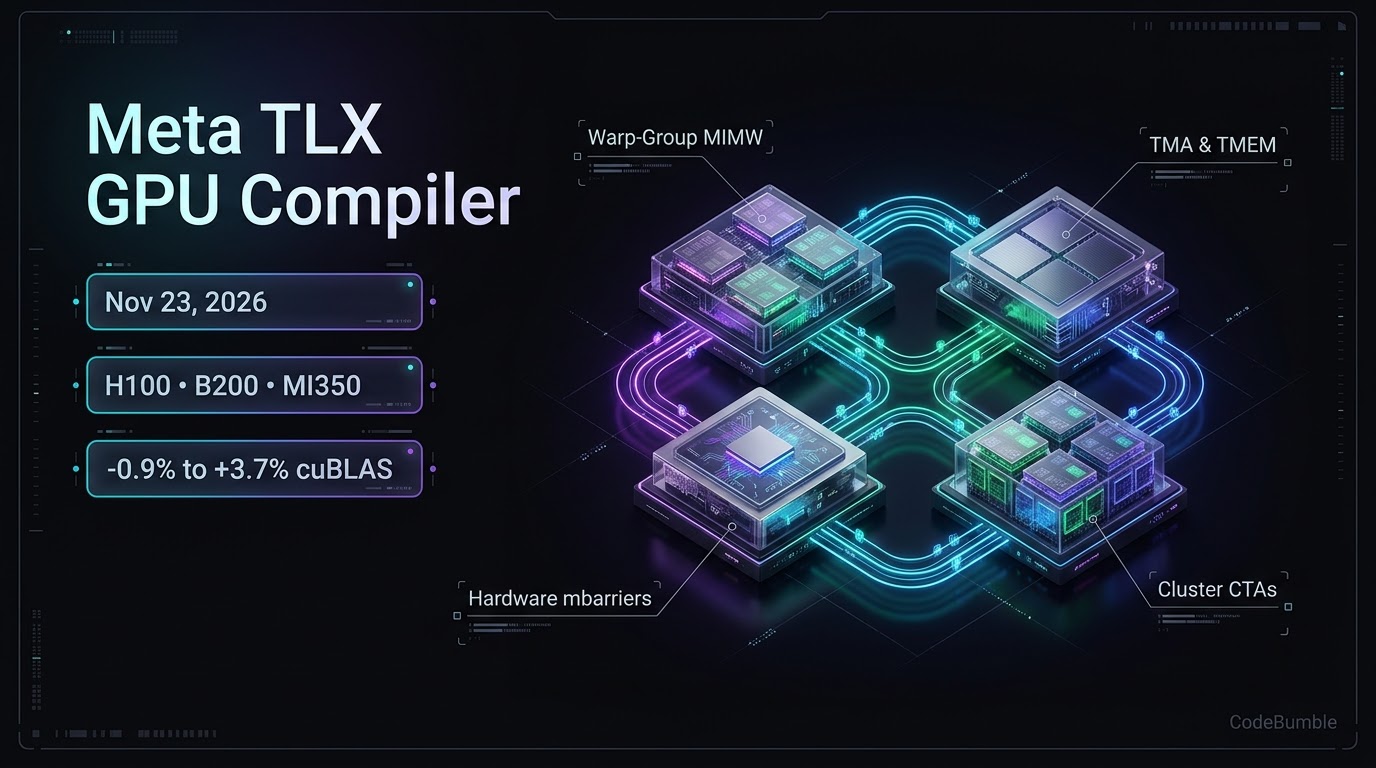
Meta has detailed TLX (Triton Low-Level Extensions), an MIT-licensed extension to the Triton GPU compiler that exposes warp-group orchestration, hardware barriers (mbarriers), Tensor Memory Accelerator (TMA) transfers, Tensor Memory (TMEM), and cluster execution directly inside Python-based Triton kernels (Engineering at Meta; MarkTechPost). Targeting NVIDIA Hopper (H100), NVIDIA Blackwell (B200/GB200), and AMD MI300/MI350 GPUs, TLX bridges the gap between Triton's block-level productivity and CUDA's fine-grained thread control (MarkTechPost; Emergent).
Across Meta's published evaluations, TLX lands within -0.9% to +3.7% of cuBLAS on six H100 FP16 GEMM shapes, beats rocBLAS by 11.8% to 15.2% on square MI350 shapes, and delivers a 4x speedup on an H100 In-Kernel Broadcast Optimization (IKBO) linear compression kernel (MarkTechPost; Engineering at Meta). At the same time, engineers should treat these figures with appropriate empirical caution: all reported benchmarks are self-reported by Meta and PyTorch without independent third-party verification, and TLX still trails NVIDIA's hand-tuned FlashAttention-4 (FA4) on dense LLM-style B200 attention at roughly 87% of FA4 forward throughput (MarkTechPost; PyTorch Blog).
Architecture & How It Works
The Missing Middle: MIMW Between SIMT and SIMB
Over a 10-month internal tracking window at Meta, Triton kernel counts grew ~3.8x compared with ~2.0x for CUDA, shifting kernel authoring from GPU specialists to ML engineers (Engineering at Meta). Yet modern GPUs increasingly depend on asynchronous, execution-oriented hardware features—Hopper's warp specialization and TMA, plus Blackwell's TMEM, register reallocation, cluster execution, and paired-CTA matrix multiply-accumulate (MMA)—that sit awkwardly between existing programming models (Engineering at Meta).
- CUDA's SIMT model operates at thread granularity, giving full control at the cost of thousands of lines of architecture-specific orchestration boilerplate.
- Standard Triton's SIMB model operates at blocked tensor granularity, hiding execution scheduling behind compiler heuristics that struggle to coordinate cooperating warp groups.
- TLX's MIMW (Multiple Instructions, Multiple Warps) model elevates the warp group (or AMD wave group) to a first-class execution agent (Engineering at Meta; MarkTechPost).
Rather than creating a separate language, TLX acts as an orchestration layer on top of Triton: Triton defines what computation runs, while TLX defines how warp groups orchestrate it (Engineering at Meta).
Five Core Extension Areas
TLX extends Triton across five hardware-control surfaces while preserving Python syntax and Triton's autotuning infrastructure (Engineering at Meta; MarkTechPost):
- Warp-Group Orchestration: Assigns explicit functional roles—such as producer, consumer, and epilogue—to cooperating warp groups inside
with tlx.async_tasks():blocks. - Warp-Group Synchronization: Exposes hardware
mbarriers(tlx.alloc_barriers,tlx.barrier_wait,tlx.barrier_expect_bytes) to coordinate producer-consumer pipelines while leaving thread-level synchronization to the compiler. - Memory Orchestration: Provides direct access to TMA descriptor loads (
tlx.async_descriptor_load), asynchronous tensor-core operations (tlx.async_dot), and Blackwell TMEM allocations (tlx.storage_kind.tmem). - Cluster Execution: Exposes multi-CTA cooperation via distributed shared memory and cluster-wide barriers, avoiding global-memory round trips.
- Optional Layouts: Unlike CUDA or CUTLASS, TLX infers shared-memory tiling and swizzling layouts automatically; engineers override layouts only when profiling shows additional headroom, dramatically simplifying multi-stage kernel fusion (Engineering at Meta).
flowchart LR
    A[Global Memory / HBM] -->|TMA Async Descriptor Load| B[Producer Warp Group]
    B -->|Shared Memory Circular Buffer + mbarrier| C[Consumer Warp Group]
    C -->|async_dot into Blackwell TMEM| D[Tensor Core Accumulator]
    D -->|mbarrier Release| E[Epilogue Warp Group]
    E -->|Descriptor Store| A
Blackwell Matmul Example in TLX
Meta's Blackwell matrix-multiplication pattern demonstrates how roughly 200 lines of Python-level Triton+TLX replace synchronous load-compute loops with warp-specialized pipelining (Engineering at Meta; MarkTechPost):
@triton.jit
def matmul_kernel(desc_a, desc_b, desc_c, M, N, K, ...):
    buffers_a = tlx.local_alloc((BLOCK_M, BLOCK_K), tl.float16, NUM_STAGES)
    buffers_b = tlx.local_alloc((BLOCK_K, BLOCK_N), tl.float16, NUM_STAGES)
    acc = tlx.local_alloc((BLOCK_M, BLOCK_N), tl.float32, 1, tlx.storage_kind.tmem)
    load_bars = tlx.alloc_barriers(num_barriers=NUM_STAGES, arrive_count=1)
    dot_bars = tlx.alloc_barriers(num_barriers=NUM_STAGES, arrive_count=1)

    with tlx.async_tasks():
        with tlx.async_task("default"):
            # Producer / epilogue coordination via descriptor loads and mbarriers
            ...
        with tlx.async_task(num_warps=1):
            for k in range(num_k_tiles):
                buf = k % NUM_STAGES
                tlx.barrier_wait(load_bars[buf], phase)
                tlx.async_dot(
                    buffers_a[buf], buffers_b[buf], acc[0],
                    use_acc=(k > 0), mBarriers=[dot_bars[buf]]
                )
Benchmarks, Cost & Latency Analysis
Kernel & Microbenchmark Results (Self-Reported)
All quantitative benchmarks currently available come from Meta Engineering and companion PyTorch blog posts; no independent third-party benchmark suite has yet audited these figures (MarkTechPost).
| Workload / Kernel | Hardware | TLX Result | Baseline Comparison | Caveat / Scope | Source |
|---|---|---|---|---|---|
| FP16 GEMM (6 shapes) | NVIDIA H100 | 577.0 TFLOPS (8192³) | -0.9% to +3.7% vs. cuBLAS (582.3 TFLOPS) | Tested on 6 FP16 shapes; self-reported | MarkTechPost |
| Square GEMM (256–2048) | AMD MI350 | +11.8% to +15.2% | Faster than rocBLAS | Limited to square shapes 256–2048 | MarkTechPost |
| Jagged Flash Attention | NVIDIA B200 | ~3.2K lines of code | +13% forward / +50% backward vs. FA4 | Production jagged Ads shapes; FA4 ~10K lines CuTe DSL | PyTorch Blog |
| Dense LLM Attention | NVIDIA B200 | ~87% of FA4 forward | Trails FlashAttention-4 | Widest gap on small causal-forward shapes | MarkTechPost |
| 2-Simplicial Attention | NVIDIA H100 | 588 BF16 TFLOPS (~60% util.) | 1.74x speedup over Triton (337 TFLOPS) | Forward pass evaluation | PyTorch Blog |
| IKBO Linear Compression | NVIDIA H100 SXM5 | 4x speedup | Persistent warp-specialized mega-kernel | Part of RecSys inference co-design | PyTorch Blog |
Production Case Studies at Meta
Meta reports running TLX in production across three major workloads (Engineering at Meta):
- Generative Ads Model (GEM) Training: Heterogeneous RecSys foundation models suffer from small input shapes and 10+ norms per layer. Using TLX alongside CUTLASS and CuTe DSL—plus an internal AI-assisted tuning framework called Agent for Compute Efficiency (ACE)—Meta reached 20% to 25% end-to-end Model FLOPs Utilization (MFU) across thousands of GPUs, with up to 2x forward speedup on Generalized Dot Product Attention (GDPA) (Engineering at Meta).
- In-Kernel Broadcast Optimization (IKBO) for RecSys Inference: Eliminating user-feature replication across candidate batches via warp-specialized fusion cut compute-intensive net latency by up to two-thirds on co-designed models, while IKBO FlashAttention reached 621 BF16 TFLOPS on H100 SXM5 (Engineering at Meta; PyTorch Blog).
- Distributed Grouped GEMM for LLM Pretraining: Deployed on Blackwell fleets to fuse Mixture-of-Experts (MoE) grouped matrix multiplications with inter-node communication, though Meta did not disclose a standalone speedup percentage for this workload (Engineering at Meta; MarkTechPost).
Compiler DSL Landscape Comparison
| Feature | Meta TLX | Gluon | CuTe DSL | TileLang | Source |
|---|---|---|---|---|---|
| Maintainer | Meta + UC San Diego | Triton project | NVIDIA | tile-ai open source |
MarkTechPost |
| Abstraction | Triton extension; MIMW warp-group orchestration; optional layouts | Lower-level Triton dialect; explicit tensor layouts | Python DSL isomorphic with CuTe C++ | Tile-level DSL with layout & pipeline control | MarkTechPost |
| Hardware Targets | Hopper, Blackwell, AMD MI300/MI350 | Hopper+ (NVIDIA); MI350/MI355 (AMD) | NVIDIA Ampere, Hopper, Blackwell | CUDA, ROCm, Metal, CPU, Ascend | MarkTechPost |
| License | MIT (facebookexperimental/triton) |
MIT (Triton) | NVIDIA EULA | MIT | MarkTechPost |
| Production Use | Meta GEM, IKBO RecSys, LLM pretraining | Not disclosed | FlashAttention-4 | DeepSeek TileKernels | MarkTechPost |
Production Deployment & Trade-Offs
Packaging & Ecosystem Integration
Developers do not need to maintain a permanent compiler fork to experiment with TLX. While TLX lives in Meta's MIT-licensed Triton fork (facebookexperimental/triton under third_party/tlx/), it also ships as triton-utlx on PyPI, loading into upstream Triton via the PyTorch-Triton 3.7 plugin system (MarkTechPost). AMD has also published a CDNA4 GEMM+activation guide using TLX (MarkTechPost).
When to Choose TLX vs. Alternatives
- Use TLX when you need custom fused kernels (irregular/jagged attention, RecSys broadcast fusion, MoE grouped GEMM, or custom quantization like MXFP8) across both NVIDIA Hopper/Blackwell and AMD MI300/MI350 fleets, and want ~3x smaller codebases (~3.2K lines vs. ~10K lines in CuTe DSL) that ML engineers can maintain (PyTorch Blog).
- Stick to CuTe DSL / CUTLASS for standard dense LLM attention on Blackwell where squeezing out the final ~13% forward throughput over TLX's current 87% FA4 parity justifies NVIDIA-only EULA lock-in and higher engineering cost (MarkTechPost).
- Stick to standard Triton for memory-bound elementwise/reduction fusion where compiler-managed pipelining already saturates HBM bandwidth without manual warp-group roles.
Looking ahead, Meta is working to expand TLX to custom accelerators like MTIA, build "auto-TLX" passes that infer warp-group orchestration automatically, and integrate TLX as a backend for torch.compile in PyTorch 2.x (Engineering at Meta).
Frequently Asked Questions
Is Meta TLX a replacement for Triton or a new language?
No. TLX is an extension to Triton, not a standalone language. Developers continue writing tensor math in standard Triton while adding TLX intrinsics only where explicit warp-group orchestration, mbarriers, TMA, or TMEM control is needed (Engineering at Meta).
Which GPUs does Meta TLX support today?
TLX currently targets NVIDIA Hopper (H100), NVIDIA Blackwell (B200/GB200), and AMD MI300 and MI350-series GPUs, with future support planned for next-generation NVIDIA/AMD silicon and Meta's MTIA accelerator (Engineering at Meta; MarkTechPost).
How does TLX compare to FlashAttention-4 and cuBLAS?
In Meta's self-reported benchmarks, TLX lands within -0.9% to +3.7% of cuBLAS on six H100 FP16 GEMM shapes and beats FlashAttention-4 by ~13% forward / ~50% backward on jagged Ads attention shapes on B200. However, on dense LLM-style B200 attention, TLX reaches ~87% of FA4 forward performance (MarkTechPost; PyTorch Blog).
How do developers install TLX without forking Triton?
TLX is available in Meta's MIT-licensed facebookexperimental/triton repository (third_party/tlx/) and also ships on PyPI as triton-utlx, which loads into upstream Triton via the PyTorch-Triton 3.7 plugin system (MarkTechPost).
Are TLX's benchmark numbers independently verified?
Not yet. As of November 23, 2026, all published GEMM, attention, and production MFU numbers come from Meta Engineering and PyTorch technical blogs without an independent third-party benchmark audit (MarkTechPost).
Sources
- How We Built TLX: A Hardware-Native GPU Compiler for Production ML at Scale — Engineering at Meta (November 10, 2026)
- Meta TLX Brings Warp-Group GPU Control to Triton on Hopper, Blackwell, AMD — MarkTechPost (November 23, 2026)
- Meta TLX Adds Warp-Group GPU Control to Triton Kernels — Emergent (November 23, 2026)
- Optimizing Jagged Flash Attention with TLX: The Road Toward SOTA FA4 on Blackwell — PyTorch Blog (October 1, 2026)
- In-Kernel Broadcast Optimization: Co-Designing Kernels for RecSys Inference — PyTorch Blog (May 5, 2026)
- Fast 2-Simplicial Attention: Hardware-Efficient Kernels in TLX — PyTorch Blog (September 5, 2025)