

Vulnerability
NGINX2Root (CVE-2026-123007): 10-Year-Old HTTP/2 Flow-Control Bug Exposes NGINX Servers to Unauthenticated RCE
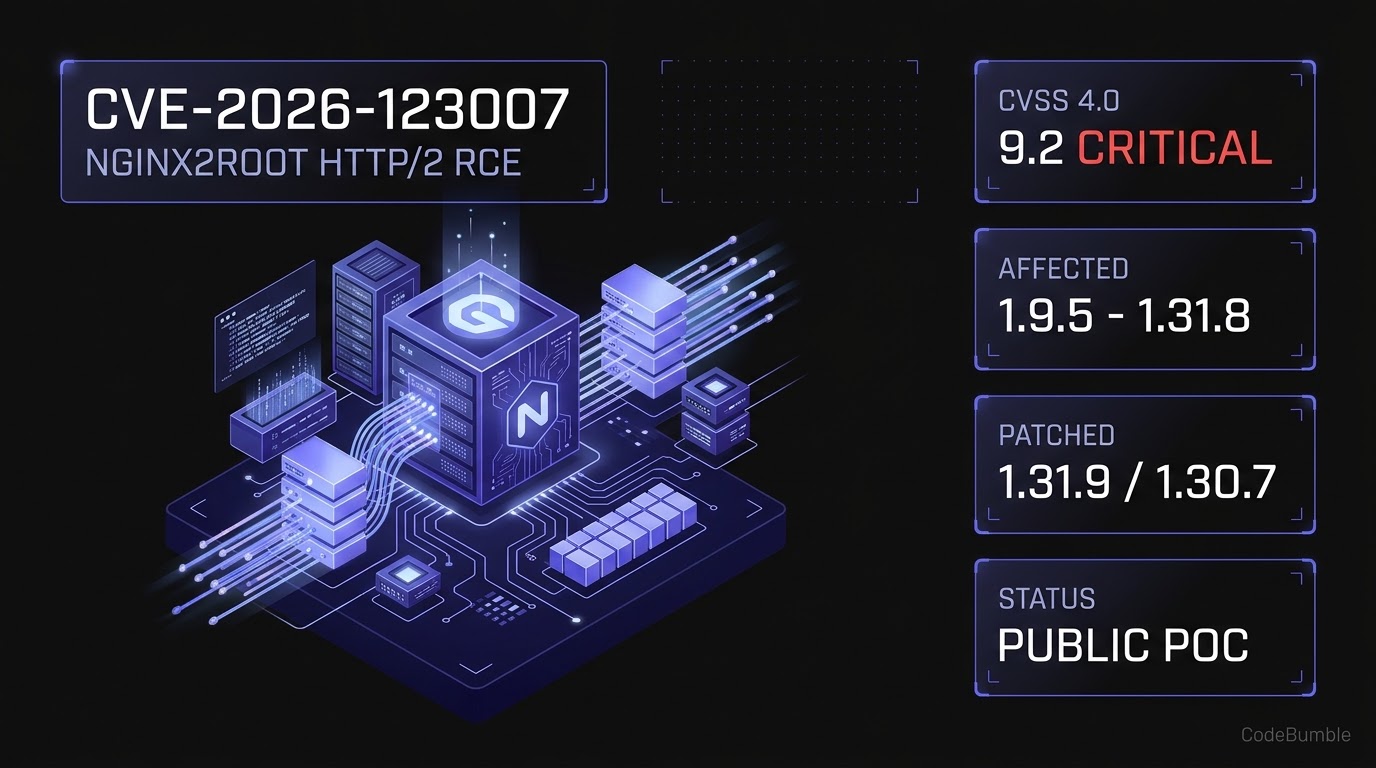
Disclosed on November 18, 2026, NGINX2Root (led by CVE-2026-123007, CVSS 4.0: 9.2 Critical) exposes every official NGINX Open Source release from 1.9.5 through 1.31.8 with HTTP/2 enabled to worker-level remote code execution. With public PoCs available and an unpatched Linux kernel SCTP escalation path reported by researchers, immediate patching to 1.31.9 or 1.30.7 is essential. Here is the technical breakdown, exposure checks, and defensive playbook.
8 min read
NGINX2Root (CVE-2026-123007): 10-Year-Old HTTP/2 Flow-Control Bug Exposes NGINX Servers to Unauthenticated RCE
Executive Summary
On November 18, 2026, F5 Networks, Rapid7, and Xint disclosed NGINX2Root, a set of five critical memory-corruption vulnerabilities in NGINX, led by CVE-2026-123007—a decade-old HTTP/2 flow-control integer underflow (CWE-191) and out-of-bounds write (CWE-787) present in every official NGINX Open Source release from 1.9.5 (2015) through 1.31.8. Rated 9.2 (Critical) under CVSS v4.0 (8.1 High under CVSS v3.1) by F5, CVE-2026-123007 allows an unauthenticated remote attacker to crash NGINX worker processes or execute arbitrary code in the worker's context when HTTP/2 is enabled and ASLR is disabled or bypassed.
F5 released patched builds in NGINX Open Source 1.31.9 (mainline) and 1.30.7 (stable), as well as NGINX Plus 37.3.0.1 and 37.0.8.1. Crucially, Xint researchers also demonstrated chaining any of the five NGINX flaws with a separate, currently unpatched Linux kernel SCTP local privilege-escalation flaw to escape Docker containers and gain root on the host. While no in-the-wild exploitation has been confirmed as of November 18, 2026, working proof-of-concept (PoC) code for CVE-2026-123007 is public.
Confidence Assessment:
- High Confidence: Technical root cause, affected and patched NGINX versions, CVSS scores, and practical exploitation constraints are verified across primary advisories and disclosures from NIST NVD, Rapid7, Xint, and Qualys TRU.
- Medium Confidence (Downstream Packaging): As of November 18, 2026, downstream Linux distributions (including Ubuntu and Debian) and third-party appliances were still publishing backported packages on independent schedules, meaning version strings alone (
nginx -v) cannot confirm patch status.
Technical Mechanics & Architecture
1. Root Cause of CVE-2026-123007: HTTP/2 Flow-Control Underflow
HTTP/2 uses flow-control windows to limit how many DATA frame bytes a server can send without client acknowledgment. NGINX tracks connection-wide send credit in h2c->send_window (an unsigned size_t, 64-bit on x86_64) while enforcing a protocol maximum of NGX_HTTP_V2_MAX_WINDOW (2^31 - 1, or 0x7fffffff).
As detailed by Rapid7 and Xint, exploitation unfolds in four stages:
- Double Credit Restoration: Using transport backpressure (pausing reads while filling buffers), an attacker forces NGINX to queue response
DATAframes, deductingQbytes fromh2c->send_window. While those frames remain queued and unstarted, the client sends a connection-levelWINDOW_UPDATErestoringQbytes back up toMAX, then triggers stream termination viaSETTINGS_INITIAL_WINDOW_SIZEorRST_STREAM.ngx_http_v2_filter_cleanup()returnsQbytes toh2c->send_windowa second time without checking theMAXupper bound, pushingh2c->send_windowtoMAX + Q. - Unsigned Integer Underflow (
CWE-191): On subsequentWINDOW_UPDATEframes,ngx_http_v2_state_window_update()checksif (window > NGX_HTTP_V2_MAX_WINDOW - h2c->send_window). Becauseh2c->send_windowexceedsMAX, the unsigned subtraction underflows to2^64 - Q, allowing the client to pumph2c->send_windowinto the upper half of its 64-bit range (near2^64 - d). - Negative Length & Shadow Buffer Corruption: In
ngx_http_v2_send_chain(),h2c->send_windowis cast to a signed 64-bitoff_t, turning2^64 - dinto-d.ngx_http_v2_filter_get_shadow()setschunk->last = chunk->pos + sizewith a negativesize, placinglastbeforepos. - Out-of-Bounds
memcpy(CWE-787): Inngx_ssl_send_chain(),last - posyields a negativessize_tthat bypasses upper-bound checks and is passed as an unsignedsize_t(2^64 - d) tomemcpy. Onx86_64glibcbuilds using AVX-512 EVEX/YMM copy routines, address-wrapping behavior turns this into bounded out-of-bounds reads and writes—leaking memory pointers to defeat ASLR and overwriting cleanup function pointers.
2. The Four Companion NGINX2Root Vulnerabilities
All five NGINX vulnerabilities were fixed in 1.31.9 and 1.30.7 and carry the same 9.2 CVSS v4.0 rating from F5:
CVE-2026-123633: Use-after-free when NGINX closes an HTTP/2 connection and frees a request still opening an upstream connection (>= 1.19.7; mitigated by disabling HTTP/2).CVE-2026-123634: Use-after-free in the DNSresolverwhen a request with a variableproxy_passand amirror/SSI subrequest wait for the same DNS lookup (>= 1.13.4; not mitigated by disabling HTTP/2).CVE-2026-121810: Use-after-free on HTTP/3 (QUIC) connections forwarding to upstream servers (>= 1.25.0; mitigated by disabling HTTP/3).CVE-2026-113425: Use-after-free in the mail proxy when a client resets during anauth_httplookup (>= 0.5.15; mitigated by restricting mail proxy access).
Architectural Attack & Trust Boundary Flow
+-----------------------------------------------------------------------------+
|                        UNAUTHENTICATED REMOTE CLIENT                        |
|                                                                             |
|  (1) Slow-read backpressure + WINDOW_UPDATE + SETTINGS / RST_STREAM         |
|  (2) Pumps ~128 GB HTTP/2 traffic (WINDOW_UPDATE flood, >= 300 Mbps)        |
+------------------------------------+----------------------------------------+
                                     |
                                     v
+-----------------------------------------------------------------------------+
|                    NGINX WORKER PROCESS (HTTP/2 + TLS)                      |
|                                                                             |
|  ngx_http_v2_filter_cleanup()  --> h2c->send_window > 0x7fffffff            |
|  ngx_http_v2_state_window_update() --> CWE-191 unsigned underflow           |
|  ngx_ssl_send_chain()          --> CWE-787 negative-to-unsigned memcpy      |
|       |                                                                     |
|       +---> Leaks memory (ASLR bypass) + hijacks worker execution           |
|       +---> (Optional Chain) Unpatched Linux Kernel SCTP LPE -> Host Root   |
+-----------------------------------------------------------------------------+
Defensive Exposure Verification Commands
Run these read-only commands on your NGINX hosts to verify version, compiled modules, active HTTP/2 listeners, and external ALPN negotiation:
# 1. Print NGINX version (check distro advisory for backports if 1.9.5 - 1.31.8)
nginx -v 2>&1

# 2. Confirm whether the binary was compiled with the HTTP/2 module
nginx -V 2>&1 | grep -q -- '--with-http_v2_module' && echo "HTTP2_MODULE=present" || echo "HTTP2_MODULE=absent"

# 3. Check on-disk configuration for active HTTP/2 directives
sudo nginx -T 2>&1 | sed 's/#.*//' | grep -nE 'listen[[:space:]].*http2|^[[:space:]]*http2[[:space:]]+on[[:space:]]*;'

# 4. Test external HTTP/2 ALPN reachability from outside the network
openssl s_client -connect YOUR_DOMAIN:443 -servername YOUR_DOMAIN -alpn h2 </dev/null 2>&1 \
  | grep -E 'ALPN protocol:|No ALPN negotiated'
Evidence & Production Impact
Practical Exploitation Constraints
According to Rapid7's technical evaluation, exploiting CVE-2026-123007 for RCE requires transmitting approximately 128 GB of HTTP/2 traffic (~119.02 GiB plaintext plus TLS overhead) over a single long-lived connection:
- Bandwidth Threshold: Exploitation takes roughly 2 minutes on a 10 Gbps link and 17 minutes on a 1 Gbps link. Because NGINX enforces a default 1-hour connection lifetime, links slower than ~300 Mbps cannot complete the current RCE strategy before timeout.
- Direct Reachability & CPU Dependency: Upstream HTTP/2 proxies/CDNs typically do not retransmit the exact frame sequence, and Rapid7's PoC relies on
x86_64glibcAVX-512 (avx512f/avx512vl)memcpywrapping. However, Qualys TRU warns that worker crashes (DoS) are trivial and alternative RCE techniques may emerge.
Ecosystem & Patch Status (As of November 18, 2026)
| Platform / Deployment | Status as of Nov 18, 2026 | Required Action |
|---|---|---|
| NGINX Open Source | 1.9.5–1.31.8 affected; 1.31.9 (mainline) & 1.30.7 (stable) fixed |
Upgrade and restart (not reload) nginx. |
| NGINX Plus | 37.1.0 < 37.3.0.1, 37.0.0 < 37.0.8.1, R33+ affected |
Upgrade to 37.3.0.1 or 37.0.8.1. |
| Official Docker Image | Mainline tags updated to 1.31.9 |
Pull updated image and redeploy running containers. |
| F5 NGINX Ingress / Gateway | Ingress Controller 5.8.0 & Gateway Fabric 2.9.0 include 1.31.9 |
Upgrade Kubernetes ingress deployments. |
Community ingress-nginx |
Archived in March 2026; no security fixes will ship | Disable HTTP/2 immediately and migrate to a maintained controller. |
| Ubuntu / Debian Packages | Fixed distro packages pending as of Nov 18, 2026 | Track vendor advisories or apply emergency HTTP/2 mitigation. |
Note: Xint reported 56.7 million Shodan-indexed product:nginx hosts as of November 10, 2026, with 98.9% of 11.94 million version-reporting hosts falling in the 1.9.5–1.31.8 range.
Hardening Playbook
- Upgrade and Fully Restart NGINX: Install NGINX Open Source
1.31.9or1.30.7(or NGINX Plus37.3.0.1/37.0.8.1). Execute a full service restart (sudo systemctl restart nginx) rather thannginx -s reload, because reloading leaves existing worker processes running the vulnerable binary for active connections. - Apply Emergency HTTP/2 Mitigation Where Patching Must Wait: On NGINX
1.25.1+, explicitly sethttp2 off;in affectedserverblocks and removehttp2fromlistenlines. On1.9.5–1.25.0, removehttp2fromlisten 443 ssl http2;. Note that native gRPC services requiring HTTP/2 will break under this workaround. - Mitigate Companion Flaws (
CVE-2026-123634,121810,113425): Replace variable-basedproxy_pass+mirrorconfigurations with staticupstreamblocks; removequiclisteners and sethttp3 off;(withAlt-Svc 'clear'); and restrict mail proxy ports (25,110,143,465,587,993,995) to trusted IPs or loopback. - Update Container Base Images & IaC Templates: Rebuild all custom Docker images, Helm charts, and AMI/VM templates so autoscaling events do not reintroduce
1.31.8or older binaries. - Hunt for Worker
execve& Anomalous HTTP/2 Streams: Deployauditdrules on NGINX hosts to alert on any shell or binary spawned by the NGINX worker UID, and monitorss/ customh2_huntlogs for long-lived connections with massivebytes_receivedvs. minimal logged request lengths. - Plan Kernel & Ingress Migrations (Rollback Note): Back up
/etc/nginx/before upgrading. If disabling HTTP/2 breaks gRPC clients, scope the exception and prioritize upgrading to1.31.9/1.30.7rather than rolling back. Monitor Linux kernel advisories for the unpatched SCTP local privilege-escalation flaw.
Defensive Detection Queries
1. Auditd Rule for Unexpected NGINX Worker Process Execution (Bash):
# Identify the NGINX worker UID and monitor execve/execveat syscalls
ps -eo uid,user,pid,ppid,args | grep '[n]ginx: worker process'
sudo auditctl -a always,exit -F arch=b64 -S execve,execveat -F euid=NGINX_UID -k nginx_worker_exec
sudo ausearch -k nginx_worker_exec -ts recent -i
2. Worker Crash & Segmentation Fault Hunt (Bash):
sudo grep -Ei 'worker process.*exited|signal 11|segfault' /var/log/nginx/error.log
sudo ss -tinp state established '( sport = :443 )'
Frequently Asked Questions (FAQ)
1. Is CVE-2026-123007 being exploited in the wild?
As of November 18, 2026, neither F5, Rapid7, nor Qualys has reported confirmed in-the-wild exploitation. However, working PoC exploit code from Rapid7 is public, making immediate patching critical for internet-facing servers.
2. Why isn't nginx -s reload enough after upgrading?
A configuration reload starts new workers with the updated config, but existing workers stay alive running the old, vulnerable binary until all active HTTP/2 connections close. A full restart (systemctl restart nginx) or live binary upgrade is required.
3. Does disabling HTTP/2 protect against all five NGINX2Root CVEs?
No. Disabling HTTP/2 blocks CVE-2026-123007 and CVE-2026-123633, but it does not mitigate CVE-2026-123634 (DNS resolver + mirror/SSI), CVE-2026-121810 (HTTP/3 QUIC), or CVE-2026-113425 (mail proxy).
4. Why can't I trust nginx -v on Ubuntu or Debian?
Linux distributions backport security patches into older NGINX version numbers (such as 1.24.0 on Ubuntu 24.04 or 1.22.1 on Debian 12) without incrementing the upstream version string. Always check the full distro package version against your vendor's security advisory.
5. What should Kubernetes teams using community ingress-nginx do?
Community ingress-nginx was archived in March 2026 and will not receive a patch for CVE-2026-123633. Disable HTTP/2 as an emergency stopgap and migrate to a maintained ingress controller such as F5 NGINX Ingress Controller (5.8.0+) or NGINX Gateway Fabric (2.9.0+).
Sources
- NIST National Vulnerability Database (Primary): NVD - CVE-2026-123007 Detail — Published November 18, 2026.
- Rapid7 Intelligence (Primary Research): CVE-2026-123007: Critical NGINX HTTP/2 Integer Underflow Leads to RCE (FIXED) — Published November 18, 2026.
- Xint Security Research (Primary Discovery): NGINX2Root: New Remote Code Execution Vulnerabilities in nginx Require Urgent Patching — Published November 18, 2026.
- Qualys Threat Research Unit (Secondary Technical): NGINX2Root: Five nginx Flaws, Led by CVE-2026-123007. How to Find, Mitigate, and Patch Now — Published November 18, 2026.