

AI
Sarvam-105B-1711 and Sarvam Dictate: Open-Weight MoE Agent Benchmarks, NVFP4 Serving, and Dictation Trade-Offs
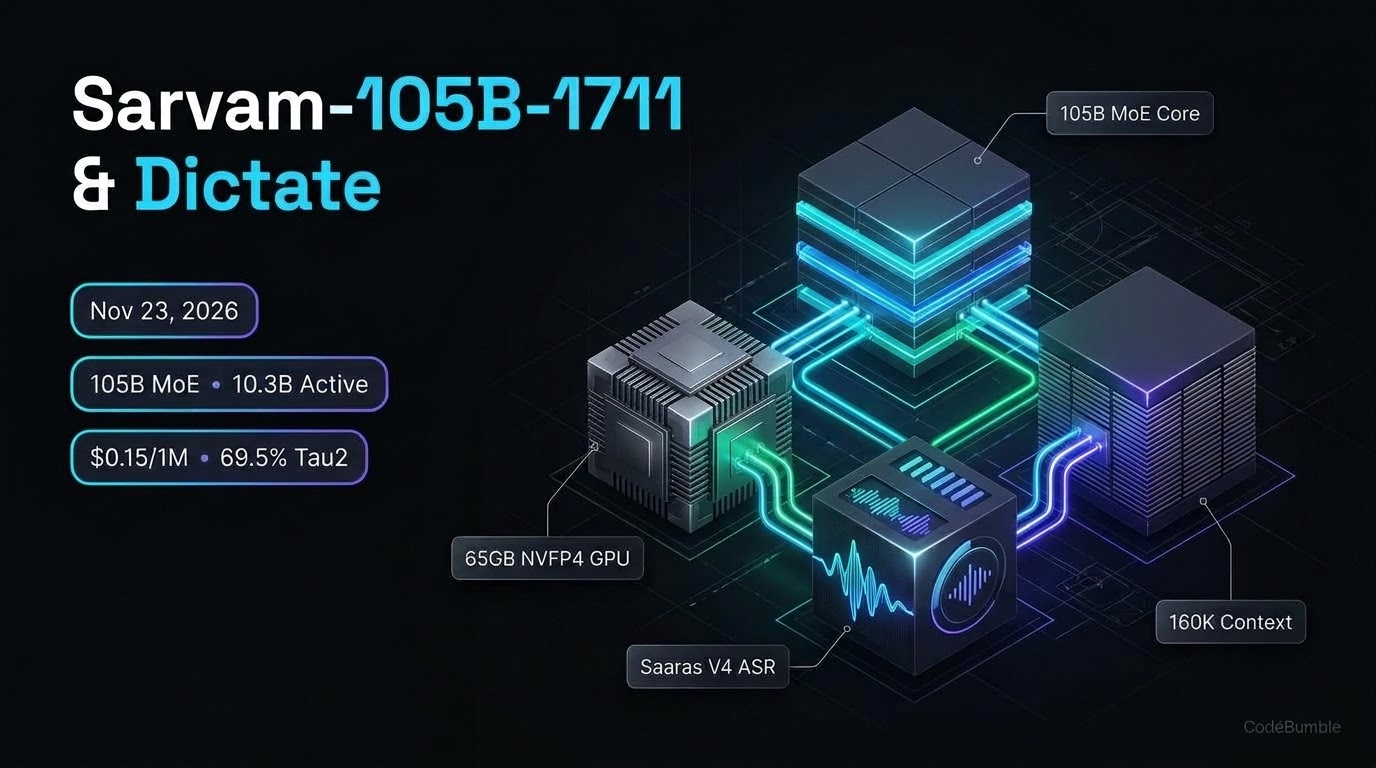
Sarvam AI followed its November 22 release of the Apache 2.0 Sarvam-105B-1711 open-weight MoE checkpoint ($0.15/1M blended, 10.3B active, 160K context) with Sarvam Dictate on November 23, pairing Saaras v4 ASR with Sarvam 105B at ₹0.50/min ($0.33/hr). We examine vendor-reported Tau2 pass^4 (69.5%), vLLM B200/RTX PRO 6000 NVFP4 throughput, and dictation AMEND edit rates—noting that all benchmarks are self-reported.
7 min read
Sarvam-105B-1711 and Sarvam Dictate: Open-Weight MoE Agent Benchmarks, NVFP4 Serving, and Dictation Trade-Offs
Executive Summary
Between November 22 and November 24, 2026, Sarvam AI shipped a coordinated stack update for high-volume enterprise and voice agents: Sarvam-105B-1711 (an Apache 2.0 open-weight Mixture-of-Experts checkpoint priced at $0.15 per million blended tokens, down two-thirds from $0.44) and Sarvam Dictate (a context-aware dictation API pairing Saaras v4 ASR with Sarvam 105B at ₹0.50 per audio minute, or $0.33/hour) (Sarvam-105B-1711 Blog; Sarvam Dictate Blog).
Across Sarvam's self-reported evaluation suite, Sarvam-105B-1711 (NVFP4) averages 73.9 across eight conversational-agent benchmarks—essentially matching Gemini 3.5 Flash-Lite (74.0 at $0.85/1M) and Gemma 4 31B (73.0 at $0.54/1M) at less than one-fifth the Flash-Lite price—while leading on Tau2 pass^4 consistency (69.5%) (Sarvam-105B-1711 Blog; CodeMyPixel). Similarly, Sarvam Dictate reports 40% fewer character edits than Gemini 3.5 Transcribe in English (4.2% vs. 7.0% AMEND) and 47% fewer across Indian languages and Hinglish (Sarvam Dictate Blog). Confidence in cross-provider parity remains partial: all model, throughput, and dictation scores are vendor-reported from Sarvam's own harness, and its Indic Suite relies on Gemini 3.1 Pro as a rubric judge (CodeMyPixel).
Architecture & How It Works
Sarvam-105B-1711: 105B MoE, 160K Context & NVFP4
Sarvam-105B-1711 retains the 105B-parameter MoE architecture with 10.3B active parameters per token and 160K-token context window (extended via 330 billion tokens of continued training on 512 GPUs in just over seven days) (Sarvam-105B-1711 Blog; Hugging Face Model Card). Sarvam ships both BF16 weights (sarvamai/sarvam-105b-1711-bf16) for fine-tuning and a 65 GB NVFP4 checkpoint (sarvamai/sarvam-105b-1711) designed to fit on a single 96 GB NVIDIA RTX PRO 6000 Blackwell workstation GPU (Sarvam-105B-1711 Blog; CodeMyPixel).
Sarvam Dictate: Two-Stage Phonetic + GRPO Editing Pipeline
Rather than using raw ASR output, Sarvam Dictate executes a two-stage pipeline in a single API call (Sarvam Dictate Blog):
- Saaras v4 ASR transcribes spoken audio across English and 22 Indian languages (supporting
mode=codemixfor native scripts + Latin English, ormode=translitfor all-Latin Hinglish). - Phonetic Matcher + RL-Tuned Sarvam 105B: Apps can supply up to 1,000 custom vocabulary entries (with
sounds_likehints) plus surroundingcontext.text. A phonetic matcher filters the list down to terms that sound like the utterance, and a GRPO-trained Sarvam 105B editor (trained across 12 sequential RL runs with zero SFT) cleans fillers, self-corrections, and restarts while receiving a-1penalty if it alters numbers, drops negations, or hallucinates an unspoken vocabulary term (Sarvam Dictate Blog).
flowchart LR
    A[Audio Input + up to 1,000 Vocab Terms] --> B[Saaras v4 ASR]
    B -->|Raw Transcript| C[Phonetic Matcher]
    A -->|sounds_like + context.text| C
    C -->|Candidate Terms Only| D[GRPO-Tuned Sarvam 105B]
    D -->|Clean Text + Raw Transcript + Applied Terms| E[Client App / CRM / IDE]
vLLM Serving Snippet (NVFP4 + DSpark Speculative Decoding)
Sarvam documents production hosting on vLLM 0.33.0 with FP8 KV cache and DSpark speculative decoding (5 draft tokens) (Hugging Face Model Card):
vllm serve sarvamai/sarvam-105b-1711 \
  --trust-remote-code \
  --served-model-name sarvam-105b \
  --tensor-parallel-size 1 \
  --max-model-len 131072 \
  --kv-cache-dtype fp8_e4m3 \
  --enable-auto-tool-choice \
  --tool-call-parser glm45 \
  --reasoning-parser glm45 \
  --speculative-config '{"method":"dspark","model":"./dspark","num_speculative_tokens":5}'
Benchmarks, Cost & Latency Analysis
Conversational Agent Benchmarks & Pricing (Vendor-Reported)
All scores below come from Sarvam's internal evaluation harness (temperature=1.0, thinking mode on, up to 65,536 output tokens, mean over 4 samples; open models on vLLM, closed models via OpenRouter) (Sarvam-105B-1711 Blog; Hugging Face Model Card):
| Model | Blended Price ($/1M) | 8-Bench Agent Avg | IFBench | Tau2 Avg | Tau2 pass^4 |
Indic Suite | Weights | Source |
|---|---|---|---|---|---|---|---|---|
| Sarvam-105B-1711 (NVFP4) | $0.15 (₹10 / ₹25) | 73.9 | 82.5 (BF16) | 85.5 (BF16) | 69.5% | 79.1 (BF16) | Apache 2.0 | Sarvam-105B-1711 Blog |
| Nemotron 3 Super | $0.17 ($0.08 / $0.45) | 62.2 | 70.9 | 77.5 | 49.9% | 39.5 | Open | Sarvam-105B-1711 Blog |
| GPT-6 Luna (high) | $0.20 ($0.10 / $0.50) | 66.3 | 57.3 | 77.5 | 54.4% | 80.9 | Closed API | Sarvam-105B-1711 Blog |
| Mistral Small 4 | $0.26 ($0.15 / $0.60) | 49.7 | 41.0 | 55.3 | 25.5% | 44.3 | Open | Sarvam-105B-1711 Blog |
| Gemma 4 31B | $0.54 (₹35 / ₹90) | 73.0 | 77.8 | 81.1 | 62.1% | 78.6 | Open | Sarvam-105B-1711 Blog |
| Gemini 3.5 Flash-Lite (high) | $0.85 ($0.30 / $2.50) | 74.0 | 73.5 | 83.1 | 63.9% | 79.7 | Closed API | Sarvam-105B-1711 Blog |
| Qwen3.8 27B (xhigh) | $0.96 (blended) | 74.6 | 79.6 | 85.8 | 69.0% | 64.8 | Open | Sarvam-105B-1711 Blog |
Notice the trade-off on non-conversational reasoning: Sarvam-105B-1711 scores 12.3% on Humanity's Last Exam (no tools) and 75.3% on LiveCodeBench v6, trailing Gemma 4 31B (22.1% HLE, 81.9% LiveCodeBench) and GPT-6 Luna (30.6% HLE, 85.2% LiveCodeBench)—confirming it is specialized for tool-calling support and voice workflows rather than frontier coding or general knowledge (Hugging Face Model Card).
NVFP4 Serving Throughput (B200 vs. RTX PRO 6000 Blackwell)
On Hugging Face, Sarvam publishes NVFP4 + DSpark throughput across single-GPU configurations (Hugging Face Model Card):
- 1× NVIDIA B200 (128K context): Scales from 532 tok/s total (576 tok/s per user, 63 ms p50 TTFT) at 1 user to 5,354 tok/s (122 tok/s per user, 156 ms p50 TTFT) at 64 users and 7,490 tok/s (80 tok/s per user) at 128 concurrent users.
- 1× RTX PRO 6000 Blackwell (96 GB, 50K context): Delivers 30.9 tok/s total (61.8 tok/s per user, 8.1 s p50 TTFT) at 1 user on reasoning prompts, or 99 tok/s per user on a 10K-token prompt per the launch post (Sarvam-105B-1711 Blog; Hugging Face Model Card).
Sarvam Dictate Accuracy & Cost Comparison
Measured across real Kivi dictations up to 1 minute long using Voice Arena's AMEND metric (share of characters needing edits, lower is better) (Sarvam Dictate Blog):
| System | Price / Hour | English AMEND (n=2,691) | Indian Languages AMEND (n=1,370) | Hinglish AMEND (n=184) | Long >1m English AMEND (n=1,077) | Source |
|---|---|---|---|---|---|---|
| Sarvam Dictate | $0.33 (₹0.50/min) | 4.2% | 8.8% | 6.6% | 8.8% | Sarvam Dictate Blog |
| Gemini 3.5 Transcribe | ~$0.31 (est.) | 7.0% | 15.5% | 17.0% | 9.9% | Sarvam Dictate Blog |
| AssemblyAI Dictation | $0.62 | 5.3% | 15.8% (n=747) | 14.7% | 10.6% | Sarvam Dictate Blog |
On Voice Code Bench (300 English recordings with 1,482 exact emails, file paths, and IDs), supplying expected values in vocabulary and context.text lifted Sarvam Dictate from 84.5% to 93.8% exact-value accuracy (Sarvam Dictate Blog).
Production Deployment & Trade-Offs
- When to Adopt Sarvam-105B-1711: Ideal for high-volume customer support, Indian-language voice bots (
Samvaadvoice fine-tune scores 68.7 vs. 68.0 for Gemma 4 31B with thinking off), and private single-GPU deployments on 96 GB Blackwell cards where $0.15/1M blended Token Factory pricing or Apache 2.0 self-hosting cuts unit economics by 3x–5x (Sarvam-105B-1711 Blog; CodeMyPixel). - When to Choose Alternatives: Pick Gemma 4 31B or Qwen3.8 27B if your workload leans heavily on general reasoning, coding (
LiveCodeBench), or non-Indic languages, or Gemini 3.5 Flash-Lite if you need a managed Google Cloud endpoint without self-hosting (CodeMyPixel). - Dictation Latency & Mode Gotchas: Sarvam Dictate splits audio longer than 30 seconds into ~500-word asynchronous jobs (
/v2/dictate/jobs), and its benchmark set skews toward Indian-English speakers using Kivi—so teams targeting North American or European accents should run an independent AMEND test before migrating (Sarvam Dictate Blog).
Frequently Asked Questions
What is the difference between Sarvam-105B-1711 BF16 and NVFP4?
The BF16 checkpoint (sarvamai/sarvam-105b-1711-bf16) is intended for fine-tuning and post-training, whereas the 65 GB NVFP4 build (sarvamai/sarvam-105b-1711) fits on a single 96 GB RTX PRO 6000 Blackwell GPU and powers Sarvam Token Factory at $0.15/1M blended tokens (Sarvam-105B-1711 Blog; CodeMyPixel).
Are Sarvam-105B-1711 and Sarvam Dictate benchmarks independently verified?
No. All agent, throughput, and AMEND dictation benchmarks published at launch are self-reported from Sarvam AI's own evaluation runs, and its Indic Suite uses Gemini 3.1 Pro as a rubric judge (CodeMyPixel; ET Enterprise AI).
How does Sarvam Dictate handle custom names and code identifiers?
Apps can pass up to 1,000 vocabulary entries (with sounds_like hints) and context.text. A phonetic matcher forwards only phonetically plausible terms to GRPO-tuned Sarvam 105B, lifting exact-value accuracy on Voice Code Bench from 84.5% to 93.8% (Sarvam Dictate Blog).
How do I disable thinking mode on Sarvam-105B-1711 in vLLM?
Thinking is enabled by default (temperature=1.0). For low-latency voice or tool-calling turns, pass extra_body={"chat_template_kwargs": {"enable_thinking": False}} with temperature=0.6 (Hugging Face Model Card).
What does Sarvam Dictate cost compared to Gemini 3.5 Transcribe and AssemblyAI?
Sarvam Dictate is priced at ₹0.50 per minute ($0.33/hour) including both Saaras v4 ASR and Sarvam 105B editing, compared with roughly $0.31/hour (token-estimated) for Gemini 3.5 Transcribe and $0.62/hour for AssemblyAI Dictation (Sarvam Dictate Blog).
Sources
- Sarvam-105B-1711: a new Sarvam 105B checkpoint — Sarvam AI (November 22, 2026)
- Introducing Sarvam Dictate: fast, accurate dictation — Sarvam AI (November 23, 2026)
- sarvamai/sarvam-105b-1711 Model Card — Hugging Face (November 22, 2026)
- Sarvam-105B: $0.15, Beats Gemini Flash-Lite on Tau2 — CodeMyPixel (November 23, 2026)
- Sarvam launches AI dictation API, claims fewer errors than Google Gemini — ET Enterprise AI (November 24, 2026)